Front Wing Load Tests: FIA Directive
FIA tightened 2025 front-wing deflection limits—mainplane to 10/15 mm and flaps to 3 mm—forcing stiffer, often heavier designs.
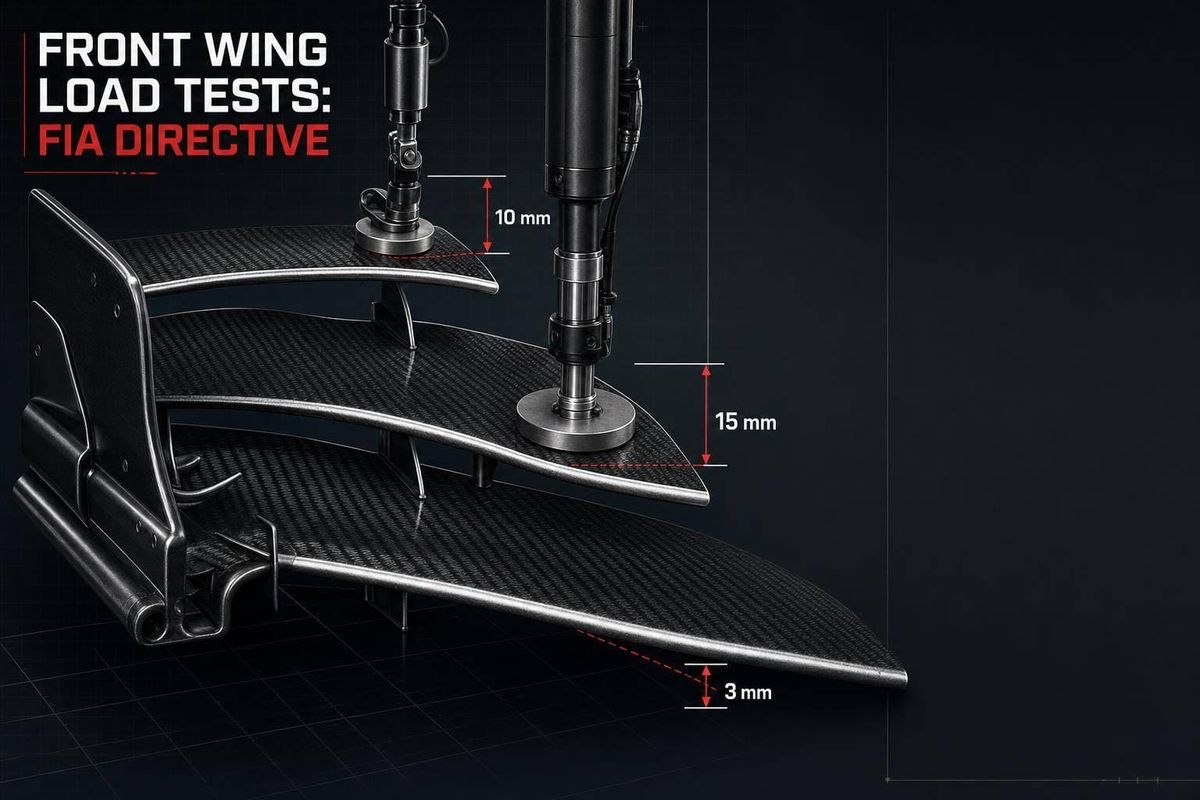
The FIA made front wings much stiffer to police flex at speed. In 2025, it cut the allowed front-wing deflection in all key tests: the mainplane limit dropped from 15 mm to 10 mm under a 1,000 N load, the one-side mainplane limit fell from 20 mm to 15 mm, and the flap limit shrank from 5 mm to 3 mm under 60 N.
If I strip it down, the rule change does three things:
- Cuts the room for planned wing flex
- Pushes teams toward stiffer, and often heavier, wing designs
- Shifts performance back toward geometry and setup instead of bend under load
That matters because a front wing does more than add front grip. It shapes airflow for the floor and rear of the car too. So when the FIA cut those limits by 25%, 33%, and 40%, it changed more than one part.
Here’s the short version you need:
- The FIA kept the same basic static tests, but made the limits tighter
- The tougher checks started at the 2025 Spanish Grand Prix
- Teams that leaned on controlled flex had the most to lose
- The flap test saw the biggest cut: 40%
- Static tests now work alongside onboard camera checks during practice
New Rules & Tougher Wings | F1 TV Tech Talk
sbb-itb-7c68254
Quick Comparison
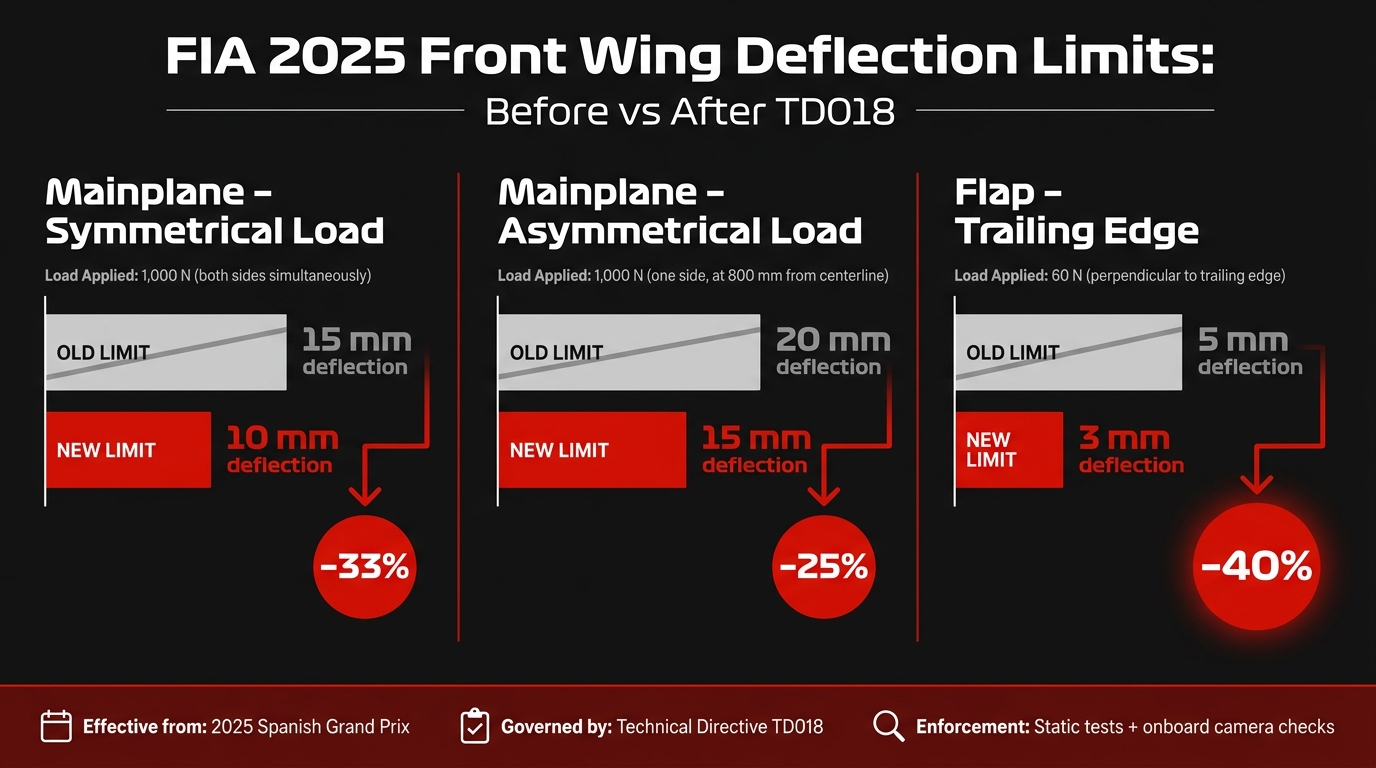
FIA 2025 Front Wing Load Test Limits: Old vs New
| Test area | Load | Old limit | New limit | Change |
|---|---|---|---|---|
| Mainplane, both sides loaded | 1,000 N | 15 mm | 10 mm | -33% |
| Mainplane, one side loaded | 1,000 N | 20 mm | 15 mm | -25% |
| Flap trailing edge | 60 N | 5 mm | 3 mm | -40% |
In plain English, I’d sum it up like this: the FIA didn’t ban wing movement, but it made performance-focused flex much harder to keep.
Regulatory Background and the Two Front Wing Tests
The FIA tightened its front-wing rules after teams showed they could pass static checks in the garage, then run wings that flexed more once the car was at speed. This came after rear-wing flex drew attention in late 2024, with front wings becoming the next focus. In response, the FIA updated Technical Directive 018 (TD018) to target parts that meet test limits in the garage but act differently under live aerodynamic load.
The FIA did not bring in the tougher front-wing tests right away. Instead, it pushed the change to the 2025 Spanish Grand Prix so teams would not have to throw away current stock in the middle of the season, which would have been expensive under the budget cap. That move gave teams time to adjust, but it also cut back the room they had to use flex as a setup and design tool. The new approach split front-wing checks into two separate tests.
Mainplane and Bodywork Deflection Test
The first test looks at the wing's mainplane and bodywork. Under Article 3.15.4, the FIA applies a 1,000N load, or about 225 lb, and then measures how far the wing moves vertically. It does this in two ways: a symmetrical setup, with load on both sides at the same time, and an asymmetrical setup, with the same 1,000N placed on one side only at a point 800 mm (31.5 in) from the car's centerline.
The mainplane does most of the heavy lifting from a structural point of view. So even a small change in how much it bends can alter front grip and straight-line drag. To stop teams from gaming the system with one wing for inspection and another for racing, the FIA carries out these checks under parc fermé conditions, usually on Saturday evening after qualifying or on Sunday morning.
As Nikolas Tombazis explained:
"Obviously it is fair for the FIA to add more flexibility tests or stiffness tests when it judges that a certain area may be getting exploited a bit too much."
Front Wing Flap Deflection Test
The second test focuses on the flaps, the smaller wing elements that can still have a big effect on drag and downforce. Under Article 3.15.5, the FIA applies a 60N point load, about 13.5 lb, straight to the trailing edge of a single flap and measures the movement in line with that load.
These flaps sit toward the outer part of the front wing and help guide airflow to the rest of the car. That makes them a big part of front downforce and the car's overall aero balance. In plain terms, if the flap bends more than expected, it can change how the whole front end works.
The tighter limits came into force at the 2025 Spanish Grand Prix. From that point on, teams had much less room to build flex into the wing and still clear FIA inspection.
Measurement Changes: Old Limits, New Limits, and Compliance Thresholds
Before-and-After Deflection Limits Under Load
TD018 tightened every front-wing load test. The changes may look small on paper, but on track they hit much harder.
| Test Component | Load Applied | Old Limit | New Limit | Reduction |
|---|---|---|---|---|
| Front Wing Mainplane (Symmetrical) | 1,000N (both sides) | 15mm | 10mm | 33% |
| Front Wing Mainplane (Asymmetrical) | 1,000N (one side) | 20mm | 15mm | 25% |
| Front Wing Flap (Point Load) | 60N (trailing edge) | 5mm | 3mm | 40% |
The big story is how little movement is now allowed. Teams have much less room to tune aero-elastic behavior.
The flap test took the hardest hit: a 40% cut, from 5mm to 3mm under a 60N point load. That 2mm sounds tiny, but it changes a lot. It makes it tougher for a flap to flatten at high speed and dump drag on the straight.
Why Measurement Points and Tolerances Matter
Where the load is applied matters just as much as how much load is used. The asymmetrical test is there to catch twist and roll under uneven force. In plain terms, it looks for wings built to flex more on one side than the other, which is the kind of behavior that tends to show up in corners or under uneven aero loads.
The flap test goes after a different weak spot. Here, the 60N load is applied perpendicular to the trailing edge, aiming straight at mounts or joints that could let the flap flatten at high speed.
That tighter limit pushes teams toward a stiffer carbon layup, and that often means extra weight. So the trade-off shifts. Instead of chasing more flex, teams now have to juggle weight, balance, and peak downforce more carefully.
Design Impact on Teams and Likely Performance Trade-Offs
Stiffness, Mass, and Aero Balance Changes
Those tighter limits didn't just push teams to tweak setup. They forced a redesign of the wing itself.
To meet the new deflection limits, teams have to make the front wing structure stiffer, especially around reinforcement points and flap mounts. And that comes with a cost: extra stiffness usually adds weight. It can also shift the car's balance, which may leave the front end feeling less responsive, most of all in slow corners.
Put simply, that added structural stiffness is the price teams pay for losing aerodynamic flex.
How the Directive Affects Downforce and Drag
A stiffer wing leaves teams facing a tough trade-off. They may have to accept more straight-line drag or give up some peak downforce in slower corners.
That matters because the front wing does far more than make front-end grip. It also shapes airflow to the floor and rear of the car. So when its flex changes, the whole aero balance of the car can change with it.
Why Some Teams Stand to Lose More Than Others
The biggest hit is likely to land on teams that built part of their pace around controlled flex. Mercedes stands out most here.
When the team tested a stiffer front wing on the W16 at Imola, it showed how much the car's balance leaned on engineered flex. Bradley Lord acknowledged the issue directly:
"We can expect it to make a difference, certainly make the car a little bit more delicate to balance between a happy low speed balance to get around the slow corners and then not being too nervous in the high speed corners."
Competitive Outlook and Conclusion
What the FIA Is Removing from the Design Space

With the new limits in place, the FIA is taking wing flex out of the front-wing performance equation. The main target is controlled flex that helps cut drag on the straights. It is also going after the mini-DRS effect, where gaps between wing elements open at speed to dump drag.
That distinction matters. The rule change does not ban movement outright. It limits movement that creates a clear on-track gain.
The tighter 10 mm, 15 mm, and 3 mm limits draw a much harder compliance line. In plain terms, teams now have far less room to find lap time through structural compliance.
Key Takeaways for Teams, Engineers, and Fans
The end result is simple: there is less space for teams to build pace into flex. This is a targeted clampdown, not a full reset of the pecking order. Front-wing performance now has to come more from geometry than from controlled deformation.
There’s also a bigger lesson here. Passing a static load test does not mean a wing will behave the same way on track. That’s why visual inspection and static testing now work side by side as enforcement tools.
For engineers, the job shifts toward finding balance through geometry and setup, not flex. For fans, the change may be hard to spot from the outside, but it shows how seriously the FIA is policing the line between smart engineering and rule exploitation.
FAQs
Why did the FIA tighten the front wing load tests?
The FIA tightened front wing load tests after teams found ways to use aero-elasticity for extra performance. In simple terms, some wings could flex under load, which helped cut drag at high speed or shift the car’s aerodynamic balance between slow and fast corners.
After extensive monitoring with onboard cameras, the FIA decided the old static tests weren’t doing enough. So it brought in stricter mid-season rules to protect a level playing field, while still giving teams enough time to adapt without taking on excessive cost.
Which teams are most affected by the new flex limits?
The biggest impact is expected to hit McLaren and Mercedes. Most people in the paddock see those two teams as the ones that gained the most from front wings with more flex. Red Bull and Ferrari have both cast doubt on those designs.
Still, this probably won’t stop with just two teams. Just about every team is thought to use some level of aero-elasticity, so the directive could shift performance across the grid instead of singling out only one or two cars.
Will stiffer front wings affect car balance and lap time?
Yes. Stiffer front wings are likely to affect both car balance and lap times because they limit the flex teams had been using to get more aero performance.
That can make the cars tougher to balance. In plain English, teams may lose some of the smooth tradeoff between low-speed grip and high-speed stability. The full effect on lap times, and on the pecking order, will depend on how well each team adapts.