Energy Recovery in F1: Data-Driven Optimization
How 2026 F1 teams trade ERS harvest, deployment, and car stability to gain lap time across circuits and race phases.
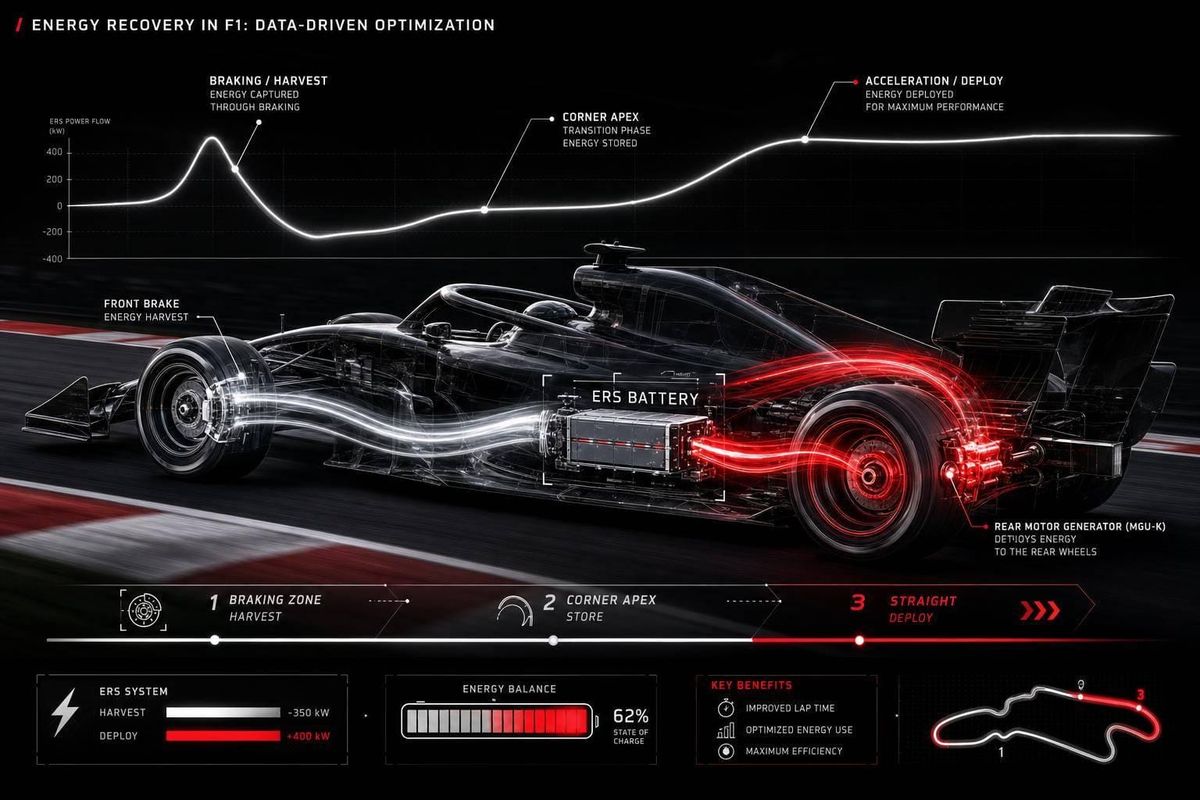
In 2026 F1, the hard part is not using ERS power. It’s getting enough of it back.
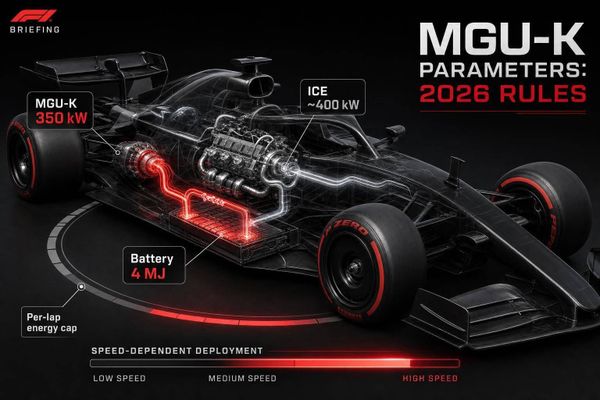
I’d sum it up like this: teams win time by deciding where to harvest, where to deploy, and how to keep the car stable while doing both. The headline numbers matter - 350 kW MGU-K output, 9 MJ harvest, 8.5 MJ deployment, and a 4 MJ SoC swing limit per lap - but lap time usually comes down to braking time, rear stability, and how the battery is managed from corner to corner.
Here’s the short version:
- More harvest can mean more speed later, but it also adds rear braking effect and can upset entry balance.
- Most tracks can’t reach the full 9 MJ harvest cap because there simply isn’t enough braking time.
- Deployment gives less back at high speed, with tapering from 290 km/h and zero at 355 km/h.
- Super-clipping can recharge the battery on straights, but it costs top speed.
- Teams switch between attack, neutral, and recharge laps based on traffic, SoC, and race phase.
- Engineers watch brake traces, SoC, MGU-K torque, wheel speed, tire temps, and driver feedback to tune the map lap by lap.
A few numbers show the tradeoff fast. At 0.35 MJ/s, a car would need about 24.3 seconds of braking to hit 9 MJ in one lap. That’s why tracks like Baku (7.1 MJ) sit much higher than Monza (3.3 MJ) or Melbourne (2.9 MJ) for brake-only recovery. And in 2026 testing, one Mercedes run showed about 320 km/h in a deploy-heavy mode versus 305 km/h in a recharge-heavy mode.
If I had to put the whole article into one simple idea, it would be this: the best ERS plan is not the one that gets the most energy - it’s the one that gets the best lap time without making the car hard to drive.
Racing Terms Explained #17: What is ERS (Energy Recovery System)?
sbb-itb-7c68254
Quick comparison
| Area | What teams check | Why it matters |
|---|---|---|
| Harvesting | Braking time, stop severity, gear, rear balance | Sets how much energy can be recovered without hurting entry feel |
| Deployment | SoC by segment, speed trace, acceleration, gear | Helps decide where battery power gives the most lap-time return |
| Super-clipping | Full-throttle speed loss, charge rate, drag effect | Builds charge mid-lap but can cut straight-line speed |
| Car balance | Brake-by-wire, rear torque split, tire temps, driver notes | Keeps the rear axle stable under harvest |
| Race use | Attack laps, recharge laps, Safety Car windows | Saves charge for overtakes, defense, and restarts |
So if you want the main takeaway before reading the rest: 2026 ERS work is a lap-time balancing act between battery state, braking zones, top-speed loss, and driver confidence.
How Kinetic Energy Recovery Works in F1
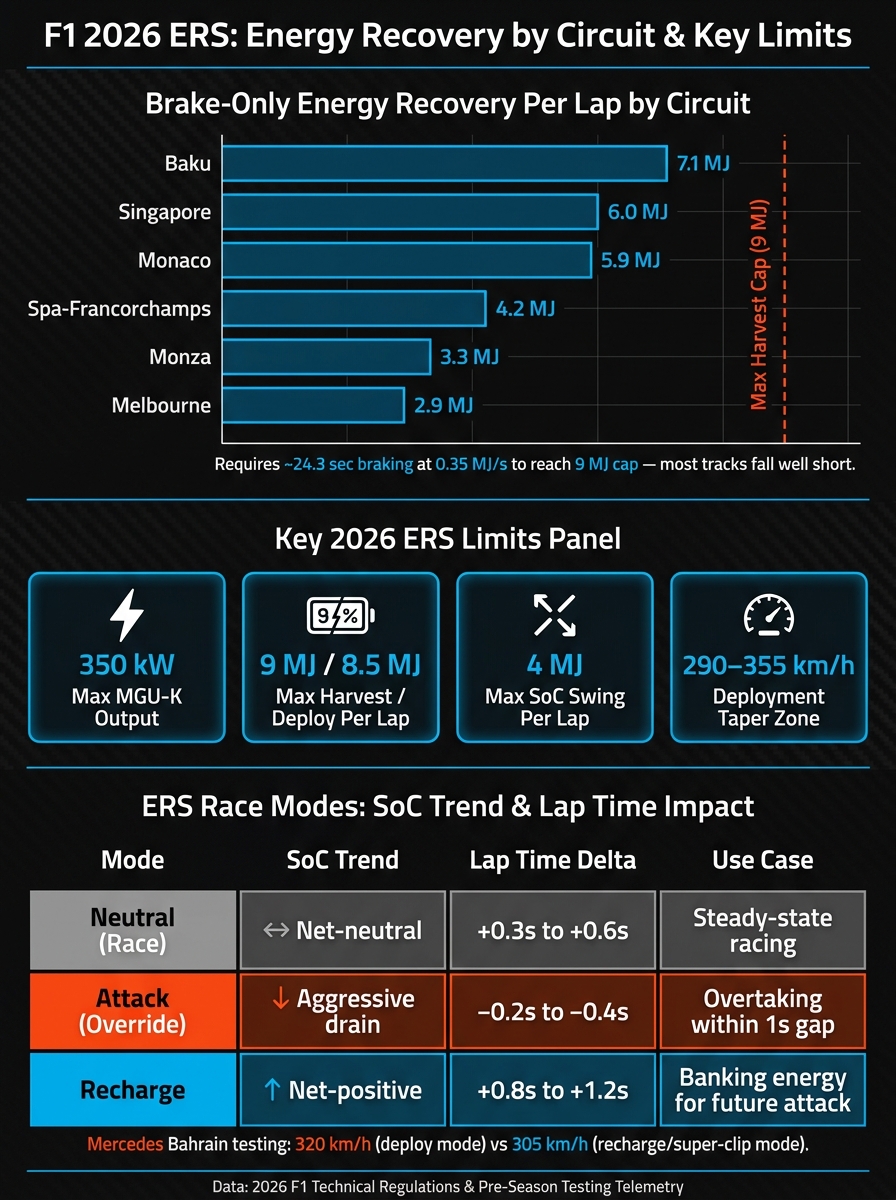
F1 2026 ERS Energy Recovery by Circuit: Harvest Potential vs. Deployment Limits
MGU-K Basics, Energy Limits, and the Per-Lap Budget
Once the per-lap budget is set, the next piece is simple in theory: turn braking into battery charge, then turn that charge back into speed.
The MGU-K sits on the power unit and connects to the crankshaft. Under braking, it works as a generator. It takes some of the car's kinetic energy, converts it into electrical energy, and sends that energy to the Energy Store. Then, on corner exit and acceleration, the system sends that stored energy back through the MGU-K as drive power.
For 2026, teams can harvest up to 9 MJ and deploy 8.5 MJ per lap, with a 4 MJ SoC swing limit. And there’s no magic here: if the system runs at 85% to 90% efficiency, the lost portion is gone, which means less energy to deploy later.
But the headline cap doesn’t tell the whole story. The real limit usually comes from how much braking time a lap gives you. That’s why the full 9 MJ is hard to reach. To recover that much at 0.35 MJ/s, a car would need about 24.3 seconds of braking per lap. Most tracks simply don’t offer that much braking time. So the practical ceiling ends up lower, sometimes much lower. Here’s what that looks like across several circuits:
| Circuit | Recoverable Energy Under Braking |
|---|---|
| Baku | 7.1 MJ |
| Singapore | 6.0 MJ |
| Monaco | 5.9 MJ |
| Spa-Francorchamps | 4.2 MJ |
| Monza | 3.3 MJ |
| Melbourne | 2.9 MJ |
That shortfall is where the game starts. Teams have to choose how much energy to take, where to bank it, and where to spend it.
Harvesting vs. Deployment: The Core Tradeoff
More harvesting gives the driver more energy to use later. But it also changes how the car feels on the brakes.
When the MGU-K harvests under braking, it adds negative torque through the rear axle. In plain English, it works like extra rear braking force. The brake-by-wire system helps by trimming rear mechanical brake pressure, yet the balance still has to be spot on. If it isn’t, the car can feel nervous on corner entry, and that can chip away at driver trust lap after lap.
Teams can also harvest when the driver is flat out on a straight. This is called super-clipping. It lets them charge the battery without waiting for a big braking zone. The catch is obvious once you think about it: generator torque pushes back through the drivetrain, so the car gives up straight-line speed.
That tradeoff showed up clearly in February 2026 Bahrain pre-season testing. Telemetry from Kimi Antonelli's Mercedes showed two different modes. In a net-deploy qualifying simulation, he hit 320 km/h before Turn 1. In a steady-state race simulation using a super-clipping regime, that dropped to 305 km/h so the SoC could stay stable.
There’s another layer too, and it’s easy to miss if you only look at battery numbers. In 2026, lifting off the throttle to harvest energy makes the active aero wings switch from low-drag X-mode to high-downforce Z-mode earlier on the run into a corner. That helps energy recovery, but it also adds drag sooner, which costs speed on the straight before the braking zone.
"In 2026, the limiting factor will not be how much energy a car can deploy, but how much it can harvest." - Nathan, Technical Analyst, The Overcut
That’s why teams don’t chase the biggest harvest number or the biggest deployment number on their own. They chase lap time. And that comes down to where the car brakes, how stable it stays, and how the energy plan changes from one corner to the next.
Checklist: Braking and Corner Data for Energy Harvesting
Per-Corner Braking Profiles and Recovered Energy
Once the harvest-vs-deploy tradeoff is clear, teams look at each corner on its own.
They almost never judge energy recovery as a lap-wide average. Instead, they go corner by corner, because every braking zone has its own limit on how much the MGU-K can harvest.
The first check is the braking trace. Teams compare braking time in each corner against the lap budget to spot where harvesting is already capped.
Then they look at entry speed and braking intensity. Big stops at the end of long straights usually give the best harvest opportunity. By contrast, fast-flowing circuits don't give you many of those clean, heavy-braking moments.
Approach gear matters too. Engineers check approach gear because higher RPM can smooth harvesting and reduce balance disturbance.
On stop-start circuits, teams compare the actual recovered energy in each corner with the theoretical opportunity. In a simulation of Albert Park, braking alone can yield about 4.11 MJ per lap, and that can climb to more than 5 MJ when lift-and-coast is added. On flowing tracks, total recovered energy falls hard, so teams have to pick their corners more carefully.
Brake Migration, Tire Temperatures, and Driver Feedback
The next step is making sure that harvest level is stable enough for both the driver and the brake system.
Teams track rear brake balance and brake-by-wire migration because harvest torque can unsettle the rear axle.
"The MGU-K's harvesting torque at the rear axle adds to the total rear braking force... the brake-by-wire system becomes essential: it reduces the mechanical rear caliper pressure to compensate." - Jarrod Partridge, FIA Accredited Journalist
Engineers also set rear torque split targets for each corner. That means deciding how much of the rear braking force should come from the MGU-K and how much should come from the friction calipers. If that split is wrong, the driver usually feels it right away as rear instability or a snap on entry.
Rear tire carcass temperature is another key readout. Harder harvesting cuts thermal load in the rear friction brakes, but it can add heat to the rear tire carcass. If engineers answer that by moving brake bias forward, front tire surface temperatures go up instead. That can bring understeer and a higher graining risk.
This is why teams read the braking trace, temperature data, and driver notes together. One data channel on its own can miss the full picture.
| Corner ID | Harvest Power Level | Rear Brake Temp Trend | Tire Temp Trend | Driver Comments | Net Lap Time Effect |
|---|---|---|---|---|---|
| T1 (Heavy) | High (350 kW) | Stable (BBW offset) | Rising | "Stable, good recovery" | -0.150s (via deployment) |
| T7 (Medium) | Moderate | Decreasing | Stable | "Slight rear locking" | -0.020s |
| T12 (High Speed) | Low (Super-clip) | Low | Stable | "Clipping felt early" | +0.040s (speed loss) |
Engineers cross-check driver feedback on engine-braking feel against rear brake pressure traces and MGU-K torque data on every lap. Rear locking or brake inconsistency is a strong sign that the corner is being over-harvested.
Checklist: Deployment Metrics for Straights, Laps, and Race Tactics
Battery State of Charge and Segment-by-Segment Deployment
Once a car has harvested energy, the next job is deciding where to spend it. Teams map State of Charge (SoC) by track segment, not just for the lap as a whole, because an early deployment call can leave the car short later in the lap.
The main cap is the 4 MJ delta per lap. So teams usually aim for net-neutral, or slightly positive, energy maps. If they harvest hard in one part of the lap, they need to balance that with deployment somewhere else to stay inside the 4 MJ SoC swing.
Acceleration Gain, Top Speed, and Diminishing Returns
Not every straight is worth the same amount of lap time. Teams study speed traces, throttle percentage, brake application, gear selection, and longitudinal acceleration to see where the MGU-K is actually helping the stopwatch.
The big physical limit is 290 km/h, where MGU-K deployment starts to taper off, before dropping to zero at 355 km/h. As the car gets close to ICE-only terminal speed, the engine is already battling drag, so extra electrical power gives less and less back. Engineers spot this with super-clipping detection: if the car slows more than drag alone should allow at full throttle, the MGU-K has stopped deploying and moved to harvesting.
Gear choice also matters more than it might seem. Charles Leclerc's telemetry from 2026 testing showed him holding 6th gear through the T12–T13 complex instead of shifting to 7th as he would have in 2025. That let the MGU-K absorb power and harvest energy without an obvious hit to acceleration. In plain English: the team used a section with low deployment payoff to top the battery back up.
Attack Laps, Recharge Laps, and Stint Management
Across a stint, teams rotate between attack, neutral, and recharge modes.
The key tactical trigger is the 1-second rule: if a car is within one second of the car ahead, it can use extended high-speed MGU-K deployment beyond the normal ramp-down profile. But that extra push only works if the battery has enough charge to support it. That's why recharge laps matter. Red Bull's Bahrain testing data showed SoC climbing over a mid-stint lap, which pointed to deliberate energy banking before simulated attack phases.
These three modes are the shorthand teams use for SoC planning:
| Mode | Typical SoC Trend | Use Case | Deployment Profile | Lap-time Delta | Impact |
|---|---|---|---|---|---|
| Neutral (Race) | Net-neutral | Steady-state racing; maintaining gap | Balanced per segment | +0.3s to +0.6s | Sustainable tire wear |
| Attack (Override) | Aggressive drain | Overtaking within 1s; defending | Extended high-speed | −0.2s to −0.4s | High rear tire stress |
| Recharge | Net-positive | Banking energy for future attack; fuel saving | Minimal; high clipping | +0.8s to +1.2s | Lower brake temps; lift-and-coast |
Safety-car laps are also a handy window to rebuild SoC before the restart.
Checklist: Race Strategy, Tools, and Post-Race Review
Pre-Race Energy Plans and Race-Phase Checkpoints
Once teams set lap-by-lap SoC targets, they turn them into checkpoints for each part of the race. Before race day, engineers run circuit-specific simulations to set harvest targets and deployment windows. And those numbers can swing a lot by track. Baku can yield about 7.1 MJ per lap, while Austria is closer to 2.9 MJ, so the energy map has to match the circuit.
A simple way to follow the plan is to track each race phase by SoC range, ERS priority, harvest focus, and the job that phase needs to do:
| Race Phase | Target SoC Range | ERS Mode Priority | Harvest Emphasis | Tactical Objective |
|---|---|---|---|---|
| Start / Opening Laps | High (80–100%) | Max Deployment | Low (Braking only) | Track position / Break DRS |
| Mid-Stint Management | Mid (40–60%) | Neutral / Balanced | Medium (Lift-off) | Maintain lap time / SoC stability |
| Attack / Overtake | High buffer (>70%) | Proximity Override | Low | Close 1-second gap / Execute pass |
| Recharge / Banking | Increasing | Recharge | High (Super-clipping) | Build buffer for late-stint attack or defense |
| Safety Car / VSC | Recovery to 100% | Idle / Recovery | Variable | Prepare for restart |
Safety Car and VSC laps are useful checkpoint laps because deployment demand drops. That gives engineers a clean moment to confirm SoC, brake temps, and the restart buffer before the race goes green again.
Telemetry Channels, Pit Wall Dashboards, and Driver Controls
Those phase targets only work if live telemetry keeps the car on plan. The pit wall watches MGU-K torque, power, SoC, charge and discharge rates, brake pressures, wheel speeds, and longitudinal acceleration against a drag baseline. Put simply, they’re checking whether the car is doing what the model said it should do.
That cross-check helps engineers spot super-clipping and confirm that brake-by-wire is making up for harvesting torque the right way, so the rear of the car stays settled under braking.
On the driver side, the tools are direct. Drivers use rotary switches for harvest and deployment presets, then tweak brake bias and ERS maps as tire wear and fuel load change through the stint.
Conclusion: The ERS-K Optimization Checklist at a Glance
Post-race review starts with harvested versus deployed energy. Then teams check the 9 MJ cap, the 4 MJ delta limit, brake-by-wire response, and how often override and super-clipping were on hand when needed. If harvest comes in short, engineers split the problem into two parts: circuit limits or an inefficient map.
FAQs
Why can’t teams reach the 9 MJ harvest cap at every track?
Because the amount of energy a car can recover changes with the track layout. A circuit with fewer heavy braking zones gives drivers fewer chances to harvest energy. By contrast, tracks with long straights and hard braking areas - like Monza - offer more room to recover it.
Teams also have to protect brake balance and car stability. If regeneration is pushed too hard, it adds retarding torque and can upset the car under braking. That’s why engineers set harvesting maps for each track based on its layout and thermal limits, instead of trying to hit the cap on every lap.
How does more ERS harvesting affect braking and corner entry?
More ERS harvesting adds negative torque at the rear axle. That shifts the braking balance and can make the rear of the car less settled on corner entry.
To maintain the deceleration the driver asks for, the brake-by-wire system cuts rear mechanical brake pressure as energy recovery goes up. In simple terms, the car trades some friction braking for regen. That also moves some of the heat load away from the friction brakes, and drivers may use lift-and-coast to recover more energy.
When do teams use attack, neutral, or recharge modes?
Teams switch between these modes depending on the track layout, race conditions, and how much energy they have left to spend. Attack mode comes into play in high-pressure moments, like making an overtake or holding a position when another car is closing in. Neutral mode sits in the middle, balancing harvesting and deployment so the car can keep up steady pace without draining the battery too fast.
Recharge mode is all about filling the battery back up. Teams often do that under heavy braking, by lifting off the throttle, or through super clipping on straights. More and more, the Electronic Control Unit handles these changes automatically, while still keeping everything inside the allowed energy limits.