Thermal Testing of Carbon Fiber in F1
How resin softening, stiffness loss, and lab tests (DSC, DMA, TGA) determine F1 carbon‑fiber part performance under race heat.
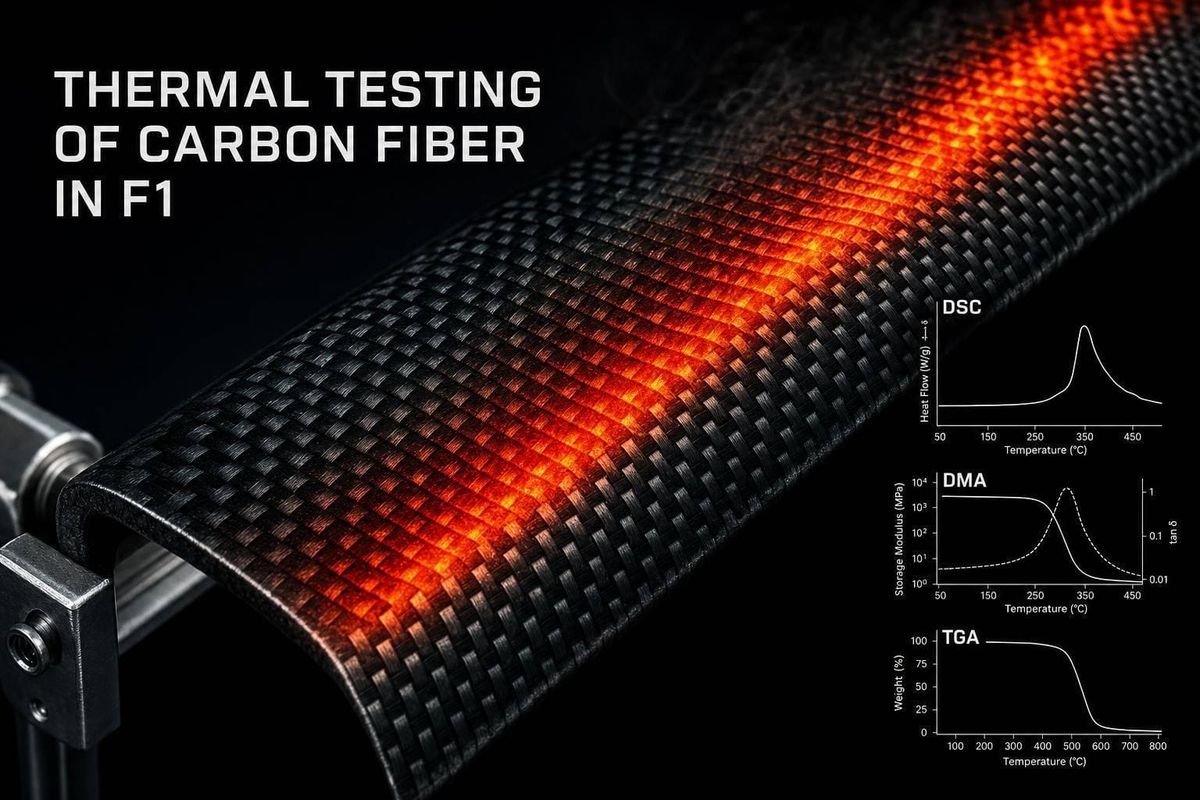
In F1, carbon fiber parts usually fail from heat in the resin before the carbon fibers fail. That’s the core point. Brake areas can go past 1,000°C (1,832°F), while many CFRP parts depend on epoxy resin that starts to soften as it nears its glass transition temperature, or Tg.
If I boil the article down, here’s what you need to know:
-
CFRP and carbon-carbon are not the same thing
- Carbon-carbon brakes can handle 1,000°C+
- CFRP chassis and body parts are much more heat-limited because of the resin
-
Heat in F1 comes from several places at once
- Brakes
- Exhaust and turbo
- Engine and hybrid systems
- Hot airflow under the floor
-
The main risk is not heat alone
- It’s stiffness loss
- Resin softening
- Strength left after repeat heat cycles
-
Heat does not move evenly through a laminate
- It moves better along the fibers
- It moves less well through the thickness
- So one area can weaken before another
- Teams use a small set of lab tests to check this
-
This data guides part design
- Ply layout
- Material choice
- Heat shielding
- On-car checks like infrared thermography
Here’s the short version: thermal testing tells teams whether a carbon fiber part will still do its job after race heat, not just whether it survives one hot moment. That matters for safety, lap time, and part life across a season.
I see the article as a simple link between lab numbers and track use: test the resin limit, measure stiffness loss, then use that data to protect parts near the hottest zones on the car.
What Recent Studies Show About F1-Type Carbon Fiber at High Temperatures
Thermal Limits of Resin, Fiber, and Laminate
Those heat loads don't affect every composite part the same way. Recent studies show that F1 CFRP laminates heat up unevenly. The resin tends to soften first, while fiber orientation and ply stacking change how each layer reacts across the laminate thickness.
That uneven thermal behavior matters because it links straight to the main failure modes engineers worry about: resin softening, stiffness loss, and laminate-level variation. In plain terms, one part of the laminate can start losing performance before another does. That's a big deal for structural composites placed near brakes, exhaust systems, and bodywork, where heat can spike fast and stay trapped in tight spaces.
How Heat Moves Through the Laminate
Heat transfer in carbon-fiber laminates is anisotropic. That means heat moves much more easily along the fiber direction than it does through the thickness of the laminate.
Engineers use fiber orientation to steer that heat flow. The goal is simple: keep heat from building up in touchy areas near brakes, exhaust parts, and nearby bodywork structures. So when teams design these laminates, directional conductivity becomes one of the main variables they watch.
That's also why lab testing looks at more than peak temperature alone. Engineers also check how much of the material's properties remain after heat exposure, because a laminate that survives the heat but loses stiffness or stability may still be a problem in service.
sbb-itb-7c68254
Lab Tests Used to Measure Thermal Performance
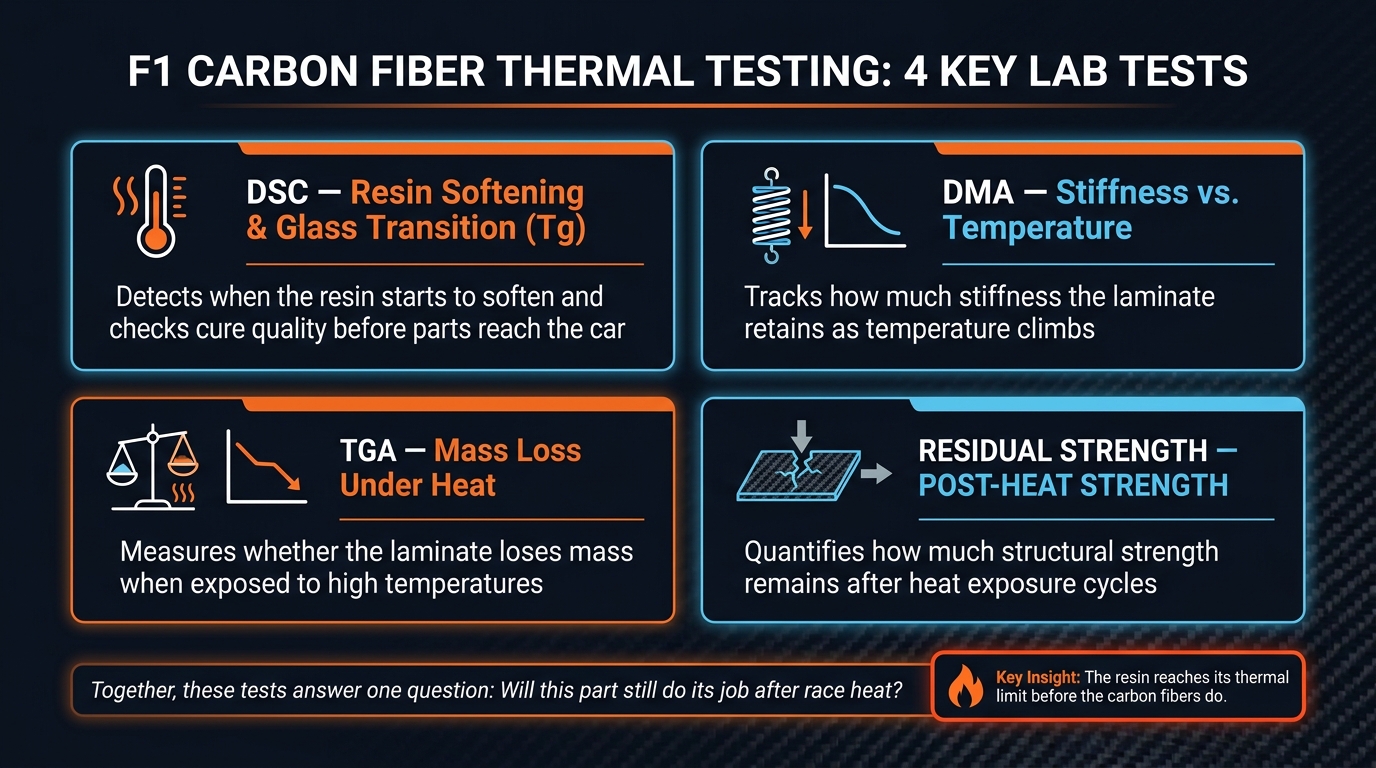
F1 Carbon Fiber Thermal Testing: 4 Key Lab Tests Explained
Recent studies look at CFRP thermal behavior with DSC, DMA, TGA, and residual strength tests. Each test answers a different part of the same problem.
DSC shows when the resin starts to soften. DMA tracks how much stiffness the material still has as temperature climbs. TGA checks whether the laminate loses mass under heat. Residual strength tests show how much strength is left after heat exposure.
Put together, these tests give a much clearer picture of what happens in service. That matters for parts placed near brakes, exhausts, and other high-temperature zones.
The main issue isn’t only the point where a part softens. It’s also how much stiffness and strength still remain after heat exposure.
How Thermal Testing Applies to F1 Components
Lab results matter only when engineers connect them to actual F1 parts. That includes brake-adjacent structures, engine covers, floors, and bodywork that sits near the exhaust.
Thermal test data helps teams choose materials, set ply layout, and decide where heat shielding needs to go for brake-adjacent composites, engine covers, floor edges, and exhaust-adjacent structures. After that, teams check whether those choices hold up on the car with infrared thermography and other in-service checks.
Conclusion: What Thermal Testing Means for F1 Design, Safety, and Future Research
Thermal testing shows whether CFRP parts keep their stiffness and strength after repeated heat cycles. That check matters anywhere heat can drive a laminate close to its thermal limit. In plain terms, thermal testing connects material selection to reliability on track.
Key Takeaways from the Research
The main finding is simple: the resin reaches its limit before the fibers do. Once temperature moves above Tg, the matrix starts to soften and stiffness falls. That’s why DSC matters so much. It checks cure quality and Tg before parts ever make it onto the car.
No single test gives the whole picture. DSC shows cure quality and Tg, while DMA measures how well stiffness holds up as temperature changes. Used together, they give teams a much clearer view of how a part is likely to behave through race-weekend heat cycling.
That test base is now moving toward real-time condition monitoring. The field is shifting from post-failure analysis to predictive monitoring. Future work is also looking at specialized graphene coatings and other advanced nanomaterials. Richer sensor data will make thermal limits easier to track in real time. With better thermal data, teams can protect safety margins without giving away performance.
FAQs
Why does the resin fail before the carbon fiber?
In Formula One carbon-fiber composites, the resin acts as the matrix that keeps the fibers locked in place. But there’s a catch: the resin can’t handle as much heat as the fibers can.
As temperature goes up, the resin loses strength and stiffness much faster. Once it starts to soften or break down, it can’t transfer stress between the fibers or keep the part in shape. At that point, the composite fails before the carbon fibers themselves do.
How do teams know if a part is safe after heat cycles?
Teams rely on strict condition monitoring and lab tests to make sure carbon-fiber parts stay safe after repeated heat cycles.
DSC is used to check structural integrity and confirm that cure parameters still fall within spec. If a sample fails, the part is quarantined for rework or disposal.
They also use DMA to measure how the part’s mechanical properties shift as temperature changes and to verify that it’s still fit for service.
Which F1 parts are most at risk of thermal damage?
The parts most at risk are the ones that face extreme heat, or the ones that lose strength as temperatures climb. That includes the braking system and the power unit, along with its hybrid parts. Too much heat can lead to failure, and once oil gets above 175°C, its lubrication starts to break down.
Composite structures such as suspension wishbones and the chassis can also be affected. Teams rely on lab testing to make sure these parts are cured properly and that their material properties stay stable, especially at bonded joints.