How TecPro Barriers Improve F1 Track Safety
TecPro barriers absorb crash energy, limit rebound and enable quick repairs—meeting FIA standards to improve F1 track safety.
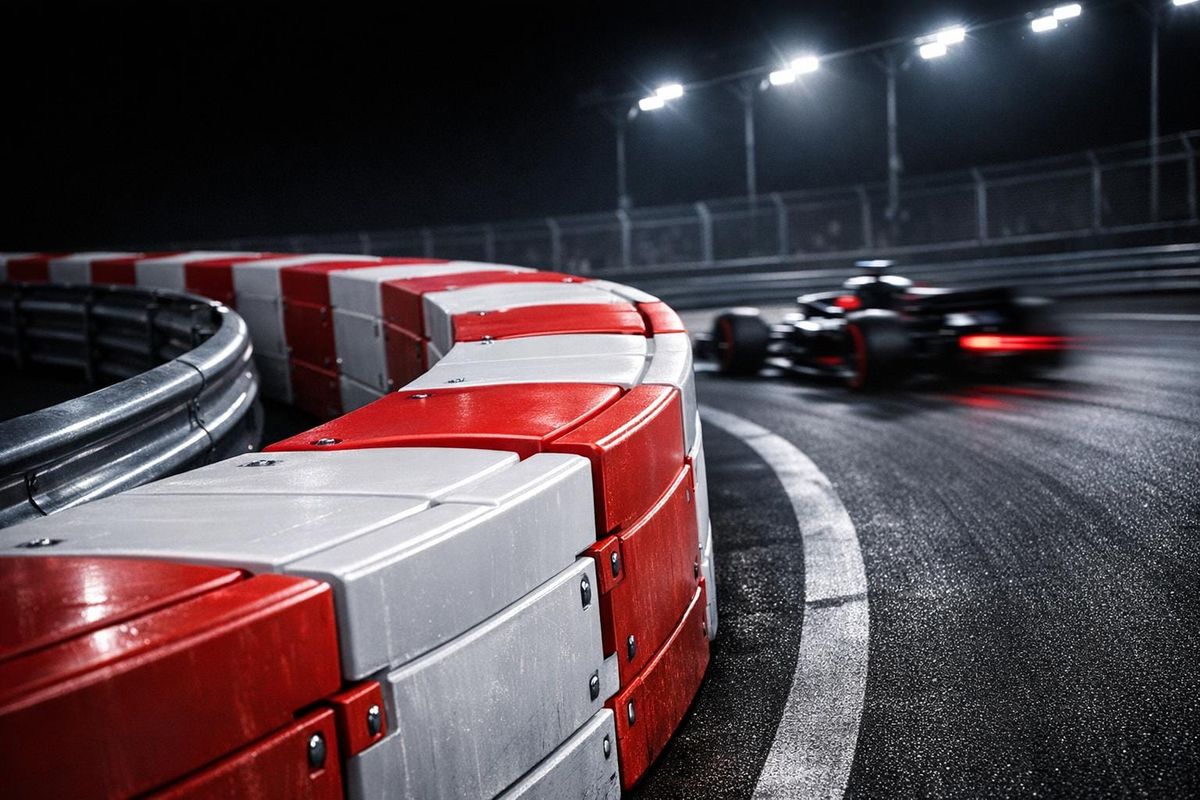
TecPro barriers are a key safety feature on Formula 1 tracks, designed to reduce crash impact and protect drivers. Unlike older systems like tire walls or Armco guardrails, TecPro barriers use high-density polyethylene (HDPE) shells and foam cores to absorb energy efficiently, minimizing rebound risks and ensuring faster repairs. First introduced in 2006 at the Monaco Grand Prix, they are now required for all FIA Grade 1 circuits.
Key Features:
- Energy Absorption: HDPE shells flex and foam cores compress to dissipate crash energy.
- Modular Design: Damaged sections can be replaced quickly, reducing track downtime.
- Safety Standards: Certified under FIA Standard 3501-2017 for high-speed impacts.
- Placement: Installed in high-risk zones like corners and braking areas, often paired with other barriers for added protection.
Why They Matter:
TecPro barriers not only lower peak deceleration forces on drivers but also prevent cars from rebounding onto the track, reducing the risk of secondary collisions. Their modular nature and rigorous design updates, informed by crash data, make them essential for modern F1 safety.
For example, after a 2015 crash involving Carlos Sainz, TecPro barriers were redesigned to prevent cars from sliding underneath, addressing critical safety concerns. In recent incidents, such as Mick Schumacher’s Monaco crash and Gabriel Bortoleto’s 57g impact in Brazil, these barriers have proven their effectiveness in protecting drivers.
TecPro barriers represent a major advancement in F1 safety, combining energy absorption, modularity, and strategic placement to safeguard drivers and improve track operations.
TecPro Barrier Design and How They Work

Construction and Materials
TecPro barriers are built with two key components: a flexible HDPE outer shell and a dense foam core designed to absorb impacts. The HDPE shell is engineered to bend under pressure, avoiding shattering and minimizing debris. Meanwhile, the foam core compresses on impact, helping to spread the force across a larger surface area, which reduces the risk of concentrated damage.
The modules are connected using interlocking couplers and anchored to the ground for stability. To further reinforce the structure, the barriers can be ballasted with sand, water, or specially designed fillers. This setup ensures that the force of a crash is distributed along the entire barrier wall, rather than being absorbed by just one section. The connectors play a critical role in both holding the modules together and spreading the impact energy evenly.
A significant redesign of the TecPro system was prompted by an incident in October 2015, when Formula 1 driver Carlos Sainz crashed at around 125 mph (200 km/h) during practice at the Russian Grand Prix in Sochi. His car became lodged beneath the barrier, raising safety concerns. In response, the FIA collaborated with TecPro on a rigorous testing campaign to address this issue.
"When Carlos Sainz had his accident in Sochi, he got buried underneath the existing design of TecPro. So we decided to carry out a test campaign with TecPro to develop a new version of the barrier that would prevent this from happening again." - Stuart Robertson, FIA Head of Circuit and Rally Safety
The updated design, now part of FIA Standard 3501-2017, prevents cars from sliding under the barrier (a phenomenon known as nose penetration) and ensures that barrier sections cannot lift and land on a car's cockpit.
How TecPro Barriers Absorb Impact
TecPro barriers are designed to manage crash forces through a multi-layered energy absorption process. When a car strikes the barrier, the HDPE shell deforms first, containing the impact and preventing dangerous fragmentation. Next, the foam core compresses, converting the kinetic energy into heat and structural deformation. This gradual dissipation of energy reduces the likelihood of a sudden, jarring stop.
The interlocking couplers between modules allow for slight movement, helping to spread the residual force along the entire length of the barrier. This redistribution limits the stress on any single point, making the system more effective at protecting both drivers and vehicles.
The result is a carefully controlled deceleration, which significantly lowers the risk of serious injuries. Here's a breakdown of how each component contributes to this process:
| Component | Material | Primary Function |
|---|---|---|
| External Shell | High-Density Polyethylene (HDPE) | Deforms without breaking; contains the impact |
| Internal Core | Dense Energy-Absorbing Foam | Compresses to dissipate kinetic energy |
| Connectors | Interlocking Couplers | Distributes force along the barrier's entire length |
| Ballast | Sand, Water, or Proprietary Fillers | Prevents movement or lifting during a collision |
Another advantage of TecPro's modular setup is its efficiency. After a crash, only the damaged sections need replacing, which minimizes track downtime during events. This makes it a practical choice for high-stakes racing weekends.
sbb-itb-7c68254
Ultimate Track Safety: TECPRO Barriers from Karting to Formula 1
Where and How TecPro Barriers Are Used on F1 Tracks
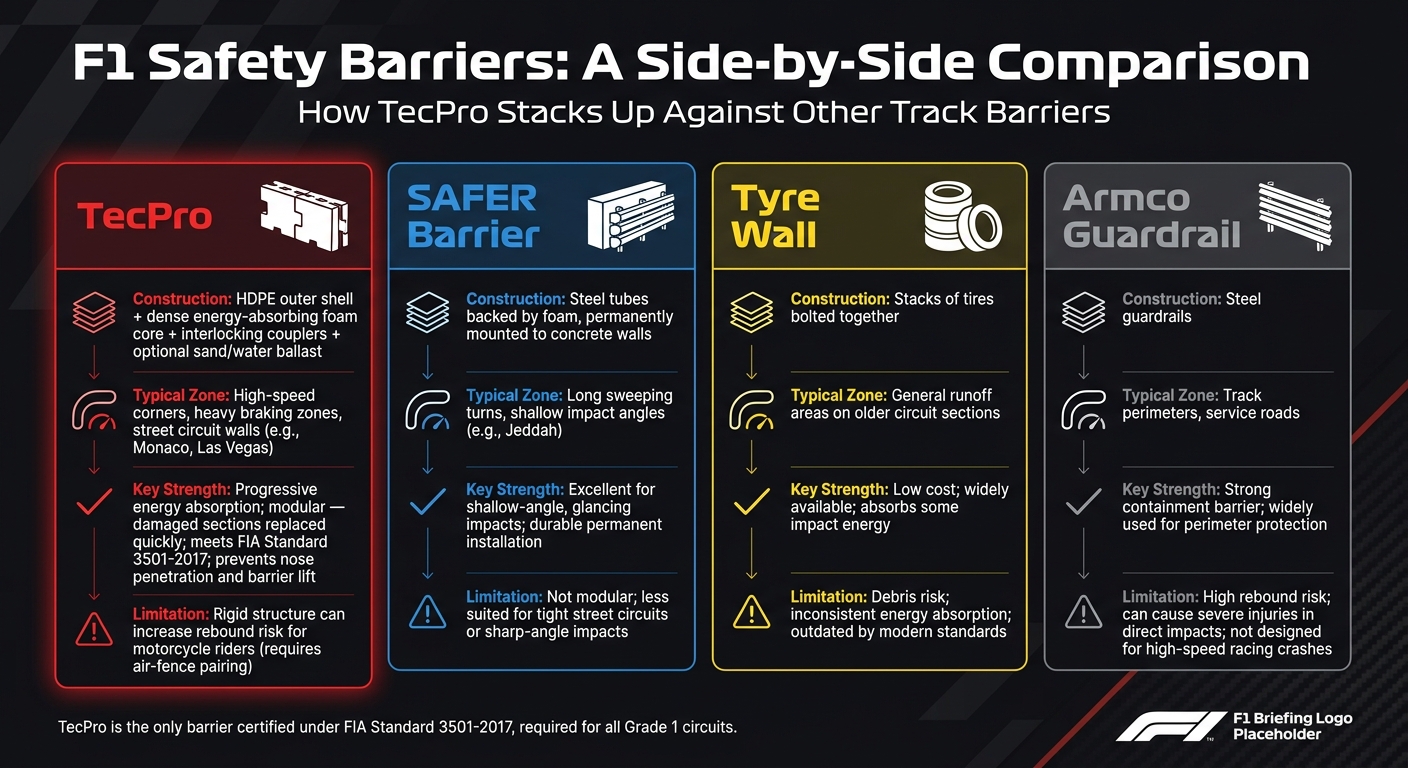
F1 Barrier Types Compared: TecPro vs SAFER vs Tyre Wall vs Armco
High-Risk Zones Where TecPro Barriers Are Installed
Track designers rely on AI simulations to figure out the best spots for TecPro barriers, focusing on high-risk areas. By running thousands of virtual crash scenarios, they pinpoint locations where cars are most likely to veer off the track. These areas usually include high-speed corners, heavy braking zones, and the ends of long straights.
On permanent circuits, TecPro barriers are anchored in runoff zones and often weighted with ballast to keep them stable during high-speed impacts. On street circuits, the barriers are mounted directly against concrete or steel walls. Monaco is a prime example, where TecPro barriers are positioned along the walls, serving as the only deformable layer between the cars and the solid track barriers.
This precise placement ensures TecPro barriers work effectively, especially when used alongside other safety systems.
Using TecPro Alongside Other Safety Barriers
F1 tracks use a layered approach to safety, combining various barriers to absorb energy progressively. TecPro barriers, strategically placed, are often paired with solid structures like concrete walls or Armco guardrails. This setup ensures the rigid backing keeps the modules in place, while the foam core absorbs the initial impact energy.
The choice of barriers depends on the track's design and specific needs, as shown in the table below:
| Barrier Type | Typical Installation Zone | Construction |
|---|---|---|
| TecPro | High-speed corners, braking zones, street circuits | HDPE shell, foam core, optional ballast |
| SAFER | Long sweeping turns, shallow impact angles (e.g., Jeddah) | Steel tubes backed by foam, permanently mounted to concrete |
| Tyre Wall | General runoff areas on older circuit sections | Stacks of tires bolted together |
| Armco | Track perimeters, service roads | Steel guardrails |
At circuits that host both car and motorcycle racing, TecPro barriers are sometimes paired with inflatable air-fences. This is because TecPro's rigid structure can create a higher rebound risk for sliding riders. The air-fence adds a softer, more progressive layer of protection. For F1 cars, though, TecPro's controlled deceleration remains the priority.
"The right approach is designing the most challenging track that you can do, and as soon as you have it, you can calculate the kind of run-off that you want." - Jarno Zaffelli, CEO of Dromo Circuit Design
The 2022 Monaco crash involving Mick Schumacher highlights how this layered safety system works. His Haas car split in two after hitting a TecPro barrier, but the barrier's ability to absorb energy was credited for his uninjured escape. It slowed the car down progressively before the safety cell reached the concrete wall behind it.
How TecPro Barriers Protect Drivers in Crashes
Lowering Peak Deceleration Forces on Drivers
When a crash occurs, TecPro barriers use their foam core to compress and spread out the energy from the impact. This process ensures a smoother deceleration, keeping the forces exerted on the driver below dangerous levels. Unlike older systems, these barriers distribute the force across the entire wall instead of focusing it on one spot.
To meet FIA safety standards, a driver's chest deceleration must not exceed 60g for more than 3 milliseconds during a crash. Motorsport editor Fraser Masefield highlighted the efficiency of TecPro barriers, saying:
"The newest TecPro barriers are now so efficient that they absorb the energy of the car upon impact and displace it along the length of the barrier."
This efficient energy absorption directly lowers the chances of injury. A striking example occurred during the Brazilian GP Sprint race at Interlagos in November 2025. Gabriel Bortoleto's car hit the barriers at Turn 1 with a 57g impact. Thanks to the barrier's energy absorption and the car's safety cell, the driver walked away unharmed. This incident underscores how TecPro barriers manage crash forces effectively, ensuring driver deceleration stays within safe limits.
Beyond controlling deceleration, TecPro barriers also address another key safety concern: secondary collisions.
Reducing the Risk of Secondary Collisions
TecPro barriers not only manage deceleration but also work to prevent rebound forces that could send a crashed vehicle back into the racing line. By absorbing and containing the vehicle's energy, these barriers significantly reduce the chance of secondary collisions.
The system's ballast chambers enhance this safety feature. Filled with sand or water, these chambers add weight to the barrier, keeping it stable during shallow-angle impacts that might otherwise push the car back onto the track. Additionally, the HDPE shell is designed to hold its shape under extreme stress, preventing it from breaking apart and creating debris that could endanger other drivers.
Maintaining and Updating TecPro Barriers
Inspections and Repairs During Race Weekends
TecPro barriers are inspected and maintained with precision to comply with FIA Grade 1 standards, as outlined in FIA Standard 3501-2017 - the first test standard created specifically for circuit safety equipment. Throughout race weekends, track marshals and race officials keep a close watch on barrier installations, particularly in high-risk zones like heavy braking areas and street circuit walls. Thanks to their modular design, damaged blocks can be quickly replaced during events.
The method used to anchor the barriers depends on the type of circuit. On permanent tracks, barriers are bolted to anchor points embedded in the tarmac. In contrast, temporary street circuits - such as Monaco or Las Vegas - use removable ground plates and brackets, allowing for quick installation and removal. This careful maintenance process ensures the barriers are always ready and paves the way for improvements based on crash data analysis.
Adjusting Barrier Placement Based on Crash Data
Routine inspections are just the beginning. Feedback from actual crashes plays a key role in refining barrier placement and design. For instance, crash data from the 2015 Russian Grand Prix highlighted the need to prevent nose penetration and barrier lift. This led to a redesign through a collaborative test campaign between the FIA and TecPro, spearheaded by Stuart Robertson. The updated barrier design was then incorporated into FIA Standard 3501-2017, which now governs the homologation and certification of all safety barriers on Grade 1 circuits.
This ongoing cycle of inspection, repair, and design modification ensures TecPro barriers continue to provide top-tier safety on Formula 1 tracks.
Conclusion: TecPro Barriers and Their Role in F1 Track Safety
TecPro barriers have become a cornerstone of modern Formula 1 safety. As the first barrier system to meet FIA Standard 3501-2017, they’ve established a new safety benchmark required for all Grade 1 circuits.
These barriers are designed to handle crash energy effectively. Thanks to their HDPE shell and foam core, impact forces are distributed across the entire structure instead of being concentrated at a single point - a crucial feature for crashes at speeds over 120 mph.
TecPro barriers also play a key role in how circuits are designed. AI-driven simulations now help determine the best placement for barriers, and TecPro's modular design makes them adaptable for both permanent tracks and temporary street circuits. This combination of advanced planning and flexibility has cemented TecPro's importance in F1 track safety.
An industry leader summed it up well:
"Circuit designers know what they have to specify, circuit operators know which company can supply the required solution and suppliers know what performance level they have to accomplish."
This clear standardization has replaced older, less effective methods, pushing F1 safety to new levels. TecPro barriers are now the gold standard in track safety, shaping the future of Formula 1 circuit design. For more technical insights on F1 innovations, check out F1 Briefing.
FAQs
How do TecPro barriers reduce g-forces in a crash?
TecPro barriers are designed to absorb and dissipate kinetic energy during crashes, effectively reducing g-forces. Built with a modular structure, they combine high-density polyethylene, foam, and ballast to cushion the impact. This setup helps limit the force experienced by drivers, significantly improving safety on F1 tracks.
Why aren’t TecPro barriers used everywhere on a track?
TecPro barriers aren't installed everywhere on a race circuit primarily because they require ample space due to their modular design and the need for a large runoff area. This kind of space isn't always available at every section of a track. On top of that, their size and cost make them less practical for widespread use across all track locations.
What changed after the 2015 Sainz crash to stop cars going under TecPro?
Following Carlos Sainz's crash in 2015, updates were made to TecPro barriers to address the risk of cars sliding underneath them. The redesigned barriers were developed to meet the FIA's stricter safety standards, ensuring such incidents could be avoided in the future.