Armco Barriers vs. TecPro: Key Differences
Breaks down Armco steel vs TecPro foam barriers — materials, crash performance, placement, and why circuits use both.
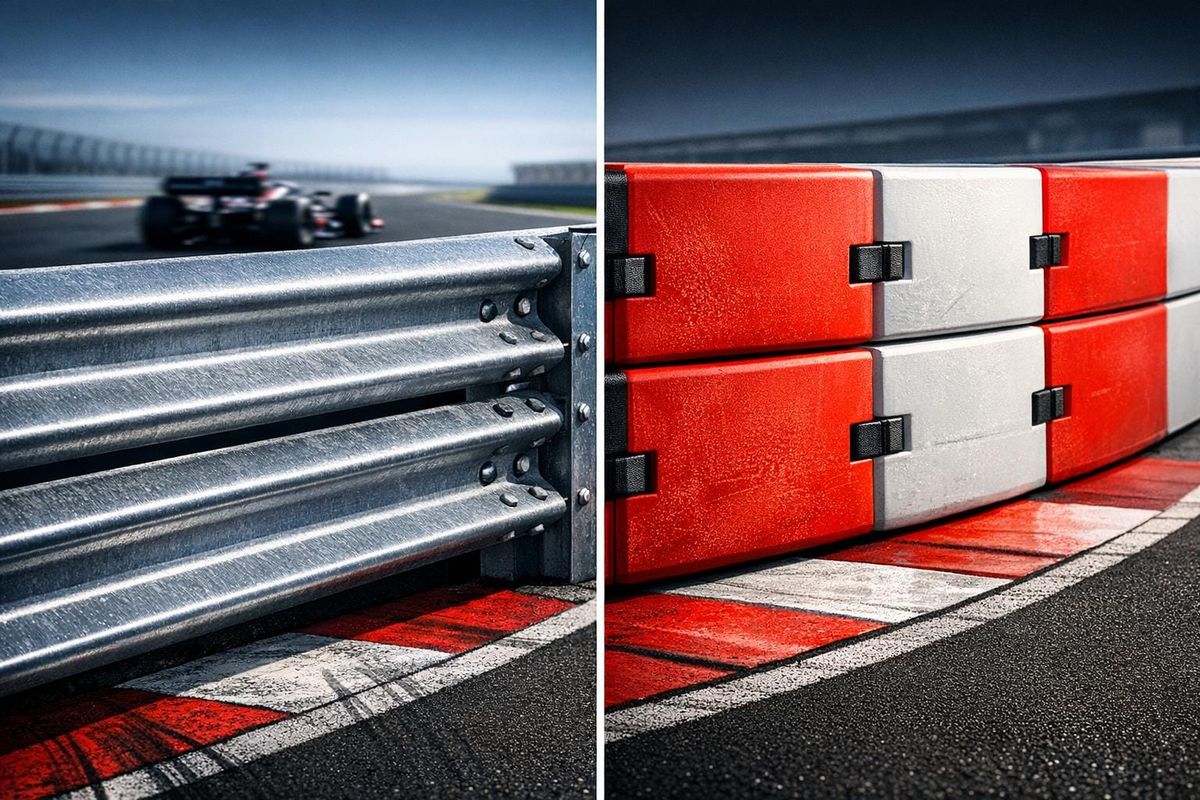
F1 safety barriers are critical for protecting drivers during high-speed crashes. The two primary systems used today are Armco barriers and TecPro barriers, each designed for specific crash scenarios. Here's a quick rundown:
- Armco Barriers: Made from corrugated steel, they absorb energy by bending and are effective for shallow-angle impacts. Commonly found on long straights and street circuits like Monaco, they guide cars along their surface but can pose risks like "submarining" or cars vaulting over them.
- TecPro Barriers: Constructed with polyethylene blocks and foam cores, they excel in absorbing energy from head-on, high-speed impacts. Used in high-risk zones like corners and braking areas, they reduce G-forces significantly compared to Armco barriers.
Both systems are often combined on F1 tracks to maximize safety by leveraging their strengths. Armco provides structural containment, while TecPro minimizes impact forces. Together, they represent the evolution of F1 safety standards.
Quick Comparison
| Feature | Armco Barriers | TecPro Barriers |
|---|---|---|
| Material | Corrugated steel | Polyethylene with foam core |
| Impact Handling | Flexes and bends | Foam compression |
| Best Use Case | Shallow-angle impacts | High-speed, head-on impacts |
| Placement | Straights, street circuits | Corners, braking zones |
| Maintenance | Requires replacement | Quick repairs possible |
| Rebound Risk | Higher | Lower |
This combination of systems ensures modern F1 circuits are equipped to handle a variety of crash scenarios effectively.
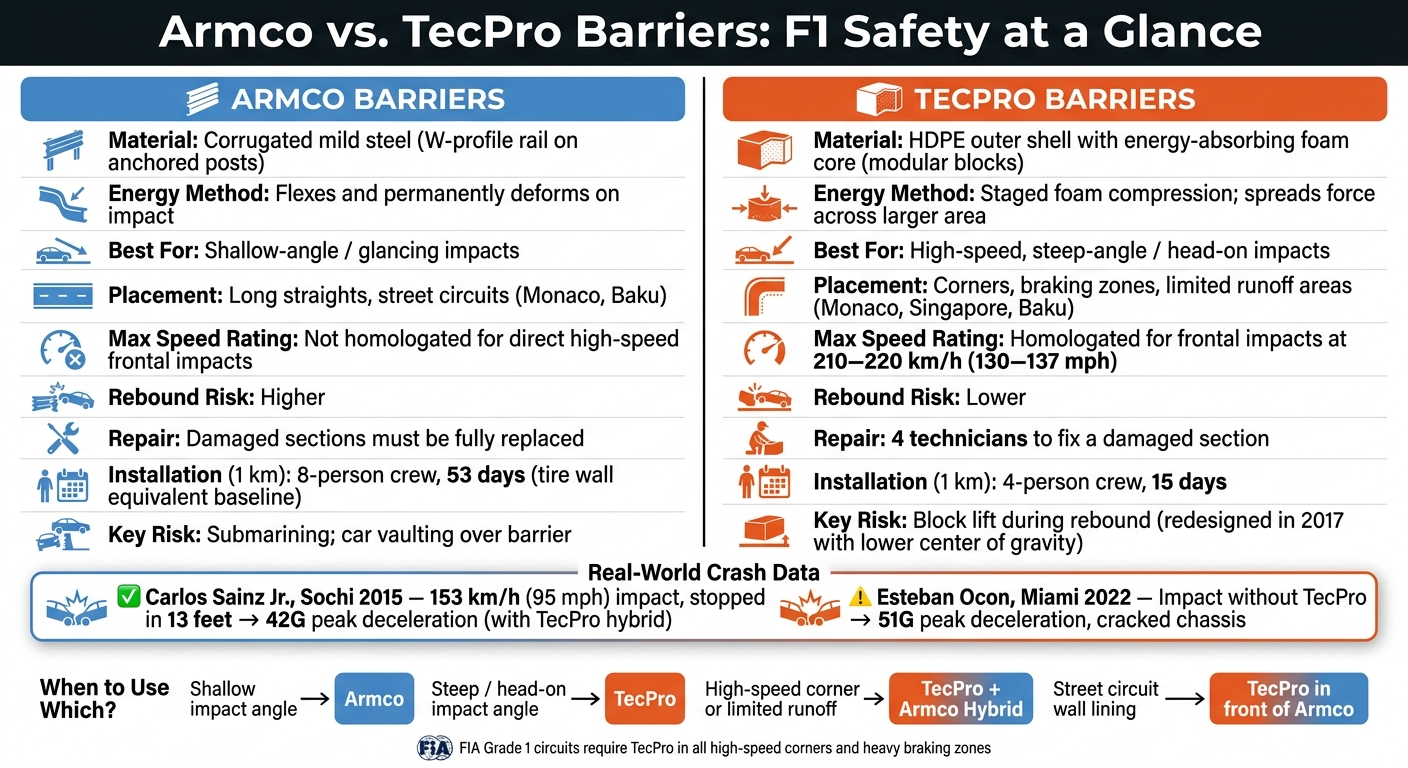
Armco vs. TecPro Barriers: F1 Safety Comparison
Armco Barriers: Design, Function, and Use in F1
Construction and Design
The term "Armco" traces back to the American Rolling Mill Company, the original manufacturer of the steel used in these barriers. These barriers are made from mild steel strips, which are punched with bolt-holes and shaped into a distinct "W" profile. This design ensures both strength and controlled deformation during impacts. As Lee Parker, Staff Writer at Formula 1 History, noted:
"The posts are deliberately spaced at intervals to give the entire barrier system flexibility. This spacing means that when a barrier section is impacted, adjacent sections can flex and give slightly."
This strategic spacing is key to how the barrier absorbs and disperses energy during a crash.
How Armco Barriers Handle Crashes
The real test of an Armco barrier lies in its performance during crashes. When a car hits the barrier at a shallow angle, the corrugated steel surface helps guide the vehicle along the length of the barrier instead of bringing it to a sudden stop. The steel deforms on impact, absorbing kinetic energy and spreading the force across multiple sections. However, once damaged, these sections cannot repair themselves and need to be replaced, often during the course of a race weekend.
Despite their effectiveness, Armco barriers are not without risks. One notable danger is "submarining", where a low-profile F1 car can slide under the barrier if its height isn’t calibrated correctly. Another risk is the potential for a car to vault over the barrier. A tragic example of this occurred at the 1974 U.S. Grand Prix at Watkins Glen. Austrian driver Helmuth Koinigg lost his life when his car breached a poorly installed Armco barrier following a suspension failure.
Where Armco Barriers Are Used in F1
The unique crash dynamics of Armco barriers determine where they are most effective. These barriers are typically placed along long straights or sections of the track where shallow impact angles are more likely. Their primary purpose in such areas is to redirect sliding cars safely. Street circuits like Monaco rely heavily on Armco barriers, as they can be securely anchored into the existing road infrastructure, creating a robust barrier between the track and spectators.
In modern Formula 1, Armco barriers are often used as a secondary layer of protection. They are placed behind primary energy-absorbing systems like TecPro blocks or tire walls. Reflecting on a severe crash, Sebastian Vettel described the aftermath:
"It was shocking to see that he was so deep in the barrier... the car eventually came to a rest after puncturing the solid Armco barrier behind the TecPro."
This layered approach highlights the specific role that Armco barriers play in F1 safety, complementing more advanced systems like TecPro while maintaining their relevance in certain scenarios.
sbb-itb-7c68254
TecPro Barriers: Design and F1 Applications

Design and Materials
TecPro barriers are built using a modular block system featuring an HDPE outer shell filled with energy-absorbing foam. Unlike the rigid steel structure of Armco barriers, TecPro is designed to deform on impact, spreading the force across a larger area to reduce the severity of crashes.
The system incorporates two types of blocks: flexible red blocks, which absorb the initial impact, and reinforced gray blocks, which ensure the barrier remains stable. These blocks are connected with nylon straps and interlocking couplers, allowing the entire wall to flex as a single unit during a collision. To prevent movement, some sections are filled with ballast and anchored to the ground.
This design plays a critical role in how TecPro barriers handle high-speed impacts.
How TecPro Barriers Perform in High-Speed Crashes
The strength of TecPro barriers lies in their ability to slow down a vehicle gradually rather than bringing it to an abrupt stop. The foam core compresses in stages, reducing peak G-forces experienced by the driver. For example, in one crash, a car traveling at 95 mph (153 km/h) decelerated over just 13 feet, with a recorded force of 42G - showing how effectively the barrier absorbs and dissipates energy.
By comparison, Esteban Ocon's 2022 crash at the Miami International Autodrome, which occurred in an area without TecPro, saw a peak deceleration of 51G that even cracked the car's chassis. This stark difference highlights the importance of TecPro in reducing the severity of crashes.
However, challenges have emerged. After an incident in Sochi, it was noted that the barrier lifted during the rebound phase, creating the risk of a car sliding underneath. To address this, Matteo Piraccini, a Senior Research Engineer at the Global Institute for Motor Sport Safety, spearheaded a redesign for the 2017 season. He explained:
"The new solution is heavier than before meaning that the element's center of gravity is now lower. At the same time, the new layout increases the strength of the full internal structure, while improving the element's anti-penetration capability."
Where TecPro Barriers Are Used in F1
Thanks to their advanced design and crash management capabilities, TecPro barriers are strategically placed in high-risk areas on F1 circuits. These include high-speed corners, heavy braking zones, and sections with limited runoff space. Their ability to decelerate cars over short distances while reducing G-forces makes them far more effective than traditional tire walls or Armco barriers. Jochen Braunwarth, Director of Motorsport at Geobrugg, emphasized their importance:
"As soon as that impact angle is reaching a certain angle, you need to put a TecPro barrier, you need to put something."
Street circuits such as Monaco, Baku, and Singapore particularly benefit from TecPro barriers. These barriers can be shaped to match the track's layout and removed after the event, making them ideal for temporary circuits. On permanent tracks, they are often installed at the exits of fast corners, where drivers are most likely to run wide at high speeds. The FIA now requires TecPro barriers as the standard for Grade 1 circuits in these critical areas, demonstrating their role in improving driver safety.
Armco vs. TecPro: A Direct Comparison
Materials and Structural Differences
The key distinction between Armco and TecPro barriers lies in their materials and how they’re constructed. Armco barriers are crafted from corrugated mild steel, shaped into a continuous W-profile rail that’s firmly mounted on anchored posts. When a vehicle impacts an Armco barrier, the steel bends and deforms permanently, absorbing energy through structural damage. On the other hand, TecPro barriers are made up of modular blocks with a high-density polyethylene (HDPE) shell and a foam core. These blocks compress upon impact, spreading the force across a larger area instead of focusing it at a single point.
| Feature | Armco | TecPro |
|---|---|---|
| Material | Corrugated mild steel | HDPE shell with foam core |
| Design | Continuous rail on posts | Modular interlocking blocks |
| Energy Method | Flexing and permanent damage | Foam compression |
| Rebound Risk | Higher | Lower |
| Installation | Permanent/semi-permanent | Portable and modular |
Safety and Crash Performance
The way these barriers handle crashes also sets them apart, with impact angles playing a significant role in their effectiveness. Jochen Braunwarth, Director of Motorsport at Geobrugg, highlights the importance of matching barriers to specific impact scenarios:
"Usually the areas where you have a very shallow impact angle the idea is... to bounce off and then slide along. As soon as that impact angle is reaching a certain angle, you need to put a TecPro barrier."
For shallow impacts - like when a car skims the barrier - Armco is effective, guiding the vehicle along without bringing it to a sudden stop. However, in situations involving steeper angles or direct collisions, TecPro barriers excel. Their foam core absorbs the energy from head-on impacts, making them particularly effective in high-speed crashes. TecPro barriers are homologated to withstand frontal impacts at speeds over 200 km/h (around 124 mph), highlighting their suitability for extreme conditions.
These safety characteristics also influence their placement on race circuits, especially when balancing crash performance with practical considerations like setup and maintenance.
Cost, Installation, and Maintenance
Beyond crash performance, the practicalities of installation and upkeep further differentiate the two systems. TecPro's modular blocks are designed for quick assembly and repair. According to TecPro's data, setting up a 1 km (about 0.62 miles) stretch of their barrier takes a four-person team just 15 days. In comparison, installing a traditional tire wall of the same length requires an eight-person crew 53 days.
Repairs after a crash are similarly streamlined with TecPro. Fixing a damaged section involves just four technicians, while a comparable tire wall repair might need up to 20 people. These logistical efficiencies make TecPro barriers particularly appealing for temporary street circuits, where rapid deployment and removal are critical to meet tight schedules.
Combining Armco and TecPro: Hybrid Barrier Systems in F1
How Layered Barrier Systems Work
Modern F1 tracks rely on layered barrier systems for safety. These systems place TecPro blocks in front of Armco rails or concrete walls, creating a multi-layer defense. TecPro blocks serve as the first point of contact, compressing upon impact to absorb kinetic energy before the car reaches the rigid structure of Armco or concrete.
In high-speed areas, circuits often use two rows of reinforced TecPro blocks to better manage energy dissipation. A notable example occurred during Carlos Sainz Jr.’s 2015 crash at the Sochi Autodrom. Traveling at 153 km/h (around 95 mph), his car hit a hybrid barrier head-on. The barrier stopped the car in just 13 feet, generating a peak deceleration of 42G. The impact caused the front row of TecPro blocks to lift off the ground and land on the car. This led to a redesign in 2017, focusing on heavier blocks with a lower center of gravity to improve performance in hybrid configurations.
To prevent "submarining" - when a car slides under the barrier - reinforced TecPro blocks feature an internal metal sheet and nylon straps. These additions help maintain the barrier’s structural integrity and prevent lifting during collisions.
These design details play a crucial role in determining where and how barriers are placed, which is discussed in the next section.
How Track Layout Shapes Barrier Choices
Different parts of a circuit require tailored barrier solutions. The FIA uses pre-race simulations to predict impact angles for each segment, which directly influence the choice of barriers:
| Scenario | Barrier Choice | Purpose |
|---|---|---|
| Shallow impact angle | Armco or concrete | Allows the car to slide, dissipating energy gradually |
| Steep impact angle | TecPro + Armco hybrid | Absorbs high kinetic energy from head-on impacts |
| Limited runoff space | TecPro | Maximizes energy absorption in tight areas |
| High-speed corner | Multi-layer TecPro + Armco | Provides maximum deceleration before hitting the rigid wall |
Street circuits add another layer of complexity. For example, at Monaco, Armco barriers are a permanent fixture for public road safety. During race weekends, TecPro blocks are added to protect drivers from the unforgiving steel barriers. A similar situation arose at the 2022 Miami Grand Prix when Esteban Ocon hit a concrete barrier at a chicane with a 51G impact. FIA simulations had predicted a shallow impact angle, favoring concrete to allow the car to slide. However, this incident reignited the debate over relying solely on simulation data versus incorporating driver feedback.
Understanding how these layout-specific decisions are made highlights the ongoing evolution of FIA safety standards, which is explored in the next section.
Keeping Up with FIA Safety Standards

As hybrid barrier systems continue to demonstrate their effectiveness, FIA safety standards evolve to optimize their use. Ahead of the 2017 season, FIA simulations projected that cornering speeds would increase by up to 25 mph due to new aerodynamic regulations. This prompted mandatory barrier upgrades at key corners. However, the FIA has taken a targeted approach to these updates.
"We are not asking them to replace everything, just update the barriers where we think there is a critical area... a minimum but important change in a few corners." - Charlie Whiting, FIA F1 Race Director
All FIA Grade 1 circuits - required for hosting Formula One races - must now include TecPro barriers in high-speed corners, heavy braking zones, and wall-lined sections of street tracks. As car performance evolves, the FIA continues to identify new critical areas, ensuring that hybrid barrier systems remain a priority for ongoing engineering improvements.
A short history of crash barrier technology in F1
Conclusion: Armco and TecPro Barriers in Modern F1 Safety
Armco and TecPro barriers serve as a dynamic duo in ensuring safety in Formula 1. Armco barriers, with their corrugated steel design, are highly effective at containing vehicles during shallow or glancing impacts, allowing cars to decelerate gradually along their surface. On the other hand, TecPro barriers, made from foam-filled polyethylene modules, are specifically designed to absorb energy during steep, high-speed, head-on crashes.
TecPro barriers can withstand impacts at speeds of 210–220 km/h (around 130–137 mph). Their modular design also makes them easier to repair - requiring just four technicians compared to the 20 needed for tire wall repairs. This feature is particularly critical during race weekends when time is of the essence.
The importance of TecPro barriers becomes even clearer when considering incidents like Esteban Ocon's 51G crash in Miami, which highlighted the risks when TecPro is absent. Otmar Szafnauer, former Team Principal at Alpine, aptly noted:
"The FIA's job isn't to protect cars, but protecting cars and drivers are highly correlated. If the car is damaged, the driver can get damaged, too."
These examples emphasize the value of combining both types of barriers. Armco provides the structural strength needed to contain vehicles, while TecPro adds a layer of energy absorption to reduce crash forces. As F1 cars continue to get faster and FIA safety standards advance, this integrated approach will remain critical to protecting drivers on the track.
FAQs
Why doesn’t F1 use TecPro everywhere?
Formula 1 doesn't install TecPro barriers everywhere because their use is determined by extensive safety simulations conducted by the FIA. In spots where cars are more likely to collide at shallow angles, options like concrete or Armco barriers often provide enough protection. Plus, TecPro barriers, with their modular design, can be challenging to move around. This makes them less practical in areas of a circuit that double as public roads or require regular access for other purposes.
How does the FIA decide where each barrier goes?
The FIA and track designers rely on AI simulations to process thousands of virtual crash scenarios. These simulations help pinpoint areas with the highest risk, such as high-speed corners, heavy braking zones, and the ends of long straights.
On permanent tracks, barriers are strategically placed in runoff areas to enhance safety. Meanwhile, on street circuits, barriers are mounted directly against walls. This approach uses a combination of energy-absorbing systems, like TecPro barriers, paired with rigid structures to manage deceleration in a controlled way.
What prevents a barrier from allowing 'submarining'?
Submarining occurs when a vehicle slides underneath a safety barrier, posing a serious risk of injury to the driver. To address this hazard, modern barriers designed to meet FIA Standard 3501-2017 incorporate specialized features. These designs ensure the barrier sections stay firmly in place and resist lifting during a crash. By doing so, they prevent cars from sliding beneath the barrier or having the barrier collapse onto the cockpit, maintaining the barrier's effectiveness even during high-speed collisions.