Understanding Grip Degradation in F1 Tires
How F1 tires lose grip: thermal and chemical degradation, graining, measurement, and strategic impact on race pace.
F1 tire grip degradation can make or break a race. Here's what you need to know:
- Grip degradation is not the same as tire wear. It refers to a loss in tire performance, even when rubber remains.
- Two main types:
- Thermal fade: Sudden grip loss when tires overheat (above 248°F).
- Chemical degradation: Gradual performance drop as rubber polymers break down.
- Impact on strategy: Degradation affects lap times, pit stop timing, and race outcomes. Misjudging it can cost positions.
- Key factors: Tire compounds, track conditions, car setup, and driving style all influence degradation rates.
For instance, in the 2026 Australian Grand Prix, George Russell won by managing a minimal degradation rate (-0.02 s/lap), while others struggled with rapid performance loss.
This guide breaks down how F1 tires are designed, how grip is generated, and how teams use data to adapt during races.
How F1 Tires Are Built for Grip
Tire Structure and Components
An F1 tire is a finely tuned system made up of three key parts: the carcass, the tread, and the sidewalls. Each piece plays a specific role in creating grip and influencing how quickly that grip wears out.
The carcass acts as the internal framework of the tire. It manages the vertical and lateral forces generated during cornering, braking, and acceleration. When the carcass flexes under these forces, it absorbs and releases energy, which directly impacts the tire's stability and how fast its grip fades.
The tread is the outer layer that touches the track. Its job is to mold itself into the tiny imperfections of the asphalt, creating friction. However, if the tread wears unevenly or the rubber's chemical properties break down, the tire's ability to maintain grip - and deliver fast lap times - can be compromised.
For the 2026 season, Pirelli introduced a new tire design featuring a smaller contact patch and adjusted car weight distribution. This change redistributes stress across the tread, making the tires more sensitive to wheelspin and lateral forces.
Beyond the physical structure, the rubber's chemical makeup is just as critical in determining grip levels.
Rubber Compounds and Temperature Sensitivity
The rubber used in F1 tires is a sophisticated mix of polymer chains that reacts dramatically to temperature changes. Pirelli’s 2026 range includes compounds from C1 (the hardest) to C5 (the softest), each tailored for a specific balance between performance and durability.
These compounds perform best within a tread surface temperature range of 212°F to 248°F (100–120°C). Within this "sweet spot", the rubber stays flexible and provides maximum grip. Outside of this range, performance drops sharply.
"The tire gets too hot. Rubber has an optimal window (roughly 100-120°C at the tread). Push past it and the compound stops behaving like grippy rubber and loses its firm grip, resembling over-softened rubber." – Podium Prophets
When the rubber is too cold, it stiffens and scrapes against the asphalt, causing graining - tiny bits of rubber peel off and reattach unevenly, shrinking the effective contact patch and often leading to understeer. On the other hand, overheating leads to chemical degradation, where the polymer chains permanently break down, resulting in a lasting loss of grip.
Temperature swings can happen fast. For example, on long straights like those in Las Vegas, front tire temperatures can drop by 35–40°C (95–104°F), while rear tires might cool by 20–25°C (36–45°F). These drops can push the tread out of its ideal temperature range before the next braking zone.
How Grip Is Generated
The way F1 tires generate grip depends heavily on how the compounds behave with temperature. Grip comes from two main mechanisms: adhesion and hysteresis.
Adhesion occurs when the warm, flexible rubber molds itself into the tiny ridges and grooves of the asphalt, creating friction through a mechanical bond. Softer compounds, like the C5, adapt more easily to the track surface, delivering higher peak grip. However, this grip tends to wear out faster compared to harder compounds like the C1.
Hysteresis refers to the energy the tire absorbs and releases as it deforms under load. When the carcass flexes in a corner, it stores energy and releases it out of sync, creating a damping effect that contributes to grip. Since F1 tires are highly sensitive to load, grip doesn’t increase in a straight line with added vertical force. This makes car balance and stability essential for getting the most out of the tires.
Adhesion and hysteresis together define the tire's performance limits. Overdriving the tire can disrupt adhesion, causing issues like graining or thermal fade. But with careful management, both mechanisms can work together effectively over the course of a race. This balance not only impacts lap times but also plays a key role in shaping race strategies based on real-time grip data.
sbb-itb-7c68254
How Does F1 Tire Degradation Affect Race Performance? - Pole Position Experts
Factors That Drive Grip Degradation
Tire performance isn't just about construction or compounds - it’s also shaped by external influences and how the tires are used. Let’s look at some key factors that contribute to grip degradation.
Wear Patterns and Visual Signs
Tire wear leaves behind visible clues, with graining and blistering being two of the most common patterns. Each tells a different story about what’s happening under the surface.
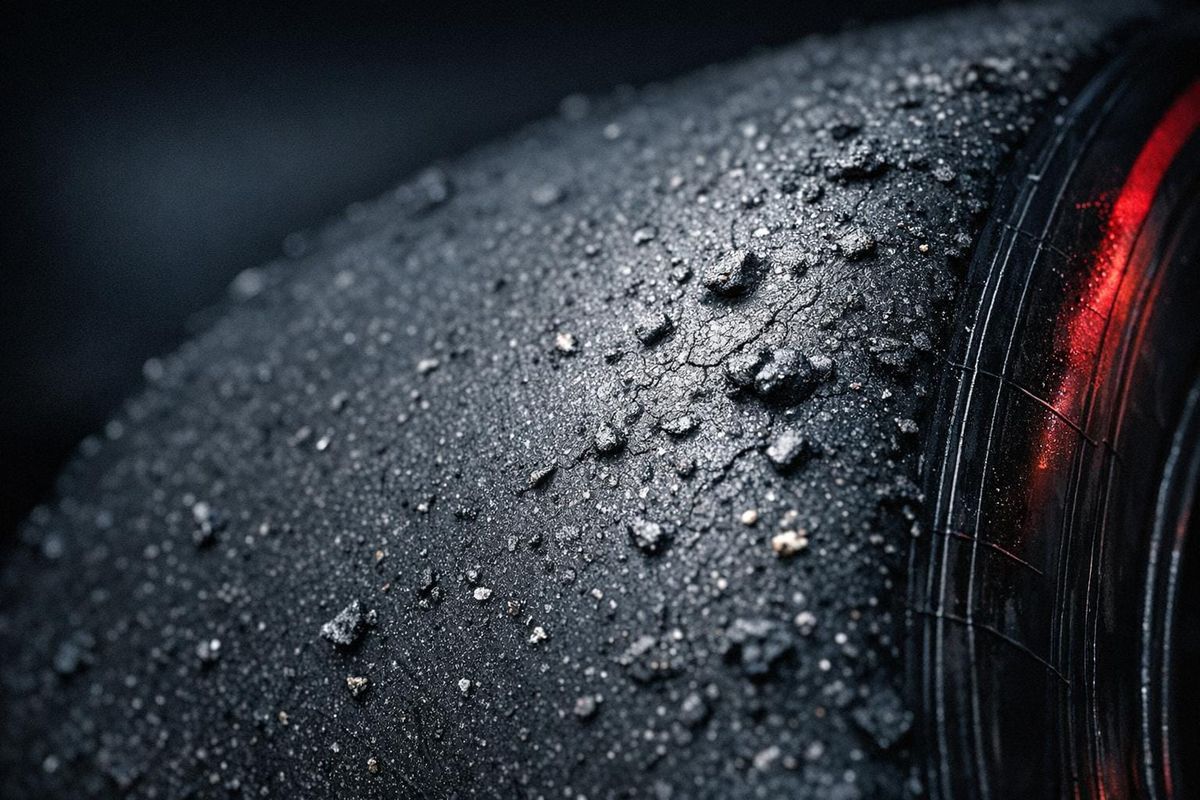
- Graining occurs when tires are too cold to grip effectively. The stiff rubber tears slightly, leaving small rubber fragments on the tread. This creates a rough texture and can lead to understeer. While frustrating, graining can sometimes be managed by driving smoothly, which wears away the damaged layer to reveal fresher rubber underneath.
- Blistering, on the other hand, is caused by excessive heat. When tire temperatures spike, gas pockets form within the rubber. These pockets eventually burst, leaving behind bubbles or craters on the tread. Unlike graining, blistering is usually permanent and signals a compromised tire.
How Weather and Track Conditions Affect Degradation
Temperature is a game-changer when it comes to tire performance. F1 tires are built to operate within a specific thermal range - between 212°F and 248°F (100–120°C). Deviations outside this range, often caused by weather or track conditions, can wreak havoc.
Take the 2023 Las Vegas Grand Prix, for example. With ambient temperatures of just 54°F (12°C) and long straights, front tire surface temperatures dropped by as much as 72°F (40°C) between corners. This cooling effect stiffened the rubber, triggering graining during braking. As Pirelli's Mario Isola explained:
"Due to the cold, the expected ambient temperature and the long straights, we will probably measure a difference between the surface temperature, which cools down, and the temperature inside, and that could lead to some graining."
The track surface is another key factor. Abrasive circuits like Bahrain gradually wear down the rubber, while smoother tracks, such as Montreal or Las Vegas, can cause tires to slide rather than grip. This sliding prevents tires from reaching their optimal temperature range, making graining more likely.
Car Setup and Driving Style
A car’s setup and the driver’s approach can make or break tire performance. Poor choices here often lead to faster grip loss and more pit stops.
One critical factor is suspension stiffness. A stiffer setup helps in high-speed corners but can cause uneven tire contact on bumpy surfaces, leading to inconsistent wear. Andrew Jarvis from McLaren Race Engineering summed it up well:
"There's a trade to make between having a stiff car for the high-speed entries and something softer for traction and the warp."
Driver input also plays a massive role. Aggressive throttle use heats the rear tires quickly, while hard, late braking adds heat to the front tires. Persistent understeer in slow corners causes the front tires to slide, producing what engineers call destructive heat, which accelerates graining. Smooth steering and throttle inputs, however, can help drivers manage graining without losing race positions.
Practical Impact of Degradation Rates
Tire degradation isn’t just a technical issue - it directly affects race strategy. Teams monitor degradation rates to decide when to pit and which tires to use. Here’s a quick reference:
| Degradation Rate (Hard Tire) | Performance Status | Strategic Impact |
|---|---|---|
| 0.02–0.05 s/lap | Excellent | Consistent performance; ideal for one-stop strategies |
| 0.06–0.10 s/lap | Healthy | Standard conditions; manageable wear |
| 0.11–0.15 s/lap | Worrying | Likely requires an extra pit stop |
| > 0.15 s/lap | Bleeding | Indicates setup issues or wrong tire choice |
For instance, at the 2026 Australian Grand Prix, George Russell (Mercedes) maintained a degradation rate of -0.02 s/lap on hard tires, running consistent lap times between 1:23.4 and 1:23.9. Meanwhile, Lando Norris (McLaren) started strong on softer tires with a 1:23.2 lap but dropped to 1:24.0 by lap 11 as chemical degradation kicked in. This difference highlights how tire choice and car setup can shape race outcomes.
Using Grip Degradation Data in Race Strategy
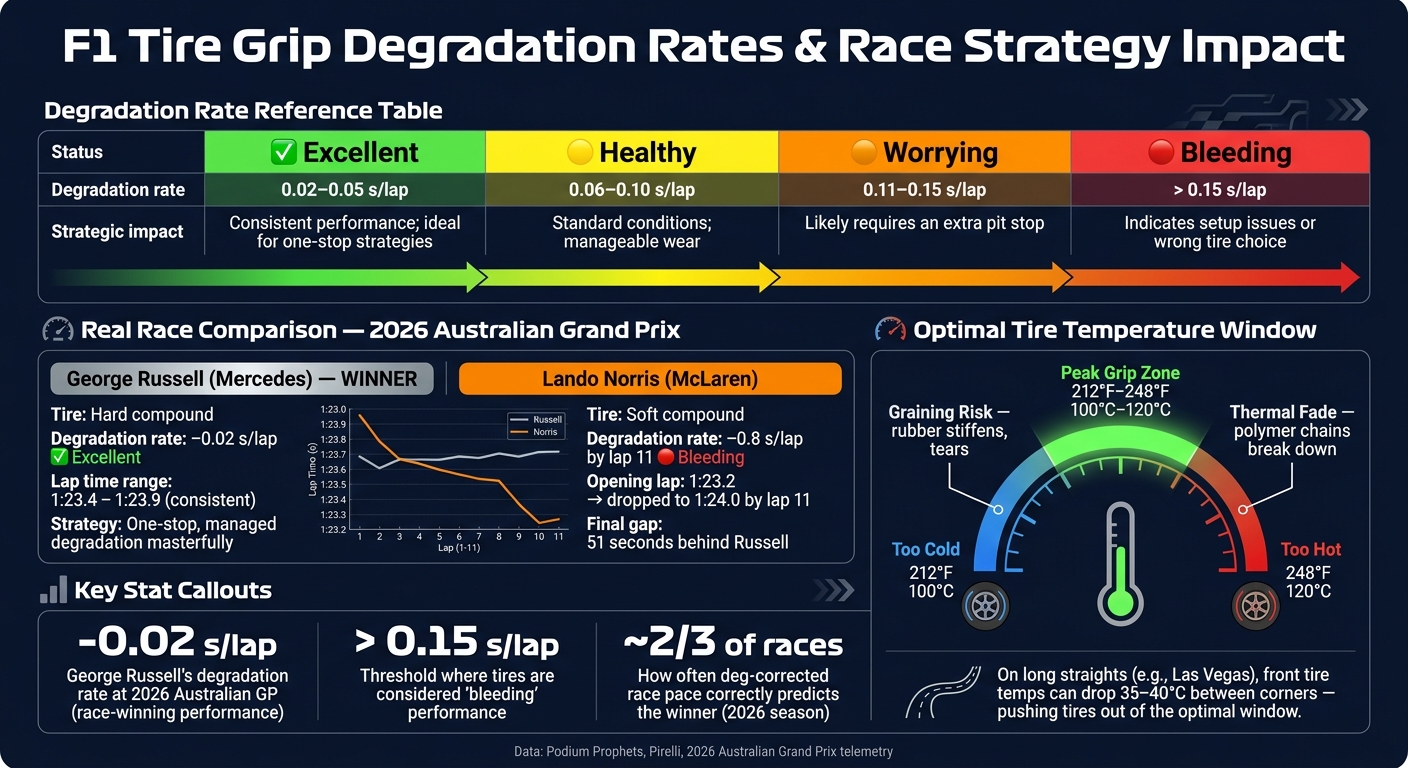
F1 Tire Grip Degradation Rates: What the Numbers Mean for Race Strategy
Tire data becomes a powerful tool when it's transformed into actionable race strategies through precise measurement, predictive modeling, and in-race adjustments.
How Teams Measure Grip Degradation
To measure grip degradation, teams rely on telemetry, sector lap times, and driver feedback. They calculate the degradation slope by dividing the time difference between the first and last clean laps by the total number of laps. For example, sector timing can reveal early signs of performance loss - if a yellow S3 indicator shows up two to four laps earlier than expected, it signals an approaching drop in tire performance.
In a typical hard-tire stint, the degradation slope is around 0.05 seconds per lap. However, if this value exceeds 0.15 seconds per lap, it indicates the tire is "bleeding" performance. These real-time metrics are essential for feeding into degradation models that guide strategy.
Degradation Models and Stint Planning
Using the collected data, teams create predictive models to fine-tune their stint strategies. For example, during FP2 sessions, long-run data helps teams calculate a degradation slope based on clean lap times. This allows them to simulate full-race scenarios with impressive accuracy. At the 2026 Australian Grand Prix, George Russell's FP2 hard-tire stint showed a slope of –0.02 seconds per lap. Mercedes used this information to craft a winning strategy.
Modern tools, like cloud-based simulators, now allow teams to integrate telemetry into thousands of pit-stop scenarios. These simulations account for factors like 2026's updated aerodynamics and weight distribution, giving teams a sharper edge in planning.
"Deg-corrected race pace beats the grid roughly two-thirds of the time." - Podium Prophets
Managing Degradation During a Race
In the heat of the race, drivers adapt their pace to manage degradation. For thermal degradation, easing off the throttle on straights or briefly adjusting racing lines can help recover grip.
Deciding whether to pit or stay out requires careful judgment. If graining occurs early in a stint, teams must weigh the risks. Can the driver wear through the rough outer layer to reach cleaner rubber? The 2021 Turkish Grand Prix highlights how tricky this decision can be. Mercedes pitted Lewis Hamilton for fresh intermediate tires with just eight laps to go. Unfortunately, the new tires immediately began graining on the drying track, causing a dramatic drop in pace:
"Massive graining. We shouldn't have come in." - Lewis Hamilton, Mercedes
Timing is everything. A fresh set of tires that hasn’t stabilized can sometimes be less effective than a worn set that’s already performing consistently.
History and Future of Grip Degradation in F1
How Tire Design Philosophy Has Changed
In the early days of Formula 1, tire design focused on durability. Teams relied on tires that could endure an entire race without significant performance loss. But everything changed in 2011 when Pirelli became F1's exclusive tire supplier. Their mandate? Create tires that degrade in a way that forces teams to make strategic choices during races. This shift introduced controlled thermal degradation as a key factor in race strategy, adding layers of complexity to how teams approach each weekend.
Fast forward to the 2026 regulations, and the sport is once again redefining tire dynamics. With lighter cars (minimum weight reduced to 768 kg, roughly 66 lbs lighter) and narrower tires (25 mm less width at the front and 30 mm at the rear), the way tires interact with the track surface is changing dramatically. These adjustments have reshaped how the load is distributed across the contact patch, making mismanagement of tire temperatures even more punishing. One of the primary goals for the 2026 tire generation is tackling the issue of graining - a problem where cold tires tear and reattach rubber unevenly, significantly impacting performance.
These evolving designs have had a noticeable impact on race outcomes, with some events serving as clear examples of how tire degradation can make or break a driver’s race.
Races Where Tire Degradation Changed the Outcome
Tire degradation has played a starring role in several races, sometimes determining the winner. Take the Emilia Romagna Grand Prix sprint race in April 2022. Charles Leclerc suffered severe graining on his front tires in the final laps, while Max Verstappen’s tires had already stabilized. This allowed Verstappen to close the gap and secure the win.
Another compelling example is the 2026 Australian Grand Prix. George Russell clinched victory by managing tire degradation masterfully, maintaining a steady loss of just –0.02 seconds per lap on hard tires. In contrast, Lando Norris, running on soft tires, experienced a steep degradation curve, losing 0.8 seconds per lap by lap 11. The result? Norris finished a staggering 51 seconds behind Russell. This wasn’t about outright speed - it was about who could sustain performance over the long haul.
As tire technology continues to evolve, these moments are becoming more frequent, with teams and drivers constantly adapting to new challenges.
What's Next for F1 Tire Technology
The relationship between tire technology and race strategy is set to deepen, thanks to advancements in materials and data-driven tools. AI-driven strategy models are now analyzing live race data with reinforcement learning, offering real-time insights that can shape decisions mid-race. On the materials side, Pirelli’s 2026 compounds are designed to resist surface graining and maintain better control over overheating. Meanwhile, the experimental C6 extra-soft compound was discarded because it didn’t provide a significant advantage over the existing C5 compound. This signals a shift in focus toward consistency and predictability rather than chasing peak grip.
The introduction of lighter cars, narrower tires, and active aerodynamics adds even more complexity. These aerodynamic systems help manage drag and energy efficiency on straights, reducing thermal stress on the tires. Rob Marshall, McLaren’s Chief Technical Officer, summed it up perfectly:
"The 2026 car basically fills and drains the battery on every straight and corner... Being able to do fast>quite-fast>quite-fast may be the way forward." - Rob Marshall, McLaren
This evolving rhythm of pushing hard, recovering, and pushing again is reshaping how teams think about tire life and race strategy. It’s no longer just about lap times - it’s about mastering the intricate balance of performance and endurance.
Conclusion
Grip degradation isn't just a minor detail in Formula 1 - it’s often the factor that separates victory from a mid-pack finish. This guide has delved into how tire construction, rubber composition, track conditions, and driving styles all contribute to a tire's degradation rate. Together, they create a complex puzzle that directly impacts race strategy and performance over a stint.
The numbers make it clear. A well-managed stint on hard tires might see lap times drop by just 0.02 to 0.05 seconds per lap. But when that degradation creeps beyond 0.15 seconds per lap, the time loss becomes significant, often forcing an extra pit stop. Over 20 or 30 laps, these small differences can snowball into race-defining gaps.
More than outright speed, degradation highlights the importance of strategy and tire management. In fact, during the 2026 season, race pace adjusted for degradation has been a better predictor of winners than qualifying position, correctly forecasting outcomes in about two-thirds of races. Knowing the nuances between thermal degradation (a sudden drop-off), chemical degradation (a gradual decline), and surface issues like graining or blistering offers fans, engineers, and drivers a deeper understanding of race dynamics.
For fans, there are telltale signs of degradation in real time - like slower sector times or braking earlier than usual by 10–20 feet. These subtle clues show where strategy and science meet during a race.
Carlos Galbally, Ferrari's Tire Performance Chief, highlighted the evolving challenges:
"The new regulations have added another layer of complexity... the increased energy recovery particularly reduces the workload on the rear brakes. That makes brake cooling management absolutely critical, in order to avoid dangerous temperature imbalances."
FAQs
How can I tell grip loss vs tire wear?
In Formula 1, tire wear refers to the actual loss of rubber from the tire's surface, while grip degradation is about the decline in performance, which can happen even when there’s still tread left. Teams keep a close eye on lap time drops - slower lap times often indicate grip issues - and rely heavily on driver feedback, such as reports of oversteer or understeer. Specific problems like graining, where rubber tears unevenly, or blistering, caused by overheating, can also highlight grip degradation, even if the tires don’t show significant physical wear.
What causes thermal fade during a stint?
When tires heat up beyond their ideal temperature range (212°F to 248°F), they experience what's called thermal fade. At this point, the rubber starts to lose its integrity, behaving more like soft gum rather than maintaining the grip needed for performance. This usually happens during intense cornering, aggressive driving, or when airflow to the tires is reduced - like when tailing another car too closely. As the heat builds, tire pressure increases, which reduces the size of the contact patch. The result? A sudden and dramatic loss of grip, often referred to as the "thermal cliff."
How do teams predict the best pit window?
Teams rely on a mix of real-time telemetry and advanced mathematical models to determine the perfect moment for a pit stop. They carefully evaluate factors such as lap times, tire wear, track temperature, and the car's weight. The goal is to find the sweet spot between the declining performance of worn tires and the time lost in the pit lane, which usually takes around 18–20 seconds. Bayesian models play a key role by interpreting lap data to estimate tire degradation, allowing strategies to adjust dynamically as race conditions evolve.