Carbon Fiber in F1: Strength and Crash Safety
How carbon fiber monocoques and sacrificial crash structures protect F1 drivers, and how FIA tests verify safety.
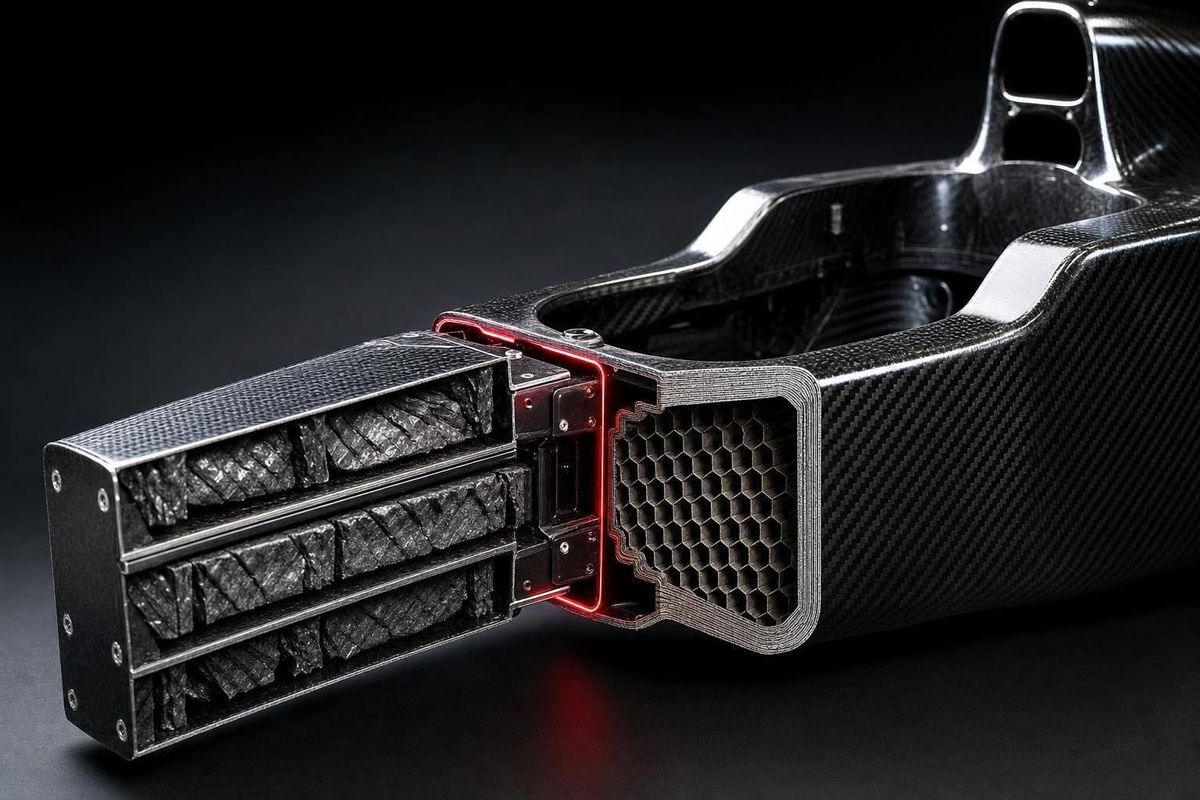
F1 cars protect drivers by using carbon fiber in two ways: a hard survival cell that must stay whole, and crushable crash parts that break in a controlled way. That mix gives teams low weight, high stiffness, and crash protection in one package.
If you want the short version, here it is:
- CFRP is the main structural material in modern F1 cars
- The monocoque protects the driver and is built to keep the cockpit space intact
- Front, side, and rear crash structures are made to crush and absorb impact energy
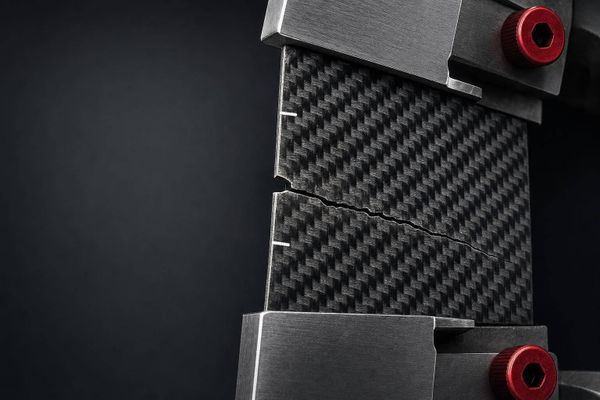
- Fiber direction matters because engineers place plies at angles like 0°, +45°, and -45° to handle different loads
- Honeycomb cores and cockpit liners help add stiffness and protect the driver area
- FIA crash tests check both impact behavior and static strength before a car can race
- Big crashes have shown the system works, including Robert Kubica’s 75g crash in June 2007
- Damage checks after impacts matter because carbon fiber can look fine on the outside while inner layers are damaged
One recent example shows how strict the rules are. In February 2026, Ferrari’s SF-26 needed more than one rear crash structure revision before FIA approval. That tells me one thing: in F1, speed does not come first if the crash test is not right.
At a simple level, this article explains how carbon fiber is built, where it protects the driver, how it fails on purpose in some areas, and how the FIA checks all of it before a car reaches the grid.
Formula One Crash Safety: Monocoque - (Grand Prix Insights)
sbb-itb-7c68254
How Carbon Fiber Gives F1 Cars High Strength at Low Weight
The key isn’t carbon fiber by itself. It’s the way teams angle it, stack it, and cure it.
Material Properties That Engineers Rely On
The monocoque has to take huge loads, so teams don’t just make it thick from end to end. They build it from layers that are strong in set directions. That’s where carbon fiber stands out: it offers high stiffness and strength without much weight, and engineers can line up the fibers with the forces the part will face.
To do that, engineers stack plies at 0°, +45°, and −45°. This helps balance bending stiffness while keeping flex in check under aerodynamic loads. This direction-based behavior, known as directional behavior (anisotropy), lets teams shape each part around its exact role. Engineers also verify load limits so parts stay safe under extreme aero and rotational loads.
That level of control comes from the layup process as much as the material itself.
Monocoque Construction, Honeycomb Cores, and Protective Layers
An F1 monocoque starts with resin-impregnated carbon-fiber sheets, called prepreg, that are hand-laid into precision molds. Each ply has to go in the right place at the right angle. Even small alignment errors can shift load paths. Continuous fibers help keep strength and stiffness through the structure.
Many structural panels use sandwich construction with a honeycomb core. Think of it like getting more rigidity without paying much of a weight penalty. Around the cockpit, teams add fire-resistant Nomex lining for cockpit protection. This setup helps the survival cell stay rigid while nearby layers absorb impact energy.
Those choices are what allow the survival cell to do its job.
The Survival Cell and the Crash Structures Around It
Once the survival cell is set, the next layer is the part built to give way for it.
The Carbon Fiber Survival Cell as the Driver's Safety Capsule
The monocoque is the rigid carbon-fiber shell at the center of the car. It holds the driver, fuel cell, and the main mounting points. Its role is blunt and non-negotiable: stay intact and keep the driver's survival space protected. Everything outside that shell is there to take the hit first.
Survival cells are built to withstand peak impact loads of up to 75g while keeping the cockpit intact. That is the standard FIA survival-cell rules are meant to verify.
Around that capsule, the rest of the outer structure is made to soak up crash energy before it gets anywhere near the driver.
Front, Side, and Rear Structures Built to Crush
The nose, side-impact structures, and rear crash structure are all sacrificial CFRP parts. They are designed to crush in stages and delaminate in a controlled way, bleeding off kinetic energy before it reaches the cockpit.
That isn't just theory on paper. In February 2026, Scuderia Ferrari's SF-26 had to go through several rear crash structure redesigns before the FIA signed off on it. The team, led by aerodynamics chief Diego Tondi, had to make sure an "exhaust wing" concept still met the required rear-impact energy-absorption rules.
Where the Halo and Roll Structures Fit In
The Halo and the roll hoop both rely completely on the monocoque's stiffness and strength at their mounting points. If those points bend too much or fail, neither part can do its job.
The Halo is there to stop tires, wheels, and debris from hitting the driver's helmet. The roll hoop is built to deal with rollover loads, but it also depends on the monocoque for support.
FIA crash tests are the last check that shows the survival cell and the crush structures work together the way they should.
How FIA Crash Tests Confirm Carbon Fiber Safety
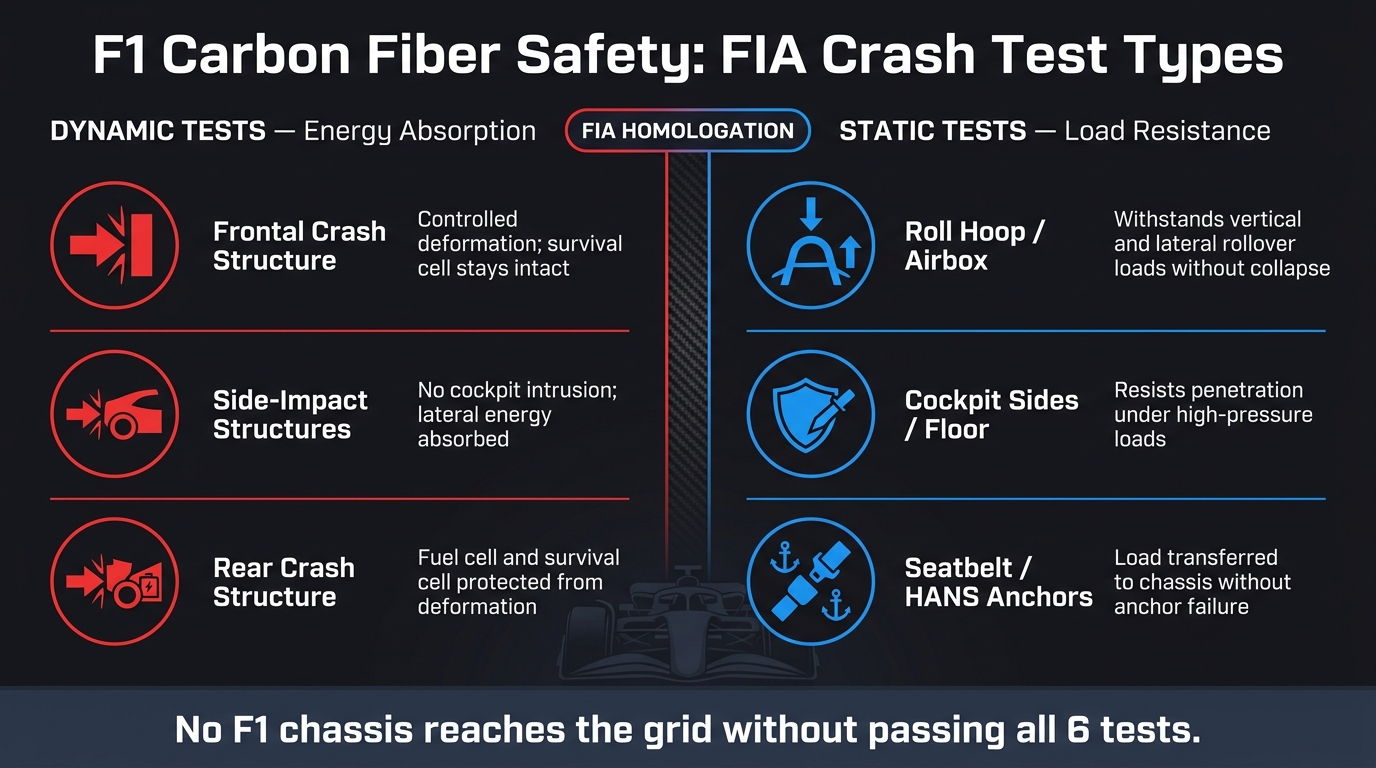
F1 Carbon Fiber Safety: FIA Crash Test Types Explained
FIA homologation proves carbon-fiber safety before a car is allowed to race. Once the survival cell and crash structures are set, FIA testing checks that they hold up under load. This approval process is the benchmark. No chassis gets through without passing a defined group of crash and load tests.
The tests fall into two buckets: dynamic tests, which simulate impact, and static tests, which apply sustained force to check stiffness and penetration resistance.
Dynamic Tests for Front, Side, and Rear Impacts
Dynamic tests are about controlled failure. The goal isn't to keep every part untouched. It's to let the impact structures crush in the right way while the survival cell stays intact.
In a frontal test, the crash structure has to absorb energy and crumple in a controlled sequence. The survival cell behind it can't show structural failure. Side-impact structures are tested to dissipate lateral energy and, just as important, stop intrusion into the cockpit. At the rear, the crash structure must protect both the fuel cell and the survival cell from deformation.
Put simply: dynamic tests show energy absorption; static tests show the chassis can still carry load without failing.
Static Load Tests for the Chassis and Safety Attachments
Static tests check whether key carbon parts can take sustained, high-magnitude loads without buckling or cracking. The roll hoop must support the car's full vertical load, which mirrors a rollover case. The cockpit sides and floor are tested for penetration resistance. If an outside object presses hard against the carbon shell, it must not break through. Seatbelt and HANS anchors are also loaded to confirm they stay attached during impact.
These tests matter for another reason too. They can expose hidden damage after a crash. Carbon fiber can look fine on the surface while the structure underneath has been weakened.
| Test Type | Structure Tested | Pass Criteria |
|---|---|---|
| Dynamic | Frontal crash structure | Controlled deformation; survival cell stays intact |
| Dynamic | Side-impact structures | No cockpit intrusion; lateral energy absorbed |
| Dynamic | Rear crash structure | Fuel cell and survival cell protected from deformation |
| Static | Roll hoop / airbox | Withstands vertical and lateral rollover loads without collapse |
| Static | Cockpit sides / floor | Resists penetration under high-pressure loads |
| Static | Seatbelt / HANS anchors | Load transferred to chassis without anchor failure |
Passing homologation means the chassis has met the FIA's standard for crash performance and post-impact inspection.
Crash Performance, Damage Inspection, and the Limits of Carbon Fiber
Crash tests show what should happen. Real accidents show what does happen on track.
What Major F1 Crashes Reveal About Carbon Fiber Safety
Big crashes are where the survival cell and sacrificial structures face their hardest test. Robert Kubica's June 2007 crash at the Canadian Grand Prix is a clear case. His BMW Sauber hit an airborne crash that peaked at 75g, and the crash structures failed in a controlled way, absorbing energy before it reached the cockpit while the survival cell stayed intact.
That’s the point of the design. The car is built so some parts give way first, taking the hit instead of passing all that force straight to the driver.
But carbon fiber doesn’t protect the driver on its own. It works only when the chassis, driver gear, and track response all do their jobs together.
How Teams Inspect and Repair Carbon Fiber After an Impact
After a heavy impact, the focus changes fast. It’s no longer just about whether the driver walked away. It’s about what the crash may have done to the car beneath the surface.
Teams use telemetry and post-crash data review to spot hidden damage before the car returns to service. The main problem isn’t just visible cracking. It’s internal damage that can rule out a part even when the outside still looks fine.
That’s what makes carbon fiber tricky after a crash. The surface can seem okay, while deeper layers have already taken a hit.
Why Carbon Fiber Remains the Standard in F1
Carbon fiber remains the standard because it brings together low weight, stiffness, and controlled crash failure. Its downside is brittle breakage and specialized repair work.
That tradeoff is why F1 still uses it.
FAQs
Why is carbon fiber better than metal in F1 cars?
Carbon fiber beats metal in Formula One for one simple reason: it delivers high strength without adding much weight. In a sport where every pound matters, that trade-off is huge. It helps the car stay light, react faster, and cope with the massive aerodynamic forces pushing down on it at speed.
It matters just as much for safety. Carbon fiber lets teams build a rigid monocoque, or survival cell, that can stay intact in high-speed crashes while absorbing impact energy better than older metal options.
How do engineers decide where carbon fiber should stay rigid or crush?
Engineers use finite element analysis to model how parts behave under load and to make sure they meet FIA safety and structural rules.
For stiffness, they line up high-modulus unidirectional carbon fibers with the main load paths. They also use closed-section shapes or honeycomb cores to keep parts from flexing more than they should.
Areas built to absorb energy are meant to deform in a controlled way. Teams then verify that behavior through crash testing. In test-point areas, titanium or aluminum inserts add reinforcement to stop unwanted localized crushing.
Can an F1 car be reused after a carbon-fiber crash?
Yes - if the carbon-fiber monocoque is still structurally sound.
F1 cars are built with sacrificial crash structures that are meant to break apart in a crash. That damage isn't a flaw. It's how the car absorbs energy and helps protect the driver.
If the monocoque stays intact, the car can often be repaired and used again after safety inspections and replacement of damaged parts to meet FIA standards.