Career Points Progression: Hamilton vs. Schumacher
A data-led comparison of Hamilton and Schumacher career points, adjusted for scoring systems, race calendars and peak-season dominance.
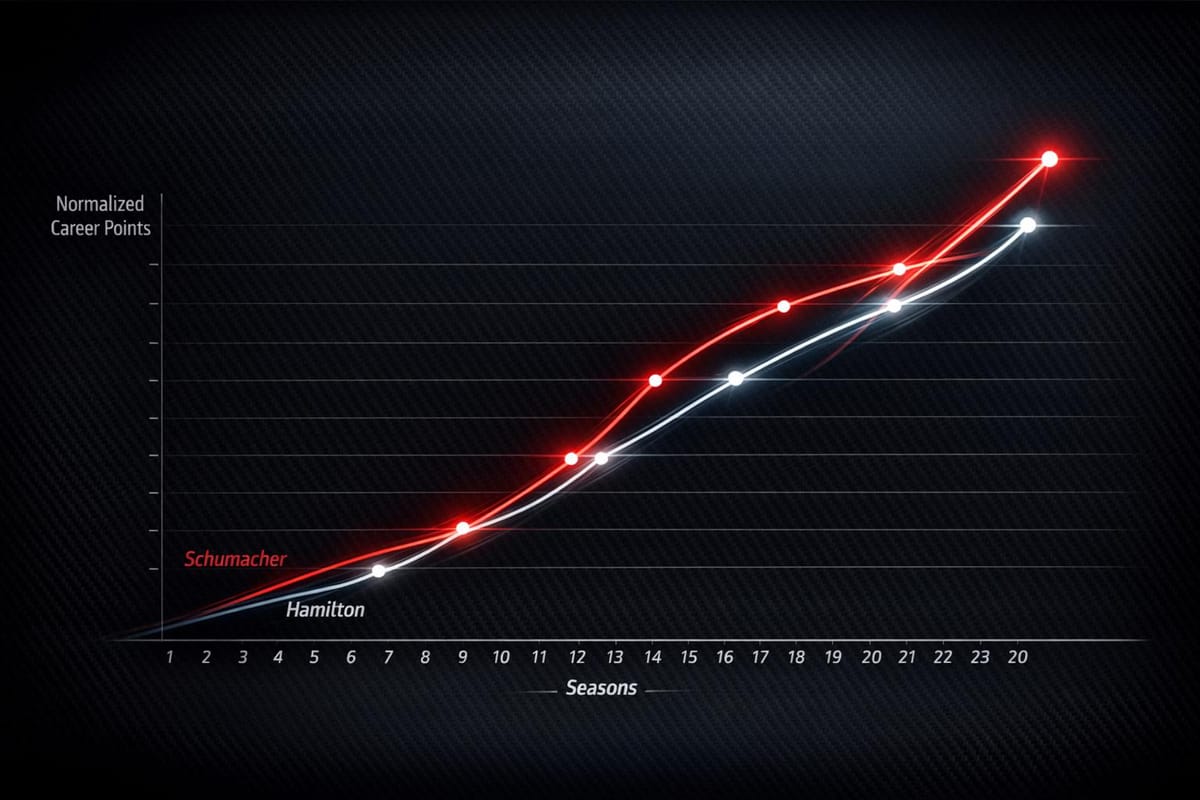
Lewis Hamilton and Michael Schumacher are two of Formula 1's most legendary drivers, each with seven world championships. Their career points totals - Hamilton's 5,355.5 from 380 races and Schumacher's 3,890 from 306 - highlight their dominance and consistency. However, comparing their achievements requires considering differences in scoring systems, race calendars, and eras.
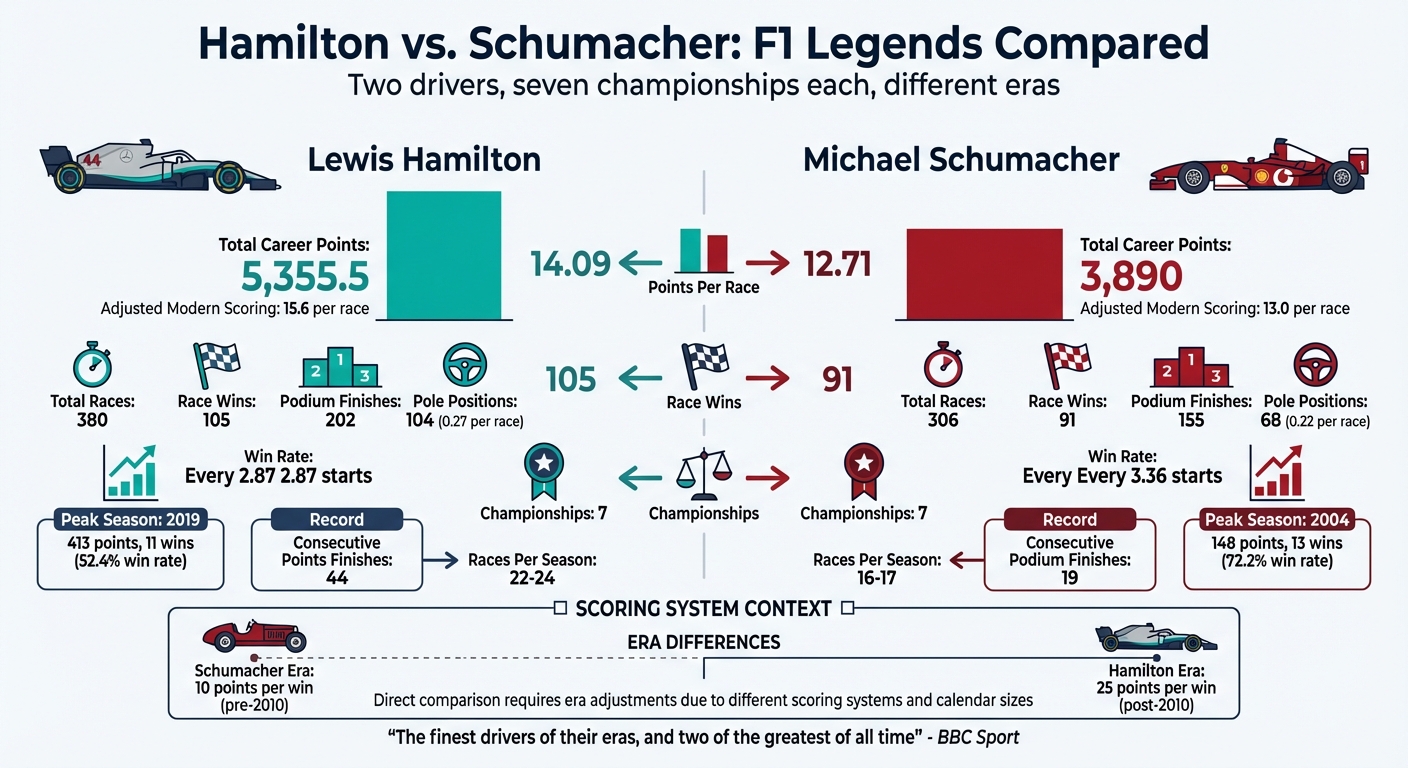
- Hamilton averages 14.09 points per race, compared to Schumacher's 12.71. But Schumacher raced when wins earned just 10 points, while Hamilton's era awards 25.
- Adjusting for modern scoring, Hamilton's average rises to 15.6, and Schumacher's to 13.0.
- Schumacher's prime years (2000–2004) showcased dominance, including a 72.2% win rate in 2004. Hamilton's peak during the turbo-hybrid era (2014–2020) saw him secure six titles in seven seasons.
- Hamilton has competed in more races due to expanded calendars (22–24 per year vs. Schumacher's 16–17), giving him more opportunities to accumulate points.
- Schumacher excelled in an era of unlimited testing and refueling strategies, while Hamilton thrives in a data-driven, tire-focused era.
Both drivers redefined F1 in their time, excelling under different conditions and leaving unmatched legacies.
Hamilton vs Schumacher F1 Career Statistics Comparison
Career Points Totals: Hamilton vs. Schumacher
Hamilton's Career Points
Lewis Hamilton has accumulated 5,355.5 points in 380 races as of early 2025, averaging 14.09 points per race [[3]](https://www.formula1points.com/head-to-head/career/Michael Schumacher/Lewis Hamilton). A significant portion of these points came during his time with Mercedes, where the team's dominant performance and an updated scoring system worked in his favor. His record of 105 race wins and 202 podium finishes highlights his ability to consistently finish at the top, creating a stark contrast with Michael Schumacher's achievements, which came under different rules and circumstances [[3]](https://www.formula1points.com/head-to-head/career/Michael Schumacher/Lewis Hamilton).
Schumacher's Career Points
Michael Schumacher ended his career with 3,890 points across 306 Grand Prix starts, averaging 12.71 points per race [[3]](https://www.formula1points.com/head-to-head/career/Michael Schumacher/Lewis Hamilton). This lower average reflects the scoring system of his era, where points for victories were fewer. Most of Schumacher's points came during his legendary stint with Ferrari (1996–2006), a period that included his five consecutive championship wins from 2000 to 2004. During much of his career, a race win earned only 10 points, compared to the 25 points awarded today. Despite this, his 91 wins and 155 podiums underscore his dominance, even if direct numerical comparisons with Hamilton are complicated by the differing systems.
How Points System Changes Affect Comparisons
To truly compare their careers, it's essential to account for changes in the scoring system. Before 2010, only the top six or eight finishers earned points, with a maximum of 10 points for a win [[3]](https://www.formula1points.com/head-to-head/career/Michael Schumacher/Lewis Hamilton). The 2010 overhaul expanded the system to reward the top ten finishers and increased the winner's share to 25 points [[3]](https://www.formula1points.com/head-to-head/career/Michael Schumacher/Lewis Hamilton).
When adjusted for these changes, the gap between Hamilton and Schumacher narrows. Using the 1991 scoring system, Hamilton's 5,355.5 points translate to about 5.3 points per race, while Schumacher's 3,890 points equate to 4.4 points per race. Under modern scoring, the averages shift to 15.6 for Hamilton and 13 for Schumacher, offering a more balanced comparison.
"This figure is due to a different points system that Schumacher's results have adhered to. Back then, only 10 points for a race victory were awarded in comparison to the present time's 25 points."
– Geetansh Pasricha, Sportskeeda
Additional factors, such as points for fastest laps and Sprint races, have further enhanced Hamilton's totals [[3]](https://www.formula1points.com/head-to-head/career/Michael Schumacher/Lewis Hamilton). For example, Schumacher's 77 fastest laps would have earned him 77 extra points under today's rules, but this bonus wasn't available during most of his career [[3]](https://www.formula1points.com/head-to-head/career/Michael Schumacher/Lewis Hamilton).
A closer look at their points accumulation over time sheds even more light on these nuanced comparisons.
Points Progression Over Time
Hamilton's Points Progression
Lewis Hamilton stepped into Formula 1 in 2007 with McLaren, making an immediate impact and claiming his first championship just a year later in 2008 [[4]](https://www.formula1points.com/driver/Lewis Hamilton 05). Impressively, he managed to win at least one race every single season for 14 consecutive years, showcasing a remarkable ability to consistently rack up points right from the start.
His performance hit another level during the turbo-hybrid era (2014–2020). During this dominant period, Hamilton secured six championships in seven years with Mercedes, reaching his highest single-season points total of 407 [[3]](https://www.formula1points.com/head-to-head/career/Michael Schumacher/Lewis Hamilton). On top of that, he holds the record for 260 consecutive race starts from his debut and an unmatched streak of 44 consecutive points finishes.
Schumacher's career, however, followed a very different pattern.
Schumacher's Points Progression
Michael Schumacher began his Formula 1 journey in 1991 with Jordan before moving to Benetton, where he clinched back-to-back championships in 1994 and 1995. His career points progression was more of a gradual climb, peaking during his Ferrari dominance (2000–2004), before tapering off significantly during his return with Mercedes from 2010 to 2012, where his scoring rate dipped.
During his prime Ferrari years, Schumacher showcased extraordinary consistency, achieving a perfect podium record in 2002 by finishing in the top three in all 17 races. He also managed an incredible streak of 19 consecutive podium finishes spanning the 2001 and 2002 seasons.
This career arc, with its peaks and valleys, stands in stark contrast to Hamilton's steady upward trajectory.
Comparing Points Accumulation Rates
When comparing their points accumulation rates, Hamilton averages 14.09 points per race, while Schumacher averages 12.71, though these figures are influenced by changes in the points system over time [[3]](https://www.formula1points.com/head-to-head/career/Michael Schumacher/Lewis Hamilton). By the time Hamilton had completed 308 races, he had amassed 4,381.5 points, while Schumacher's total at the same point in his career stood at 1,566 points. This disparity reflects not only the shift in the points system post-2010 but also the increase in the number of races per season, with Hamilton's era featuring 22–24 races compared to Schumacher's era of 16–17 races [[4]](https://www.formula1points.com/driver/Lewis Hamilton 05).
Hamilton's dominance in qualifying also played a key role in his consistent points haul. He has secured 104 pole positions (0.27 per race) compared to Schumacher's 68 (0.22 per race) [[3]](https://www.formula1points.com/head-to-head/career/Michael Schumacher/Lewis Hamilton). However, Schumacher often relied on his racecraft to climb through the field, particularly during the refueling era, where starting positions like 2nd or 3rd were often converted into victories. Hamilton, on the other hand, has leaned on exceptional tire management and sustained race pace to maintain his edge.
Andrew Shovlin, Mercedes' Trackside Engineering Director, summed up their approaches:
"When Michael arrived at our team, the thing that stood out with him was the way he would always go after marginal gains, and it didn't matter if it was 0.01s... Those are two characteristics that Lewis very much has."
Ultimately, Hamilton's and Schumacher's points accumulation rates reflect not only their individual strengths but also the changing nature of Formula 1, from calendar expansions to evolving race strategies. These differences provide a fascinating backdrop for examining their peak seasons.
Peak Seasons and Performance Streaks
Hamilton's Peak: 2019 Season
Lewis Hamilton's 2019 season is often viewed as one of the defining chapters of his career. Across a 21-race calendar, he racked up an impressive 413 points and clinched 11 victories - winning more than half the races that year. Interestingly, he only started from pole position five times, yet he managed to convert those limited opportunities into a dominant season by capitalizing on his rivals' mistakes. As Andrew Benson, BBC Sport's Chief F1 Writer, aptly described:
"Lewis Hamilton ended 2019 with a dominant victory in the Abu Dhabi Grand Prix, a fitting end to possibly the most impressive season of his career."
Hamilton's consistency was a key factor. He finished 20 of the 21 races and outqualified his teammate Valtteri Bottas in 14 of the 21 sessions. He also bested Bottas in 13 of the 19 races where direct comparisons could be made. While the Mercedes W10 gave him a slight edge in qualifying - averaging 0.116 seconds faster than Ferrari - Hamilton's mental strength and ability to perform under pressure were what truly set him apart. This season showcased how Hamilton could dominate even when traditional strengths, like pole positions, were less of a factor.
Schumacher's Peak: 2004 Season
Michael Schumacher's 2004 campaign is often held up as the gold standard for dominance in Formula 1. Out of 18 races, he won 13, including an astonishing 12 victories in the first 13 races, achieving a jaw-dropping 72.2% win rate. By mid-August, at the Belgian Grand Prix, he had already secured his seventh world championship. He also matched Nigel Mansell's 1992 record by winning the first five races of the season.
This dominance was the result of multiple factors coming together: Ferrari's technical excellence, flawless strategy execution, and Schumacher's unparalleled ability to extract the best from the car. The team's partnership with a specialized tire supplier further enhanced performance. Ferrari's precision in pit stops and strategy, combined with Schumacher's mastery of the refueling era, allowed them to secure victories even when he didn’t start from pole. His 2004 season stands as a testament to how a team and driver can work in perfect harmony to dominate a championship.
Comparing Their Best Seasons
These standout seasons from Hamilton and Schumacher not only highlight their individual brilliance but also reflect the shifting dynamics of Formula 1, from the refueling era to modern strategies focused on tire management and race pace.
| Metric | Michael Schumacher (2004) | Lewis Hamilton (2019) |
|---|---|---|
| Total Races | 18 | 21 |
| Race Wins | 13 | 11 |
| Win Rate | 72.2% | 52.4% |
| Podium Finishes | 15 | 17 |
| Points Total | 148 | 413 |
| Pole Positions | 8 | 5 |
| Fastest Laps | 10 | 6 |
Schumacher's higher win rate and his ability to consistently convert pole positions into victories highlight the strategic advantages of the refueling era. On the other hand, Hamilton's mastery of tire management and his ability to sustain race pace over longer stints underline the demands of modern Formula 1. Both drivers demonstrated that peak performance is about more than just raw speed - it's about seizing every opportunity throughout a season.
Era Adjustments and Context
Adjusting for Points System Differences
Comparing Lewis Hamilton and Michael Schumacher becomes tricky when you factor in Formula 1's evolving scoring systems. Schumacher spent most of his career under a system where wins earned 10 points, while Hamilton has primarily raced under the 25-points-per-win system that started in 2010. Naturally, this inflates Hamilton's raw career totals - Hamilton's 5,355.5 points far exceed Schumacher's 3,890 [[3]](https://www.formula1points.com/head-to-head/career/Michael Schumacher/Lewis Hamilton).
To level the playing field, their careers have been recalculated using the 2021 scoring system (25-18-15-12-10-8-6-4-2-1). Under this system, Schumacher would have accumulated 3,967 points (averaging 13.0 per race), while Hamilton would have 4,172 points (15.6 per race). Hamilton still edges ahead in points-per-race metrics, but the gap is far smaller than the raw totals suggest. These adjustments provide a clearer framework for understanding their achievements, particularly when considering differences in race calendars and technological advancements.
Impact of Race Calendar Expansion
The Formula 1 calendar has expanded significantly over the years, giving modern drivers more chances to rack up points and break records. During Schumacher's prime, seasons typically had 16–17 races, while Hamilton's era regularly features 22–24 races per year. Despite both competing for 19 seasons, Hamilton has participated in 380 Grands Prix, compared to Schumacher's 306 [[14]](https://www.formula1points.com/head-to-head/career/Lewis Hamilton/Michael Schumacher)[[13]](https://www.formula1points.com/head-to-head/career/michael schumacher/lewis hamilton).
This difference in race opportunities allowed Hamilton to reach the 300-race milestone much faster than Schumacher. By the time Hamilton had completed 308 races, he had amassed 4,381.5 points, while Schumacher had only 1,566 points at the same stage. This disparity reflects not only the scoring system changes but also the increased number of races in a season. These extra opportunities, combined with advancements in technology, highlight how their respective eras shaped their careers.
Technology and Competition Factors
Technological and regulatory shifts have further influenced how these two legends built their legacies. Schumacher's era allowed unlimited testing, enabling him to log an astonishing 89,533 kilometers - equivalent to circling the globe twice - between 2000 and 2006. In contrast, Hamilton's career has unfolded under strict testing regulations, forcing drivers to lean heavily on simulators and data analysis.
Hamilton also navigates the challenges of high-degradation Pirelli tires and races without refueling, emphasizing tire and fuel management. During Schumacher's era, from 2003 to 2006, cars qualified with race fuel loads, reducing the strategic importance of pole position compared to today.
Team dynamics add another layer of complexity. Schumacher often enjoyed a clear "No. 1" status within his team, with teammates like Rubens Barrichello explicitly supporting him as "No. 2". Hamilton, however, has faced fierce competition from teammates who were world champions in their own right - Fernando Alonso, Jenson Button, and Nico Rosberg - without formal team hierarchies. These differences in team strategies and technological landscapes make direct statistical comparisons difficult, as each driver's success reflects the distinct challenges of their era.
Lewis Hamilton vs Michael Schumacher | Who is the greatest F1 driver?
Conclusion
Looking at the career points progression of Lewis Hamilton and Michael Schumacher offers a fascinating glimpse into the achievements of two drivers who defined Formula 1 in their respective eras. Both clinched seven World Drivers' Championships, and their career arcs reflect a striking level of similarity in terms of dominance and success.
However, these raw numbers need to be understood within the context of evolving points systems and race calendars. Hamilton's 5,355.5 career points surpass Schumacher's 3,890 [[3]](https://www.formula1points.com/head-to-head/career/Michael Schumacher/Lewis Hamilton), but this difference stems largely from changes in scoring systems and an expanded race schedule rather than a direct comparison of on-track performance. For example, in their first 308 races, Hamilton amassed 4,381.5 points compared to Schumacher's 1,566, a disparity influenced by the shift from 10 points per win to 25. Hamilton also averages 14.09 points per Grand Prix, slightly higher than Schumacher's 12.71 [[3]](https://www.formula1points.com/head-to-head/career/Michael Schumacher/Lewis Hamilton). Their win rates remain close, though: Schumacher claimed victory every 3.36 starts, while Hamilton wins roughly every 2.87 starts.
"The stats have one clear, obvious message - these were the finest drivers of their eras, and two of the greatest of all time." - Andrew Benson, Chief F1 Writer, BBC Sport
Consistency is another hallmark of their greatness. Both drivers set records that highlight their sustained performances over time. Hamilton holds the record for the most consecutive points finishes at 44, while Schumacher achieved an unparalleled 19 consecutive podiums between 2001 and 2002. Remarkably, each driver also won at least one race in 15 different seasons. Together, they account for approximately 17.2% of all Grand Prix victories in Formula 1 history, a staggering testament to their enduring excellence across decades of competition.
The differences in their eras only enhance their legacies. Schumacher's success was built around a team-focused approach that transformed Ferrari into a juggernaut, while Hamilton's era has showcased his exceptional qualifying skills and the reliability of modern hybrid cars. Each driver mastered the unique challenges of their time, setting standards that continue to define greatness in Formula 1.
FAQs
What’s the best way to compare points across different F1 scoring eras?
To evaluate greatness in motorsport, it's important to look beyond just raw points. Scoring systems have evolved over the years, so adjusting for era-specific rules is key. Metrics like points per race, wins, podiums, and overall dominance should be analyzed within the context of their time. Comparing performances across different scoring systems helps create a fairer picture, especially when considering factors like advancements in technology and the level of competition during each driver's career.
How much have longer seasons boosted Hamilton’s career points total?
Longer seasons have played a key role in boosting Lewis Hamilton's career points total, giving him more chances to accumulate points. With a career total of around 5,341.5 points, Hamilton has far surpassed Michael Schumacher’s 3,890 points. This difference is partly due to the number of races each competed in annually. Schumacher raced in shorter seasons, which naturally limited his opportunities to score, while Hamilton has benefited from the expanded race calendars of modern Formula 1. This shift underscores how extended seasons have reshaped the landscape of F1 records.
Which era changes most affected Schumacher vs. Hamilton: testing, refueling, or tires?
The most defining shifts in the eras of Schumacher and Hamilton revolved around tire regulations and refueling policies. Schumacher competed in a period where in-race refueling was permitted, heavily influencing race strategies and car setups. In contrast, Hamilton's career unfolded after the 2010 ban on refueling, placing greater emphasis on tire management throughout races. Additionally, tire rules saw major changes between their eras. Schumacher's time focused more on outright speed, while Hamilton's era introduced stricter controls, demanding a balance between strategy and consistency for success.