Deep Learning For F1 Pit Stop Support
Deep learning supports F1 pit-wall calls by forecasting tire life, pit windows, and rival-response—fast numerical guidance, not a replacement.
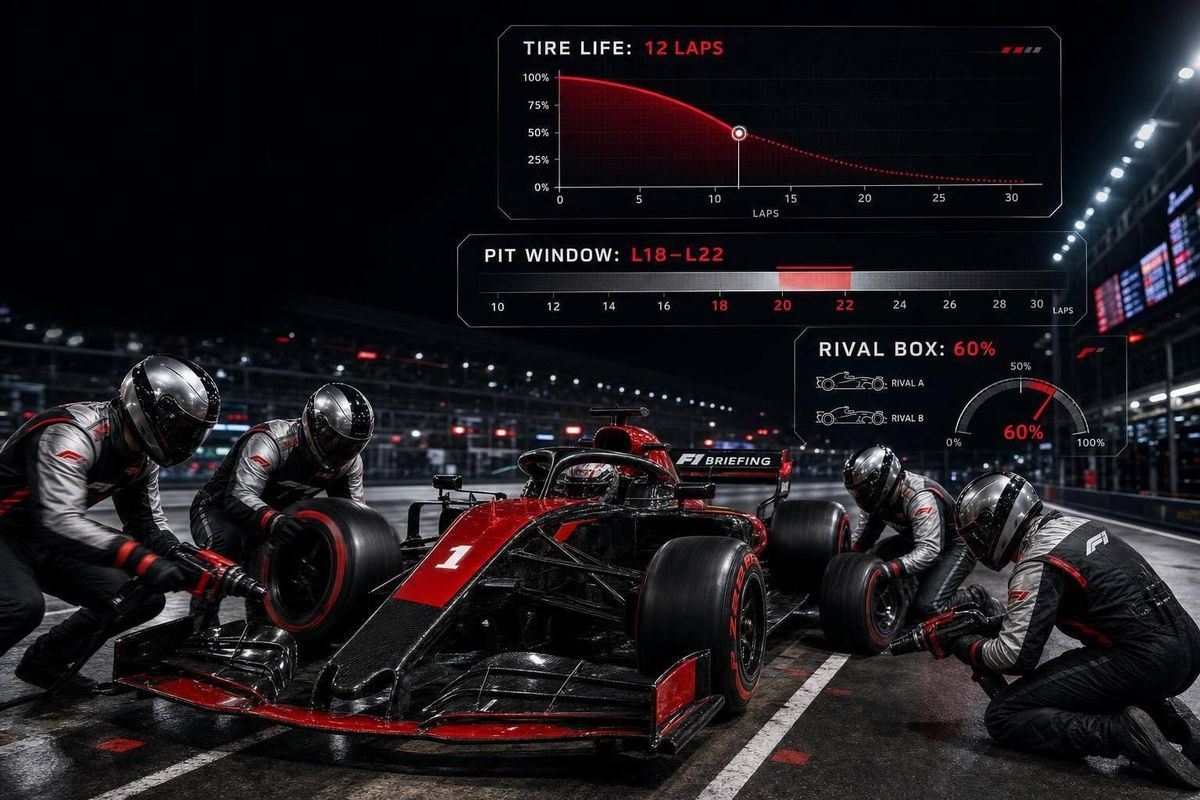
In F1, a pit call can swing a race by 1+ second or more, and deep learning helps teams judge that risk lap by lap. I’d sum it up like this: the model does forecasting, not final decision-making. It estimates tire life, pace drop-off, pit window timing, rejoin chances, and undercut or overcut outcomes so the pit wall can act with more context.
Here’s the short version:
- I see deep learning as a support tool, not a replacement for the race engineer.
- It works best when teams need fast forecasts from live telemetry, lap times, gaps, tire age, and race-control data.
- The main job is to predict things like remaining tire life, next 5–10 laps of pace, and the best lap range to pit.
- This matters because tire wear can vary from 0.03 to 0.20 seconds per lap, and a sharp drop can add 0.7 to 1.5 seconds in one lap.
- A safety car or VSC can cut pit-lane time loss by 30% to 60%, which can flip the right call in seconds.
- Even a small forecast miss - like 0.05 seconds per lap over 20 laps - can cost about 1 second overall.
- The strongest use cases are stint planning, one-stop vs. two-stop checks, and rival-response calls like cover, undercut, and overcut.
- The weak spots are rule changes, new tire behavior, weather shifts, and rare race events like red flags and safety cars.
- On race day, the output has to be short and clear: what to do now, what it may gain or lose, and how sure the model is.
A simple way to look at it: I’d use deep learning to answer, “If we pit now, next lap, or stay out, what’s the likely time cost and position outcome?” That’s the core of the article.
| Focus area | What the model tries to answer |
|---|---|
| Tire life | How many laps are left before pace falls too far? |
| Pace forecast | What will lap time look like over the next few laps? |
| Pit window | Which lap range gives the lowest total race time? |
| Rejoin position | Will the car come out ahead or behind traffic? |
| Rival move | Should the team cover, delay, undercut, or overcut? |
Bottom line: deep learning gives the pit wall a fast read on likely outcomes, but humans still weigh driver feedback, weather, traffic, and race context before making the call.
Data Inputs And Training Targets
What Data Feeds A Pit Stop Model
Pit stop support models turn race signals into strategy forecasts. In plain English, they take what’s happening on track and estimate what a team should do next.
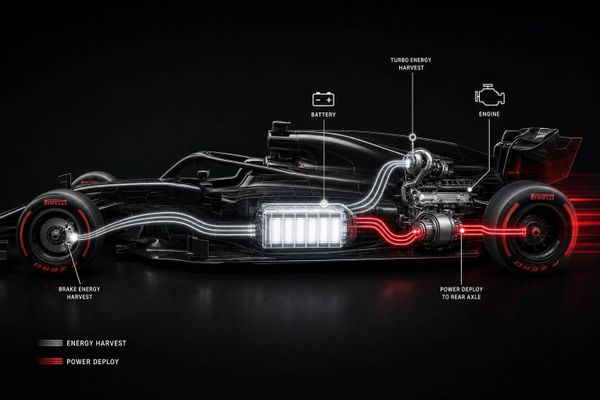
A pit stop model pulls from two main sources: public timing data and internal telemetry. Public feeds include lap times, sector splits, gaps to the cars ahead and behind, stint lengths, pit stop times, and safety car or VSC flags. Teams also monitor tire carcass and surface temperatures, brake and brake-disc temperatures, fuel consumption and fuel load estimates, throttle and brake traces, steering angle, and hybrid energy deployment and recovery - all at sub-lap frequency.
That level of detail matters. It lets the model follow how conditions change within a stint, not just from one lap to the next. For outside projects, public timing data is the practical place to start. The more detailed sensor streams are still proprietary.
One recent open-source project trained models for lap-time prediction, tire degradation, pit-stop duration, and undercut success using telemetry, lap data, and race-control messages from 71 Grands Prix between 2023 and 2025, all pulled from public APIs like FastF1 and OpenF1. Another project used roughly 50,000 lap records across 22 Grands Prix, with 25 input features that covered race state, tire info, competitor gaps, and engineered signals like UndercutRisk and DegradationRate.
Those signals then become the training set for the targets below.
How Teams Define Training Labels
Label choice shapes what the model learns. The same race data can be used for three different jobs: predicting a team’s own stop, estimating tire performance, or judging the result of a strategy decision.
Behavior labels use the actual pit lap as the target. That helps the model learn when teams tended to stop in the past, which makes it handy for estimating what a rival may do next.
Performance labels try to remove the human choice and focus on the car and tire behavior instead. That can mean degradation rate in seconds per lap, remaining tire life in laps, or a predicted lap-time curve for the rest of the stint.
Outcome labels work at the top level. They look at the result of a call: total race-time impact, finishing-position delta, or whether an undercut worked.
A single dataset can support all three label types.
Remaining tire life is the number of laps before lap time crosses a threshold above the adjusted stint baseline. Degradation rate is the pace loss per lap after correcting for fuel burn and track evolution. Undercut success can be labeled in two ways: a binary result for position gained, and a time-delta result for gap change.
The next step is turning those labels into live pit-wall forecasts.
Core Pit-Stop Predictions
On the pit wall, the most useful outputs are narrow, direct, and tied to numbers. The table below sums up the main targets a pit stop support model is built to produce.
| Prediction Target | What It Answers | How It's Expressed |
|---|---|---|
| Remaining tire life | How many laps left on this set? | Laps until performance threshold is crossed |
| Lap-time degradation curve | How will pace change over the next 5–10 laps? | Predicted lap times with uncertainty bands |
| Optimal pit window | Which lap range minimizes total race time? | Lap range [L_min, L_max] |
| Probability of rejoining ahead | Will we come out in front after stopping? | Probability score (0–1) |
| Strategy time delta | What does each strategy branch cost or gain? | Seconds vs. reference strategy |
These outputs feed tire-life forecasts, pit-window timing, and rival-response models.
sbb-itb-7c68254
How Deep Learning Supports Tire-Life Forecasts, Pit Windows, And Rival Response
Tire-Life Forecasts And Stint-Length Decisions
These outputs only start to matter when the model turns them into lap-by-lap forecasts.
Sequence models take lap-by-lap inputs and estimate how tire performance is likely to shift over the next few laps. They look at tire compound, tire age, a fuel-load proxy, track temperature, traffic, and driver pace to build a predicted pace curve. That curve gives strategists a clearer view of when degradation is likely to hit the point where stretching the stint no longer pays off.
That’s where the trade-off becomes clear. If the model forecasts a 0.8-second-per-lap pace loss across the next five laps on the current set, the strategist can stack that up against the roughly 20–30 seconds lost in the pit lane by stopping now. Clean air can hide some of the pain from tire wear for a while, but the model still shows when staying out stops helping and starts burning race time.
Research on state-space tire degradation models points to another key detail: tire degradation is not linear. Early in a stint, the rate can even start negative as the tires come up to temperature and fuel burns off. Then it begins to climb, and later the drop-off gets much sharper.
Once the model has a read on tire life, those same signals can also sort the best lap to stop.
Pit Window Prediction And Race-Time Optimization
The model scores each candidate lap by its expected race-time cost. It factors in pit-lane loss, out-lap warm-up loss, tire age, and the traffic situation at rejoin. Then it ranks those laps and returns three things:
- the best lap to pit now
- an acceptable pit window
- how much the call could shift if conditions change
This feeds straight into one-stop vs. two-stop simulations. Frameworks such as the Virtual Strategy Engineer split the job into two parts: first, they generate all feasible compound combinations, like soft–medium–hard. Then they optimize stint lengths for each one to cut total race time.
Deep learning helps with that second part by supplying lap-time and degradation forecasts. In plain English, it turns strategy comparison from a paper exercise into something teams can use while the race is moving.
The same setup can also test what happens when a rival blinks first.
Rival-Response Scenarios: Undercut, Overcut, And Covering A Stop
When a rival pits, the model can check cover, delay, and stay-out scenarios. For each option, it projects both cars’ lap times over the next several laps - the rival on fresh tires and the team’s car on older rubber - and estimates the chance of gaining or losing track position.
For an undercut, it asks whether pitting one lap earlier creates enough fresh-tire speed to jump the rival before they leave the pit lane. For an overcut, it estimates whether staying out with track position and cleaner air can make up for the pace hit from older tires. The cover decision is more subtle: does matching the rival’s stop protect position, or does it throw away flexibility for later in the race?
Tools like the AutoF1 simulator use neural networks along with analytic equations for tire degradation and pit durations to build these rival-response scenarios. The end result is a ranked set of options with probability scores, so the pit wall isn’t picking blind - it’s choosing from a short list with the numbers already laid out.
How AWS machine learning supports Scuderia Ferrari HP pit stops | Amazon Web Services
Model Types, Strengths, And Limits In Real Race Conditions
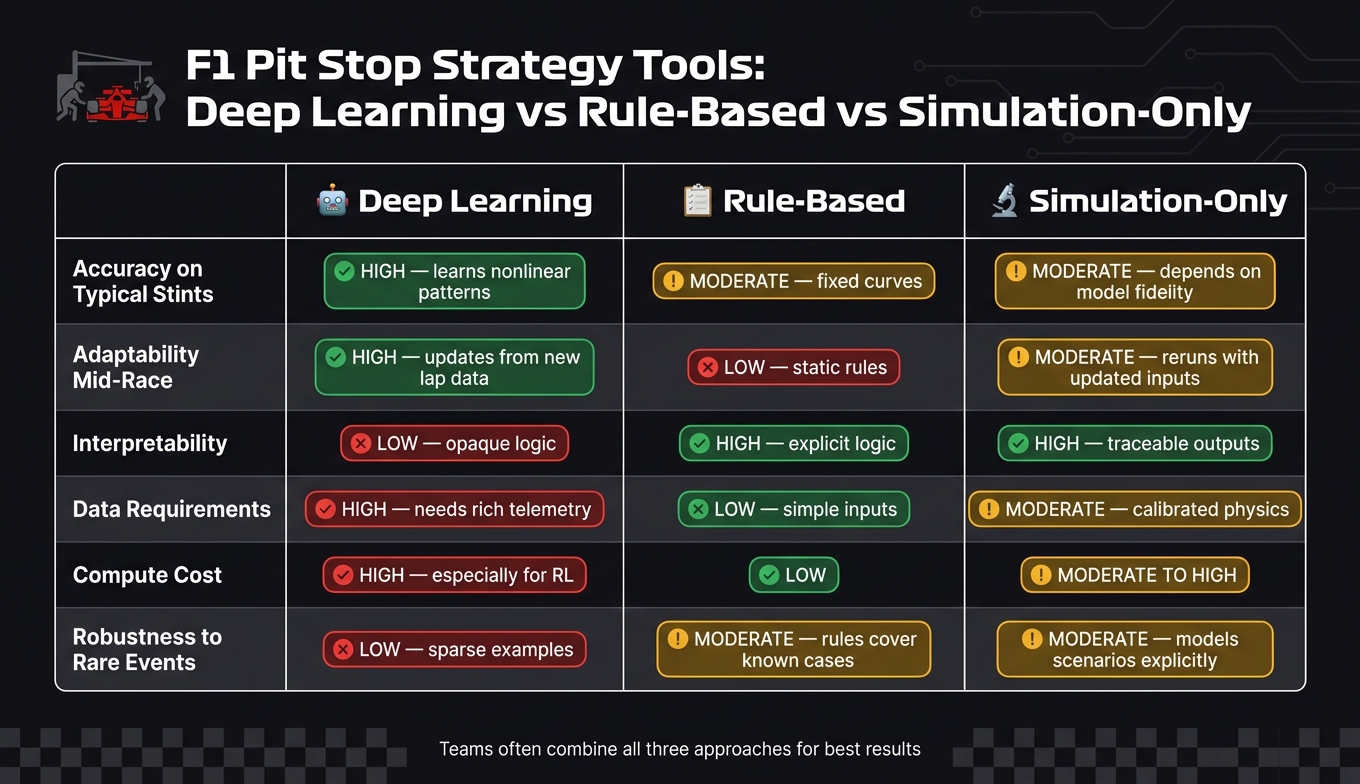
Deep Learning vs Rule-Based vs Simulation: F1 Pit Stop Strategy Tools Compared
Which Model Architectures Match Which Tasks
Not every pit-stop problem needs the same kind of model. Some jobs are about forecasting a sequence of laps. Others are a simple yes-or-no call. And some are about picking a full race policy.
LSTMs and GRUs are a strong fit for lap-by-lap forecasting. If the goal is to predict pit timing, Bi-LSTMs are especially useful because they read context across the full stint, not just one lap at a time.
Temporal convolutional networks (TCNs) make sense when time is tight. Since they process sequences in parallel, they can run fast enough for live use on the pit wall. In a public F1 strategy models repository, a TCN with Monte Carlo dropout produced P10/P50/P90 quantile outputs for pit-window detection. That matters because strategists don't just want one answer. They want a range: the early case, the middle case, and the late case.
For the binary call to pit or stay out, small feed-forward networks can do the job well when the inputs are already boiled down into structured features. The Virtual Strategy Engineer concept splits this into two models: one network decides whether to pit, and the second picks the tire compound.
Reinforcement learning fits race-policy selection. These agents train in simulators across thousands of races, then learn patterns like when to undercut, when to overcut, and when to cover a rival's stop. One Deep Recurrent Q-Network setup used LSTM-based state processing with inputs such as tire degradation, gaps to rivals, and race progress.
So the choice comes down to a simple trade-off: accuracy, speed, or ease of explanation. You usually can't max out all three at once.
Where Deep Learning Performs Well
Once the model type is chosen, the next step is figuring out where it helps most.
Deep learning tends to do best when the inputs and outcomes are nonlinear and change with race state. Tire degradation is the clearest example. Sequence models can learn those interactions from telemetry, then update the forecast after every lap. In practice, that means the model keeps recalculating remaining tire life as new pace data arrives.
Pair that with a simulator, and the system can score thousands of strategy paths fast enough for live pit-wall use.
Where It Breaks Down: Data Drift, Rare Events, And Trust
This is where things get messy. A model may look sharp in testing, then lose its edge when the race no longer looks like the data it learned from.
Big regulation changes can do that fast. The move to ground-effect cars in 2022 changed pace, tire use, and overtaking enough that older models needed retraining or recalibration. New tire constructions can shift warm-up behavior and operating temperature windows. Mid-season aero updates can also change tire wear in ways the model hasn't seen before.
Rare events are even tougher. Safety cars, red flags, and sudden weather shifts don't show up as often in training data. So a model trained mostly on green-flag laps can struggle after an interruption, especially when tire state resets. That's why teams often use hybrid systems. Simulation or rule-based logic handles the odds and impact of interruptions, while deep learning focuses on continuous pace and tire evolution once the race settles.
Here’s the usual trade-off pattern:
| Dimension | Deep Learning | Rule-Based | Simulation-Only |
|---|---|---|---|
| Accuracy on typical stints | High - learns nonlinear patterns | Moderate - fixed curves | Moderate - depends on model fidelity |
| Adaptability mid-race | High - updates from new lap data | Low - static rules | Moderate - reruns with updated inputs |
| Interpretability | Low - opaque logic | High - explicit logic | High - traceable outputs |
| Data requirements | High - needs rich telemetry | Low - simple inputs | Moderate - calibrated physics |
| Compute cost | High - especially for RL | Low | Moderate to high |
| Robustness to rare events | Low - sparse examples | Moderate - rules cover known cases | Moderate - models scenarios explicitly |
On the pit wall, none of this can come out as a wall of numbers. The tool has to turn model output into short, ranked recommendations a strategist can scan in seconds: projected finish, tire-life margin, and time gained or lost.
Conclusion: What Deep Learning Can Realistically Do On The Pit Wall
Deep learning fits F1 strategy best as a fast, data-led support tool, not as a stand-in for the strategist on the pit wall. It can keep tire-life estimates up to date, tighten the pit window, and put numbers around undercut, overcut, and cover moves by simulating current gaps, out-lap deltas, and traffic patterns. In plain English, teams can test tire-life, pit-window, and rival-response scenarios in seconds. That kind of speed matters most when the race shifts lap by lap.
A neural network can warn the team that stretching a stint is getting risky, or that a rival’s stop could swing the position fight. But it still can’t fully weigh weather, driver feedback, or championship context. Those calls still sit with the race engineer and strategist.
The big limit isn’t raw prediction speed. It’s whether the live race still looks enough like the data the model learned from. If telemetry is noisy, labels are unclear, or conditions drift from the training set, even a strong network can start to lose reliability. That’s why teams need backtesting and live calibration checks instead of assuming a model that worked last weekend will act the same way this weekend. Deep learning is the co-pilot. The strategist still makes the call.
FAQs
How accurate can a pit-stop model be live?
Live pit-stop models can be highly accurate because they keep updating in real time with telemetry, GPS, tire wear, and fuel-use data. In testing, deep learning models such as Bi-LSTM and RNNs reached 0.77 precision and 0.86 recall when predicting the best time to pit.
That said, they’re not perfect. Teams treat these systems as decision-support tools, not automatic decision-makers. Engineers still check each prediction against what’s happening on track, what the driver is feeling, and surprise events like safety cars.
What data does the model need most?
The model needs high-frequency, synchronized real-time telemetry plus race context to make good calls.
The biggest inputs are tire signals: thermal degradation, pressure, and energy use. Those factors shape pace from lap to lap and help pinpoint the ideal crossover to fresh tires.
It also leans on GPS timing for gaps, track position, and traffic windows. On top of that, it uses fuel-load estimates, engine performance, weather telemetry, and historical track data to project pit windows and respond to rivals in real time.
Why can’t deep learning make the final pit call?
Deep learning can forecast pit windows by reading telemetry such as tire wear, gap shifts, and fuel use. It gives teams a strong read on when a stop may make sense.
But it can't see everything that happens in a live race.
There are still messy, hard-to-predict moments where people have to step in. A model can't fully account for a sudden driver error, an unexpected safety car, or weather that changes over one part of the track but not another. In those situations, engineers make the final call.