Formula One as Television: Global Fan Exchange
How live F1 feeds, graphics, commentary and scheduling shape what fans abroad see, debate, and believe.
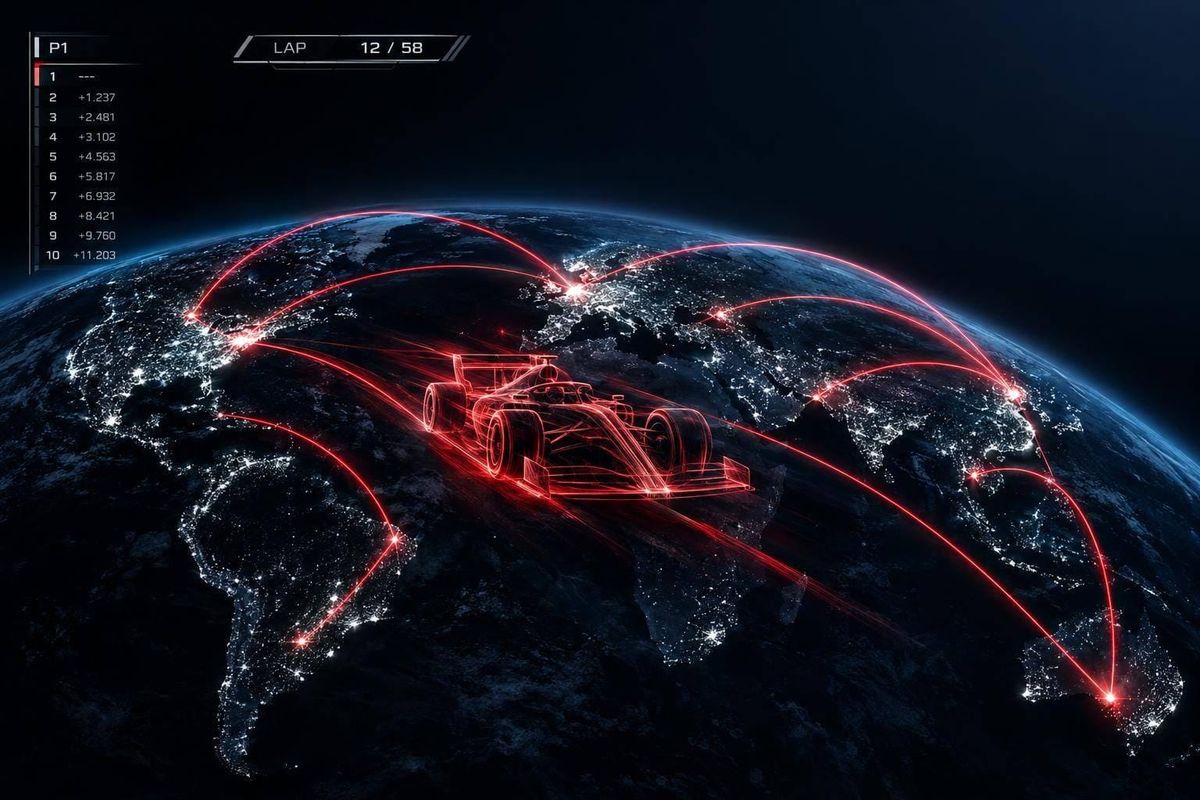
F1 fans watch the same race feed, but they don’t always get the same story. I look at how graphics, selected team radio, local commentary, and race times shape what you know - and what you debate with fans abroad.
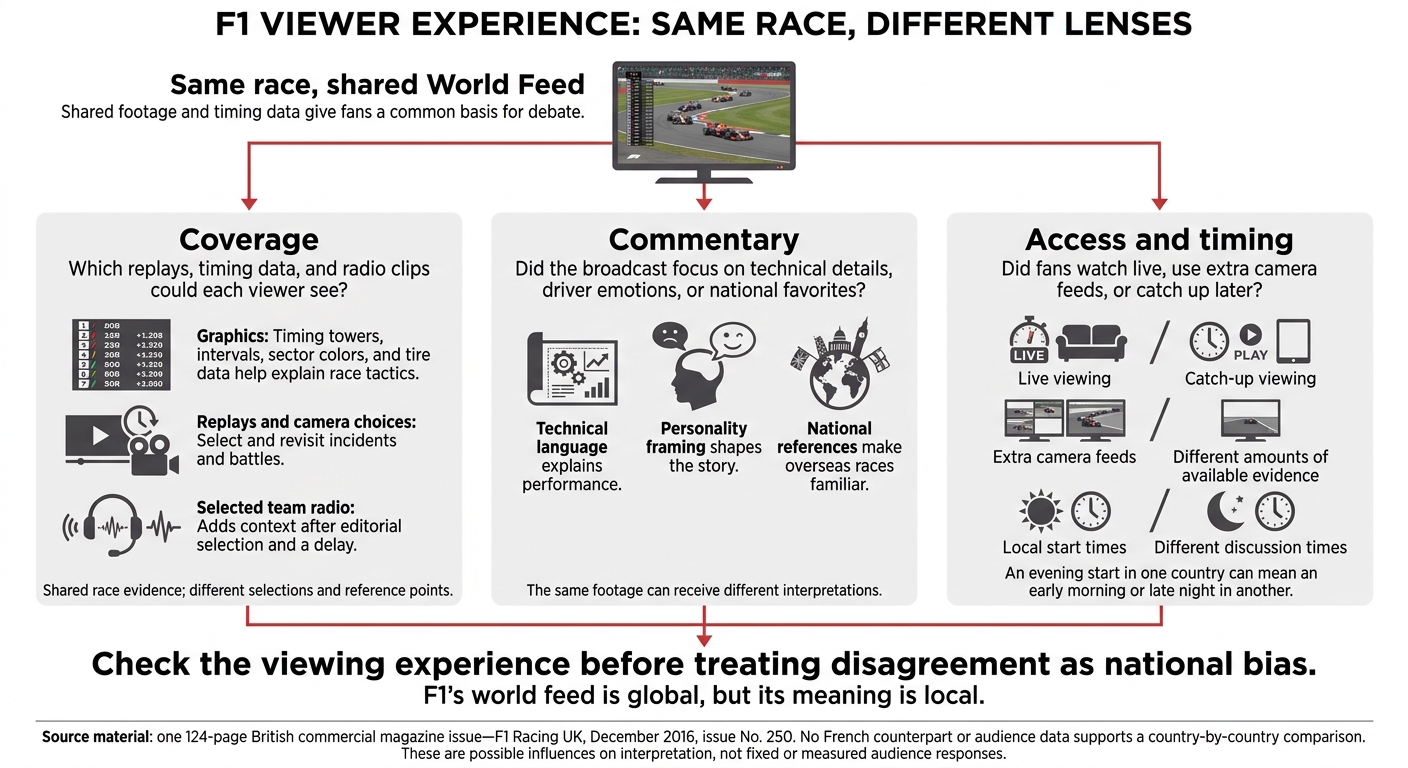
Before comparing reactions, I’d check three things:
- Coverage: Which replays, timing data, and radio clips could each viewer see?
- Commentary: Did the broadcast focus on technical details, driver emotions, or national favorites?
- Access and timing: Did fans watch live, use extra camera feeds, or catch up later?
The research has limits: it draws on one 124-page British magazine issue from December 2016, with no French counterpart or audience data to support a country-by-country comparison. My takeaway: <u>check the viewing experience before treating disagreement as national bias.</u>
F1 Broadcasts: Same Race, Different Viewing Experiences
Broadcast Formats and Shared Race Knowledge
How Graphics, Replays, and Radio Explain Races
The World Feed gives fans the same race image. Graphics help them read it. Timing towers, intervals, sector colors, and tire data turn scattered action into a clear race map - and give fans across countries a shared language for debate. Formation-lap graphics show the grid and weather, while safety-car updates explain pit-stop options. Predictive graphics translate telemetry into simple cues about race tactics.
To judge a pit stop, read the gap alongside the tire data available at that moment. An undercut works only if new tires provide enough pace to move ahead when the rival pits. Replays show the result, not the information available live.
Onboard footage and slow-motion replays let viewers examine overtakes and incidents, but they don't settle blame. Selected team radio adds context about team decisions, though viewers hear clips only after editorial selection and a delay. Camera choices determine which battle becomes the story and which moments fans discuss across countries. Podium coverage provides the broadcast’s closing ritual.
Shared Race Footage and Local Coverage
Broadcast choices shape discussion across borders. Viewers can debate the same footage differently depending on what their broadcaster emphasizes. The effects below are possible interpretations, not fixed audience responses.
| Feature | Broadcast function | Likely cross-border effect | Possible local variation |
|---|---|---|---|
| Use of footage and replays | Selects and revisits moments for analysis | Steers debate toward different aspects of the same incident | Local analysis may focus on different incidents or assign blame differently |
| Timing and predictive graphics | Shows gaps and estimates tactical options | Gives viewers shared terms for discussing pit stops | Analysts may question predictions or focus on different drivers |
| Selected team radio | Links technical problems with driver reactions | Shapes shared impressions of drivers under pressure | Translation and censorship may change tone or meaning |
| Local commentary and studio analysis | Explains decisions and reviews outcomes | Encourages different readings of the same footage | Technical focus, national references, and attention to drivers can differ |
| Broadcaster-specific access | Gives some viewers more reference points than others | Leaves viewers with different amounts of evidence for debate | Availability and prominence vary by platform and country |
When comparing reactions across countries, check which coverage each viewer received. Disagreement may reflect differences in access or editorial focus, rather than national loyalties alone. Local commentary adds a national lens to the shared picture.
sbb-itb-7c68254
Commentary and National Identity
Technical Talk, Emotion, and National References
National commentary can change what a race means to viewers, even when they watch the same feed.
In F1 Racing UK, “Inside Tech” segments explain aerodynamics and mechanics, including vortices, wakes, and wheelnuts, while coverage of the 2016 Hamilton–Rosberg title fight emphasizes the psychology of competition.
Technical language explains performance; personality framing shapes the story. The first gives fans shared terms for discussing the race. The second guides how they interpret it. Commentary does more than explain what happened - it offers a way to understand it.
Features such as “Jolyon’s Japan” and “Ricciardo Road Trip” in Austin use familiar driver personalities to make overseas events domestically legible.
These features bring overseas races closer to a home audience, but they do not, by themselves, prove national bias. Fans can also value F1’s rituals while supporting national drivers or teams.
The British coverage presents a friendlier format, a simpler rulebook, unpredictability, and the TV spectacle as values linked to fan attachment.
The material comes from just one British source in late 2016. It cannot establish how common these preferences are, and the lack of another national source limits comparison.
French and British Media Research
The supplied material does not support a French–British comparison. F1 Racing UK (December 2016, issue No. 250) is a 124-page commercial magazine, not a peer-reviewed study. It provides one British snapshot, with no French study, sample, or research period to compare against it.
| Dimension | British source | French limit |
|---|---|---|
| Technical detail | Aerodynamics and mechanical components | No French sample to assess relative depth |
| Emotional framing | Driver psychology in the 2016 Hamilton–Rosberg title fight | No matched French evidence |
| National framing | Driver-led references connecting overseas races with familiar personalities | No comparable French sample |
| Research limits | One commercial magazine issue from late 2016 | Without a French counterpart, the comparison remains one-sided. |
Scheduling, Time Zones, and Access
Race Start Times and Commercial Goals
Formula One schedules races to reach more TV viewers and fit how people watch today. Calendar changes and weekend format tweaks support that goal.
Night races such as Abu Dhabi align start times with peak viewing hours in key markets.
Start times help determine who watches live and who catches up later. They also set the pace of fan discussion. A packed calendar means fans need to jump back into the conversation more often.
Live Races, Replays, and Fan Discussion
Race times serve a global audience. An evening start in one country can mean an early morning or late night in another. Fans share the same sport and build shared meaning around it, even when they watch and discuss it at different times.
Conclusion: One Sport, Different Viewing Experiences
Research Findings and Limits
Broadcast format, commentary style, and scheduling point to the same pattern: F1’s world feed is global, but its meaning is local. The sources are limited, so the conclusions are narrow. Editorial commentary and official race records show how television presents F1 - not how all fans respond.
What Television Means for Global Fan Exchange
Shared footage and timing data give fans a common basis for debate. But commentary and scheduling still shape how each audience reads the race. National loyalties can sit alongside a broader F1 identity: fans exchange views using shared race evidence, while differences in language, interpretation, time zones, and access remain.
The Art of F1 Commentary with James Hinchcliffe: Live From Las Vegas
FAQs
How can I spot bias in F1 commentary?
Pay attention to how coverage frames the race. When commentary focuses on personality clashes, body language, or provocative quotes instead of technical details, it may put drama ahead of objective racing analysis.
Check the narrative against the data: telemetry, tire wear statistics, and live sector splits. Changes in pace and pit windows can help you judge whether a broadcast’s account of a driver’s performance or an incident matches what the race data shows [3].
How can I assess strategy without hindsight bias?
Focus on live data available at the time of a decision, not the story told after the race. Track tire degradation, sector splits, pit windows, and pace changes to understand why teams make strategy calls as the race unfolds.
Judge each call by what was known at that moment - not just how it turned out. That lets you assess the decision for yourself without letting the final result skew your view.
What evidence would reveal national differences among F1 fans?
Regional broadcasters shape how F1 fans view race stories and rivalries, revealing differences among fans across countries.
U.S. coverage often leans into heroes-versus-villains drama. European and UK coverage more often tells season-long stories rooted in the sport’s history, sometimes favoring homegrown drivers. Asia-Pacific coverage tends to focus on respectful competition, technical strategy, and professionalism rather than personal conflict.
These approaches influence how fans see drivers and teams, helping shape fan identities tied to their regions.