10 drivers with strongest wet-race record
Top 10 F1 wet-weather drivers ranked by teammate gaps, podiums, recovery drives and crossover timing.
Rain changes everything in F1, and this list says Ayrton Senna still stands at the top. I’d sum this ranking up like this: Senna, Schumacher, Hamilton, and Verstappen lead the pack, while Button, Alonso, Prost, Villeneuve, Clark, and Hülkenberg round out a top 10 built on wet-race results, teammate gaps, points rate, podium rate, and comeback drives.
If you want the short version, here it is:
- No. 1: Ayrton Senna
- No. 2: Michael Schumacher
- No. 3: Lewis Hamilton
- No. 4: Max Verstappen
- No. 5: Jenson Button
- No. 6: Fernando Alonso
- No. 7: Alain Prost
- No. 8: Gilles Villeneuve
- No. 9: Jim Clark
- No. 10: Nico Hülkenberg
This list is not just about wet-race wins. I’m looking at repeat results in mixed or soaked conditions, how drivers stack up against teammates, how often they still score or reach the podium, and how well they handle the wet-to-dry tire switch. That matters because one bad call can drop a driver from the lead to the edge of the top 10 in a lap.
A few points stand out fast:
- Senna is first because his wet pace and control kept showing up again and again.
- Schumacher sits close behind on long-term output across Benetton and Ferrari.
- Hamilton and Verstappen are the top modern names for calm pace, recovery, and low-grip speed.
- Button and Alonso earn their spots with tire timing and clean race reads.
- Hülkenberg makes the list more for sharp crossover calls than for raw front-running speed.
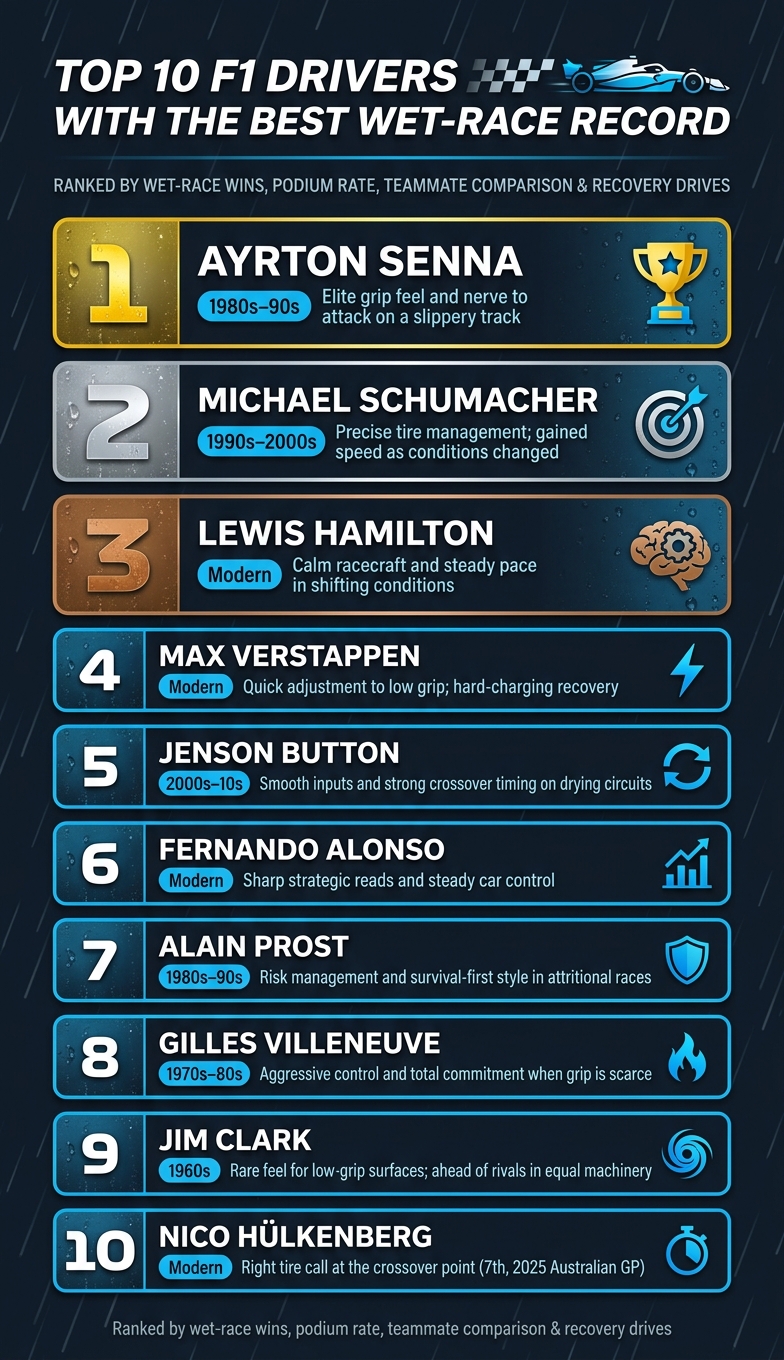
Top 10 F1 Drivers with the Best Wet-Race Record
Top 10 Wet Weather Drives In F1
sbb-itb-7c68254
Quick Comparison
| Driver | Main wet-race strength |
|---|---|
| Ayrton Senna | Grip feel and attack in low traction |
| Michael Schumacher | Control, tire timing, and strong gaps to teammates |
| Lewis Hamilton | Calm pace in changing conditions |
| Max Verstappen | Fast response when grip drops |
| Jenson Button | Patience and tire-switch timing |
| Fernando Alonso | Smart race reads and steady execution |
| Alain Prost | Clean, low-risk wet running |
| Gilles Villeneuve | Commitment on the limit |
| Jim Clark | Smooth control on slick surfaces |
| Nico Hülkenberg | Sharp calls at the crossover point |
Put simply, I’d read this ranking as a list of the drivers who made rain work for them, not just drivers who survived it.
Why Wet Weather Is So Hard to Master in Formula 1
Wet races in Formula 1 are hard because everything changes at once. Grip drops, visibility falls apart, and strategy can flip in a lap. The dry racing line, which works so well in normal conditions, often turns greasy once rain hits because it's covered in laid-down rubber. So drivers have to move off-line to find traction, while braking points and turn-in markers keep shifting corner by corner. That's why strong wet-weather results usually come down to repeatable execution, not just raw pace.
Aquaplaning is one of the biggest dangers. When standing water builds up, the tires can't push it away fast enough. The car then hydroplanes and loses contact with the track. When that happens, braking, steering, and throttle inputs stop working the way a driver expects until the tires cut back through the water.
Then there's visibility, which can be just as bad as the lack of grip. The spray from cars ahead can form a wall of water, leaving following drivers close to blind. George Russell put it bluntly at the 2025 Australian Grand Prix, calling it "Survival". The race backed that up: four of six rookies crashed or spun before the checkered flag. In conditions like that, picking the right tire at the right time matters just as much as car control.
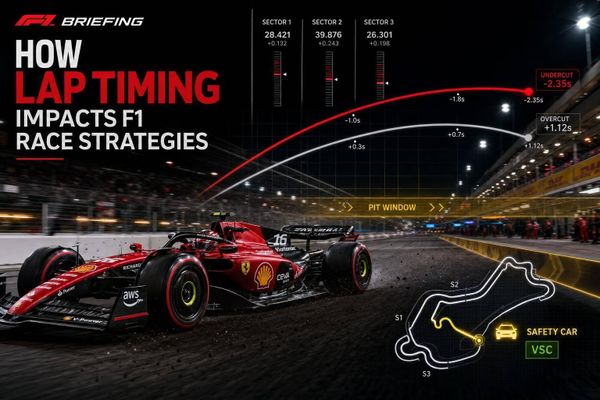
Teams also have to nail the switch between full wets, intermediates, and slicks as the track changes. Get it wrong, and the race can unravel fast. Stay on slicks a lap too long in heavy rain, and the car can become almost undriveable. At the 2025 Australian Grand Prix, Ferrari left Lewis Hamilton and Charles Leclerc on slick tires during a heavy shower. Both then had to pit under a late Safety Car, and they fell to 8th and 10th. Sauber went the other way. Nico Hülkenberg switched to intermediates at just the right moment and finished 7th, scoring more points than the team managed in the entire 2024 season.
That tiny window between the right call and the wrong one is often where wet races are decided. In Formula 1, rain doesn't just test speed. It tests judgment under pressure.
1. Ayrton Senna
Ayrton Senna stands apart because he turned those conditions into an edge. He tops this list because his wet-race record blends wins, steady podium finishes, and recovery drives that kept races alive when things could've easily fallen apart.
His car control in low-grip conditions was on another level. Senna had a rare feel for the track when it was slick, patchy, or fully soaked, and he paired that feel with sharp decision-making in the moment. When the weather shifted and the surface got tricky, he wasn't just good - he became a threat in a way few drivers ever did.
2. Michael Schumacher
If Senna seemed to own the rain through instinct, Schumacher owned it through precision. The Regenmeister tag fit him well because he kept turning wet races into an opening, often running faster than most of the field when the track got messy.
One of the clearest patterns showed up in his gaps to teammates. At Benetton and Ferrari, Schumacher regularly out-qualified and out-raced the driver in the other car on damp or drying tracks. That matters for a simple reason: it showed he wasn’t just making the most of a good car. He was doing more with the same machinery when the rain arrived.
The strongest example came at the 1996 Spanish Grand Prix. Schumacher timed the tire switch just right and kept finding pace as the circuit dried.
What set him apart was the mix of car control and judgment as grip changed lap by lap. He knew when to push, when to hold back, and how to stretch a lead while the track kept shifting under everyone else.
And it wasn’t just a few standout afternoons. Schumacher’s wet-weather record carries extra weight because it lasted for years, across two title-winning eras: Benetton in the early 1990s and Ferrari in the 2000s. That run of form across both periods is a big part of why he still sits near the top of wet-race rankings.
3. Lewis Hamilton
Like Schumacher, Hamilton blends precision with patience. But the thing that stands out most is how calm he stays when the weather shifts. When rain starts falling, he usually doesn't panic, overpush, or get dragged into mistakes. He keeps the pace steady, and that often turns messy races into chances to move forward.
His teammate record in changing conditions is strong, and that matters. It shows his wet-weather speed isn't a one-off or tied to one race. It's something he brings again and again. At the 2022 Singapore Grand Prix, Hamilton read the changing track well and stayed in a strong top-four spot during the wet phase, while George Russell's early move to slicks left him with nothing to show for it.
What sets Hamilton apart from most drivers isn't just raw speed in the wet. It's that his pace can still look good even when the team misses the crossover point. At the 2025 Australian Grand Prix, Hamilton was leading as late as Lap 46 before Ferrari left him on slick tires as heavy rain arrived. That call dropped him to 10th, two places behind teammate Charles Leclerc. The speed was there. The strategy wasn't.
4. Max Verstappen
Where Hamilton often looks calm and controlled, Verstappen brings that same control with a harder edge. In the wet, one thing stands out: he adjusts to low-grip conditions fast. When the track gets messy, he usually finds speed and track position before much of the field does.
Starting 3rd in intermittent rain with three Safety Cars, Verstappen fought back when the late downpour arrived and pushed Norris all the way to the flag. You can see that same pace in his head-to-head results too. In Melbourne, Liam Lawson crashed out while Verstappen finished 2nd. His clearest setback came at the 2022 Singapore Grand Prix, where Perez won and Verstappen came home 7th after a lock-up.
That balance - aggression without going too far - is a big part of why he’s still so dangerous in wet races. When rain opens the door for overtakes, Verstappen usually spots it early and acts on it fast.
5. Jenson Button
Button lands here because he was so good in the wet for a simple reason: he stayed patient when other drivers lost their heads.
He had a sharp feel for changing grip, and he used that feel to turn messy, mixed conditions into track position while others made expensive mistakes. The most chaotic laps in a wet race often come at the crossover point, when the track is changing and drivers have to judge when to switch. Button was calm in those moments. He stayed out of trouble, picked the right time to move, and that shows up in his podium rate and the points he scored when rivals read the track the wrong way.
While more aggressive drivers sometimes pushed too hard, too soon, Button kept his composure. Then he made the tire switch at the right moment and worked his way forward, step by step.
That approach made him one of the most dependable wet-weather drivers of his era. Alonso - the next driver on this list - shares that trait too, even if he showed it in a different style.
6. Fernando Alonso
Alonso shares Button’s patience, but he uses it with sharper judgment when conditions get messy. His wet-weather record is better than a simple win-rate stat makes it look. Rain may have cut into his win percentage, but his value shows up elsewhere: points, podiums, and recovery drives.
That matters even more when the car isn’t near the front on pace. In a car that scored only 51 points across the full season, Alonso still pulled out top-level results. In 2025, he beat Lance Stroll in 82% of races and in every qualifying session.
You see that same skill when the track is changing lap by lap. Alonso’s edge in wet races often comes from reading the crossover point before other drivers do. Fuji in 2007 showed how small the gap can be: Alonso got the out-lap wrong after pitting, and the race swung away from him.
7. Alain Prost
The Professor was the perfect nickname for the way Prost handled wet races. He didn’t attack every lap at the edge. He read the track, noticed grip shifts early, and kept the car just short of the limit. When conditions changed, that calm approach often helped him move forward while others slipped up.
That style did more for his points and finish rate than for his win count. He ranks No. 7 because his discipline, tire judgment, and clean execution made him one of the most steady drivers in mixed conditions. When rain scrambled the order, Prost was often the one who turned chaos into points - even if it didn’t always turn into the big, headline-grabbing win.
His measured way of driving also makes a sharp contrast with Gilles Villeneuve's more aggressive wet-race approach.
8. Gilles Villeneuve
Gilles Villeneuve earned his place in wet-race history with sheer commitment and a rare feel for the edge of grip when the track turned slick. While other drivers eased off as conditions shifted, he stayed committed, held his line, and found speed where most couldn’t in mixed or fully wet races.
His reputation in the rain comes down to two things: commitment and control. That’s the split between a driver who simply survives bad weather and one who can still attack when the circuit feels like ice.
9. Jim Clark
Jim Clark belongs on this list for one simple reason: when grip faded, he still looked in control.
He had a rare feel for low-grip surfaces, which made him one of the steadiest drivers of his era when conditions started to shift. Once the rain came, Clark didn’t wrestle with the car. He adjusted early, stayed smooth with his inputs, kept the tires alive, and settled into a rhythm that many of his rivals just couldn’t find.
You can see that in his podium rate across wet and damp races. He regularly finished ahead of teammates and rivals in equivalent machinery, which says a lot. This wasn’t luck. It was repeatable pace when the track got slick and the margin for error shrank.
His recovery drives also had their own style. They weren’t flashy or packed with wild overtakes. Instead, they came from clean laps, calm decisions, and steady speed. While others slipped backward, Clark kept inching forward. Against teammates, he held a clear edge in the kind of conditions where feel counted for more than outright speed.
That mix of feel and calm racecraft leads neatly to Nico Hülkenberg, whose wet-race value has often come from timing and survival.
10. Nico Hülkenberg
Hülkenberg ranks here because of what he does in wet races, not because of outright pace. When points-per-race swings on the crossover call, he tends to make the right read.
His best wet-weather showing came at the 2025 Australian Grand Prix. Hülkenberg nailed the move from slicks to intermediates right at the crossover point, finished seventh, and scored 6 points - more than Sauber managed in the whole 2024 season. He also held off a final-lap attack from Oscar Piastri and came home ahead of Charles Leclerc and Lewis Hamilton, while teammate Gabriel Bortoleto crashed out in the wet.
That’s where his edge shows. He stays calm, reads the grip level fast, and makes tire calls that can turn a messy race into a points finish. So when a wet race becomes a test of timing more than pure speed, Hülkenberg tends to look strong. That kind of driver profile shows up most clearly in normalized wet-race metrics.
How the 10 Drivers Compare Side by Side
Comparing wet-race records across eras works best when you look at era-adjusted points, podium rate, teammate comparison, and recovery drives. That gives a cleaner view than raw win totals alone.
The table below shows how each driver's wet strength tends to show up in a different form.
| Driver | Wet-race edge |
|---|---|
| Ayrton Senna | Elite grip feel and the nerve to attack on a slippery track. |
| Michael Schumacher | Precise tire management that helped him gain speed as conditions changed. |
| Lewis Hamilton | Calm racecraft and steady pace in shifting conditions. |
| Max Verstappen | Quick adjustment to low grip and hard-charging recovery when rain opens the race up. |
| Jenson Button | Smooth inputs and strong crossover timing on a drying circuit. |
| Fernando Alonso | Sharp strategic reads and steady car control in mixed conditions. |
| Alain Prost | Risk management and a survival-first style that pays off in attritional races. |
| Gilles Villeneuve | Aggressive car control and total commitment when grip is scarce. |
| Jim Clark | Rare feel for low-grip surfaces that kept him ahead of rivals in equal machinery. |
| Nico Hülkenberg | Right tire call at the crossover point; finished 7th in the 2025 Australian Grand Prix. |
Conclusion
The drivers on this list don't come from the same era, don't drive the same way, and didn't rely on the same machinery. But they do share a few things: feel for grip, calm judgment, and the right crossover calls. In wet races, that matters a lot. Rain punishes hesitation fast, so repeatable pace in the wet says more than one famous drive.
A strong wet-race record means doing it again and again across different cars, circuits, and race conditions. Podium rate, points per wet race, teammate comparison, and recovery drives all show the same thing: these drivers stay clean while others make mistakes, then make the most of a shaken-up order.
Rain reshapes Formula 1 every time it falls. These are the drivers who read it fastest.
FAQs
How were wet races measured?
Wet-race analysis mixed two things: survival and timing the switch between wet and dry tires.
Analysts looked at average lap times against baseline numbers to spot where drivers gained time and where they lost it as the track changed. That matters because a wet race can flip fast. One lap, the track is soaked. A few minutes later, a dry line starts to appear, and the whole pace picture shifts.
They also factored in key moments like tire warm-up and safety cars. Using historical timing data and real-time telemetry, they judged how well drivers pulled pace from the car without making costly errors in low-grip conditions.
Why isn’t this ranking based on wins alone?
Wins can be swayed by a lot more than driver skill alone. Car pace, team strategy, and even the timing of a safety car can all tilt the result. So while wins matter, they don't give a clean read on who was best in the wet.
That’s why this ranking takes a broader, data-led view. It looks at podium rate, points per wet race, teammate comparisons, and recovery drives. Put together, those factors give a sharper view of wet-weather form and how each driver deals with shifting grip, tire warm-up, and split-second calls during a race.
What makes crossover timing so important?
Crossover timing is the moment when a tire change starts to save time as track conditions change, like switching from intermediates to slicks on a drying circuit.
Get that call wrong and the cost shows up fast. Pit too early, and the car struggles for grip on a damp surface. Stay out too long, and you give away lap time while others gain pace on fresh tires.
To find the right window, teams watch real-time telemetry and lap-time data as the conditions change.