Early Turbo Engines in F1: Guide to Adoption
How a 1.5L turbo gamble became the grid's dominant F1 engine, driving power gains, reliability trade-offs, and eventual rule changes.
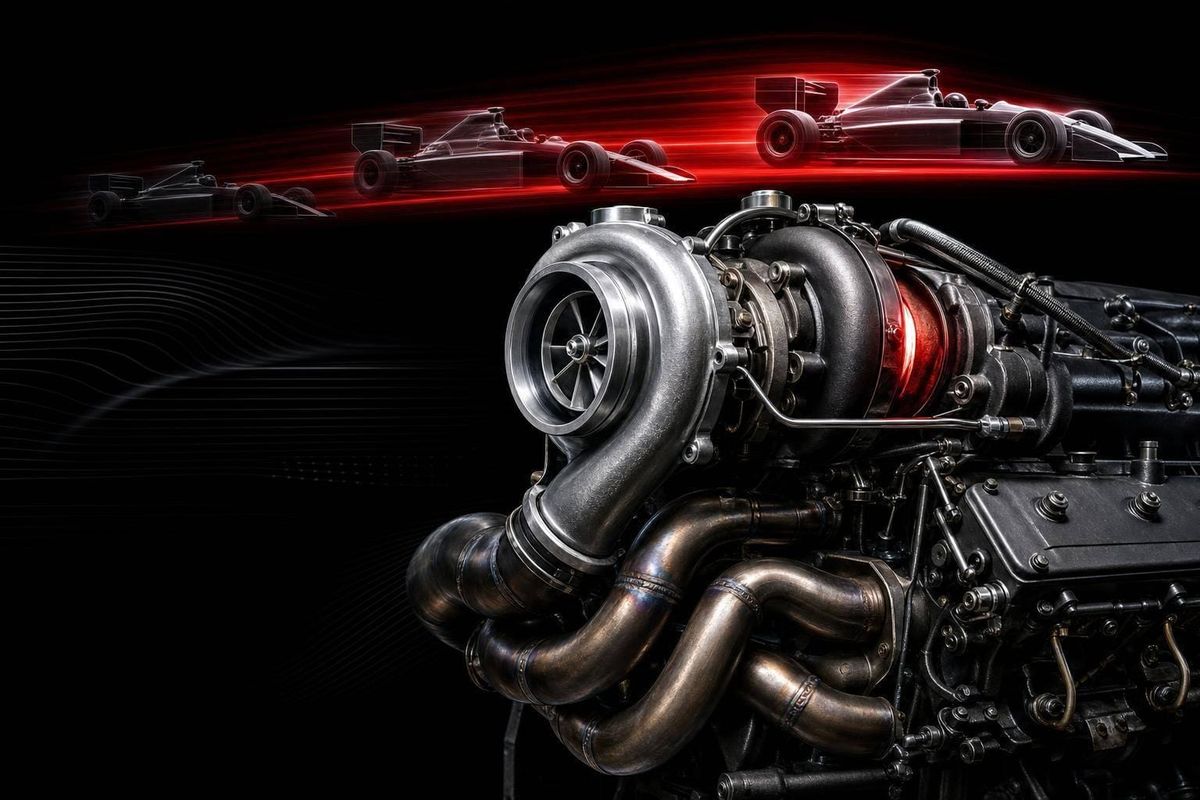
Turbo engines changed F1 because they turned a rule option into the only front-running choice. I’d sum it up like this: Renault proved in 1979 that a 1.5-liter turbo could beat the old 3.0-liter naturally aspirated cars, other top teams copied the idea, and by 1987 turbo cars had become so fast that the FIA stepped in with tighter limits before banning them for 1989.
If you want the short version, here it is:
- Renault opened the turbo era with the RS01 in 1977
- The early car was unreliable and earned the nickname “Yellow Teapot”
- Jean-Pierre Jabouille gave turbo power its first F1 win at Dijon on July 1, 1979
- Teams like Ferrari, Brabham-BMW, McLaren-TAG Porsche, and Honda-backed Williams followed
- Turbo cars made more power, but they were harder to drive, hotter, and tougher on fuel
- By 1987, pole speeds like 159+ mph at the Österreichring showed how far things had gone
- The FIA answered with fuel limits, boost caps, and then a full 1989 turbo ban
If I strip it down even more, the story is simple: more power won races, but heat, lag, fuel use, and failures shaped the whole era. That’s the main idea you need before getting into the full timeline.
| Topic | Short answer |
|---|---|
| What started the shift? | Renault backing the 1.5L turbo rule option |
| What proved it could work? | Jabouille’s 1979 French GP win |
| Why did teams switch? | Turbo cars had a clear power edge |
| What made them hard to use? | Lag, heat, fuel burn, and poor reliability |
| Why did rules change? | Speeds got too high and control got harder |
| How did the first turbo era end? | Turbos were banned for 1989 |
So before the details, that’s the full picture: one rule gap, one early gamble, a fast shift across the grid, and then rule changes once turbo power took over.
The rulebook opening and Renault's first move
Why a 1.5-liter turbo was allowed alongside a 3.0-liter naturally aspirated engine
The engine rules gave teams two paths: a 3.0-liter naturally aspirated engine or a 1.5-liter turbocharged engine. The tradeoff was pretty plain. The 3.0-liter setup was the safer bet. Teams knew it, trusted it, and had years of experience with it.
The 1.5-liter turbo route promised much more peak power. But that extra power came with a price: more heat, heavier fuel use, and a much higher risk of failure. Renault looked at that gamble and went all in. The team committed early, knowing the engine might break often before it became race-winning.
The RS01, the 'Yellow Teapot,' and the first proof of concept
The RS01 had a rough start. Turbo lag made throttle response hard to judge, so the car could feel unpredictable at the exact moment a driver needed control. Heat was a constant headache too, and mechanical failures happened so often that the car picked up the nickname "Yellow Teapot" because of the smoke pouring out during engine blowups.
Still, Renault kept pushing. That mattered. Instead of backing away from the failures, the team used them as part of the learning process.
That work paid off on July 1, 1979, when Jean-Pierre Jabouille won the French Grand Prix at Dijon - the first win for a turbocharged engine in Formula One. That result changed how the rest of the grid saw turbo power. It was no longer a strange side project. It was something rival teams now had to chase.
sbb-itb-7c68254
Formula1 Engine Evolution: The Full Story | 76 Years
How turbo use spread from one team to the whole grid
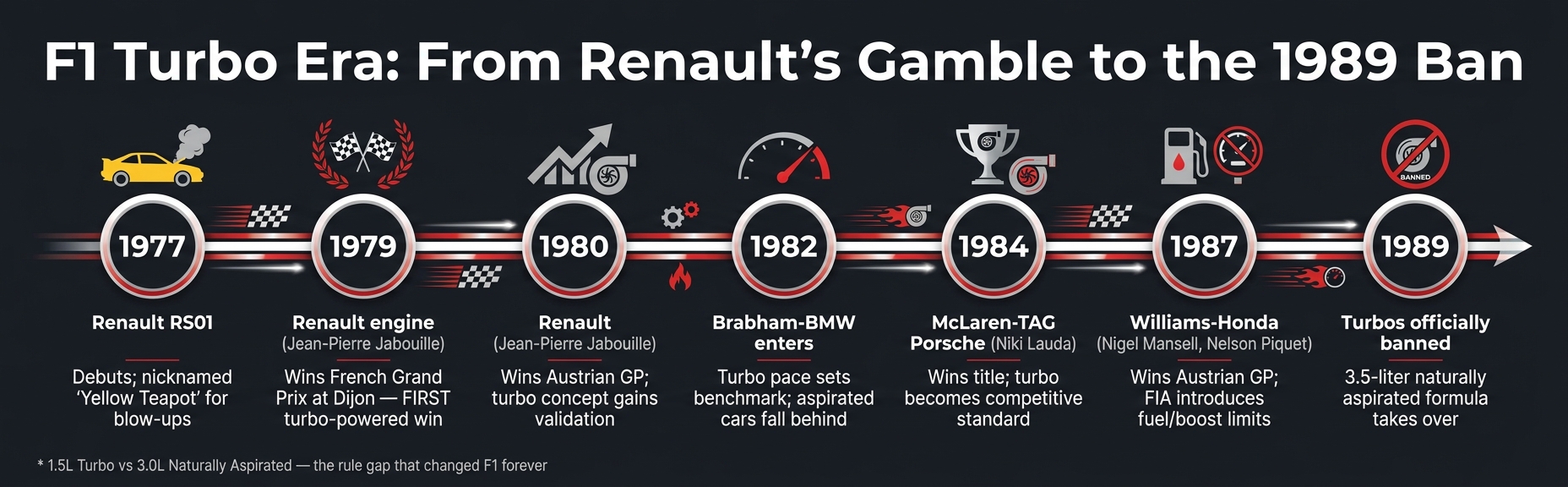
F1 Turbo Era Timeline: From Renault's Gamble to the 1989 Ban
After Renault's early wins, the rest of Formula 1 didn't all jump in at once. The shift was slower than that, and in some cases a bit reluctant. But results have a way of changing minds. Renault followed its first success with another win at the 1980 Austrian Grand Prix, this time with Jean-Pierre Jabouille. Ferrari then turned turbo power into a second front-running route, while Brabham-BMW helped show it could work as a broader race-winning setup. At that point, the big question wasn't whether turbo engines could win. It was which top team would back them next.
Brabham-BMW and the first turning points
Brabham's deal with BMW changed the picture. It made turbo engines look less like a gamble and more like a proper front-running option. In 1982, naturally aspirated cars could still compete, but turbo pace was starting to set the benchmark. That mattered. Once a second front-running team went in, turbo power stopped looking like one team's idea and started looking like the direction of the sport.
TAG-Porsche, Honda, and the shift from bold option to expected choice
McLaren's move to the TAG-Porsche turbo engine pushed that change even further. By then, turbo power wasn't just a daring choice. It was becoming the thing serious title contenders were expected to use. Niki Lauda won in 1984, and Alain Prost took three victories in four years starting in 1983 with Renault and McLaren turbo power.
By 1987, Williams had switched to Honda turbo power. Nigel Mansell's win at the Austrian Grand Prix came in a period when turbo performance was no longer the outlier. It was the norm. And once the whole grid started chasing the same edge, the next problem came into focus: these engines were blisteringly fast, hard to manage, and often fragile.
The timeline below shows the key moments that turned turbo power from Renault's solo bet into the grid standard:
| Season | Team | Engine | Milestone |
|---|---|---|---|
| 1979 | Renault | Renault | First turbo-powered win at Dijon |
| 1980 | Renault | Renault | Austrian Grand Prix win with Jean-Pierre Jabouille |
| 1982 | Brabham-BMW | BMW | Turbo pace begins setting the benchmark |
| 1984 | McLaren | TAG-Porsche | Niki Lauda win; turbo becomes competitive standard |
| 1987 | Williams | Honda | Nigel Mansell win; turbo dominance complete |
Why early turbo F1 cars were faster, harder to drive, and harder to finish races
Early turbo F1 engines made much more power than the 3.0-liter naturally aspirated cars they raced against. But there was a catch: that power often showed up in a small, tricky window. The result was a car that could be blisteringly fast one moment and a handful the next. Drivers had to stay on top of the throttle all the time, because a small mistake could turn into wheelspin, lost time, or worse.
Power gains, boost behavior, and the lag problem
The basic deal with early turbo engines was pretty clear. They offered huge peak power, but they didn't deliver it in a smooth, friendly way. Boost often arrived with a delay after the driver hit the throttle, then came on hard. Instead of a clean build of power, drivers got a sudden shove.
That made these cars tough to place and tough to trust. The power band was narrow and peaky, so drivers had to judge throttle timing with care, especially on corner exit. Too early, and the car could break traction. Too late, and they'd give away speed. It wasn't just about being brave. It was about being precise, lap after lap.
The upside was huge. At the 1982 Austrian Grand Prix, turbo pace set the benchmark even as reliability kept the result open. When the turbo cars held together, they were usually the faster package. Niki Lauda's 1984 Austrian Grand Prix win also showed how much mental strain these cars put on a driver, even when everything ended well.
Heat, fuel, and packaging limits behind the headline numbers
The same parts that gave turbo cars their speed also caused many of their headaches. Early turbo machines ran hot, used a lot of fuel, and were hard to package, especially once teams tried to fit them into ground-effect chassis. On paper, the power looked amazing. Over a full race distance, the picture got messier.
Fuel use was a big part of that. Drivers and engineers couldn't just chase flat-out speed from start to finish. They had to think about pace, fuel burn, and whether the car would last. In other words, the edge was real, but so was the risk.
Reliability was always hanging over these cars. Nigel Mansell's 1980 F1 debut in a turbo Lotus included a fuel leak into the cockpit for 40 laps. That wasn't some strange one-off. It fit the pattern of the time: very fast cars, but not always cars you could count on.
Put side by side, the contrast is easy to see:
| Factor | Early Turbo Engines | Naturally Aspirated (3.0L) |
|---|---|---|
| Power delivery | Delayed boost and a narrow power band | Linear, predictable delivery |
| Fuel consumption | High; race management mattered | Lower, easier to manage |
| Reliability | Heat, fuel, and mechanical issues made finishes less certain | Generally more consistent |
| Packaging | Harder to integrate around ground-effect aerodynamics | Simpler chassis packaging |
Those trade-offs shaped the rule changes that followed.
Rule changes that made turbos dominant and then restricted them
As turbo power went from a nice edge to something teams almost had to have, the FIA shifted from open rules to tighter control. The early rules allowed turbos, but once their speed got out of hand, the FIA had to step in.
From competitive edge to the only real choice
By the mid-1980s, turbo performance had stopped being just an advantage. It had become the thing you needed to run at the front. At high-speed tracks like the Österreichring, turbo cars took over, and Nelson Piquet's 1987 pole lap there averaged more than 159 mph. At that point, trying to fight for top spots without a strong turbo package just wasn't realistic.
Fuel limits, boost caps, and the road to the 1989 ban
The FIA responded by cutting turbo power step by step. Fuel limits meant teams had to think harder about race pace and fuel use, not just raw speed. Boost caps also limited how much peak power teams could pull from their engines. On top of that, the FIA brought back a 3.5-liter naturally aspirated formula alongside the turbo cars, which gave teams a way back without going all-in on turbo power.
Those changes shut down the first turbo era and led straight into the next rules reset.
| Season | Engine Rules | Result |
|---|---|---|
| 1982 | 1.5-liter turbo vs. 3.0-liter naturally aspirated | Turbo pace starts setting the benchmark; NA cars lose ground |
| 1987 | Turbo speeds forced further limits | FIA adds fuel and boost restrictions to limit output |
| 1989 | 3.5-liter naturally aspirated formula in place | Turbos banned; grid returns to naturally aspirated engines |
Conclusion: What the first turbo era changed in Formula One
By the time the FIA started tightening fuel and boost rules, turbo power had already flipped the pecking order. What began as a gap in the rulebook ended up becoming the new standard in F1. Once Renault showed it could work, the rest of the field followed. Ferrari, BMW, Porsche, and Honda turned Renault's gamble into the go-to setup at the front, making turbo power the default pick for teams fighting to win.
The downsides didn't go away. The price of all that speed stayed the same: lag, heat, fuel burn, and cramped packaging. And that jump in pace pushed Formula One toward tougher rules. Piquet's 159 mph pole lap showed just how far turbo performance had moved beyond what the old limits could comfortably hold.
The first turbo era reset F1's standards for engines, drivers, and circuit design.
FAQs
Why did Renault take the turbo risk so early?
Renault moved early because FIA rules and homologation timing gave it a strategic opening. By starting turbo development sooner, the company had a shot at gaining power earlier and then building on that edge within the rules.
That move also cut down the time Renault would have spent playing catch-up if it had waited and started development later.
What made early turbo F1 cars so hard to drive?
Early turbo F1 cars were tough to drive because turbo lag delayed power delivery in a way that felt awkward and hard to judge. A driver could go from waiting on the engine to getting hit with a sudden shove of acceleration. In a corner, that was a serious problem. It made throttle control much harder, and it was easy to ask too much from the tires and lose grip.
Things got even harder because engine management was still pretty basic. Teams also didn’t have the kind of live telemetry we take for granted now, so engineers couldn’t fine-tune performance while the car was out on track. That left drivers to do a lot of the work on instinct. They had to read the car through the steering wheel, the seat, and the sound of the engine, then react on the fly.
Why did the FIA ban turbos after they became dominant?
The search results don’t answer the core question: why the FIA banned turbo engines after they took over Formula One.
Instead, they drift into other topics, like:
- modern F1 rules
- the 2026 power unit changes
- energy recovery systems
- the history of telemetry
So the gap is pretty clear. The material covers today’s engine setup far more than the rule-making logic behind the end of the original turbo era.
Put simply, if you’re looking for the FIA’s reasoning for banning turbos after their peak, these results don’t get you there. They give technical background and current regulation details, but not the historical case for the ban.