What Tire Degradation Tells Us About F1 Battles
How tire wear and degradation shape overtakes, pit strategy and when a pass becomes likely - watch lap-time falloff and stint trends.
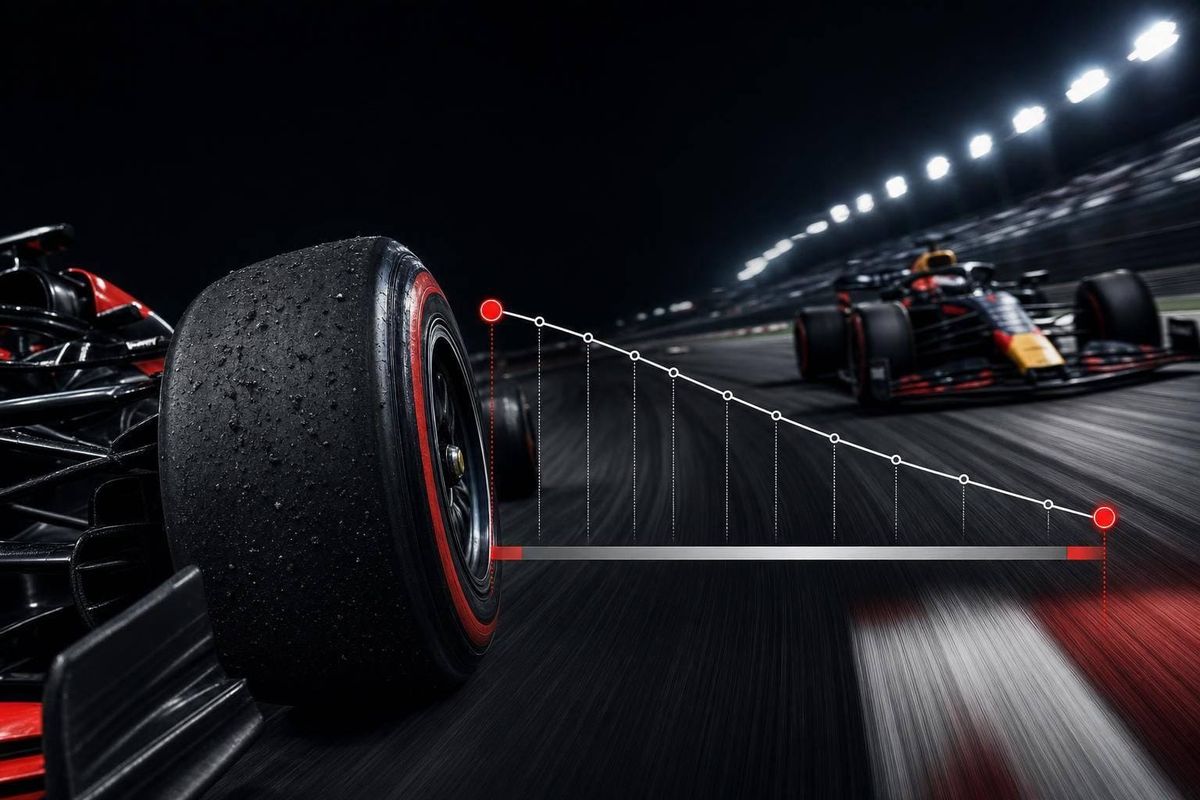
Most F1 passes are set up laps before they happen. I’d read the race by watching lap-time falloff, tire age, and pit timing first, because a gap can vanish when one car starts losing 0.5–0.7 seconds per lap, and a bigger drop can turn into a 2–4 second loss on soft tires late in a stint.
Here’s the short version:
- Degradation is when the tire loses grip and pace from heat and load.
- Wear is the rubber getting scrubbed away.
- Graining often costs about 0.2–0.4 sec/lap and can improve.
- Blistering can cost close to 1.0 sec/lap and usually does not improve.
- Many battles are decided before the overtake, when one car’s stint pace starts bending upward.
- Undercuts work when old tires are fading and the new set comes in fast.
- Overcuts work when warm-up is slow, degradation is light, and track position matters more.
If I want to know who is under pressure, I don’t just watch the car behind. I watch whether the car ahead is sliding more, braking with less margin, and drifting from steady laps into clear falloff. That is often the first sign the fight is already underway.
Quick comparison
| Topic | What it means | What I’d watch for |
|---|---|---|
| Wear | Rubber coming off the surface | How much tire is left |
| Degradation | Grip and pace dropping over a stint | Lap times getting worse |
| Graining | Torn rubber building on the tread | Mild pace loss, possible recovery |
| Blistering | Heat damage under the surface | Sharp pace loss, little recovery |
| Undercut | Pit earlier to beat a rival in the stop phase | Big fade, clean out-lap, no traffic |
| Overcut | Stay out longer and use the rival’s slow warm-up lap | Light fade, hard-to-warm tires, strong track position |
So to me, this article comes down to one idea: F1 tire battles are timing battles. The pass you see is often just the last step of a tire trend that started several laps earlier.
TYRES THAT FELL OFF A CLIFF! The Story of Pirelli's Early F1 Tyres (2011-12)
Why most overtakes happen late in a stint
Early in a stint, fuel burn-off can mask tire fade. As the car gets lighter, lap times often fall even while grip is slipping away. So early stint pace can fool you. A car that looks calm and planted on lap 3 may already be edging closer to the cliff than it seems.
How lap-time curves show when a car becomes vulnerable
Most stints follow three clear phases: warm-up, a steady middle section, and then late fade, when lap times start to climb. That last phase is usually where the fight opens up.
If Car A’s curve rises faster than Car B’s, the gap shrinks because Car A is losing pace, not because Car B has found sudden speed. It’s an important difference. On high-degradation compounds, that opening can be brief, which helps explain why a pass often becomes possible only when the leading car’s lap times begin to slip away.
What a tire cliff looks like during a battle
A tire cliff is not a slow fade. It’s a sharp drop. One lap, the car still looks under control. The next, it can lose several tenths, with more rear sliding, more wheelspin, and less stable braking. For a driver trying to defend, that change can hit before there’s time to adjust.
This gets even riskier near a pit window. A driver trying to stretch the stint can’t defend too hard without putting more heat into the tires and speeding up the drop-off. That’s the trap: the cliff often becomes clear only after it has already started. So a car that was tough to pass a few laps earlier can suddenly look exposed.
What separates a fading tire from a strong defense is how the car and driver handle load, heat, and slip.
Why some cars and drivers hold position better on old tires
Some cars and drivers hang on to grip much longer because they manage heat and slip better across a stint. The core idea is simple: some setups keep the tire in its working window for longer.
Car traits that protect tires in close racing
A stable car gives the driver the confidence to place it accurately without sliding the rear, and that helps keep tire temperature under control. With traction control banned, rear tire slip comes down to setup and driver input alone. If a car lets the driver get on the power early and smoothly - without wheelspin - rear temperatures stay lower lap after lap.
That edge builds over time. Every clean corner exit saves a bit more rubber, which then pays back on the next lap, and the one after that.
Driving habits that extend tire life under pressure
What the driver does matters just as much as the car underneath them. Smooth steering, clean braking, and a progressive throttle all help limit slip and stop sharp heat spikes.
The best drivers don’t go flat-out everywhere. They pick their spots. In some corners, they’ll even lift and coast a little to ease lateral load, choosing where to attack and where to save the tires. Once fade starts to show up - more steering angle, less traction, slower exits - forcing the issue usually makes things worse. Backing off a touch can protect more grip than leaning harder on a tire that’s already past its best.
Attack-first vs. conserve-first race craft: a direct comparison
The split between pushing early and saving tires for later is one of the clearest patterns in F1 tire fights. A driver who attacks at the start of a stint will often look faster right away, but that extra pace usually comes with a steeper degradation curve later. By contrast, a driver who looks a bit slower early on may be building toward a flatter lap-time curve that becomes a weapon late in the run.
| Factor | Push Early | Save Tires |
|---|---|---|
| Lap-time profile | Fast early, rising sharply late | Steady throughout, slower fade |
| Degradation rate | Higher - more thermal load on rear tires | Lower - less slip and heat buildup |
| Best phase | Early in the stint | Late in the stint |
| Position-holding ability | Weakens as tires age | Improves relative to opponents late on |
On softer Pirelli compounds, that late drop-off can cost 2–4 seconds per lap, turning early speed into late weakness. You can see that shift clearly in stint data and in the timing of pit stops.
sbb-itb-7c68254
What the data says about undercuts, overcuts, and battle patterns
F1 Tire Strategy: Undercut vs Overcut Decision Guide
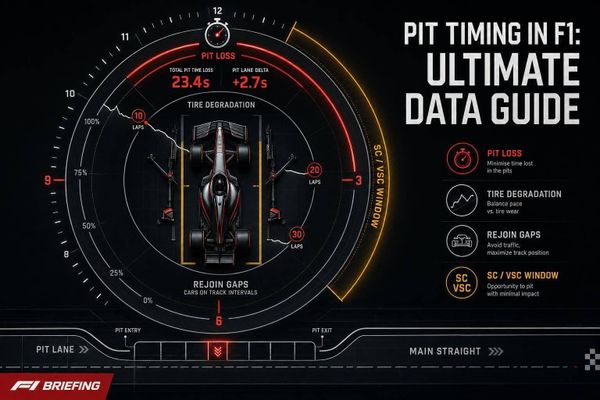
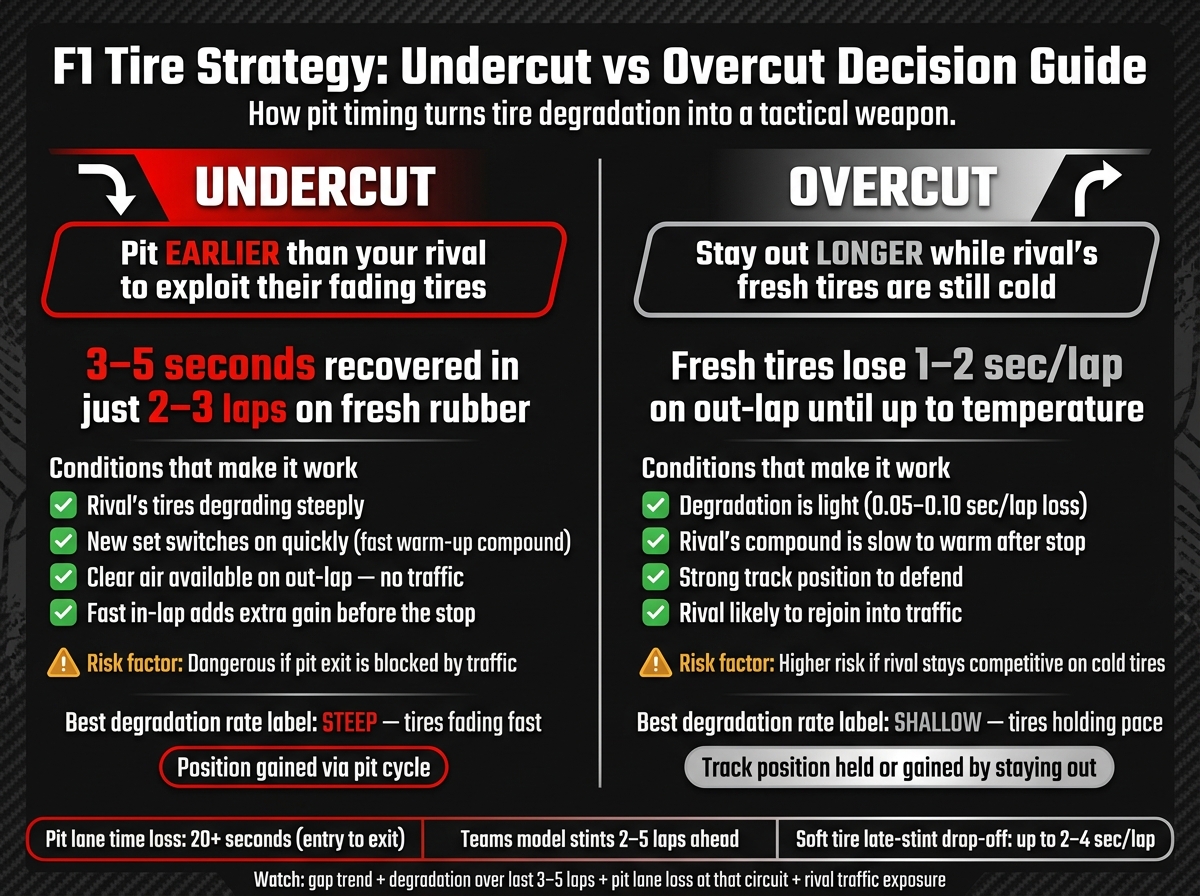
Once tire fade starts to hit lap times, pit timing stops being a background call and becomes part of the fight itself. At that point, strategy is a straight lap-time tradeoff. Every tenth lost to tire fade gets weighed against pit lane time loss, which in modern F1 usually sits at 20+ seconds from entry to exit, plus the pace a driver is expected to find once a fresh set is fitted. That’s why pit calls so often decide position before any pass happens on track. Teams model stints 2–5 laps ahead, because when degradation gets steep, a small gap can disappear in a hurry.
When an undercut works because old tires have faded
An undercut hits hardest when three things come together:
- The rival’s tires are dropping off fast
- The new set switches on quickly
- The car that pits gets clear air on the out-lap
When that happens, a driver on fresh rubber with no traffic can pull back 3–5 seconds in just 2–3 laps. That can be enough to wipe out the pit lane loss and come back out in front. A fast in-lap can add another small gain before the stop, which makes the swing even bigger. And if the rival then needs extra time to warm cold tires or slots back in behind traffic, the undercut window gets even larger.
When staying out on an overcut still makes sense
If the undercut attacks worn tires, the overcut goes after the weak point on fresh ones: warm-up time. Instead of stopping first, the driver stays out and pushes while the other car’s new tires are still coming in. Fresh tires can lose 1–2 seconds per lap on the out-lap until they reach temperature. If the car that stays out can keep its pace in that stretch, it can pit later and still rejoin ahead, or at least right on top of the rival.
This tends to work best when degradation is light, with lap-time loss around 0.05–0.10 seconds per lap. In that case, the older tires still have enough life to make use of the rival’s slow out-lap.
Monaco is the clearest case. Pit lane loss there is huge, passing is almost impossible, and tire preservation is strong enough that staying out often beats stopping first. In close battles, track position becomes the main thing that matters.
How to read undercut and overcut conditions during a race
The key is to read the gap and the tire trend at the same time. Four signals matter most: the gap before the stop, the degradation pattern over the last 3–5 laps, the pit lane loss at that track, and whether the rival will come back out into traffic.
If the gap is closing lap after lap and the trailing car’s times are already slipping, the undercut starts to look strong. If the car ahead is still putting in steady laps and the rival’s out-lap is likely to be cold or blocked by traffic, the overcut still has a shot.
| Condition | Undercut | Overcut |
|---|---|---|
| Degradation rate | Steep - tires fading fast | Shallow - tires holding pace |
| Compound behavior | Activates quickly on out-lap | Slow to warm after stop |
| Out-lap risk | Low - clear air available | Higher - rival may stay competitive |
| Traffic exposure | Dangerous if pit exit is blocked | Useful if rival rejoins into traffic |
| Likely result | Position gained via pit cycle | Track position held or gained by staying out longer |
Conclusion: What tire degradation really tells us about F1 battles
The pattern is pretty simple: tire degradation turns race battles into timing battles. A late pass, a car hanging on under pressure, or a pit stop that swaps track position usually comes back to one thing - how fast one car’s tires are dropping off compared with the other. What looks like a flash of driver magic late in a stint often starts much earlier in the data. The gap in pace has usually been building for several laps, and once the tires hit a steeper drop-off, the result is often close to inevitable. Staying ahead longer isn’t just about sharp defending, either. It often comes down to whether the car-driver pairing can slow tire wear while the chasing car’s lap times begin to drift upward.
The clearest way to read this during a race is to watch lap-time falloff, tire age, and stint pace together instead of waiting for a pass to show up on the timing screen. If the defending car’s lap times start bending upward lap after lap while the car behind stays steady, that’s usually a strong sign a move is coming soon. Read the trend, not just the move.
FAQs
How can I spot tire fade before a pass happens?
Watch for a lap-time crossover on the timing board. That’s the moment when a driver’s pace starts to fall off as tire wear builds, and a rival on fresh tires becomes fast enough to attack. When that gap flips, a pass may be close.
You can also catch grip loss with your own eyes: graining, sliding under braking, or weak traction on corner exit. Teams back that up with live tire temperature, pressure, and tire-energy data.
Why do some overtakes only happen late in a stint?
Overtakes often happen late in a stint because of the crossover point. That’s the moment when a car on fresher tires finally has enough pace to beat a rival on worn rubber.
As tire wear builds, teams watch the pace drop in real time. And when the tire delta gets big - often 12 to 15 laps - the car on fresher tires can gain around 0.6 to 0.9 seconds per lap. That gap is usually what creates the speed needed to make a pass.
What makes an undercut stronger than an overcut?
An undercut is often the stronger move because fresh tires can produce faster lap times right away. Pit early, and a driver can use that extra grip while a rival stays out on worn tires, making up enough time to cover the pit stop.
This tends to work best on high-degradation tracks, where the pace difference between new and old tires is much larger. It also relies on one thing going right after the stop: clean air. If the driver can push hard without traffic, the undercut becomes much more likely to pay off.