F1 Telemetry Stack: Trackside vs Cloud Analysis
Keep split-second safety logic at the circuit while offloading heavy modeling, simulations, and season-scale analysis to the cloud.
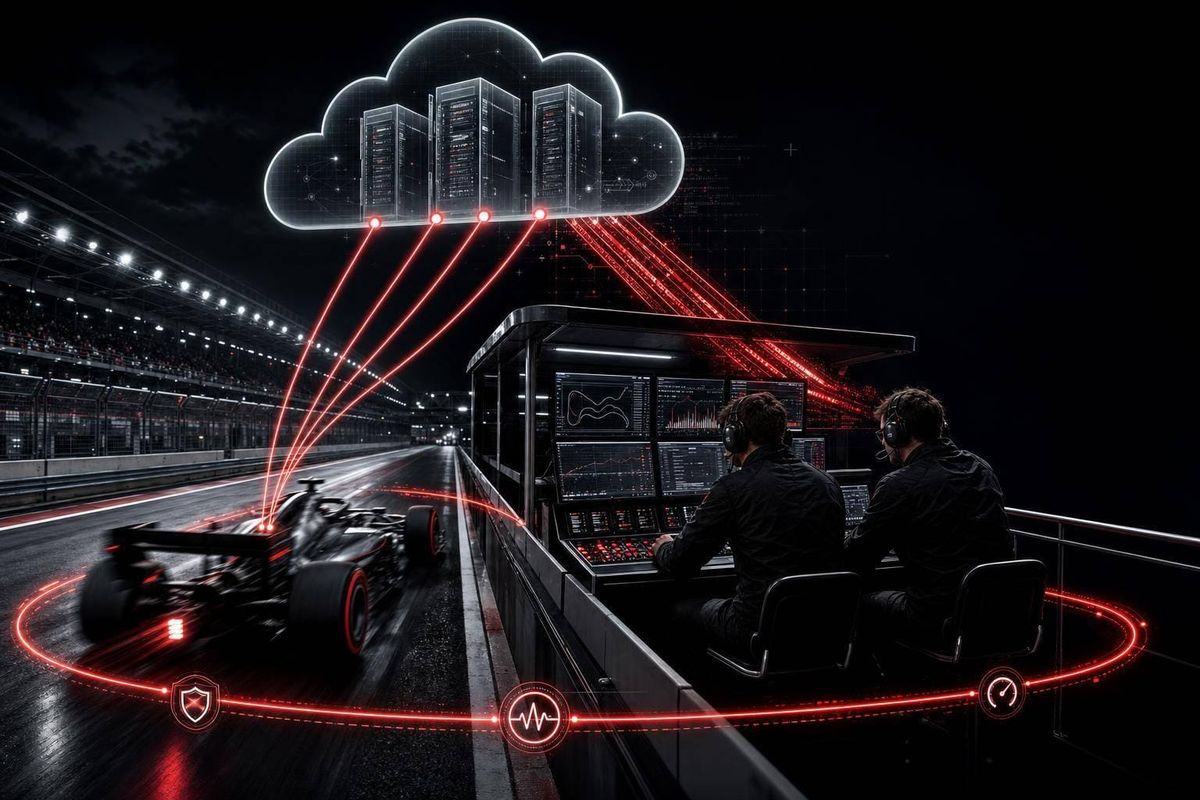
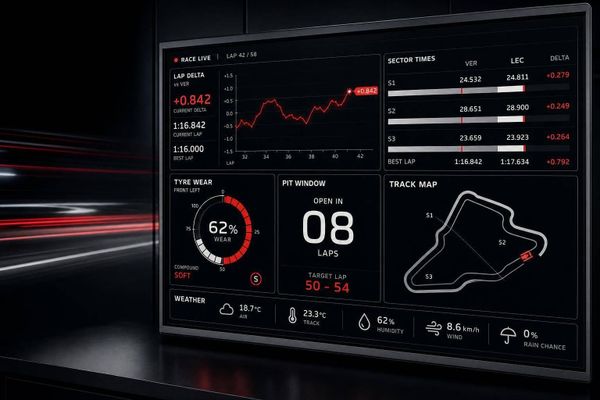
An F1 team does not send everything to the cloud. I’d split it this way: instant car-health checks stay at the track, while heavier modeling, storage, and factory support run offsite.
A modern F1 car can produce about 1.1 million data points per second from 300+ sensors. That volume matters, but the main issue is time delay. If a brake temp spikes or the car shows a misfire, engineers need that signal in milliseconds, not after a round trip to a remote system. On the other hand, tire-life forecasts, pit-stop scenarios, and season-long model training can handle a short wait and need much more compute.
If you only want the short answer, here it is:
- Keep local: live telemetry, safety alerts, reliability alarms, pit-wall dashboards, and any logic that must work even if the factory link drops.
- Send to the cloud: race simulations, ML scoring, long-term storage, cross-race analysis, and remote teamwork with factory staff.
- Why the split works: the trackside stack is built for low delay and staying online; the cloud side is built for scale, history, and shared access.
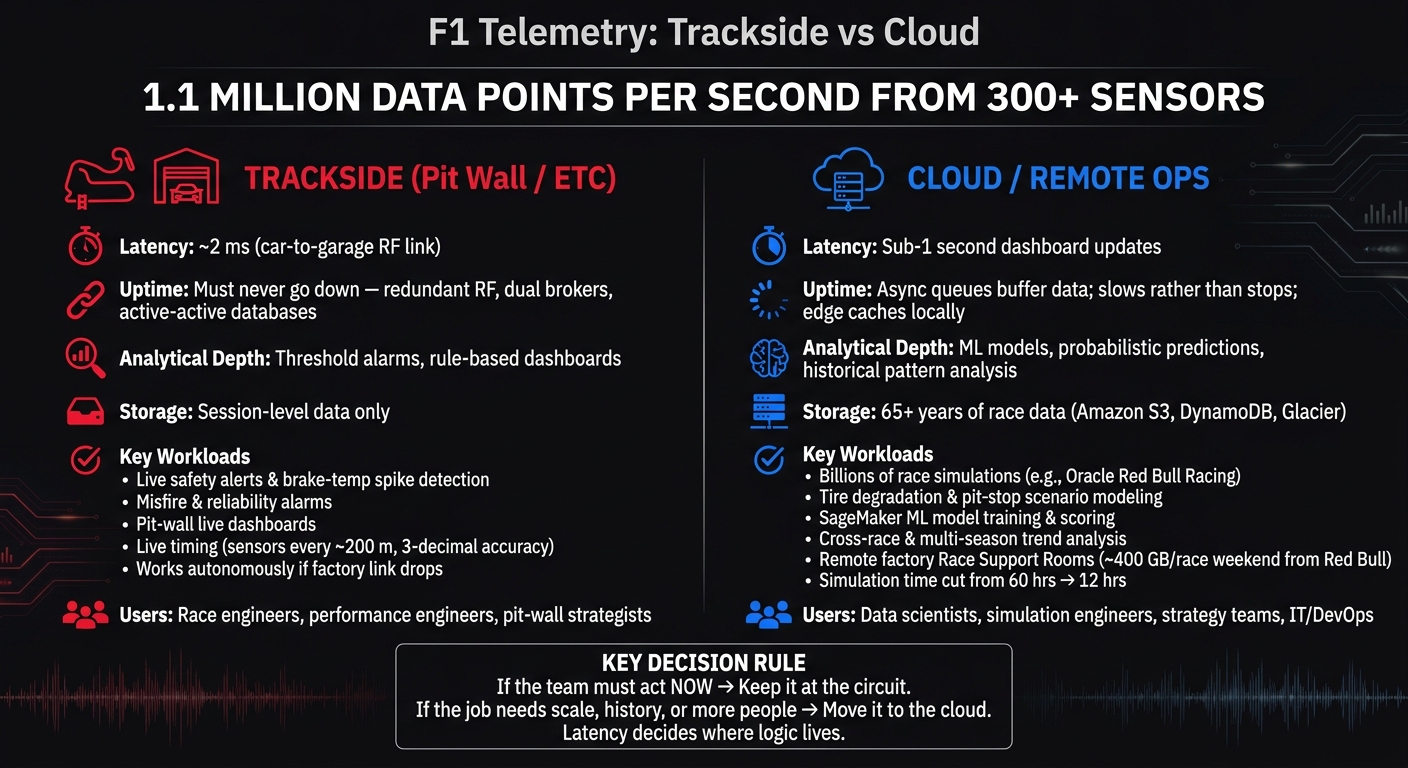
F1 Telemetry: Trackside vs Cloud Analysis at a Glance
How Formula 1 Builds Cloud + Trackside Systems Where Milliseconds Matter | Ryan Kirk, F1
sbb-itb-7c68254
Quick Comparison
| Area | Trackside | Cloud |
|---|---|---|
| Main job | Live race decisions | Deep analysis and remote support |
| Time target | Milliseconds | Usually under 1 second for dashboard insight |
| Best for | Safety alerts, live car status, instant engineer response | Simulations, tire models, scenario testing, archives |
| If link fails | Keeps working on local systems | Buffers data and catches up later |
| Data scope | Current session | Full season and multi-year history |
What this comes down to is simple: if the team must act now, I’d keep it at the circuit. If the job needs more compute, more history, or more people, I’d move it to the cloud.
Trackside systems: What teams keep local and why
Trackside systems are built around one job: getting car data to engineers fast and without fail. The big need is simple. Teams need data in milliseconds, and they need it even if outside links go down. If the factory connection drops in the middle of a race, the pit wall still has to see live car data. That’s why the local setup has to stand on its own.
How data moves from the car to the garage and Event Technical Center
It all starts on the car. Hundreds of sensors feed data into the ECU, which time-stamps each sample and packages it for encrypted RF transmission. Trackside receivers then pick up that signal and send it into the Event Technical Center (ETC), where live timing and telemetry are pulled together for the garages and race control.
Inside the garage, a central server sends that stream to each engineer’s subscribed channel. The local network uses prioritized switching and QoS so telemetry keeps flowing even when other traffic surges. At European events, end-to-end latency from the car to engineer screens is usually about 10–15 ms.
Decisions that cannot wait for a remote system
Some decisions can’t sit in a queue. They have to happen within a lap, and sometimes within a few corners.
Brake-temperature spikes and misfire detection are good examples. If a reading goes past the limit, the alert has to show up at once. There’s no time to send that signal off to a cloud system, wait for it to process the data, and then wait again for a response. When the goal is protecting the car and driver, delay is a bad bet.
Strategy calls work the same way. The race engineer needs a live view of car state and track position to change a plan by a lap or more. That awareness sits on the trackside stack, fed by live timing loops placed about every 200 meters around the circuit, with timing accurate to three decimal places.
Why trackside tools favor predictability over compute scale
At the circuit, teams want systems that behave the same way every time. So local tools are built for predictable response, not big compute power. That means stable timing, low jitter, and guaranteed execution for key monitoring tasks. Some teams do run lightweight pattern recognition at the track, like misfire or lockup detection, but they keep it simple to avoid delay.
The heavier work goes elsewhere. Deep models, long-horizon simulations, and full-car digital twins are pushed offsite, while the pit wall gets only the outputs it needs. Think of it like this: trackside handles the split-second calls, and remote systems handle the bigger-picture math.
If outside links fail completely, the local trackside stack keeps running. Safety-critical alerts stay live, dashboards keep updating, and engineers still get a full picture of car health using only local infrastructure.
Anything heavier moves offsite for deeper modeling and longer-term storage.
Cloud analysis: What gets offloaded for scale, modeling, and remote access
Once the pit wall has what it needs for live calls, telemetry moves to the cloud. That offsite layer is built for scale, deeper modeling, and access for factory engineers and remote analysts.
How data travels from the circuit to remote operations
This handoff starts after the trackside team gets the data it needs in real time. The connection from the circuit to the factory runs through a dedicated high-bandwidth backhaul link. Formula 1 has standardized on services such as Kinesis, SageMaker, and Lambda to stream, process, and analyze race data.
Cloud systems can handle more latency than trackside systems. That’s fine, because they’re not there for live control. Their role is to take raw feeds and turn them into simulations, model outputs, and shared analysis that offsite teams can work with.
Workloads that fit cloud compute
Cloud compute is a strong fit for live strategy simulation and scenario analysis. Oracle Red Bull Racing runs billions of simulations on Oracle Cloud Infrastructure before and during each race. Those runs test pit windows, tire compounds, degradation curves, and Safety Car scenarios.
Formula 1 has also said its analytics mix live telemetry with more than 70 years of historical race data stored in Amazon S3. That data feeds SageMaker models used for race-strategy predictions. Teams also use cloud compute to run hyperparameter searches, back-test models, and deploy updated models between sessions.
One number shows what this kind of scale can do: F1's move to cloud infrastructure cut simulation runs from 60 hours to 12. That shift also makes season-long analysis much easier to run.
Storage, collaboration, and learning across a season
Cloud storage keeps both raw and processed telemetry from practice, qualifying, and race sessions. It also stores simulation outputs, setup configurations, and historical timing databases.
That shared data supports several groups at once:
- Strategy teams compare race outcomes with model predictions.
- Performance engineers run cross-race pace comparisons.
- Car development groups link aero and suspension changes to on-track behavior.
Because the data sits in one central place, analysts can query it without moving files around by hand.
Remote technical centers get the same live telemetry as the pit wall. They use cloud-connected collaboration tools to send steady feedback during sessions. Mercedes has said its integrated platforms let trackside and factory engineers study live data together and pass strategy suggestions to race engineers while the driver is still in the car.
Trackside vs. cloud: Roles, limits, and tradeoffs compared
Trackside and cloud layers do different jobs. One protects live decision-making at the circuit. The other adds deeper analysis in the background. You see that split most clearly when the data pipeline gets hit by delay or failure.
Latency, resilience, and how each side handles failures
Cloud-processed insights usually show up on team dashboards in under 1 second. That’s fast for strategy calls, trend checks, and support from the factory. It is not fast enough for instant safety alerts. That gap shapes how each side is built to fail.
Trackside systems cannot go down during a session. Teams use redundant RF channels, multiple receivers, dual message brokers, and active-active databases so data keeps moving even if a part of the stack drops out. If sensor traffic spikes all at once - say, during a multi-car incident - queues and backpressure make sure the safety-critical signals get through first.
Cloud pipelines deal with failure in a different way. Asynchronous messaging buses and queue-based decoupling let analytics slow down instead of stop when connectivity gets weak. If the WAN link between the circuit and the factory degrades, edge systems store data locally and send it on after the link comes back. The local safety path keeps running. Analysis can wait, catch up, and keep going later.
Analytical depth, storage horizon, and how teams staff each side
Trackside tools lean on threshold alarms and rule-based dashboards. They’re fast, predictable, and built for the session happening right now. Cloud-backed systems go further. They run machine learning models that estimate tire degradation, undercut success, mechanical risk, and race outcome probabilities in near real time.
Storage follows the same split. Trackside systems keep the session data needed for immediate decisions. Cloud storage holds raw and processed telemetry across a full season and far beyond. F1’s historical dataset covers 65+ years of race data stored in services such as Amazon S3, DynamoDB, and Glacier. That long-term data lake supports model training and trend analysis. Red Bull Racing alone sends about 400 GB of data per race weekend from the circuit back to its UK headquarters.
The comparison below shows where each side fits.
| Aspect | Trackside (Pit Wall / ETC) | Cloud / Remote Ops / Factory |
|---|---|---|
| Latency | ~2 ms car-to-garage RF link | Sub-second dashboard updates; tolerates slight delay |
| Resilience & outage behavior | Redundant RF, multiple receivers, dual brokers, active-active databases; operates autonomously if WAN fails; safety path stays fully operable from local data alone | Async queues and decoupling buffer data; slows rather than stops; edge caches locally; analytical workloads run on cached snapshots until connectivity restores |
| Analytical depth | Threshold alarms, rule-based dashboards, session-focused | ML models, probabilistic predictions, historical pattern analysis |
| Storage horizon | Session-level data for immediate use | 65+ years of race data in cloud data lakes |
| User groups | Race engineers, performance engineers, reliability and systems engineers, pit-wall strategists | Data scientists, simulation engineers, larger strategy teams, IT/DevOps staff |
A single lap of telemetry: from sensor to insight
A single lap makes the whole setup easier to picture. Each car carries 300+ sensors and produces about 1.1 million data points per second. That stream leaves the car over an RF link and reaches circuit-side receivers in around 2 ms.
From there, the data moves across the trackside LAN and ATLAS servers to the pit wall, garage, and Event Technical Center for live monitoring. At the same time, that same feed is sent to factory and cloud systems for remote analysis, where Factory-based Race Support Rooms receive the telemetry alongside the pit wall.
In the cloud, services such as Amazon Kinesis ingest the stream, Lambda functions process it, and SageMaker models score it against past patterns stored in S3. The outputs then come back to the pit wall: tire degradation forecasts, undercut success estimates, and race outcome probabilities.
That’s why teams build both sides as one system: deterministic, low-latency safety monitoring at the track paired with probabilistic, historically informed strategy modeling in the cloud.
Conclusion: The split itself is where the advantage lies
Trackside and cloud don't compete with each other. They work as parts of the same system.
Trackside handles the decisions that need to happen right now. Cloud handles the work that can happen later, across more data, more time, and more people. The dividing line is simple: latency decides where logic lives. If a call has to be made in the moment, it stays local. If the job depends on scale, history, or team-wide access, it moves remote.
That means the edge isn't just about raw compute power. It's about making a clean call between what must be decided now and what can be refined later. That's where the advantage sits.
Key points to take away
- What stays local: Safety-critical telemetry, live dashboards, and instant reliability alarms stay on the trackside stack.
- What goes remote: Long-horizon simulations, machine-learning models, multi-season trend analysis, and archival storage move to the cloud.
- Resilience is layered by design: Trackside resilience protects race-day decisions; cloud resilience protects the team's long-term learning.
FAQs
Why not keep all telemetry in the cloud?
F1 teams can’t keep all telemetry in the cloud because race-day calls depend on near-instant response times. Trackside systems give engineers the split-second data they need for decisions like pit timing or energy recovery changes.
A cloud-only setup also brings extra risk, including signal interference, network congestion, and latency caused by distance. That’s why teams lean on the cloud for heavier computing, storage, and deeper post-race analysis instead.
What happens if the factory link fails mid-race?
If the link between the track and factory drops during a race, teams fall back on a dual-site architecture. Telemetry goes to both the garage and the factory at the same time, which lets the trackside crew keep an eye on the car locally with portable data centers and servers.
Teams also rely on backup links, including fiber, microwave, and satellite, to keep data moving if one connection goes down.
Which F1 telemetry tasks need cloud compute most?
Cloud compute matters most for telemetry work that needs serious processing power, room to scale, and deep analysis over time, not instant trackside response.
That covers heavy jobs like CFD, long-term storage for huge datasets - often more than 1.5 terabytes per race weekend - and post-race analysis. It also helps power digital twins and machine learning models used to predict tire wear and energy recovery.