7 Interview Tests For F1 Aerodynamicist Roles
Seven practical F1 aero tests—CFD, wind tunnel, correlation, theory, problem-solving, design review and resilience.
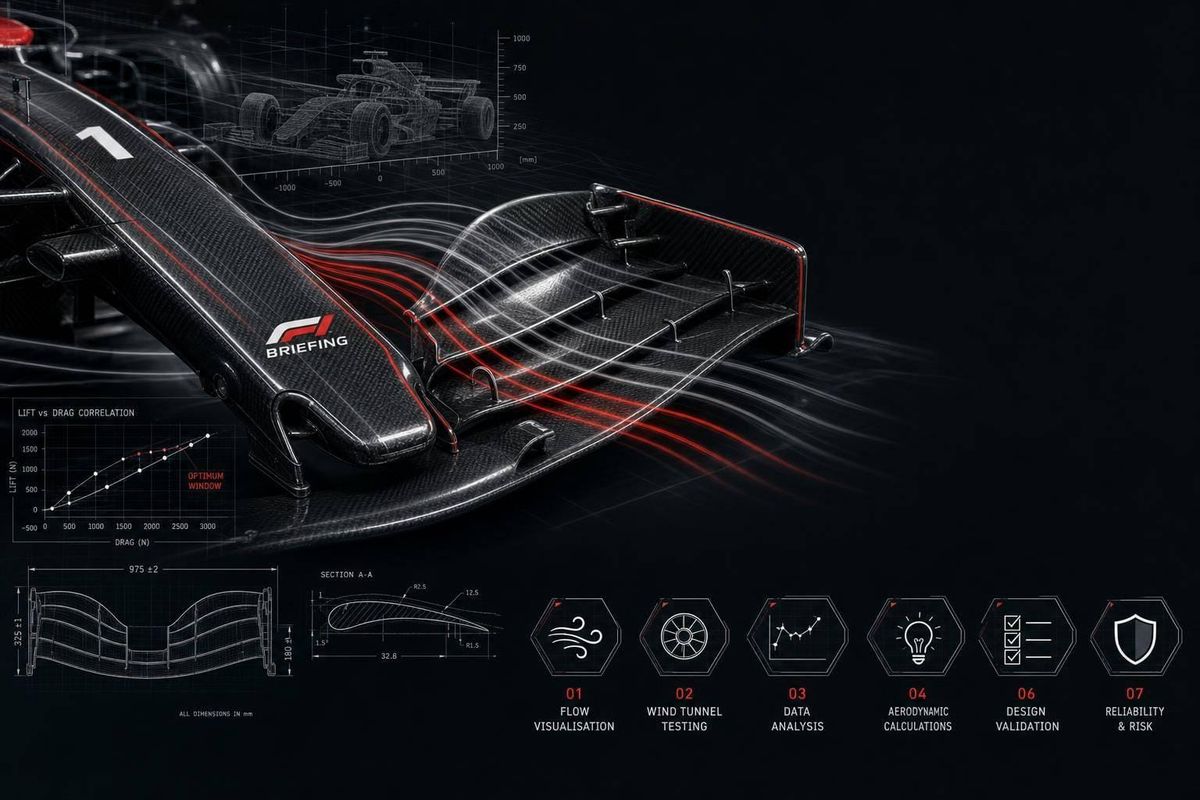
If I were preparing for an F1 aerodynamicist interview, I’d expect seven checks: CFD work, wind tunnel reading, correlation, theory, problem-solving, group review, and pressure handling. Teams use this mix because a 0.01 Cd change can affect lap time, and they need people who can link simulation, tunnel data, and track behavior without missing the bigger car picture.
Here’s the short version:
- CFD case study: I’d need to solve an aero problem under FIA rule limits.
- Wind tunnel exercise: I’d need to read test data and decide if a part should move forward.
- Correlation task: I’d need to explain why CFD, tunnel, and track data do not line up.
- Theory interview: I’d need to explain flow physics, not just software output.
- Problem-solving scenario: I’d need to diagnose handling or setup issues under time pressure.
- Design review: I’d need to defend my thinking in front of other engineers.
- Fit and resilience round: I’d need to show I can handle long hours, setbacks, and team pressure.
What stands out is simple: this is not just a software job. I’d be judged on physics, judgment, data reading, and how well I explain my calls.
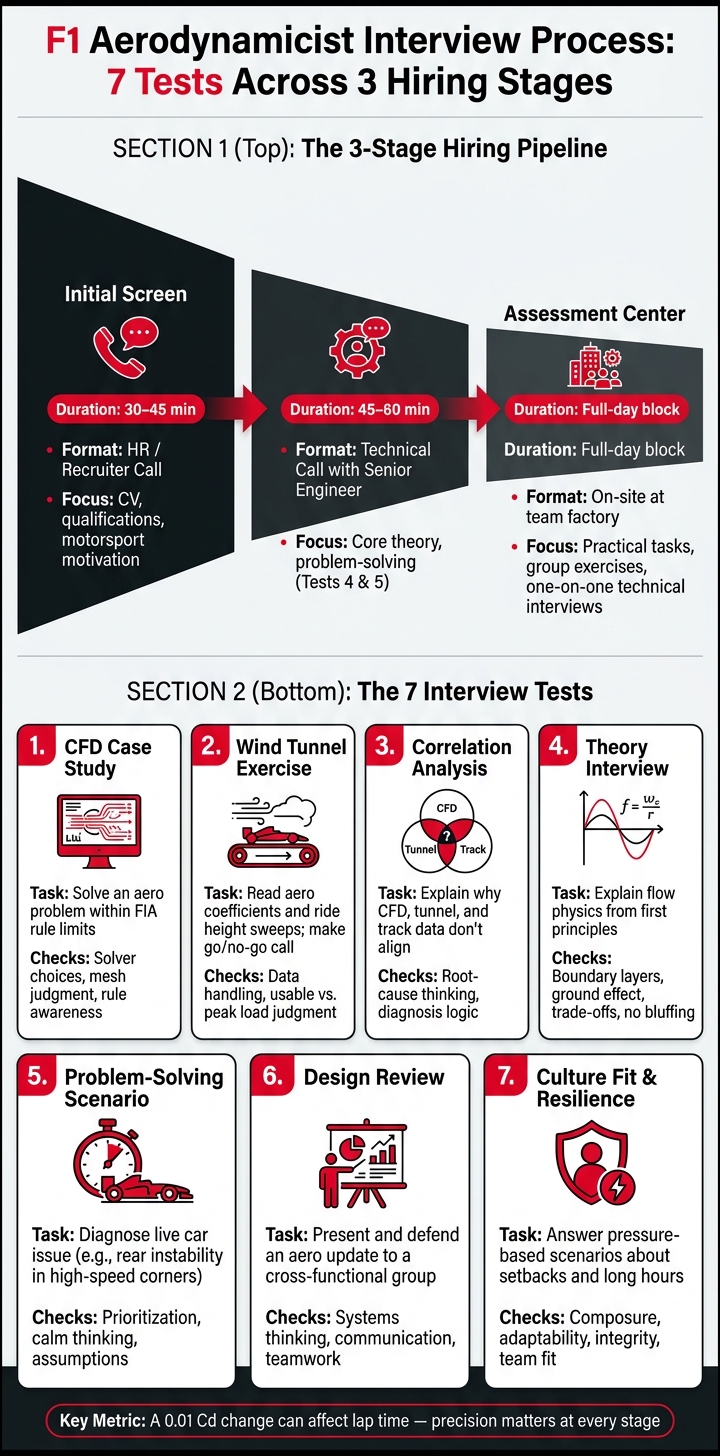
F1 Aerodynamicist Interview Process: 7 Tests & 3 Hiring Stages
How to get a JOB in F1 - Your AERODYNAMICIST Interview
sbb-itb-7c68254
Quick Comparison
| Test | What I’d be asked to do | What teams are checking |
|---|---|---|
| CFD case study | Run or review a simulation case | Solver choices, mesh judgment, rule awareness |
| Wind tunnel exercise | Read aero coefficients and sweeps | Go/no-go decision, load window, data handling |
| Correlation task | Find why results do not match | Root-cause thinking, metrics, diagnosis |
| Theory interview | Explain aero physics | First-principles knowledge, trade-offs |
| Problem-solving scenario | Work through a live car issue | Prioritization, assumptions, calm thinking |
| Design review | Present and defend an update | Systems thinking, teamwork, clear speaking |
| Fit and resilience round | Answer pressure-based scenarios | Composure, work style, integrity |
I’d also expect these tests to appear in stages: a 30–45 minute recruiter screen, a 45–60 minute technical call, and then a full-day factory assessment. So if I were getting ready, I wouldn’t just study CFD plots. I’d also practice explaining why a result happened, what I’d check next, and how I’d turn aero data into a car decision.
Why F1 Teams Use Multiple Interview Tests
One day you're checking CFD mesh settings. The next, you're trying to work out why wind tunnel data doesn't line up with your simulation. A little later, a race engineer asks you to explain how a front wing change is shifting rear-end balance. That's why teams use multi-stage assessments.
Each test looks at a different skill. A theory interview checks physics knowledge, not just whether someone knows their way around software. A practical data task shows whether a candidate can read results the right way. A group session shows whether they can talk with other departments without losing technical precision. So teams split the process into technical, analytical, and behavioral tests.
With tighter budgets and a heavy flow of applicants, structured screening gives teams a clear way to compare people. Trackside aerodynamicists work inside a three-day race weekend, turning live sensor data into setup calls with very little room for error. Timed exercises show who can stay calm when the clock is ticking and the pressure is on. That's why the first round often starts with a CFD case study.
1. CFD Case Study Simulation Test
You’re given a specific aero problem - say, improving a front wing endplate or changing part of the floor geometry - and a tight deadline to work through it. The catch is that the work has to stay inside current F1 technical rules, so you’re dealing with the same limits the job would bring on day one. This first test is meant to show whether a candidate can make solid aero calls when the rules, time, and setup all put pressure on the work.
Why It Fits the Job
This task is built to show how someone works, not just the final answer they land on. Candidates are expected to deliver pressure coefficient plots, velocity fields, and measurable percentage shifts in downforce and drag, all while staying within a limited CFD testing allowance set by FIA rules.
There’s also a big focus on usable downforce, not just the best-looking number on a screen. Downforce that stays stable during car roll, braking, or in the dirty air of traffic matters much more than a figure that only looks strong in clean air.
Ability to Reveal Technical Judgment and Scoring
Interviewers score the candidate’s method choice, data extraction, correlation logic, and how well they manage limited resources. Then they push a step further and ask how the candidate would look into a CFD and wind tunnel mismatch.
That score also reflects some nuts-and-bolts judgment:
- Which turbulence model was picked
- How the mesh was handled near key wall regions
- Whether the candidate can tell the difference between a real flow effect and a numerical artifact
Signal on Cross-Functional Communication
The test ends with a short presentation. Candidates have to turn CFD output into a clear design recommendation and explain the physics behind it without hiding behind software plots.
Next, teams check whether those CFD calls stand up when matched against wind tunnel data.
2. Wind Tunnel Data Interpretation Exercise
Once a candidate can suggest an aero change in CFD, the next step is simple: can they read the physical result the right way?
In this exercise, candidates get a dataset that looks like actual wind tunnel work. That usually includes aerodynamic coefficients, ride height sweeps, correlation plots, and flow visualization images. From there, they need to make a go/no-go call on whether a component should move to track validation. In F1, wind tunnel time is tightly limited by the FIA's Aerodynamic Testing Restrictions (ATR), so every run needs to matter.
This part of the interview checks whether someone can compare physical data to a baseline and tell when a concept is ready to move forward. CFD can test lots of virtual versions, but the wind tunnel is where teams check the strongest ideas before track testing. Because F1 wind tunnel models run at 60% scale under the rules, this exercise is very close to the job itself. Candidates are usually expected to begin with a baseline, work through ride height sweeps, and judge each component change against that reference point.
And that's why interpretation matters more than just reading off the numbers. Interviewers aren't only looking for someone who can spot a higher or lower value. They want to see how that person thinks. A strong candidate doesn't stop at what changed. They explain why it changed and which flow structures moved with it. That's a big deal with ground-effect cars, where a package can look strong in one ride-height window and then lose a lot of its effect when conditions shift.
Interviewers usually score a few things closely:
- Correlation accuracy
- Judgment on usable load versus peak load
- Data handling
Python and MATLAB skill is also expected, since modern wind tunnel sessions produce large datasets that have to be processed fast and cleanly.
At the end, candidates are often asked to brief the result as if they were speaking to a Principal Aerodynamicist, then handle follow-up questions from nearby departments. The main signal here is whether they can turn C_L and C_D into setup guidance that a race engineer can actually use, such as a front wing flap adjustment or a ride height target.
When tunnel and CFD don't match, the next thing interviewers want to see is whether the candidate can explain the gap.
3. Aerodynamic Correlation Analysis Task
The wind tunnel exercise shows whether a candidate can read physical test data. The correlation task goes one step further. It tests whether they can explain why the data does not line up with the simulation.
Candidates usually get a mixed dataset from CFD, the wind tunnel, or track testing and are asked to find where the model and the car part ways. The key point is simple: this task is not about saying, “these numbers don’t match.” It’s about explaining the reason behind the gap.
Job Relevance to F1 Aero Workflows
This mirrors the factory-to-track loop: CAD, CFD, wind tunnel, and track validation.
Ability to Reveal Technical Judgment
This is where interviewers split basic data readers from people who can diagnose a problem. A strong candidate does more than point at the mismatch. They walk through the likely cause.
For example, they might explain that a RANS turbulence model is over-predicting performance. Or they may point to Reynolds number effects and boundary layer differences between a 60% scale model and the full-size car as the source of the divergence. That kind of answer shows judgment.
The same applies when separation appears in the data. Is it a genuine flow issue on the car, or is it just a numerical artifact from the simulation? That distinction matters a lot, and it is exactly what interviewers are trying to test.
Use of Structured Scoring Rubrics
Teams score these tasks on a few things:
- Predictive accuracy
- The logic used to diagnose mismatches
- The ability to set up solid correlation metrics
This matters because bad correlation is not just a technical headache. It costs time and money. If the model is wrong, teams can burn limited ATR hours and waste development budget chasing the wrong direction. So the final check is whether the candidate can explain the diagnosis clearly enough to support the next design call.
Signal on Cross-Functional Communication
After that, interviewers look at communication. Can the candidate turn the diagnosis into a clear next step for aero, design, and race engineering?
That skill maps straight into structured problem-solving interviews. In F1, spotting the issue is only half the job. The other half is making sure the next group knows what to do with it.
4. Core Aerodynamics Theory Interview
After correlation testing, teams use this interview to find out whether a candidate can explain the flow physics underneath the result, not just point at a mismatch and name it. This is a first-principles check. The point is simple: can the person explain the physics behind a design choice, or are they only repeating what the solver says.
The topics are the ones you'd expect to sit at the heart of race-car aero: boundary layers, separation, turbulence, ground effect, ride-height sensitivity, and aero-platform stability. A candidate might be asked to explain how a diffuser works, sketch a fix inside tight packaging limits, or use telemetry data to diagnose a handling problem. In plain terms, this stage asks: do you understand why the car is doing what it's doing? That then leads into the next step, where teams test whether the candidate can use that theory in a live engineering setting.
Ability to Reveal Technical Judgment
This is where memorized textbook answers tend to fall apart. Interviewers are looking for judgment, and the strongest signal is car-level thinking instead of part-level thinking.
A strong candidate doesn't talk about a front wing change as if it lives on its own little island. They explain how that change can shift flow into the floor, change diffuser behavior, and alter overall balance across the car. That's a much better sign than treating each surface as a separate box.
Judgment also shows up when trade-offs enter the discussion. Teams want to hear candidates weigh usable downforce against peak load. That distinction matters a lot. Peak numbers may look great in clean air, but if the load drops off under braking, roll, or dirty air, the car can become hard to drive when it matters most. So the better answer isn't just “more load is better.” It's whether that load stays with the driver through race conditions.
Use of Structured Scoring Rubrics and Cross-Functional Communication
Interviewers score candidates on depth of first-principles knowledge, how clearly they reason through trade-offs, and whether they're honest about where their knowledge runs out. Bluffing gets punished.
There's also a very direct communication test here: can the candidate explain theory clearly to non-aero engineers while under pressure? F1 aero work feeds into vehicle dynamics, race engineering, and technical decision-making. So if someone can speak with design, vehicle dynamics, and race engineering teams without getting vague or losing technical accuracy, that's a strong sign they can do the job from day one.
From here, the interview process shifts from theory to execution in a more structured problem-solving exercise.
5. Structured Problem-Solving Scenario
Once a candidate can explain the physics, teams want to see if they can use that knowledge on a live aero issue. This part of the interview tests something very close to race-weekend work: Can the person spot the problem fast, work with missing data, and stay clear-headed under pressure?
A common prompt sounds like this: "Rear instability is appearing in high-speed corners during a race weekend - outline your diagnosis step by step." Another might ask for a setup choice, like picking a high-downforce package for Budapest or a low-drag setup for Monza. The point isn't to chase a perfect answer. It's to give a diagnosis the team can defend.
Job Relevance to F1 Aero Workflows
These scenarios are built to match day-to-day life inside an F1 team. Trackside aerodynamicists read live data from hundreds of sensors over a three-day race weekend and often have to make setup calls before the full picture is clear. That makes this test less about reading numbers and more about figuring out what those numbers mean.
Ability to Reveal Technical Judgment
This is usually where the gap shows up between candidates who see the car as one connected system and those who think one component at a time. The stronger candidate follows a single change through the whole car and explains the trade-off in plain terms.
Interviewers also pay close attention to how candidates talk about the downforce-versus-drag trade-off in race conditions. A package can produce strong peak load in clean air, then fall apart in turbulence. That may look great in qualifying and much weaker in race trim. A better answer makes that clear and shows that usable load across changing conditions matters more than a big number on a data sheet.
Use of Structured Scoring Rubrics
Teams often score the answer on a few core points:
- the assumptions the candidate makes
- how they prioritize likely causes
- the predicted effect on drag, downforce, cooling, and ride height
Signal on Cross-Functional Communication
Interviewers are also listening for communication. Can the candidate explain the diagnosis clearly? Can they say what they don't know yet? Can they point to the next action without rambling?
That matters because the job isn't done in isolation. Someone who can walk through the issue, flag the main uncertainty, and give an action the team can use is showing they can step into that setting from day one. The next test looks at whether that same judgment still holds when other people start pushing back in a group design review.
6. Collaborative Design Review Assessment
After working through a structured aero problem, candidates usually have to defend their thinking in front of a group. In practice, that often means a group exercise or a mock presentation. It’s a direct test of how someone thinks on their feet, explains technical work, and reacts when other people push back.
A common prompt asks the candidate to present a proposed aerodynamic update to a cross-functional group. From there, they need to explain why that change makes sense and what it does to balance, load distribution, and development trade-offs. The point isn’t to land the “perfect” aero answer. The point is to defend a workable answer under pressure.
Job Relevance to F1 Aero Workflows
This is very close to a real design review in F1, where aero changes get challenged before they ever reach the car. A concept has to hold up against manufacturing limits, test constraints, and scrutiny from other stakeholders.
Ability to Reveal Technical Judgment
This stage says a lot about judgment. Strong candidates don’t stop at one part of the car. They walk through how one aero change affects the full package.
Interviewers want to see whether the candidate gets that changing the front wing doesn’t stay a front-wing problem. It changes what happens at the floor, the rear wing, and the car’s overall balance. If someone only talks about local flow gains, and doesn’t follow the downstream effect, that usually points to a gap in judgment.
Use of Structured Scoring Rubrics
Interviewers usually score this assessment across four areas:
| Assessment Category | What Interviewers Look For |
|---|---|
| Communication | Clear summaries for non-aero stakeholders |
| Decision Quality | Evidence-based design choice with specific metrics |
| Teamwork | Handles disagreement constructively |
| Systems Thinking | Traces downstream aero effects and trade-offs |
Signal on Cross-Functional Communication
The biggest signal here is simple: can the candidate brief senior engineers in a way they can use? That means turning raw CFD or wind tunnel output into a clear recommendation that a Principal Aerodynamicist can act on.
"Technical output in an F1 aero group goes to Principal Aerodynamicists before it influences car decisions. Engineers who can present findings clearly, not just analyze the data, progress faster." - Tiro Associates
At this stage, clear and calm presentation often separates stronger candidates from the rest. After that collaboration test, teams usually shift to a different question: can this person stay effective under pressure and work well within the team’s day-to-day style.
7. Culture Fit and Resilience Interview
Once candidates have defended their aero choices in a group setting, the focus shifts. Teams want to know if that person can still do the job when things get messy. And in F1, they often do.
This final stage looks at pressure, setbacks, and the grind of day-to-day work on an F1 program.
Job Relevance to F1 Aero Workflows
F1 aero work doesn't run on a calm, predictable schedule. Wind tunnel sessions can stretch across shifts, and race weekends squeeze heavy sensor data review into just three days. Trackside aerodynamicists may travel to 24 races per year.
So this part of the interview checks whether the candidate gets what the job is actually like - and whether they've handled anything close to that pace before.
The conversation is usually practical, not academic. Interviewers often use scenario prompts to see how someone reacts when a workflow starts to fail. One common example is: "Your CFD and wind tunnel data don't match. What do you check first?"
That isn't just a data question. It's a stress question too. Teams want to see how the candidate deals with correlation gaps: calmly, step by step, and with proof behind each move.
Use of Structured Scoring Rubrics
This round is often scored using a simple rubric built around four areas:
| Criteria | What Interviewers Look For |
|---|---|
| Resilience | Composure when CFD and wind tunnel results conflict |
| Adaptability | Prioritizing work within FIA Aerodynamic Testing Restrictions (ATR) |
| Team Fit | Communicates across aero, design, and race engineering |
| Integrity | Handling sensitive technical data responsibly |
That scoring setup helps teams compare candidates on more than just technical depth. They also want to know who can keep a clear head, make sound calls, and work well with people from other parts of the car program.
Signal on Cross-Functional Communication
This interview also checks whether a candidate can communicate across specialized groups like CFD Methodology, Aero Production, and Model Design when the pressure is on - not just stay inside their own area.
"The engineers who get hired share a specific combination: 1. CFD AND wind tunnel, not one or the other... 2. Full aero package understanding, not just their sub-system... 3. The ability to report upwards." - Tiro Associates
How These 7 Tests Fit Into a Hiring Pipeline
Taken together, these tests usually sit inside a staged hiring funnel. F1 teams tend to run them in sequence, not all at once, using a three-stage process that filters candidates before the team puts more time into the next step.
It usually begins with a 30–45 minute screening call with HR or a recruiter. This step checks the CV, confirms qualifications, and looks at motorsport commitment. Candidates who move forward will often have a 45–60 minute technical call with a senior engineer or department head. That’s where Tests 4 and 5 often show up.
The last stage is the longest: a full-day assessment center at the team’s factory. Here, teams combine technical interviews, practical tasks, and group exercises to see how a candidate performs across different settings.
| Pipeline Phase | Typical Format | Indicative Time | Tests Covered |
|---|---|---|---|
| Initial Screen | HR/Recruiter Call | 30–45 minutes | CV, qualifications, motivation |
| Technical Hurdle | Technical Call with Senior Engineer | 45–60 minutes | Core theory, problem-solving |
| Assessment Center | On-site assessment | Full-day block | Practical tasks, group exercises, one-on-one technical interviews |
After that, Principal Aerodynamicists or team leads review the results against role-based rubrics before any offer is made. For CFD-heavy roles, teams also look for clear ATR budgeting judgment.
Before the interview, candidates need the right F1 context to read these tests the right way.
Where to Build F1 Context Before Your Interview
Strong technical skills might get you in the room. F1 context is what makes your answers sound believable. And that’s exactly what the seven interview tests are built to check.
Start with the FIA Technical Regulations and Aerodynamic Testing Restrictions (ATR). These rules set the hard limits every aero candidate needs to know, including the 60% scale model limit for wind tunnel testing. If you can explain how you'd use limited ATR runs, you show that you understand the day-to-day trade-offs teams deal with. That shows up most clearly in CFD case study and correlation questions.
F1 Briefing is a good place to build team and technical context you can reference in your answers. If active aero comes up, frame your response around regulation-led simulation changes.
Friday practice is also worth studying. It gives you a direct look at how teams test wing levels, flow-vis, and setup changes. You can often see the logic behind a test plan if you watch closely enough.
It also helps to study aerodynamicists like Adrian Newey, Peter Prodromou, and Dan Fallows to see how different design philosophies appear at the team level. Then tie that back to your own toolset. Spend time with Star-CCM+, ANSYS Fluent, OpenFOAM, and Python. Review RANS and DES too, so you can explain why you'd choose one simulation method over another instead of just naming software.
The goal is simple: keep your answers specific, technical, and clearly grounded in the rules.
Conclusion
Taken together, these seven tests screen for one core ability: turning aero data into car performance.
Strong candidates do more than know the theory. They can explain why a result looks the way it does, make a sound call when the data is incomplete, and communicate that clearly to a Principal Aerodynamicist or Technical Director.
Teams are looking for people who can move from CFD to wind tunnel to correlation without losing judgment.
The best prep looks like what happens inside a real aero department: design, simulate, validate, correlate - then do it again. That’s what these interview tests are built around, not isolated software tasks or theory in a vacuum. Every answer needs to show that you understand the job’s actual constraints: limited ATR testing allowances, tight deadlines, and the cost of getting correlation wrong. That’s the standard teams hire against.
FAQs
How technical are these interview tests?
Very technical. These tests mirror F1’s fast-moving, data-heavy factory setting.
You can expect questions on core fluid dynamics, along with hands-on tasks like explaining how a diffuser works, diagnosing differences between CFD and wind tunnel results, reviewing telemetry, and working with tools such as CAD, MATLAB, or Python.
Which test matters most for getting hired?
The test that matters most is the one that proves you can line up CFD with what the wind tunnel shows - and then use that match, or mismatch, to make aero calls that matter.
The strongest candidates do three things well:
- check whether CFD and tunnel results agree
- explain the physics behind the trend
- show, in plain terms, why any gaps exist
That matters because correlation is what tells you whether wind-tunnel time and development effort will turn into lap-time gains under F1 limits. If your tools don’t line up, you’re flying half-blind.
How should I prepare if I lack F1 experience?
Show that you can work like an F1 aerodynamicist. That means hands-on work across the CFD-to-wind-tunnel correlation loop, not just course projects or software walk-throughs. A strong way to prove it is with a portfolio that walks through what you built, what you measured, and what you checked when the numbers didn’t line up.
Your CV should be just as direct. Spell out your exact role, the tools you used, and the output you owned. Add concrete numbers where you can. For example, include model scale, mesh size, run time, test points, or how many designs you compared. Be clear about your skills in:
- CAD/CFD
- Meshing
- Data post-processing
Don’t leave it at “worked on aero analysis.” Say what you did. Did you clean CAD, set up boundary conditions, build meshes, review pressure plots, compare tunnel data against CFD, or flag bad sensors? That level of detail matters.
You should also rehearse the basics until you can explain them without hesitating. Be ready for aero fundamentals, day-to-day cases, and tough trade-offs under pressure. If someone asks why CFD and tunnel data disagree, you need to talk through it like you’ve been there before: geometry gaps, ride height mismatch, wheel treatment, mesh limits, blockage, Reynolds effects, sensor drift, or plain old setup error.
And one more thing: explain trade-offs like an engineer, not like a student. Sometimes the “best” aero answer hurts cooling, balance, or test speed. Interviewers want to see how you think when there isn’t a perfect option.