How F1 Drivers Adjust Brake Bias In Race
How F1 drivers tweak front/rear brake bias from the wheel to control stability, rotation, tire wear, and lockup risk during a stint.
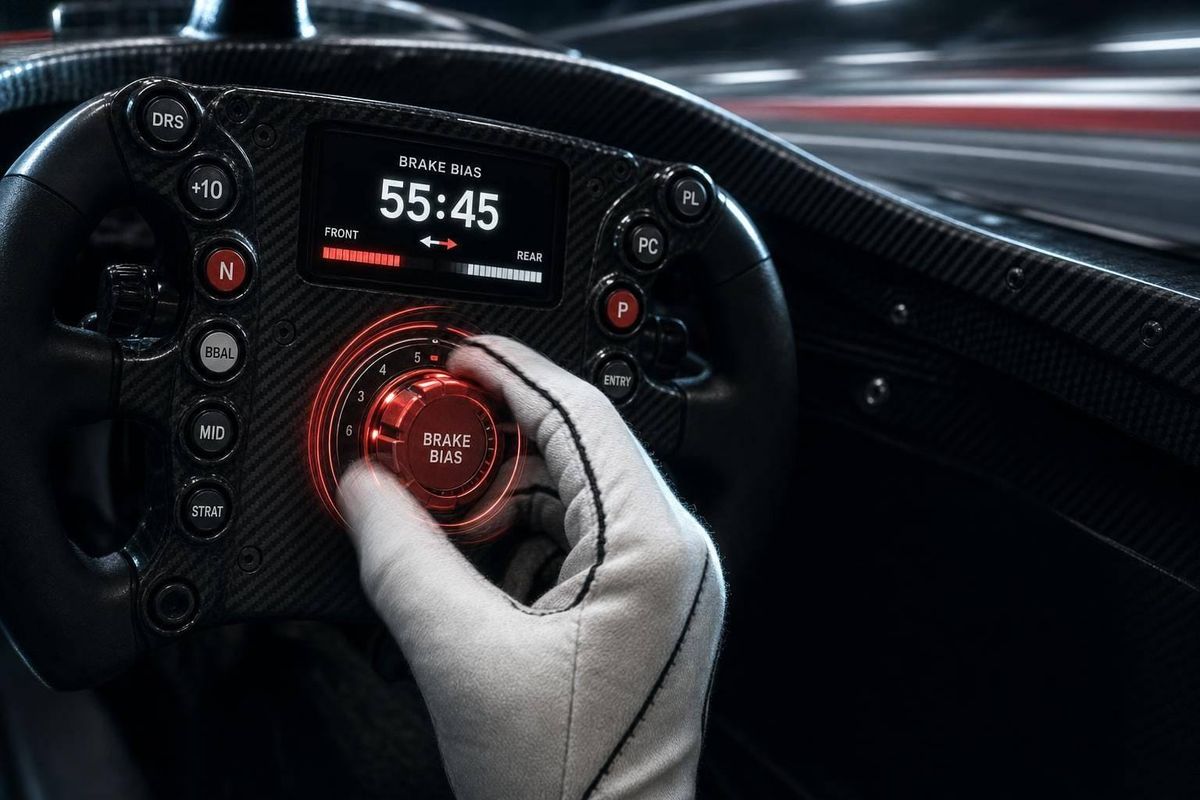
F1 drivers keep changing brake bias because one setting does not work for a whole race. I’d sum it up like this: they use the steering wheel to move braking force between the front and rear, usually within a 55% to 60% front window, to control stability, rotation, tire wear, and lockup risk.
If you want the short answer, here it is:
- I see more front bias used for heavy stops, low grip, dirty air, and cold tires.
- I see more rear bias used in slower corners where the driver wants the car to turn more.
- I see changes made in small clicks, sometimes corner by corner.
- I see teams start with a planned range, then adjust from telemetry, tire wear, fuel burn, and driver feedback.
- I see brake migration used alongside base brake bias, but it is not the same thing.
A tiny move matters here. Even a 1% change can alter how calm the car feels on entry, how it rotates in trail braking, and whether the front or rear locks first.
| Bias direction | What I’d expect |
|---|---|
| More front | Safer entry, less rear instability, more front lockup risk |
| More rear | More turn-in, more rear lockup risk, sharper car on entry |
So the main idea is simple: drivers are not chasing one perfect number. They are chasing the right feel for each corner and each phase of the stint.
How to adjust BRAKE BIAS
sbb-itb-7c68254
How Drivers Change Brake Bias From the Steering Wheel
Drivers change brake bias from the steering wheel with mapped rotary controls and buttons. Brake bias is one of the main settings they can change during a race.
Buttons, Rotary Switches, and Dash Readouts
Most modern F1 wheels use a mix of a rotary dial for bigger bias changes and BB+ / BB− buttons for smaller step-by-step adjustments. Teams map those BB+ and BB− steps to each driver's preference. That matters because the driver is always balancing entry stability against rotation.
The steering-wheel display shows the current brake-bias value as a front-percentage figure, such as 57.0% front. Drivers check that readout to make sure the setting is where they want it.
Some cars also have a brake migration control. Brake migration changes how the balance moves rearward as the driver comes off the brakes. It does not change the base bias setting.
That mix of controls gives drivers room to fine-tune balance for one corner or reset the car's default braking feel for the rest of the stint.
Quick Corner Tweaks vs. Stint-Long Baseline Changes
There’s a big difference between a quick corner tweak and a baseline change that stays in place for several laps. A driver might tap BB+ to add more front bias for a heavy braking zone, then tap BB− to move the balance rearward when a corner needs more rotation. That can all happen within the same lap.
A baseline change is more deliberate. The driver turns the rotary or makes a few button presses to shift the overall bias target, then leaves it there for a longer part of the stint.
FIA rules say brake-bias changes must be started by the driver, not adjusted automatically by software during braking. That control layout helps the driver make fast changes without upsetting the car.
How Drivers Adjust Brake Bias Corner to Corner
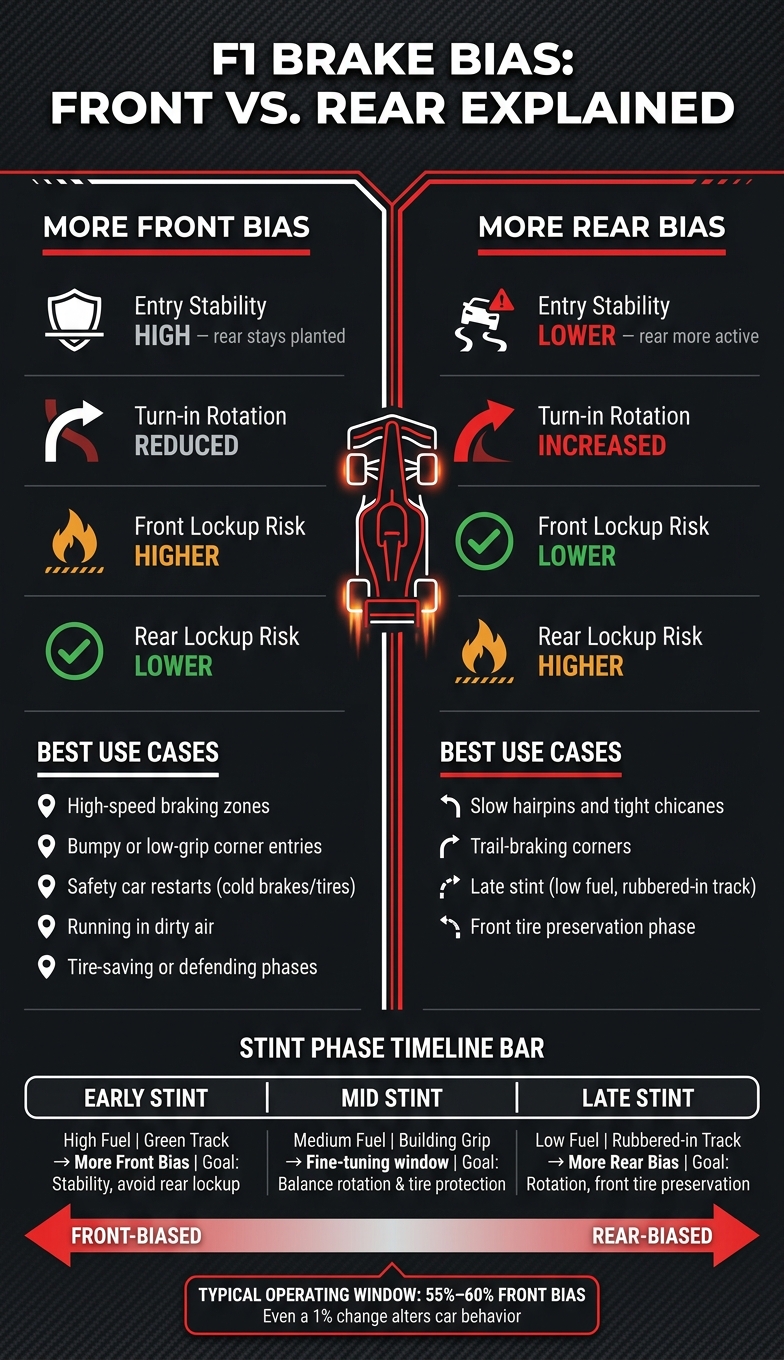
F1 Brake Bias: Front vs. Rear – When & Why Drivers Adjust
With the baseline set, brake bias turns into a corner-by-corner tuning tool. Drivers make small changes for each braking zone based on speed, braking distance, bumps, grip, and how calm the car feels on entry. That’s why they usually work in single-click steps instead of making big swings.
More Front Bias for Heavy Braking and Entry Stability
In a long, high-speed braking zone, adding front bias sends more braking force to the front axle. That helps stop the rear tires from locking at peak deceleration, which can lead to snap oversteer or even a spin.
It also makes the first hit of the brake pedal feel more planted and easier to trust, especially over bumps or on low-grip corner entries. On top of that, front bias can smooth out brake release, which helps the driver settle the car and get back to the throttle sooner.
More Rear Bias for Rotation in Slower Corners
Slower corners - like tight hairpins and low-speed chicanes - often suit more rear bias. When the front axle does a little less of the braking work, the car can rotate more easily on turn-in, helping it point at the apex earlier.
This matters a lot in trail-braking, where the driver keeps some brake pressure after turn-in to help the car change direction.
The catch is simple: rear lockup risk goes up. Since the rear tires carry less load under braking, too much rear bias can make them lock first, which can trigger snap oversteer or a spin. It also makes brake release sharper and less forgiving. The car feels less settled in trail-braking, so the driver has to modulate the pedal with extra care.
Front Bias vs. Rear Bias: Side-by-Side Comparison
The tradeoff is pretty simple: more front bias gives the driver more stability, while more rear bias helps the car rotate.
| Factor | More Front Bias | More Rear Bias |
|---|---|---|
| Entry stability | Higher - rear stays planted | Lower - rear more active |
| Turn-in rotation | Reduced | Increased |
| Front lockup risk | Higher | Lower |
| Rear lockup risk | Lower | Higher |
| Best use | High-speed stops, bumpy zones, low-grip entries | Slow hairpins, tight chicanes, trail-braking corners |
Those corner-by-corner calls also have to fit the bigger picture of a stint, where fuel burn and tire wear keep moving the target for ideal brake bias.
How Brake Bias Changes Across a Stint
Those corner-to-corner tweaks are part of a bigger stint plan. Brake bias doesn’t stay fixed for an entire run. It changes as fuel burns off, tires wear, brake temperatures move around, and track grip comes in. A car that begins at around 55–60% front may need a different target later, and teams usually map out that shift ahead of time.
How Fuel Burn Shifts the Bias Target
A full fuel load puts more demand on the car under braking, so teams usually start with a setting that leans a bit more to the front. As the fuel load drops, drivers often move the bias rearward in small clicks. That matches how the lighter car behaves, helps protect the front tires, and can make the car turn in better on corner entry.
This usually isn’t one big change. It’s more like a steady drift across the stint.
How Tire Wear and Temperatures Change the Balance
Tire condition is the other major factor. If the front tires start to grain, overheat, or lock again and again, that’s a sign they’re doing too much of the braking work. In that case, the usual move is to shift the bias rearward. That takes some load off the fronts and lowers the risk of flat spots.
If the rear of the car feels nervous under braking, the move goes the other way. Shifting the bias forward can settle the rear axle down. Put simply, the choice depends on which end of the car is giving up first.
Track grip matters too. Early in a stint, when the surface is green or only lightly rubbered in, drivers tend to want a safer, more front-biased setting. As rubber builds on the racing line and grip improves, they can usually run more rearward bias without setting off lockups.
Bias Trends by Stint Phase: Early, Mid, and Late
| Stint Phase | Fuel Load | Grip Level | Common Bias Direction | Main Driver Goal |
|---|---|---|---|---|
| Early | High | Lower (green track) | More front | Stability, avoid rear lockup |
| Mid | Medium | Building | Fine-tuning window | Balance rotation and tire protection |
| Late | Low | Higher (rubbered in) | More rear | Rotation, front tire preservation |
From there, engineers and drivers turn those patterns into live calls. Teams use stint trends like these to set lap-by-lap targets and radio prompts during the run.
How Teams Plan and Manage Brake Bias Changes During a Race
Pre-Race Bias Plans, Telemetry, and Radio Feedback
Race-day brake bias targets start with practice work and live telemetry. By the time Sunday arrives, teams already have a solid baseline built from Friday and Saturday race-stint simulations. In those runs, engineers track brake temperatures, lockup traces, and tire temperature trends for each corner on the circuit. That gives them a starting bias plus an acceptable range the driver can use during the race.
Before the race begins, teams also program brake-migration curves into the car. These shift the bias rearward as fuel burns off, helping the car stay in roughly the right operating window even if the driver doesn’t touch the setting manually. On top of that, the driver can make small trims from the steering wheel.
During the race, engineers watch live telemetry, including brake disc temperatures and brake pressures at all four corners. If the driver comes on the radio and reports front lockup or rear instability, the engineer checks the wheel-speed and brake-pressure traces for that part of the lap to see if the data lines up with the driver’s feel. Those checks help the team decide when the driver needs to move beyond the planned range.
Race Situations That Call for a Bias Change
The pre-race plan is just the opening setup. It’s not something drivers follow blindly. Several race situations can force a move away from the target window.
| Situation | Bias Direction | Reason |
|---|---|---|
| Safety car restart (cold brakes/tires) | More front | Stability into the first heavy brake zone |
| Running in dirty air | Slightly more front | Reduced rear downforce can make the rear feel light under braking |
| Defending or tire-saving phase | More front | Helps avoid rear overheating and preserves traction on exit |
During a safety car period, brake and tire temperatures fall away, so engineers will often ask for a more front-biased setting until grip comes back.
Following another car closely brings a different problem. Dirty air cuts downforce, and that can make the rear of the car feel nervous under braking. To settle it down, engineers may ask for a slight move forward in brake bias, even if it puts more load into the front tires. The same move can help any time rear stability drops off without warning.
Key Points to Remember
Brake bias is one of the settings drivers and teams manage most often over a full F1 race distance. Here’s how it fits together:
- Drivers adjust it manually from the steering wheel, making small changes from corner to corner and lap to lap.
- The best setting keeps moving based on entry stability, rotation needs, fuel burn, tire condition, and changing race conditions. Safety cars, dirty air, overtaking, and tire-saving phases can all pull the driver away from the planned target for a few corners or even the rest of the stint.
- Teams set a baseline curve before the race using practice data, then fine-tune it in real time through telemetry and short radio calls.
- Changes are small and deliberate so the car doesn’t become unstable.
FAQs
How often do drivers change brake bias in a race?
Drivers adjust brake bias all through a race. Sometimes it changes from one lap to the next. Sometimes it even changes from one corner to another. Using controls on the steering wheel, they fine-tune how the car feels under braking.
Why does that matter? Because the car never stays the same for long.
As fuel burns off, the car gets lighter. Tires wear down. Tire temperatures move up and down. Grip changes as the track evolves. Put all of that together, and the balance under braking can shift fast.
So drivers keep tweaking brake bias to match those changes. It helps the car stay settled, predictable, and fast.
Teams don’t leave this to guesswork, either. They often map out brake bias changes across a stint so the car stays balanced and efficient as conditions change.
What’s the difference between brake bias and brake migration?
Brake bias is the front-to-rear split of braking force. The driver sets it by hand with steering wheel controls, usually to match things like tire wear and fuel load.
Brake migration is different. It’s an automatic change in that balance during one braking event, shifting from the moment the driver hits the pedal as the car slows and turns toward the apex.
Can brake bias changes help prevent tire wear and lockups?
Yes. Adjusting brake bias helps control tire wear and cut down on lockups by shifting braking force between the front and rear wheels.
It also lets drivers adapt to changing conditions, like fuel burn and a track that gains grip over time. That helps keep the car stable under heavy braking and lowers the risk of overheating, sliding, or locking a tire.