F1 Diversity Charter: Impact On Talent Scouting
How F1's Diversity Charter widened recruitment routes but still struggles to convert access into engineering roles and top driver seats.
The short answer: the Charter has changed how F1 looks for talent more than who ends up getting picked.
If you want the full picture fast, here it is:
- F1, the FIA, and all 10 teams signed the Diversity and Inclusion Charter in November 2024
- The main goal is simple: change entry routes into engineering, team jobs, and driver programs
- Before the Charter, scouting was often shaped by elite school pipelines, referral networks, karting costs, and early bias
- On the driver side, money is still a big wall: junior racing can cost tens of thousands to hundreds of thousands of dollars per season
- Since 1950, only five women have raced in Formula 1
- 76% of parents see motorsport as a boys’ sport, which cuts the driver pool early
- Mercedes reported 38% of new hires from underrepresented groups in the first year of Accelerate 25, but much of that change came in non-engineering roles
- F1 Academy’s Wild Card route has helped 8 drivers move into full-time seats
- In September 2025, 18 female drivers took part in a rookie test with track, physical, and cognitive checks
So, what’s the takeaway?
I see two things. First, F1 now has more formal paths into the sport through internships, apprenticeships, scholarships, rookie tests, and academy scouting routes. Second, the hardest part has not changed enough yet: turning access into lasting movement into engineering teams and upper driver ladders.
That is the main test. Not press statements. Not top-line workforce totals. But whether shortlists, academy picks, and early career progress start to look different year after year.
Here’s the article in one plain-English view:
| Area | What changed | What still hasn’t changed much |
|---|---|---|
| Engineering hiring | More outreach, internships, and hiring reviews | Core STEM roles still move slowly |
| Driver scouting | Wild Cards, rookie testing, formal assessments | Cost barriers still block many drivers early |
| Workforce data | Some teams now publish hiring figures | Retention and long-term progress data are still thin |
| Female pathway | More testing and support systems | Higher-level promotions still take time to prove |
If you’re judging the Charter, I’d keep it simple: the process looks better, but the end results are still limited. That gap is the whole story.
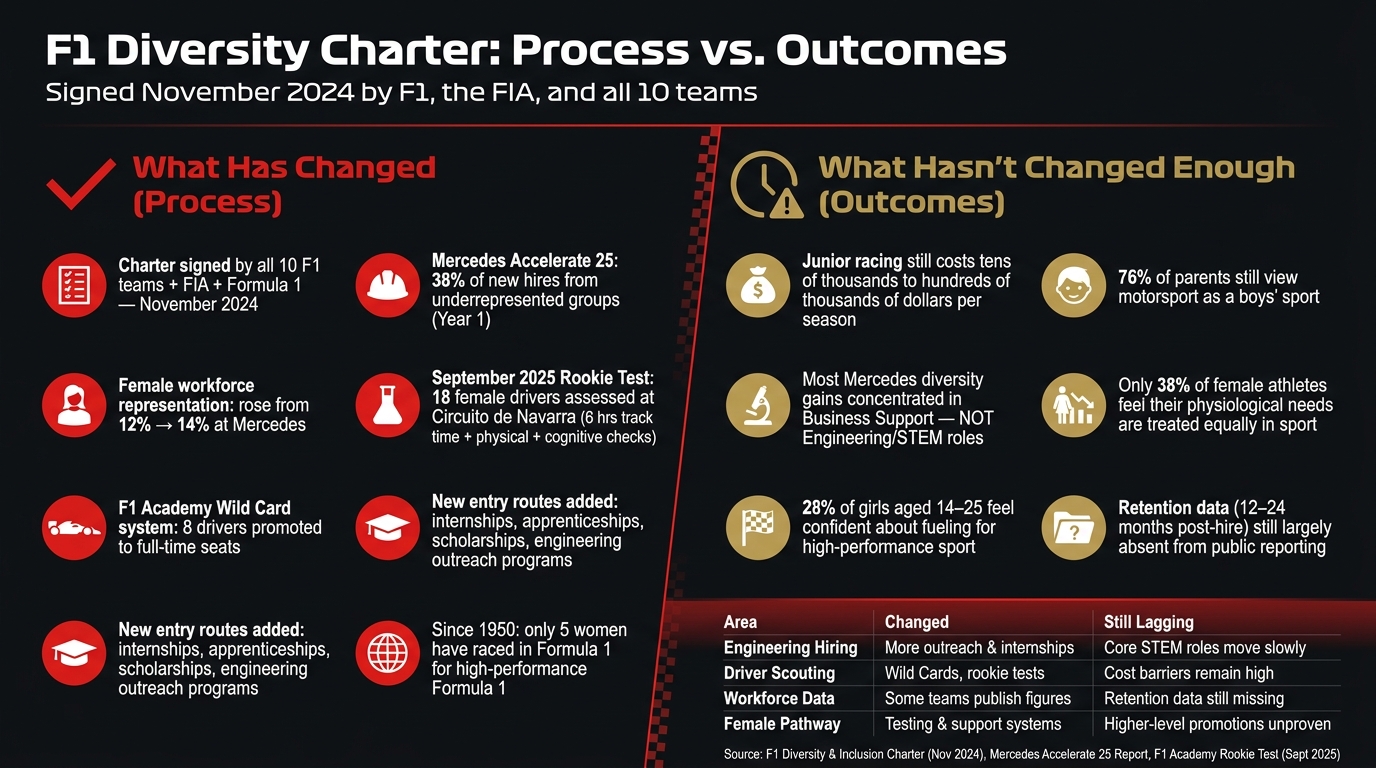
F1 Diversity Charter: Process Changes vs. Outcome Gaps (2024–2025)
Why F1's Old Talent Pipeline Left Out Too Many Candidates
Engineering and Operations Hiring: Narrow Feeder Systems
For years, engineering hiring drew from a small group of elite universities. That meant plenty of capable people never even made the shortlist. If a candidate was outside Europe, or outside the usual motorsport centers, their odds dropped even more. In practice, teams often hired through existing connections, so the workforce mirrored those networks instead of the full talent pool.
Even when teams faced budget pressure and talked about change, the technical side did not shift much. Mercedes' "Accelerate 25" program made most of its gains in business support roles, not in engineering or STEM jobs. So while top-line diversity figures looked better, the core technical pipeline stayed tight.
The same pattern showed up even earlier on the driver side.
Driver and Academy Selection: Cost, Karting Access, and Early Filtering
The first cut often happens before a young driver gets anywhere near an academy. Karting and junior single-seaters can cost tens or hundreds of thousands of dollars per season. That price tag pushes many drivers out before teams can judge their ability.
There is also a quieter filter at work. 76% of parents see motorsport as a boys' sport, which shrinks the pool long before formal scouting starts. So the issue is not just money. It is also who gets encouraged to try in the first place.
For female drivers who did move forward, another problem appeared: they were trained and judged against male-based benchmarks. Only 38% of female athletes feel their physiological needs are treated equally, and just 28% of girls ages 14 to 25 feel confident about how to properly fuel their bodies for high-performance competition. That means some "performance gaps" were not about talent at all. They were gaps in the data, support, and standards being used.
Put all of that together, and teams were losing candidates before they ever had a fair shot to measure actual performance.
Barrier Comparison Table: What Each Obstacle Does to Scouting
| Barrier | Direct Effect on Scouting |
|---|---|
| Technical recruitment gatekeeping | Elite university bias and informal referral networks limit engineering recruitment, reducing access for Black candidates, women, and lower-income applicants |
| Geographic concentration | Favors candidates near UK and European motorsport clusters, excluding talent from outside established racing hubs |
| High entry costs | Narrows the driver pool to those who can afford karting and junior formulas before academies can assess ability |
| Male-based benchmarks | Female drivers are assessed against male physiological standards, creating performance gaps that are actually data gaps |
| Perception and cultural bias | Parents discourage girls from entering the sport at the karting level, reducing the candidate pool before formal scouting begins |
| Lack of demographic data | Prevented teams from identifying where exactly the pipeline was losing diverse candidates |
As Mercedes team principal Toto Wolff said:
"We remain acutely conscious that this is a long-term commitment... building a pipeline of talent who we hope may consider joining us in the future."
That gap is exactly what the Charter tries to close through internships, apprenticeships, and outreach.
sbb-itb-7c68254
What the Charter Changed in Recruitment, Internships, and Outreach
From Open Promises to Clear Entry Routes
The formal Charter for Diversity and Inclusion, signed in November 2024 by Formula 1, the FIA, and all ten teams, was developed with the Royal Academy of Engineering and Mission 44. It moved the conversation from broad promises to clearer entry routes.
Teams were pushed to audit recruitment and widen long-term paths into the sport. That meant looking at hiring channels, spotting barriers for underrepresented groups, and shifting outreach toward STEM access, apprenticeships, and internships.
The clearest movement shows up in team hiring and academy intake.
Programs That Have Changed Where Teams Look for Candidates
Mercedes' Accelerate 25 is one of the clearest examples of how a team can widen the funnel before final hiring decisions are made. In its first full year, 38% of new hires came from underrepresented groups. Female representation rose from 12% to 14%, and minority ethnic representation went from 3% to 6%.
Those numbers matter. But there's a catch: most of that progress was concentrated in Business Support, not Engineering or other STEM roles, where budget caps make it harder to scale hiring changes.
A similar pattern shows up in junior-driver scouting. On the driver side, F1 Academy's Wild Card system turned into a formal scouting route, giving regional drivers a chance to compete in single races. Since then, eight Wild Card drivers have earned full-time seats in the series. Programs like Discover Your Drive and engineering scholarships also extend the pipeline into both driving and technical jobs.
In September 2025, F1 Academy held its first rookie test at Circuito de Navarra. Eighteen female drivers went through six hours of track time, along with physical and cognitive assessments run by More Than Equal. Katie Denver, F1 Academy's Performance & Talent Development Manager, said:
"Change demands meaningful action, and our mission is to create a clearer, more accessible pipeline that breaks down barriers, and creates a pathway for the most talented to succeed."
Charter Commitments vs. Reported Recruitment Changes: A Comparison
The table below shows where charter-level commitments have turned into reported action, and where the gap between process and results is still pretty wide.
These are process changes, not final results. The next step is figuring out how to judge whether they're working over time.
| Commitment | Mechanism | Public Metric | Current Gap |
|---|---|---|---|
| Broader workforce diversity | Mercedes "Accelerate 25" targeted recruitment and STEM outreach | 38% of new hires from underrepresented groups in year one | Budget caps limit diverse hiring in Engineering |
| Female driver pathway | F1 Academy Wild Card system and rookie test | 8 Wild Card drivers promoted to full-time seats; 18 rookies assessed in Sept. 2025 | Outcomes remain unproven at higher junior levels |
| Technical role access | F1 Academy engineering scholarships and Discover Your Drive | Structured support for female engineers and mechanics | Career outcomes are still being tracked; progress remains process-led |
| Early talent identification | Audi Revolut F1 Team in-house development program, launched Jan. 2026 under Allan McNish | Program active; scouting from karting ranks | It will take years to see whether prospects reach F1 seats |
How to Measure Progress and Where the Charter Falls Short
The Metrics That Matter More Than Headline Statements
The main question isn’t whether the charter produces good headlines. It’s whether it changes the scouting funnel.
That distinction matters because scouting metrics tend to move slowly. F1 team turnover is low, so big shifts won’t show up overnight. The harder thing to measure is also the thing that matters most: who gets noticed, who gets picked, and who keeps moving up.
Instead of leaning on company-wide totals, it makes more sense to track year-over-year new-hire mix by function and Wild Card-to-seat conversion. Those numbers get closer to what’s happening on the ground.
Retention is another weak spot. Hiring diverse candidates is one thing. Keeping them past the first 12–24 months is another. Right now, that data is still mostly missing from public reporting.
Why Progress Is More Likely to Be Gradual Than Rapid
The limits here are structural.
Budget caps restrict how many people teams can hire in the first place. And when headcount is tight, hiring in high-cost engineering roles is harder to scale than hiring in business support functions.
That’s a big reason progress is likely to be gradual. The charter can widen recruitment, but it can’t quickly remake the upstream pool teams scout from. So even when teams cast a broader net, results may take time to show.
The same logic applies to driver development. Rookie tests don’t prove talent in one session. They show progression over time.
What Can Be Measured vs. What Cannot: A Data Gap Table
The clearest way to see the problem is to split process metrics from the outcome data that’s still missing.
| Goal | Available Metrics | Missing Data / Blind Spots |
|---|---|---|
| Outreach | Number of applicants from underrepresented groups; partner program reach | Long-term STEM uptake |
| Scholarships | Number of engineering scholarships awarded; conversion rate to full-time employment | Retention rates of scholarship recipients after 3–5 years |
| Internships | Percentage of interns from underrepresented backgrounds; conversion to junior roles | Whether interns are placed in technical vs. administrative roles |
| Driver pipeline access | Number of Wild Card promotions to full-time seats | Socioeconomic background of drivers entering the academy system |
| Technical Hiring | Demographic splits across Business Support and Engineering functions | Impact of budget caps on the ability to hire diverse senior engineers |
| Driver benchmarking | Physical and cognitive assessments vs. F3/F4 standards | Longitudinal data on how benchmarks translate to results in higher tiers |
Process metrics are available. Outcome metrics are still missing.
How do F1 teams choose their future drivers? We ask the man who decides!
Conclusion: The Charter Has Changed the Search Process More Than the Final Outcomes
The Charter has changed how F1 looks for talent. The process is more organized now. But wider access still hasn't led to equal outcomes at the same rate.
You can see that most clearly in how teams recruit and judge candidates.
Mercedes' Accelerate 25 is a good example of that gap: 38% of new hires came from underrepresented groups, but budget caps meant most of those gains showed up in Business Support, not Engineering.
The driver path tells a similar story. The rookie test made evaluation more consistent, but it still didn't guarantee a promotion.
Key Takeaways for Readers Tracking F1's Talent Pipeline
That's the lens readers should use when judging the Charter.
The pipeline was already narrow before the Charter. Karting cost a lot, and access to engineering was uneven. The Charter has added more credible ways in, but the biggest roadblocks still sit both inside and outside F1's control.
Inside F1, budget caps limit technical hiring. Outside F1, early access to karting and engineering education is still far from equal.
Some teams have gone further than others. Mercedes has published workforce data. F1 Academy has added standardized benchmarking and Wild Card routes, and those routes have led to eight full-time seat promotions since the system launched.
The next test is simple: do these routes become lasting paths into core technical jobs and driver ladders? In plain English, are different candidates being found, funded, and moved forward on a steady basis, or are they mostly being highlighted in press releases?
Right now, the process has changed more than the outcomes. That gap is what the Charter still has to answer.
FAQs
How will success be measured over time?
Success will show up in workforce data and in the long-term talent pipeline. Teams can track representation across underrepresented groups within their staff. And the sport can look at how well talent progresses through Formula 3, Formula 2, and then into Formula 1.
Programs like F1 Academy also use physical and cognitive benchmarking to measure individual growth and guide future hiring decisions.
Why are engineering roles changing more slowly?
Engineering roles in Formula 1 are changing at a slower pace for two main reasons: system-level barriers and day-to-day limits inside teams.
One issue starts with hiring. Many teams still lean on a small circle of top universities, which keeps recruitment tight and a bit closed off. The result is a narrower candidate pool, even when strong talent exists outside those routes.
There are also bigger pipeline problems in play. Limited access to STEM education, fewer visible role models, and bias in academic pathways all make it harder for more people to reach these jobs in the first place. By the time teams are hiring, part of the field has already been cut down.
Budget cap rules add another layer. When teams have to make hard choices about headcount, they may put more focus on business support roles instead of adding engineering and technical staff. So even when there’s interest in change, the room to grow those teams can be tight.
Can the Charter really reduce driver cost barriers?
Not directly. The Diversity and Inclusion Charter doesn't remove the high cost of racing itself, but it does set a clear framework for cutting some of the money barriers through targeted programs.
In practice, that can mean support like scholarships, apprenticeships, and more accessible talent pipelines. It also includes structured programs like F1 Academy, which give talent a fairer path to grow without relying only on the usual high-cost routes.