How F1 Teams Partner with Universities
How F1 teams partner with universities to solve engineering problems, protect data, and recruit talent under 2026 rules.

F1 teams work with universities to solve engineering challenges, develop cutting-edge tools, and recruit top talent. These partnerships combine academic research with F1's fast-paced innovation needs. For example, Mercedes-AMG PETRONAS collaborated with Imperial College London in 2025 to create the RSRL model, improving race strategies by outperforming traditional methods during simulations.
Key insights from these collaborations include:
- Specialized Expertise: Universities contribute knowledge in areas like aerodynamics, fuel chemistry, and race strategy optimization.
- 2026 Regulations: New rules, including active aerodynamics and a 50/50 electric-ICE engine split, make academic input more important than ever.
- Recruitment Pipeline: Programs like Formula Student and internships help teams identify and train future engineers.
- Data Security: Teams use abstraction layers to protect proprietary systems while enabling academic research.
These partnerships deliver measurable results, from technical advancements to a steady flow of skilled engineers, ensuring F1 teams stay competitive in a rapidly evolving sport.
KAUST and McLaren Racing: A winning formula for innovation and impact
sbb-itb-7c68254
Identifying the Right Partnership Needs
F1 2026 Regulation Changes: Technical Challenges & University Expertise Needed
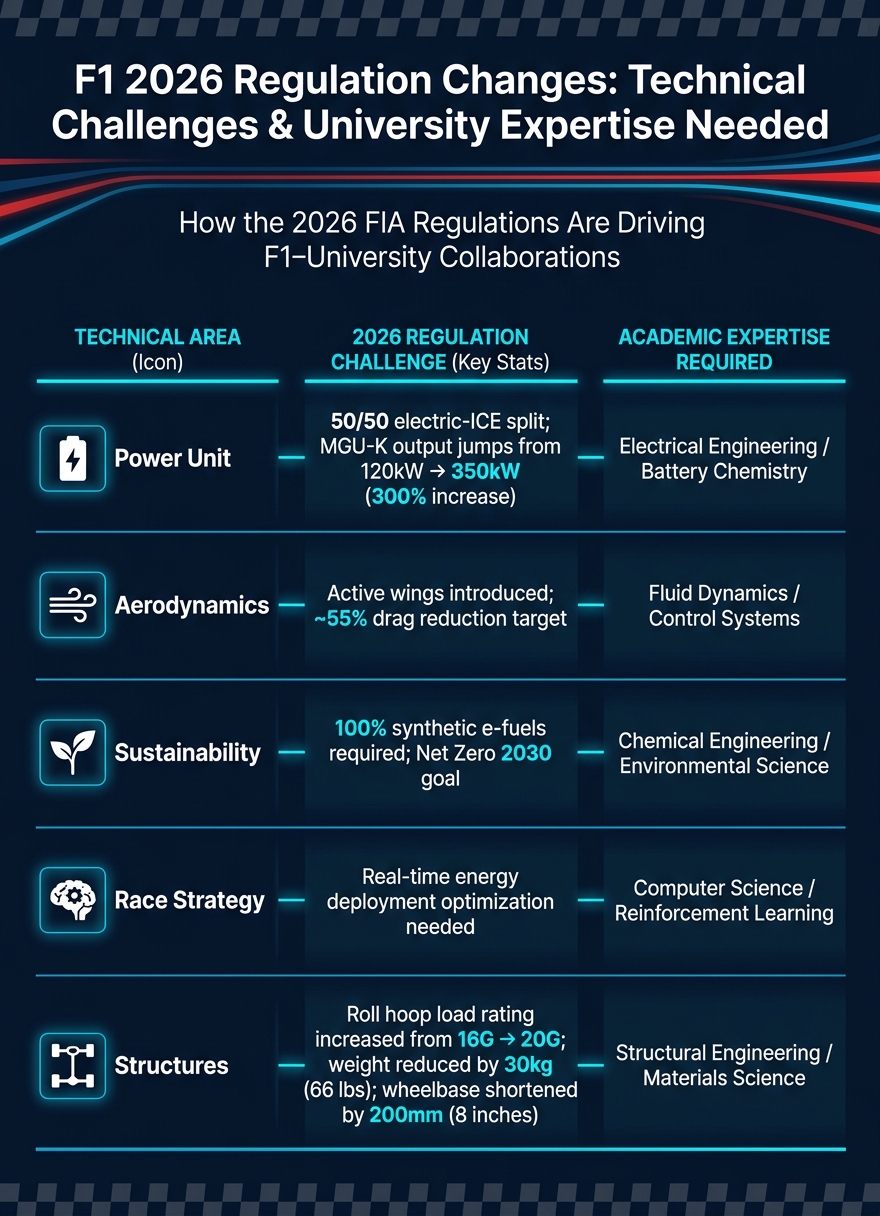
F1 teams need to start by taking a hard look at their internal capabilities. Whether it’s aerodynamics, power unit performance, materials science, or race strategy, pinpointing the areas where in-house solutions fall short is crucial. The upcoming 2026 regulation changes add even more complexity to this process. These include a 50/50 split between internal combustion engines (ICE) and electric power, a 300% increase in battery output (from 120kW to 350kW), active aerodynamic components, a 66-pound (30kg) weight reduction, and a shorter wheelbase by 8 inches (200mm). Each of these changes introduces a unique technical hurdle, often requiring input from specialized academic departments. By clearly identifying these gaps, teams can align their needs with the specific expertise universities offer.
Matching Team Goals to Academic Strengths
Past collaborations, like the one between Imperial College and Mercedes-AMG PETRONAS, highlight the importance of precision in defining research needs. Teams that focus on specific bottlenecks - rather than broad research areas - are more likely to see tangible results. For instance, when traditional Monte Carlo simulations fell short for real-time race strategy, Mercedes-AMG PETRONAS didn’t just seek a generic "data science partner." Instead, they collaborated with Imperial College London’s Department of Computing to create a Reinforcement Learning model tailored for race strategy. This targeted approach delivered measurable improvements.
Fuel chemistry offers another great example. According to ExxonMobil’s Matti Alemayehu:
"The 2026 FIA regulations require fuels derived from what the rules define as 'Advanced Sustainable Components,' such as municipal waste and second-generation, non-food biomass."
To meet this challenge, ExxonMobil pulled together 75 specialists and tested over 100 fuel formulations across three years. Teams tackling similar challenges need partners with expertise in molecular engineering and environmental science, not just generic chemistry departments. Precision in matching needs to expertise is what makes partnerships effective.
Choosing the Right University Partners
Once teams understand their specific needs, selecting the right university becomes a more practical process. While research reputation is important, it’s not the sole factor. Teams also evaluate whether the university has the right infrastructure, such as Driver-in-the-Loop (DIL) simulators, wind tunnels, or advanced fuel analysis labs. Another critical consideration is whether faculty members can work under strict confidentiality agreements while handling proprietary data.
Having faculty with industry experience is another major advantage. Former F1 engineers who transition into academia bring a unique perspective - they know how to translate research into real-world applications, like improving car performance on the track, rather than just producing academic papers. This ability to bridge theory and practice often determines whether a partnership thrives or stalls.
| Technical Area | 2026 Challenge | Academic Strength Needed |
|---|---|---|
| Power Unit | 50/50 electric-ICE split; 350kW MGU-K | Electrical Engineering / Battery Chemistry |
| Aerodynamics | Active wings; ~55% drag reduction | Fluid Dynamics / Control Systems |
| Sustainability | 100% synthetic e-fuels; Net Zero 2030 | Chemical Engineering / Environmental Science |
| Race Strategy | Real-time energy deployment | Computer Science / Reinforcement Learning |
| Structures | Roll hoop loads increased from 16G to 20G | Structural Engineering / Materials Science |
This table shows just how specific the matching process needs to be. A university with a strong chemical engineering department might be perfect for fuel development but entirely unsuited for research into active aerodynamics. Getting these alignments right from the start saves both time and resources for everyone involved.
Setting Up Joint Research Projects
Once you've chosen a university partner, it's critical to establish clear agreements upfront. Define the project scope, set realistic timelines, clarify data access protocols, and address intellectual property (IP) rights to avoid misunderstandings down the line.
Funding Models for Joint Research
Strong collaborations depend on well-structured funding plans tied to clear project goals. Funding alone isn't enough - timelines play an equally important role. Hywel Thomas, Managing Director of Mercedes-AMG HPP, emphasizes this need for speed:
"What distinguishes this era is the pace at which we must learn... We can't rely on long testing cycles to polish solutions; we must design, simulate, validate, and refine in tighter intervals."
This fast-paced environment shapes how projects are scoped. For example, short-term goals like improving an aerodynamic component might be tackled within 12 to 18 months. On the other hand, longer-term efforts, such as developing sustainable fuels, call for more extensive planning and resource allocation. A well-thought-out funding structure ensures teams can align their research timelines with these objectives.
Using Facilities and Sharing Data
Beyond funding, access to specialized facilities and secure data-sharing mechanisms is essential for advancing joint research projects. Universities often provide cutting-edge infrastructure, such as computational fluid dynamics labs or materials testing equipment, which can complement proprietary tools and race data.
However, balancing data security with effective collaboration is crucial. A standout example is the 2025 partnership between Mercedes-AMG PETRONAS and Imperial College London. They implemented a "translator layer" using UnifiedRaceState and UnifiedRaceStrategy software. This allowed researchers to develop and test reinforcement learning (RL) models without exposing sensitive Monte Carlo simulator code. The result? A scientifically robust and commercially secure system. The RL model achieved an average simulated finishing position of P5.33 at the Bahrain Grand Prix, outperforming the baseline P5.63.
This method of separating research layers from proprietary systems offers a win-win. University researchers can tackle real-world problems, while teams maintain their competitive edge by safeguarding sensitive data and technology.
Building a Talent Pipeline Through University Partnerships
F1 teams don’t just rely on cutting-edge technology to stay ahead - they also need a steady stream of top talent. Partnering with universities gives these teams a way to identify promising engineers early, sometimes even before they officially enter the job market.
Using Formula Student and Racing Competitions
Formula Student has become a key tool for spotting future motorsport talent. In this competition, students design, build, and race a single-seat car, tackling real-world challenges like aerodynamics, weight distribution, and powertrain integration. For F1 teams, it’s a chance to observe how students handle complex trade-offs under intense time pressure - something no traditional interview can replicate.
This competition is more than just a showcase of technical skills. It reveals how students deal with setbacks, collaborate with teammates, and turn theory into practice - all qualities that are essential in the fast-paced world of F1. Many teams go beyond simply watching these events. They send engineers to judge, host workshops, or even mentor participants, turning these events into active recruitment opportunities. Beyond the racetrack, structured programs help refine their initial impressions of potential hires.
Internships and Graduate Recruitment Pathways
Internships and graduate programs are another way F1 teams bridge the gap between academic learning and the demands of high-performance motorsport. Take the Mercedes-AMG PETRONAS Junior Programme, for example: it provides a clear route from junior racing roles to essential technical positions.
By February 2026, three alumni of this program - George Russell, Kimi Antonelli, and Fred Vesti - were integral to the team. Fred Vesti’s role as Third Driver highlights the program’s focus on engineering literacy. His responsibilities include ensuring the simulator delivers consistent performance between races and maintaining technical continuity, a role that requires far more than just driving skills. Toto Wolff, CEO and Team Principal of Mercedes-AMG PETRONAS, summed it up well:
"George, Kimi, and Fred represent everything our driver programme stands for... that collaboration - on track, in the simulator, and within the garage - will be an important force in driving the team forward."
The same principles apply to engineering recruits. Internship programs often involve rotations through departments like aerodynamics, vehicle dynamics, or data analysis. This setup allows teams to evaluate potential hires while giving graduates hands-on experience. By the time they’re hired, these recruits need minimal additional training.
Shaping University Curricula for Motorsport
F1 teams don’t just recruit from universities - they also help shape what students learn, ensuring graduates are equipped with the skills the sport demands.
Dr. Sammy Diasinos, a former Williams F1 engineer turned lecturer at Macquarie University, is a great example. He uses his industry experience to teach students about F1 car design, including the transition from ground-effect aerodynamics to the active aerodynamics required by the 2026 FIA regulations. This kind of curriculum alignment ensures graduates are ready to hit the ground running.
Teams also contribute by offering guest lectures, setting capstone project challenges, and co-supervising dissertations. For instance, a final-year project might focus on solving a real aerodynamic issue or improving fuel efficiency to meet the 2026 mandate for 100% sustainable fuel. These experiences give students practical knowledge they can immediately apply in their careers, allowing F1 teams to develop a talent pool without needing to create extensive internal training programs.
Measuring and Improving University Partnerships
How Teams Measure Partnership Success
F1 teams rely on various metrics to evaluate the success of their collaborations with universities. These include technical advancements, research contributions, recruitment outcomes, and adherence to regulatory standards.
One standout metric is performance benchmarking, which involves comparing the results of university-developed models to the team's existing methods. For instance, in January 2025, researchers from Imperial College London's Department of Computing - Devin Thomas and Junqi Jiang - teamed up with Mercedes engineers Aaron Russo and Steffen Winkler to create RSRL, a reinforcement learning model designed for race strategy. When tested in a simulated 2023 Bahrain Grand Prix scenario, the RSRL model delivered an average finishing position of P5.33, surpassing the team's Monte Carlo baseline of P5.63.
Beyond performance, teams monitor research outputs, recruitment progress, and regulatory compliance. Here's a breakdown of the key metrics they use:
| Metric | What It Measures |
|---|---|
| Technical Gains | Enhancements in areas like energy recovery, aerodynamic performance, or strategy precision |
| Research Outputs | Contributions such as co-authored papers, new models, or certified fuel formulations |
| Recruitment Results | Successful integration of PhD and master's students into team projects |
| Regulatory Compliance | FIA approval of components developed through the partnership |
While these metrics provide a clear framework for assessing partnerships, achieving these results often involves navigating significant challenges.
Common Challenges and How to Handle Them
Even with robust metrics in place, practical obstacles can hinder the success of these partnerships. Common issues include confidentiality concerns, mismatched timelines, and skepticism toward AI models.
To safeguard proprietary data, teams can implement abstraction layers like UnifiedRaceState. These layers allow academic models to interact with simulators without exposing sensitive information. As explained by the researchers:
"By defining a custom UnifiedRaceState and UnifiedRaceStrategy classes with a translator layer in between, the model maintains its interoperability with the race simulator and decouples RSRL from the black-box." - Devin Thomas et al., Imperial College London
Building trust in AI-generated outputs is another critical step. Techniques like Explainable AI (e.g., TimeSHAP, VIPER) can help by breaking down complex model behaviors into actionable insights. Lastly, the timing mismatch between academic research schedules and the fast-paced demands of the racing season can be mitigated by using quicker reinforcement learning models as alternatives to resource-intensive Monte Carlo simulations.
Conclusion: Why F1–University Partnerships Work
F1–university partnerships thrive because they blend cutting-edge research, technical innovation, and a steady flow of skilled talent to meet the sport's evolving demands.
The multidisciplinary challenges of F1, especially with the sweeping 2026 regulations, make academic collaboration indispensable. Universities bring specialized research capabilities that align perfectly with F1's need for rapid advancements - whether it's optimizing race strategies or innovating with sustainable fuels.
These partnerships also help bridge the gap between theory and practice. Former F1 engineers who transition into academia enrich educational programs with real-world insights, ensuring that graduates are ready to make an immediate impact in the industry.
As F1 becomes increasingly reliant on synthetic fuels and advanced materials science, the stakes have never been higher. Teams with strong academic alliances are better positioned to navigate these technological challenges. In a sport where even the smallest gains can determine victory, these collaborations are proving to be a crucial advantage.
FAQs
What do F1 teams gain from university partnerships?
F1 teams collaborate with universities to tap into specialized knowledge, cutting-edge research, and highly skilled talent - key ingredients for thriving in the fiercely competitive world of Formula One engineering. These partnerships address complex challenges such as improving aerodynamics, adapting to new regulations, and innovating with materials. Through academic research, teams boost car performance and maintain their edge in the sport's constantly shifting technical arena.
How do teams share data without risking secrets?
F1 teams go to great lengths to protect their innovations. They keep development processes in-house and follow strict regulations to avoid leaks. When working with external partners, teams rely on controlled environments, such as on-site labs, to safeguard their intellectual property. Additionally, the FIA enforces financial rules and reporting standards that balance confidentiality with necessary information sharing. For a deeper dive into how these measures shape the sport, F1 Briefing provides detailed analysis.
How can students use Formula Student to get hired?
Students can use Formula Student as a stepping stone to land roles with Formula One teams. This competition offers a chance to gain real-world engineering experience in environments that mirror professional standards. By designing, building, and testing race cars, participants demonstrate their technical skills and ability to work as part of a team - two traits highly valued by F1 teams when recruiting fresh talent.