Undercut vs Overcut: Tire Strategy Impact
When to undercut or overcut in F1: balance tire wear, warm‑up, pit loss and traffic to pick the fastest pit call.
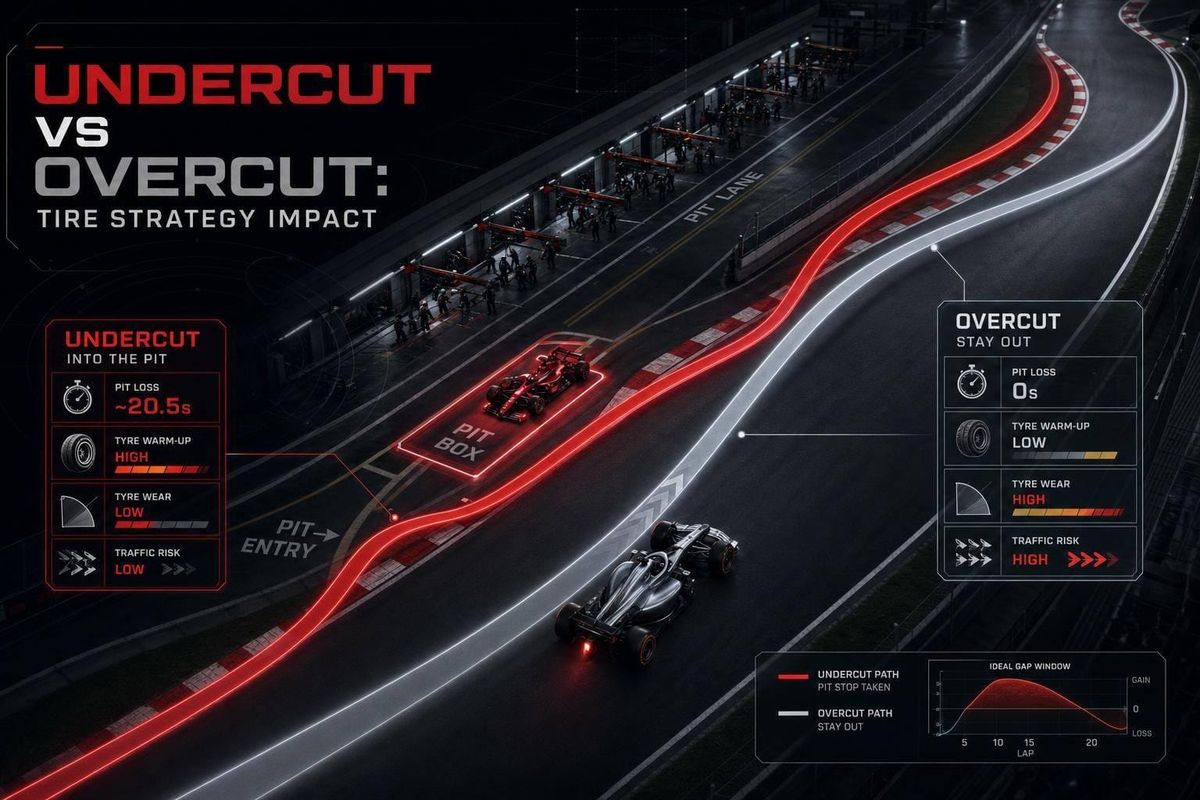
In F1, the undercut wins when tire drop-off is steep and a new set works on the out-lap. The overcut wins when warm-up is slow and the old tires still hold pace.
If I had to boil the whole topic down, it’s this:
- Undercut: pit first, then use the new tires to gain time at once
- Overcut: stay out longer, then gain time while the other car’s new tires are still coming in
- The call depends on tire wear, temperature, out-lap speed, in-lap speed, traffic, pit-lane loss, and track position
- In most cases, the swing happens over 1 to 3 laps
- If the pace gap after the stop is only small, either move can work
A simple way I look at it: which changes faster - old-tire lap-time loss or new-tire warm-up? That usually decides the move.
Quick Comparison
| Factor | Undercut | Overcut |
|---|---|---|
| Pit timing | Stop before rival | Stop after rival |
| Main time gain | Out-lap after the stop | Laps before own stop |
| Tire pattern needed | High wear, strong grip right away | Low wear, slower warm-up |
| Best track type | Tracks where tire pace drops fast | Tracks where old tires stay steady |
| Main risk | New tires take too long to work | Old tires lose too much pace |
| Key data teams watch | Out-lap delta, pit loss, traffic | Old-tire pace, temp trend, gap control |
In other words: this isn’t just about pitting early or late. It’s about matching the stop to how the tires behave lap by lap.
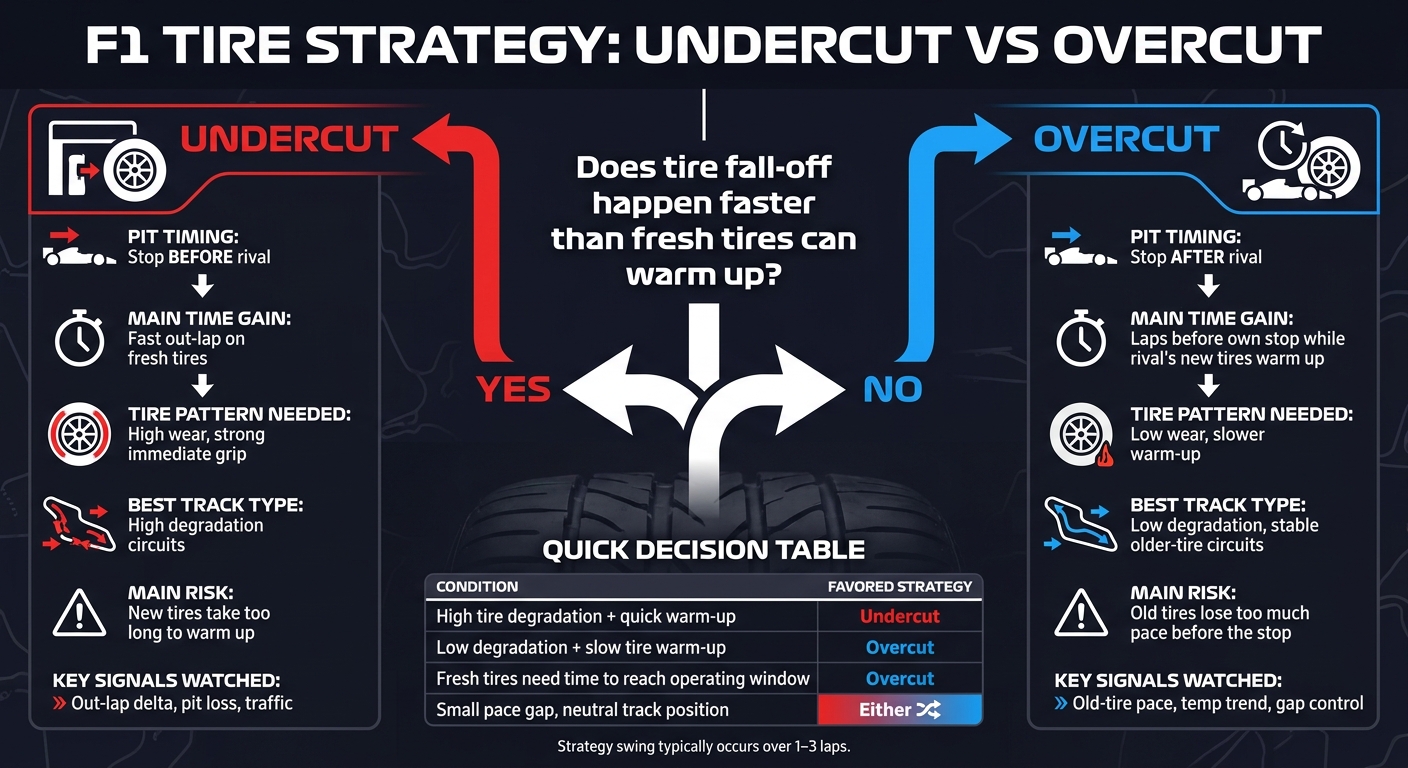
F1 Tire Strategy: Undercut vs Overcut Explained
F1 Undercut vs Overcut Explained
sbb-itb-7c68254
How each strategy creates a lap-time gain
The gap comes down to where the time is gained: right after the stop, or in the short spell before the other driver's new tires come alive.
Undercut
The undercut works when fresh tires give a big enough pace advantage to beat the time lost in the pit lane. It usually comes down to three laps: a quick in-lap, a clean stop, and a fast out-lap.
That last part is often where the whole move stands or falls. If the new tires get up to operating temperature fast, the driver can eat into the gap before the rival pits. The out-lap matters most because tire behavior changes the most there. If warm-up takes too long, the gain disappears.
Overcut
The overcut works when older tires can hang on for long enough to cancel out the other driver's warm-up loss. Fresh tires often need a lap or two before they hit peak grip.
If the driver who stays out can keep lap times steady during that stretch, and the tire remains inside its usable window, the overcut can wipe out the rival's new-tire edge. In some cases, it can even build enough margin to pit later and still keep the position.
The whole thing depends on keeping degradation under control. The tires need to stay quick enough to protect the gap, but not so worn that the pace drops off a cliff. That's the trade-off shown in the table below.
| Undercut | Overcut | |
|---|---|---|
| Pit timing | Earlier than rival | Later than rival |
| Tire state at stop | Older, but still usable | Stint extended on worn tires |
| Pace requirement | Fast in-lap and strong out-lap on fresh tires | Stable lap times on older tires |
| Best-use conditions | Strong immediate out-lap pace | Slow warm-up, steady older-tire pace |
| Main risk | New tires do not reach operating temperature fast enough | Older tires lose too much pace before the stop |
Tire degradation and temperature: the technical factors that shift the balance
That lap-time gap isn’t fixed. Tire degradation and temperature decide how big it gets.
At its core, undercut vs. overcut comes down to one thing: does tire fall-off happen faster than fresh tires can warm up? Whichever factor moves faster usually decides the call.
Wear rate, thermal degradation, and compound behavior
Tire performance drops in two main ways. Abrasion wear strips rubber from the surface. Thermal degradation happens when the tire overheats and loses grip.
That matters because softer compounds can fade fast. When they do, they create the pace difference that the undercut relies on. Harder compounds usually degrade at a slower rate, so the gap between old tires and new tires gets smaller. And when that gap shrinks, the undercut loses a lot of its bite.
Saudi Arabia made that pretty clear: low degradation kept older tires in the fight, so the fresh-tire edge was too small to swing the undercut.
But low wear doesn’t settle it on its own. Sometimes the temperature trend still calls the shot.
Warm-up phase and operating window
Fresh tires only come alive once they hit the operating window. On high-energy circuits, that can happen fast. On cooler tracks, or layouts that put less load into the tire, it can take longer. That’s where the overcut starts to look stronger.
If the driver who stays out can keep lap times stable while the new set is still warming up, that driver can protect the gap - or even stretch it. That’s the exact dynamic behind the track conditions and race context in the next section.
Track conditions and race context: when each strategy works best
Once you understand tire degradation and warm-up, the next piece is the track itself. Circuit layout often decides which tire edge matters more. And that can flip the script fast: the same tire may support one strategy at one circuit and the opposite approach at another.
Circuit layout, overtaking difficulty, and clean air
Race context decides whether the theory turns into an on-track gain. Clean air can tilt things toward the undercut, because a driver on fresh tires can use peak grip without getting stuck in traffic.
| Circuit characteristic | Strategy that tends to benefit |
|---|---|
| High tire degradation, difficult overtaking | Undercut |
| Low tire degradation, slow tire warm-up | Overcut |
The key issue is simple: does the fresh-tire pace show up early enough to cover the time lost in the pit stop?
Track layout sets the starting point. But traffic and pit-lane risk often decide whether that edge still holds after the stop.
How to choose the right strategy in real time
What teams monitor before making the call
Live tire data turns the undercut-versus-overcut decision into a simple pace-versus-loss math problem.
The main question is straightforward: Will the fresh-tire out-lap be faster than the rival’s current lap pace by more than the pit-loss gap? If the answer is yes, the undercut starts to look strong. If not, staying out can make more sense.
To make that call, engineers watch a tight set of live signals:
- Lap-time delta to the car ahead or behind
- Tire age
- Surface and carcass temperature trends
- Fuel-corrected pace
- Degradation rate, lap by lap
Then they stack those inputs against pit-loss, traffic, and Safety Car risk before they commit.
Key takeaways
The undercut and overcut are not interchangeable. Each one fits a different tire profile.
The undercut works best when tire degradation is high and fresh tires switch on fast. The overcut makes more sense when worn tires stay stable and new tires need longer to hit their operating window.
That’s why teams often boil the decision down to a few simple rules:
| Condition | Favored strategy |
|---|---|
| High tire degradation, quick warm-up | Undercut |
| Low degradation, slow tire warm-up | Overcut |
| Fresh tires need time to reach the operating window | Overcut |
| Small pace gap, neutral track position | Either strategy |
In plain English, the right move is the one that lines up with tire behavior and the lap-time data right in front of the team.
FAQs
How much time can an undercut usually gain?
It depends on the track, how fast the tires wear, the gap between compounds, and how long each stint lasts.
As a rule of thumb, tires that are 10 laps fresher can be worth about 1.0 second per lap compared with older rubber.
That said, an undercut is never a sure thing. A pit stop delay of just 0.3 to 0.4 seconds can cancel out the edge. Traffic after the stop can do the same.
Why do new tires sometimes make the overcut stronger?
The overcut tends to work best on tracks with low tire wear and in cooler conditions. In those cases, a driver can stay out longer without giving up much pace.
If they can keep posting strong lap times on older tires while rivals get stuck in traffic or struggle to switch on their new rubber right away, they have a shot at gaining track position and coming out ahead after their stop.
How does traffic affect the undercut or overcut call?
Traffic can make or break a pit strategy.
With an undercut, the whole idea is simple: pit, bolt on fresher and faster tires, then use that extra pace in clear air. But there’s a catch. If the driver comes back out behind slower cars, that edge can disappear fast.
An overcut tends to work when the rival pits into traffic. If that happens, the driver who stays out gets to keep lapping in clear air, which can help maintain the gap or even stretch it a bit more.