AI and Reinforcement Learning in F1 Simulations
Layered use of RL, supervised learning, PINNs and MPC in F1 simulations for strategy, prediction, and physics-aware control.
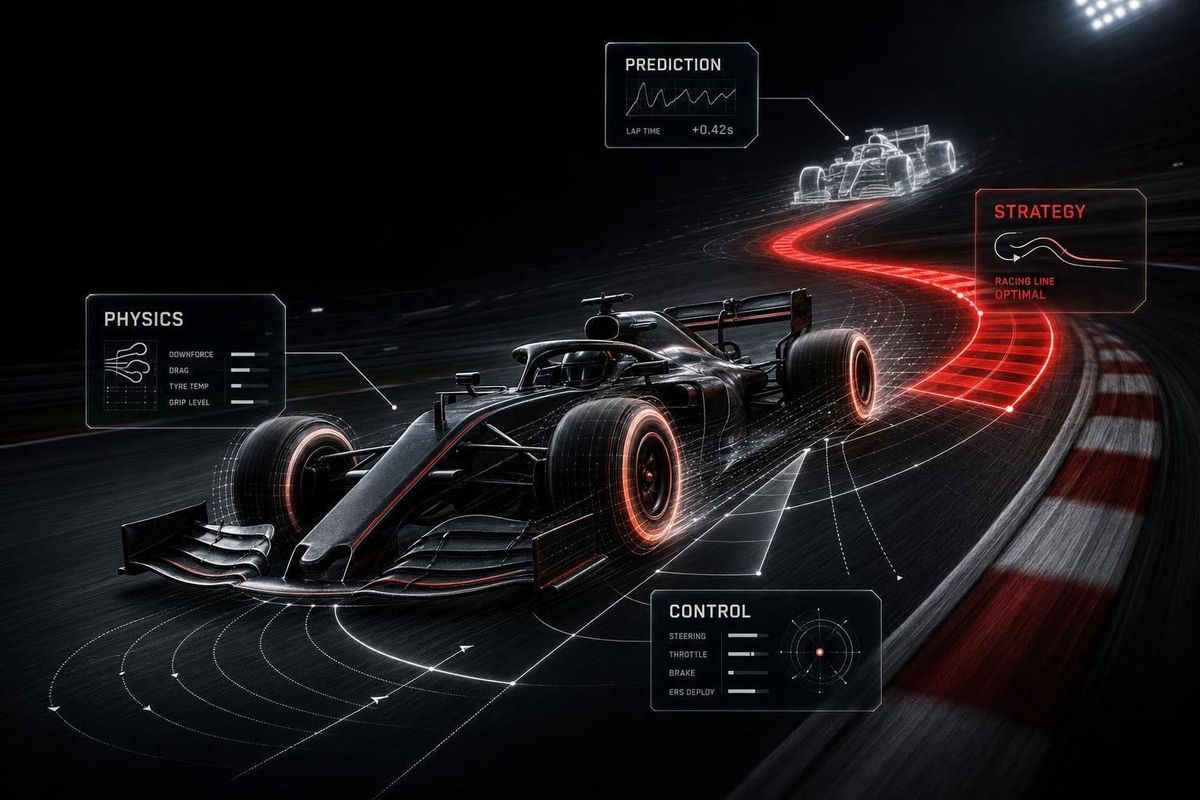
If I had to boil this down to one point, it’s this: no single AI method runs F1 simulation well on its own. I’d use reinforcement learning for race decisions, supervised models for fast predictions, PINNs when physics must stay in the loop, and MPC/optimal control when rules and limits drive the choice.
Here’s the short version:
- RL fits race decision chains like pit timing and tire calls. In one June 2026 study, RSRL reached P5.33 in a 2023 Bahrain GP sim, beating a rule-based and Monte Carlo baseline at P5.63.
- Supervised learning fits prediction jobs like lap time, tire wear, and pit-window estimates. The Virtual Strategy Engineer was trained on 131,527 laps from 121 races.
- PINNs are best when data alone is not enough and the model needs physics rules built in.
- MPC and optimal control are best when the goal and limits are clear, but they can struggle when race conditions shift fast.
What stood out to me most is the split between prediction and decision-making. Some tools answer “What is likely next?” Others answer “What should we do now?” In F1, that difference matters.
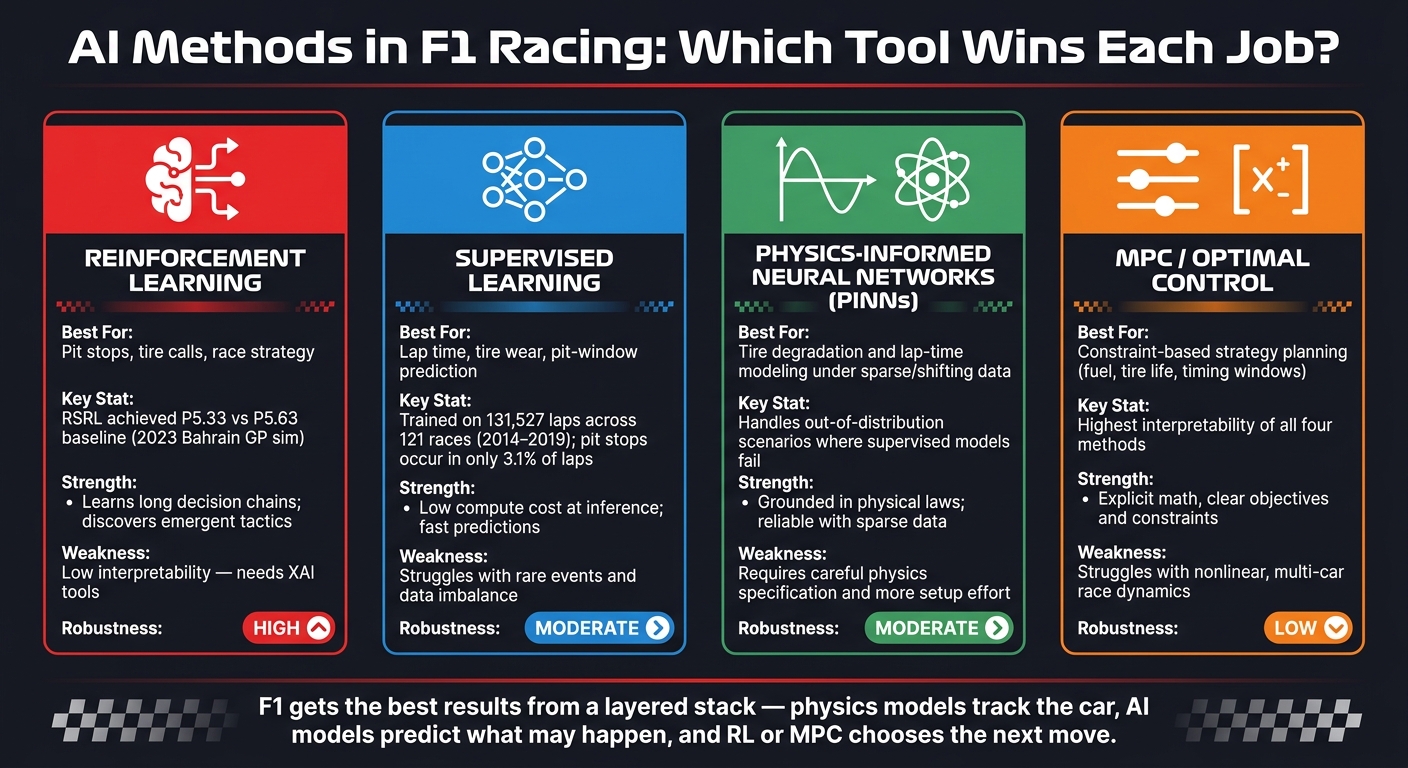
AI Methods in F1 Racing: Which Tool Wins Each Job?
DeepRacing AI - Autonomous Formula One Racing
sbb-itb-7c68254
Quick Comparison
| Method | Best for | Main strength | Main limit |
|---|---|---|---|
| Reinforcement Learning | Pit stops, tire calls, race decisions | Learns long decision chains | Hard to explain |
| Supervised Learning | Lap time, tire wear, pit-window prediction | Low-cost inference | Weak on rare events |
| PINNs | Tire and pace models with physics rules | Holds up better with sparse or shifted data | More setup work |
| MPC / Optimal Control | Constraint-based decision-making | Clear math and limits | Can strain under fast-changing race states |
I see the article’s core message as simple: F1 gets the best results from a layered stack, not one master model. Physics models track the car, AI models predict what may happen, and control systems or RL help choose the next move.
1. Reinforcement Learning
Problem fit
Reinforcement learning treats a race as a chain of decisions. Every call - when to pit, which tire compound to choose next, how to use energy - changes what happens later. That makes it a strong match for F1 strategy, where the aim is to improve the end result, like final finishing position, not just one lap.
In June 2026, Imperial College London and Mercedes-AMG Petronas published RSRL, which finished P5.33 in a 2023 Bahrain Grand Prix simulation, ahead of the best rule-based and Monte Carlo baseline at P5.63. The model also found new tactics that rule-based systems can miss.
Data and compute
Training an RL agent costs a lot up front. It has to run through many simulated race scenarios before its decisions become dependable. Those runs use inputs like tire energy, weather patterns, and live telemetry. Teams often lean on digital twins - high-fidelity virtual car-and-track models - to model the conditions the cars will face on track. As Guillaume Dezoteux, Head of Vehicle Performance at Visa Cash App RB, put it:
"AI can help inform teams when it comes to planning as it means you don't need to run 100 simulations."
That matters during a Grand Prix, when engineers need answers fast and repeated Monte Carlo runs can take too long.
Interpretability
RL's biggest weak spot is simple: it doesn't explain itself very well. A race engineer needs to know why the model wants a pit stop on one lap instead of another, not just see the recommendation. The RSRL research addressed this by pairing the model with surrogate decision trees and what-if explanations, which made strategy calls easier to inspect. That kind of explainability helps teams trust the system when the pressure is on.
Live-race robustness
RL's value in a live race depends heavily on data flow. McLaren uses mobile data centers flown to each race weekend to process live sensor data from the car during a Grand Prix. As Dan Keyworth, McLaren's Director of Business Technology, noted:
"Connectivity is probably the lifeblood of the sport. Without it, nothing starts. No car can be on the track safely."
So the bottleneck isn't only the policy itself. It also comes down to telemetry quality and sim-to-track fidelity. When connectivity is steady, RL can react to weather, track conditions, and traffic with more flexibility than rigid rule-based systems. That's where it shines most: sequential strategy calls with lots of incoming data. For simpler prediction tasks, supervised models still tend to be the better pick.
2. Supervised Learning and Regression
Problem fit
Where reinforcement learning deals with sequences, supervised learning deals with patterns. Give it enough past data - tire age, compound type, fuel load, lap number - and it learns to predict outputs like lap time or the likely pit window.
That makes it a good match for questions like "what will probably happen next?" rather than "what's the best long-term plan?" In plain English, supervised learning is better at prediction than at step-by-step race control.
Data and compute
A strong example is the Virtual Strategy Engineer (VSE), built by researchers at the Technical University of Munich in November 2020. The VSE used two artificial neural networks: one to decide whether a driver should pit, and another to choose the tire compound. It was trained on six full seasons of F1 timing data - 131,527 laps across 121 races from 2014 to 2019 - and could automate strategy calls in simulations.
The hard part is the signal itself. Pit stops appeared in only 4,087 of those 131,527 laps, about 3.1% of all recorded laps. That imbalance makes training tougher, because the model sees far more stay out cases than box now cases. If the labels are messy, things get worse fast. Tire compounds and neutralization phases, including Virtual Safety Car and Safety Car periods, need to be tagged with care.
Once training is done, these models are cheap to run. That matters in F1, where teams don't have time for slow systems on the pit wall. As the Munich research team noted:
"ML methods are computationally cheap during inferencing... the VSE could be used not only in simulation, but also to support time-critical strategy decisions in real-world races."
Interpretability
Supervised models don't explain their thinking on their own. Still, teams can inspect them with XAI tools like feature importance or surrogate models, which help engineers see why the model is pushing a certain call.
Aston Martin Aramco's Chief Information Officer, Clare Lansley, summed up the wider aim well:
"By adopting this tech, we are going to be able to free up multiple engineers so they can focus more acutely on car performance."
Live-race robustness
Supervised models usually handle changing race conditions better than static rule sets. The VSE, for example, was built to react to Virtual Safety Car (VSC) phases - when lap times rise to about 140% of normal - and full Safety Car phases, where times climb to around 160%. Those moments can open the door for an undercut or overcut, and a model trained on past race patterns can spot that setup and flag a response.
The main weak spot is rare events. Strange car damage, a sharp weather swing, or a multi-car crash can create conditions that barely show up in the training data. When the race moves too far away from those past examples, the model can start to miss. Its biggest limit is physical consistency in odd conditions, which physics-informed methods are built to handle more directly.
3. Physics-Informed Neural Networks
Problem fit
Supervised models learn from patterns in past data. PINNs work a bit differently: they bake the rules of physics into the model itself.
In F1 simulation, that can mean splitting lap time into parts like base pace, tire wear, fuel mass, car state, driver behavior, grid position, and pit-loss time.
That setup makes PINNs a strong fit for tire degradation modeling and lap-time prediction. A standard data-driven model can get thrown off when a tire change happens because of a collision instead of normal wear. A PINN has more to lean on, because it is tied to the physical drivers of tire wear.
Data and compute
PINNs also tend to cope better with sparse data or changing data, since the physics constraints help keep predictions on track when the training set has gaps. Season-to-season changes, such as new tire sizes or compound rules, can shift the data distribution. In those out-of-distribution cases, purely supervised models may have a harder time.
The downside is the modeling work. Engineers need to define the right equations and constraints up front, and that usually takes more effort than training a standard neural network.
Interpretability
PINNs still gain from XAI tools, especially when race engineers need to trust what the model is doing. In practice, that can include:
- feature importance
- surrogate trees
- counterfactuals
These methods make predictions easier to read. Physics sets the guardrails; XAI helps explain a given prediction.
Live-race robustness
PINNs fit dynamic race conditions well, especially when pace shifts all of a sudden. A supervised model trained on a narrow set of similar events can struggle here. A PINN, by contrast, stays tied to physical timing relationships, so it keeps its logic when race pace changes fast, such as during neutralization phases where pit-lane speed stays fixed.
That makes PINNs a strong option for prediction in changing race conditions, while control methods handle the next move.
4. Model Predictive Control and Optimal Control
Problem fit
PINNs are built to predict. Model Predictive Control (MPC) and optimal control are built to decide.
That difference matters on race day. MPC doesn’t just estimate what might happen next. It picks the next best move while staying inside fixed constraints and aiming at a clear goal. Dynamic programming takes a race and breaks it into a chain of decisions, then looks for the path with the best total result. In that setup, MPC works as the control layer: it turns forecasts into action.
Data and compute
MPC fits well with the simulation workflows teams already use. AI-assisted digital twins give teams a way to test more pit-stop and tire scenarios in real time. That helps them model specific choices, like pit stop timing and tire selection, with high accuracy.
Once teams define the scenario set, the next issue is simple: how much can the model explain by itself?
Interpretability
MPC is easier to inspect than RL because engineers set the objective and constraints up front. You can see what the system is trying to do and what limits it must obey. For race engineers who need to make fast calls, that kind of clarity is a practical edge.
Live-race robustness
These methods work best when the simulation stays close to what’s happening on track. Real-time monitoring plays a big role, and newer setups mix data from tires, weather, and track conditions to keep decisions responsive.
When conditions move away from the model, MPC has to re-optimize using fresh telemetry. As that gap grows, accuracy falls. That’s where its limits start to show, and it sets up the next section’s split between methods by task.
Where Each Method Wins and Where It Falls Short
No single method wins across every F1 simulation task. Each one has a sweet spot, and each one starts to crack when the job changes. You see that split most clearly when the work shifts from prediction to control.
Reinforcement learning does best with sequential race-strategy choices, especially pit timing and responses to changing track conditions. Its big downside is simple: it can be hard to see why it made a given choice.
Supervised learning is strong at fast, repeatable predictions like lap time and tire wear. But it runs into trouble when rare events shape the race. Pit stops happen in only about 3.1% of all laps, which creates a serious data imbalance.
Physics-informed neural networks (PINNs) do best when physics rules matter more than plain pattern matching. That makes them useful for tire degradation and lap-time prediction, especially when data is sparse or starts to shift.
Model predictive control (MPC) and optimal control give engineers the clearest logic of the group. The objective and constraints are set up in advance, so the reasoning is easier to inspect. The catch is that fast, multi-car race changes can strain the method pretty quickly.
The trade-offs are easier to see side by side.
| Criterion | RL | Supervised Learning | PINNs | MPC / Optimal Control |
|---|---|---|---|---|
| Problem Fit | Race strategy and pit stops | Tire degradation and lap-time prediction | Tire degradation and lap-time prediction under sparse or shifting data | Constraint-based control in limited scenarios |
| Data & Compute | High training cost; fast inference | Needs large historical datasets | Requires CFD and physics data | High compute; iterative evaluations |
| Interpretability | Low - often needs XAI support | Moderate - feature importance helps | Moderate - physics-grounded | High - explicit math |
| Live-Race Robustness | High - adapts to emergent events | Moderate - limited by training data | Moderate - strong for prediction, weak for live control | Low - struggles with multi-driver complexity |
Pros and Cons of Each Approach
A simple way to compare these methods is to look at what each one does well and where it starts to struggle. The table below turns those trade-offs into a practical F1 guide.
| Method | Advantages | Disadvantages | Ideal F1 Use Case |
|---|---|---|---|
| Reinforcement Learning | Faster than Monte Carlo; discovers emergent tactics; generalizable across tracks | Low interpretability; requires XAI tools to build engineer trust | Real-time race strategy and pit stop optimization |
| Supervised Learning and Regression | Low computational cost at inference; handles complex historical patterns | Needs massive, balanced datasets; sensitive to regulation changes | Tire degradation prediction and pit stop decision support |
| Physics-Informed Neural Networks | High-fidelity modeling grounded in physical laws; reliable under sparse data | Requires careful physics specification and more setup effort than standard neural nets | Car performance modeling and aerodynamic testing |
| Model Predictive Control / Optimal Control | Mathematically rigorous; explicit objectives and constraints | Computationally expensive; struggles with non-linear, discontinuous dynamics | Constrained strategy planning |
The easiest way to read this is as a task-by-task split. For strategy, prediction, physics, and control, a different method tends to fit best.
RSRL suggests that RL can improve strategy outcomes, which is a big deal in a sport where a few seconds can flip a race. But there’s a catch: engineers still need explainability tools before they’ll trust the system in the heat of competition.
Supervised models still hold their place when the job is prediction. They’re good at learning from past race data and spotting patterns that aren’t obvious at first glance. The weak spot is rare events. When the unusual happens - and in F1, it always does at some point - reliability can drop.
MPC works well when planning has to stay inside clear limits, like fuel, tire life, or timing windows. That said, it starts to lose steam when the decision space gets more nonlinear and when multiple cars shape the outcome at once.
Conclusion
Reinforcement learning now plays a clear role in F1 simulation, and it has already shown a measurable edge in race-strategy simulation. But there’s a catch: RL only works well when the simulation under it reflects the sport with enough physical realism.
That’s why F1 simulation is a hybrid system, not a one-model setup. Physics models still anchor the race state that RL depends on. And the best simulation stacks split the work in a smart way: physics handles car behavior, while AI handles decisions. Put simply, simulation works best when physics, prediction, and control each stay in their lane.
Each method also has a tight best-fit use. RL is well suited to sequential strategy. Physics-informed models fit car performance. Supervised learning helps with pattern recognition. Optimal control works for constrained decisions. In F1, the edge doesn’t come from chasing one all-purpose model. It comes from using the right method at the right layer.
FAQs
Why can’t one AI model handle every F1 simulation task?
No single AI model can handle every Formula 1 simulation task. Formula 1 is fast-moving, complex, and constantly changing, so each problem calls for its own approach.
For example, reinforcement learning works well for real-time strategy. But aerodynamic and mechanical modeling depend on other machine learning methods, along with digital twins, to reflect how the car behaves under different conditions.
There’s another issue: rival teams don’t stand still. They keep changing their cars, tactics, and setup choices. That makes any all-in-one model harder to keep stable and less reliable over time.
How does reinforcement learning differ from supervised learning in F1?
In F1 simulations, supervised learning depends on having the right action already mapped to each race situation. That’s a problem in a Grand Prix, where conditions can change fast and often don’t follow a script. In practice, this method usually leans on past race data to predict outcomes like pit decisions.
Reinforcement learning works differently. It learns by trial and error inside the simulation. There are no preset labels telling it what to do. Instead, the system gets rewards from the environment, which helps it figure out race strategy and adjust in real time.
When would a team choose PINNs or MPC over RL?
Teams usually turn to PINNs or MPC when they need tight control over physical limits like tire wear, fuel flow, or aerodynamic operating windows.
Compared with RL, these methods make more sense when the team needs a deterministic, explainable, and reliable baseline. That matters most in real-time, high-pressure moments, where every decision has to stay physically feasible and within the car’s mechanical limits.