F1 in Africa: Past, Present, Future
Explore the challenges and potential of bringing Formula One back to Africa, highlighting historical significance and future opportunities.
Formula One’s absence from Africa is glaring - it's the only inhabited continent without a regular Grand Prix. The last race there was in 1993 at South Africa’s Kyalami Circuit. Meanwhile, F1 has expanded globally, hosting 24 races across 21 countries in 2025, yet Africa remains overlooked.
The numbers tell the story: Each Grand Prix generates over $100 million for host economies, and African TV audiences are growing rapidly. South Africa and Rwanda are leading the race to bring F1 back, with proposals for Kyalami upgrades and a new circuit in Kigali targeting 2027. Challenges include high costs, infrastructure gaps, and a lack of local representation, but the potential benefits - economic boosts, global exposure, and motorsport development - make the return a compelling opportunity.
F1’s future in Africa hinges on collaboration between governments, private investors, and F1 leadership. With growing interest from fans and drivers like Lewis Hamilton advocating for change, the question isn’t if Africa will return to the F1 calendar, but when.
Africa's Bid to Host a Formula 1 Grand Pix
F1's History in Africa
Africa's connection with Formula One stretches back decades, featuring groundbreaking races, legendary circuits, and significant political challenges.
Early African Races: Morocco and South Africa
Africa's first encounter with Formula One came in 1958 during the Moroccan Grand Prix, the championship's sole race in the country. Held at the Ain-Diab Circuit in Casablanca-Settat, this event saw Stirling Moss take the win while Mike Hawthorn secured the World Championship by a single point. However, the race was overshadowed by tragic accidents . Morocco's Grand Prix history actually began earlier, in 1925, with a non-championship F1 event in 1957, won by Jean Behra .
South Africa marked the next chapter in F1's African story. On December 29, 1962, the continent hosted its first World Championship race at the Prince George Circuit in East London. Graham Hill won the race, playing a pivotal role in the championship's outcome that year . The Prince George Circuit, originally a 24.4-km (15.2-mile) road course when it debuted in 1934, evolved into a shorter 17.7-km (11.0-mile) layout in 1936 before a permanent circuit was constructed in 1959. The first three South African Grands Prix (1962, 1963, and 1965) were held there, with Jim Clark dominating the 1963 and 1965 races .
These early races set the stage for South Africa to become home to one of F1's most iconic circuits.
Kyalami Circuit's F1 Era
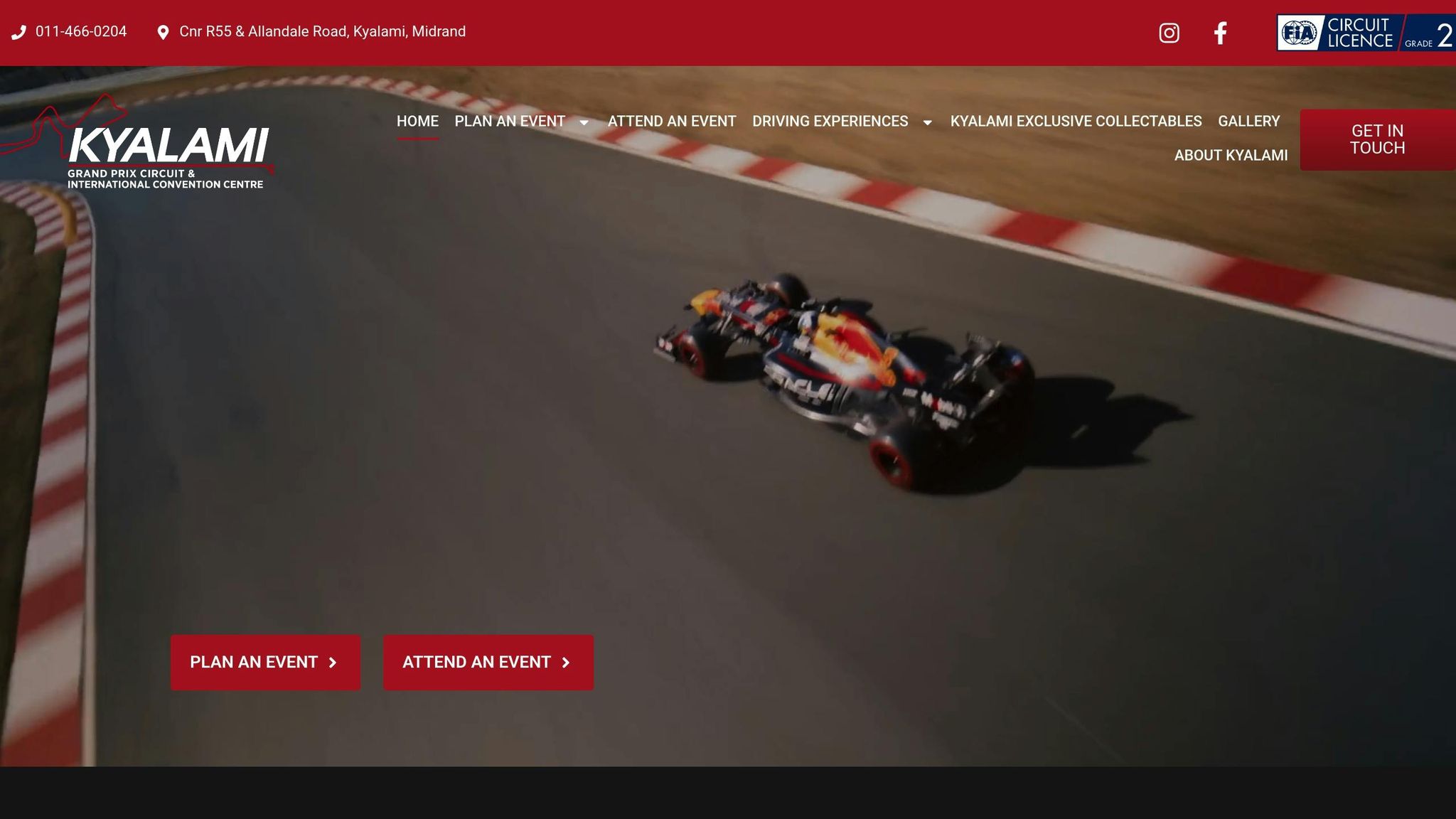
In 1967, the South African Grand Prix moved to its permanent home at the Kyalami Circuit, located near Johannesburg. Officially opened on November 4, 1961, Kyalami's high-altitude location - approximately 1,500 meters (4,920 feet) above sea level - posed unique challenges for engine performance and aerodynamics . Pedro Rodríguez won the first F1 race held there in 1967, and over the next two decades, the circuit hosted 18 official F1 Grands Prix, drawing the sport's top drivers .
"With its high‑speed straights, challenging corners and scenic setting near Johannesburg, Kyalami quickly earned a reputation as one of the most exciting circuits on the F1 calendar."
The 1970s and early 1980s were a golden era for Kyalami. Jim Clark's victory in 1968 would be one of his last before his untimely death, while Niki Lauda achieved back-to-back wins in 1976 and 1977 . A defining moment for South African motorsport came in 1975, when Jody Scheckter claimed victory at Kyalami driving a Tyrrell, a landmark achievement on his path to becoming South Africa's only F1 World Champion in 1979 .
During this period, Kyalami wasn't just an F1 venue - it also hosted major endurance and motorcycle championships. Legends like Gilles Villeneuve, Alain Prost, and Nigel Mansell left their mark on the track. Motorsport festivals at the circuit often drew crowds nearing 100,000, reflecting Africa's enthusiasm for high-profile racing. However, the excitement was tempered by tragedy, such as the 1977 South African Grand Prix, which saw the deaths of driver Tom Pryce and track marshal Frederick Jansen van Vuuren in a horrific accident.
Despite its successes, external forces soon disrupted F1's presence in Africa.
Political and Economic Obstacles
The 1980s brought significant challenges that ultimately ended F1's regular visits to Africa. South Africa's apartheid regime led to international sanctions, with the 1981 South African Grand Prix losing its championship status due to global opposition to apartheid policies.
Across the continent, economic and political instability further complicated the hosting of international events. From 1974 to the mid-1990s, sub-Saharan Africa experienced negative economic growth, with per capita GDP dropping over 11% during that time. The 1973 OPEC oil embargo hit African economies hard, particularly the 40 countries reliant on oil imports. Between 1970 and 2002, sub-Saharan Africa borrowed $294 billion but still owed $300 billion . Political turmoil added to the challenges, with half of Africa's independent nations under military rule by 1970, and conflicts like the Second Congo War claiming an estimated 2.7–5.4 million lives .
"Many countries experienced economic stagnation during this period, but in Africa the effects were compounded by debt crises and political instability, which led to a longer period of shrinking."
- Dr. Leigh Gardner, Associate Professor in Economic History, LSE
The words of Ghana's first Prime Minister, Kwame Nkrumah, resonate deeply: "Political independence without economic independence was meaningless".
Kyalami briefly returned to the F1 calendar in 1992 and 1993, but the combination of political isolation, economic struggles, and logistical issues proved overwhelming. The 1993 South African Grand Prix remains the last F1 race held in Africa, marking the beginning of a long absence for the sport on the continent.
F1's Current Presence in Africa
Africa has a deep history with Formula One, but its current connection to the sport has taken a new shape, thanks to digital platforms and a growing fan base. Although there hasn’t been a Formula One race on African soil since 1993, the sport is thriving across the continent. Broadcasting partnerships, online streaming, and enthusiastic fan communities are redefining how F1 interacts with African audiences.
Broadcasting and Media Access
The way F1 reaches African viewers has come a long way. What started with limited terrestrial broadcasts has now evolved into widespread digital streaming. SuperSport serves as the primary broadcaster across the continent, while F1 TV Pro, launched in February 2020, offers live streaming in 11 African countries. For just $4.99 per month, fans can enjoy ad-free races along with premium features like live timing, onboard cameras, and team radio access.
South Africa stands out with one of the most affordable F1 TV Pro subscriptions globally - $4.99 per month or $44.99 annually. This package includes live coverage of Formula 1, F2, F3, and the Porsche Supercup, making it an excellent option for fans looking for a comprehensive experience. For regions where F1 TV Pro isn’t available, Canal+ Sport steps in to provide live race coverage across much of Sub-Saharan Africa.
| Platform | Coverage in Africa | Key Features |
|---|---|---|
| SuperSport | Continent-wide | Comprehensive F1 coverage |
| F1 TV Pro | 11 countries, including South Africa | Live streams, onboard cameras, team radio, $4.99/month |
| Canal+ Sport | Sub-Saharan Africa | Live race coverage |
This improved accessibility through broadcasting and streaming is fueling a surge in viewership, as highlighted in the next section.
African F1 Viewership Data
Formula One’s audience in Africa is growing like never before, driven by a younger demographic and their increasing engagement with the sport. This growth mirrors global trends while showcasing unique regional dynamics, positioning Africa as a promising market for F1.
South Africa leads the charge with impressive numbers. During the first two race weekends of the 2025 season, the country saw a 148% rise in unique secondary audience and a 290% increase in secondary consumption on SuperSport. These stats highlight not just rising interest but also deeper engagement, as fans explore F1 content beyond live races.
"It's encouraging to see early-season F1 viewership reflecting such diverse and engaged audiences. The live unique audience has seen a significant upturn, and the growth in secondary viewership tells us that fans are finding flexible ways to stay connected to the sport." - Tumelo Selikane, Managing Director, Nielsen Sports South Africa
North Africa is also showing strong numbers, with TV viewership tripling in recent years. This aligns with F1’s global expansion, which saw the sport’s total fanbase grow to 826.5 million in 2024, an increase of 90 million from the previous year.
Africa’s median age of 19.7 years plays a key role in this growth. With Generation Z making up 27% of F1’s global fans - and nearly half of them women - the sport is striking a chord with younger audiences.
Fan-driven initiatives are also making waves. In Kenya, the Paddock Experience community hosts events that draw up to 1,400 fans per race weekend, turning F1 races into lively social gatherings complete with giveaways, trivia, and music. Influencers like Joy Jeptoo amplify this enthusiasm by organizing viewing parties in Nairobi and traveling to international races, demonstrating the sport’s growing appeal.
"People here know the sport. They know the drivers, the strategies, the engineering." - Joy Jeptoo, Kenyan F1 influencer
Ghana and Nigeria are also contributing to this momentum. Communities like "F1 Naija" serve as hubs for fans, hosting viewing parties and creating content that fuels regional excitement for the sport.
"Formula 1's growth in Africa is no longer speculative - it's already in motion." - TechTrendsKE
Obstacles to F1 Growth in Africa
Despite the excitement and growing fan engagement, F1 faces significant hurdles in expanding its presence in Africa. These challenges include economic constraints, infrastructure limitations, and a lack of representation that collectively slow the sport’s progress on the continent.
Economic and Infrastructure Challenges
Hosting an F1 race is an expensive endeavor. Annual hosting fees alone can reach $40 million, and upgrading circuits to meet FIA Grade 1 standards can cost an additional $50 million. Currently, no African circuit holds the required FIA Grade 1 certification; Kyalami in South Africa, with its Grade 2 rating, is the closest contender.
"The biggest challenge would be logistics. It's incredibly expensive to build and maintain an F1-level circuit, and it needs consistent investment, both local and foreign, to meet FIA standards." - Keiny, Junior Aerospace Engineer
African nations also face stiff competition from regions like the Middle East and Asia, where governments justify the high costs of hosting F1 races as part of tourism and branding strategies.
Representation Gaps
Another barrier is the lack of African representation in Formula One. No African drivers currently compete in the sport, and only one - South Africa’s Jody Scheckter - has ever won the world championship, back in 1979. This absence makes it harder for F1 to connect with African audiences on a personal level.
Funding Limitations
While African startups secured around $2.2 billion in funding in 2022, this growth primarily supports small and medium enterprises rather than large-scale infrastructure projects. Disparities in access to capital further complicate the financial landscape, with domestic credit to the private sector ranging from 8% of GDP in Zimbabwe to 32% in Kenya.
"Securing adequate funding remains a significant impediment despite increasing investor interest and a dynamic entrepreneurial landscape. Africa is frequently perceived as a high-risk investment destination because of factors such as political instability, currency fluctuations, and governance issues." - Jacob Chizunza, MBA '25, Cornell SC Johnson
Corporate Sponsorship Gaps
Unlike regions such as the Middle East or Asia, Africa has fewer major corporations willing to sponsor F1 events or invest in local motorsport development. This lack of corporate backing further limits the sport’s growth potential on the continent.
Despite these obstacles, Africa’s young population, expanding digital access, and passionate fan communities provide a solid foundation for F1’s future. Even without hosting races immediately, the continent is proving to be an important part of Formula One’s global story.
sbb-itb-7c68254
F1's Potential Return to Africa
The push for Formula One's return to Africa is gaining momentum. F1 CEO Stefano Domenicali has emphasized that Africa remains the only inhabited continent without an F1 Grand Prix. With this in mind, the sport's leadership is actively working to bridge this gap. After decades away, a return to African soil could reshape F1's global presence. The key questions now are where and when this will happen.
This growing interest invites a closer look at potential venues, economic opportunities, and initiatives to nurture local talent.
Possible African Grand Prix Venues
South Africa and Rwanda have emerged as the leading contenders to host Africa's next Formula One Grand Prix, with both targeting 2027 as a potential debut year. This timing coincides with the Dutch Grand Prix's removal from the calendar after 2026, opening up a slot for a new race.
South Africa's historic Kyalami Circuit, which last hosted a Grand Prix in 1993, is a strong candidate. Toby Venter, the circuit's owner, has announced plans to upgrade Kyalami to FIA Grade 1 status. These upgrades will focus on areas like run-offs, barrier systems, fencing, kerbs, and drainage, all while preserving the track's original layout.
"Today, we turn the page to a bold new chapter for Kyalami. We are ready for the return of Formula 1 to African soil." - Toby Venter, Kyalami Circuit Owner
Another South African proposal suggests a street race in Cape Town, capitalizing on the city's breathtaking Table Mountain backdrop and its appeal as a global tourist destination. Such a race would showcase one of the continent's most picturesque cities to over 500 million global viewers.
Rwanda, on the other hand, is proposing a brand-new circuit near Kigali's Bugesera International Airport, designed by former F1 driver Alexander Wurz. This project is part of President Paul Kagame's vision to position Rwanda as a global sports hub, with a focus on sustainability and innovation. The plans include solar energy installations, electric vehicle charging stations, and eco-friendly designs aligned with F1's net-zero emissions goals. Rwanda has also banned single-use plastics to strengthen its environmental credentials.
"Africa deserves a F1 event and Rwanda is the best place." - Mohammed Ben Sulayem, FIA President
Other potential venues include Morocco (Marrakech), Egypt (Cairo/Giza), Nigeria (Lagos), and Kenya (Nairobi). Morocco, for instance, is planning a $1.2 billion motorsport complex in Tangiers, featuring a cutting-edge racetrack, luxury housing, and an economic zone.
| Country | Venue | Key Advantages | Main Challenges |
|---|---|---|---|
| South Africa | Kyalami Circuit | Historic significance, existing infrastructure, passionate fans | Requires upgrades, political concerns |
| South Africa | Cape Town Street Race | Iconic urban scenery, strong tourism appeal | Complex logistics, new construction |
| Rwanda | New Kigali Circuit | Government backing, sustainability focus | High costs, brand-new development |
Economic Benefits of African F1 Races
Hosting a Formula One Grand Prix offers substantial economic benefits. A single race can inject between $150 million and $300 million into a host city's economy. Some recent Grands Prix have even surpassed $500 million in economic impact.
For African nations, these numbers represent a chance to significantly boost local economies. An F1 event can create between 10,000 and 20,000 jobs, while also driving billions in tourism revenue.
"When news broke that hosting a Formula 1 Grand Prix in South Africa could cost as much as R2 billion, the headlines focused on the bill. The critics warned of wasteful spending. Parliament debated priorities. But while the accountants saw a liability, I saw something very different: 20,000 jobs waiting to be created and an economy in motion." - Dr. Nik Eberl, Founder & Executive Chair: The Future of Jobs Summit™
F1 host cities often generate between R1.8 billion and R7.2 billion annually through tourism, sponsorship, and media exposure. For instance, Singapore's Grand Prix contributes approximately S$150 million (around R2 billion) in visitor spending each year, delivering a return of three to five times the initial investment.
The benefits extend beyond immediate economic gains. Hosting an F1 event often prompts upgrades to infrastructure like airports, roads, hotels, and telecommunications. Abu Dhabi's Yas Marina Circuit, for example, transformed Yas Island into a major tourism and real estate hub. These events also generate tax revenue; the Las Vegas Grand Prix brought in $45 million in tax income for Nevada, with $15 million allocated to local schools.
With F1 broadcasts reaching over 500 million viewers across 180 countries, host nations gain unparalleled global exposure. This visibility attracts foreign investment and boosts industries such as technology and manufacturing.
"F1 will have the same effect - it will create jobs, boost tourism, and showcase South Africa to the world. When people say money could be spent elsewhere, they miss the bigger picture." - Gayton McKenzie, South Africa's Minister of Sports, Arts, and Culture
Developing African F1 Talent
Beyond the immediate financial benefits, F1's return could help nurture motorsport talent across Africa. The continent has seen only one F1 champion - South Africa's Jody Scheckter in 1979 - highlighting the need for driver and technical development programs. Rwanda's proposed circuit includes plans for karting facilities and driver academies to cultivate young talent.
The potential isn't limited to drivers. F1 teams could partner with local universities and vocational schools to establish motorsport academies, mobile STEM labs, and scholarship programs, particularly benefiting underserved communities. The sport's reliance on cutting-edge engineering, from aerodynamics to data analysis, aligns well with Africa's growing tech sector.
F1's focus on sustainability also provides opportunities for innovation. Rwanda's investments in solar power and electric vehicle infrastructure could make it a testing ground for green racing technologies. Additionally, F1's advancements in recycling composite materials could lead to the creation of processing centers, generating jobs while reducing environmental impact.
Local businesses stand to gain as well. The logistical demands of F1 open up opportunities in transportation, catering, security, and technical services. Unlike one-off events like the Olympics, the regular scheduling of F1 races ensures ongoing benefits from the infrastructure investments.
In short, Formula One's return to Africa could spark long-term economic growth, inspire a new generation of motorsport talent, and drive technological advancements across the continent.
Conclusion: F1's African Future
The prospect of Formula One returning to Africa holds immense promise. From the historic days of Kyalami to recent discussions involving Rwanda and South Africa, the continent finds itself on the brink of a motorsport revival. This could not only expand F1’s global presence but also contribute to Africa’s economic development in meaningful ways.
Africa’s youthful population - boasting a median age of just 19.7 years - and its projected growth to 2.5 billion people by 2050 underline its potential as a dynamic market. However, turning this potential into reality won’t come easy. The challenges are steep, particularly in terms of financial investment and infrastructure upgrades.
For instance, bringing Kyalami back to FIA Grade 1 standards alone would require around $50 million. On top of that, hosting fees range between $40–50 million annually, with maintenance costs adding another $18 million each year. To make this vision viable, African nations will need to focus on building strong infrastructure and securing dependable funding through public-private partnerships. Political stability and transparent governance will also be critical to meet Formula One's stringent requirements for long-term commitments.
But the rewards extend far beyond the financials. An African Grand Prix could serve as a platform to showcase the continent’s modern cities, technological advancements, and vibrant cultures to a global audience of over 500 million viewers. It could also ignite a passion for motorsport among Africa’s youth, inspiring the next generation of drivers, engineers, and innovators.
F1’s push toward sustainability aligns perfectly with Africa’s vast renewable energy potential, paving the way for innovations in green racing technologies and environmentally conscious circuit designs. This synergy could position Africa as a leader in the future of motorsport.
The path forward will demand collaboration - African governments, private investors, and international partners all have a role to play. As seven-time World Champion Lewis Hamilton aptly stated:
"We can't be adding races in other locations and continuing to ignore Africa."
The continent’s rich motorsport heritage deserves its rightful place on the F1 calendar. With the right investments, political will, and strategic partnerships, Africa could not only rejoin the Formula One circuit but also redefine its role on the global stage. The question now is: which nation will seize this opportunity first?
FAQs
What challenges does Africa face in hosting a Formula One Grand Prix, and how can they be addressed?
Africa faces several hurdles when it comes to hosting a Formula One Grand Prix. These include a lack of advanced motorsport infrastructure, such as FIA Grade 1 circuits, the high financial demands of organizing such an event, political instability in certain areas, and a relatively modest level of long-term fan engagement. Moreover, the continent doesn’t share the deep historical ties to F1 that other regions enjoy.
Addressing these challenges will require substantial investment to build or upgrade racetracks and develop local motorsport communities. Ensuring political and economic stability is equally important, along with initiatives aimed at expanding and energizing the fanbase. Promising signs, like South Africa’s efforts to revive the Kyalami Grand Prix Circuit, show that Africa has the potential to carve out a lasting spot on the F1 calendar.
How is the growing popularity of F1 in Africa influencing the chances of the continent hosting future races?
The buzz around Formula 1 in Africa is gaining momentum, making the idea of the continent hosting future races more realistic than ever. In recent years, TV viewership across Africa has skyrocketed, with audiences in some regions more than tripling. South Africa, in particular, is leading the charge with efforts to bring F1 back to the iconic Kyalami circuit, aiming for a potential race as early as 2027.
This growing enthusiasm mirrors the global trend, where F1 viewership has been climbing steadily at an annual rate of about 12%. With a rapidly expanding fanbase, strong governmental backing, and untapped market opportunities, Africa is positioning itself as a compelling contender for future spots on the F1 calendar.
What are the economic and social benefits of hosting a Formula One race in African countries like South Africa or Rwanda?
Hosting a Formula One race in African nations like South Africa or Rwanda could bring major economic and social benefits. From an economic perspective, F1 events drive local tourism, generate millions in revenue, create employment opportunities, and often lead to improved infrastructure. For example, past F1 races have funneled hundreds of millions of dollars into host cities through visitor spending, global media coverage, and related investments.
On the social side, these events have the power to inspire communities, spark youth interest in STEM fields, and boost national pride. For a country like Rwanda, hosting an F1 race could also help position it as a global destination for tourism and innovation - aligning perfectly with its broader vision of economic growth and international prominence.