Can F1 Run Race Sites on Renewable Power?
Some F1 venues can run parts of a race site on renewables with grid, batteries and hybrid backup, but full weekend coverage is limited by demand and cost.
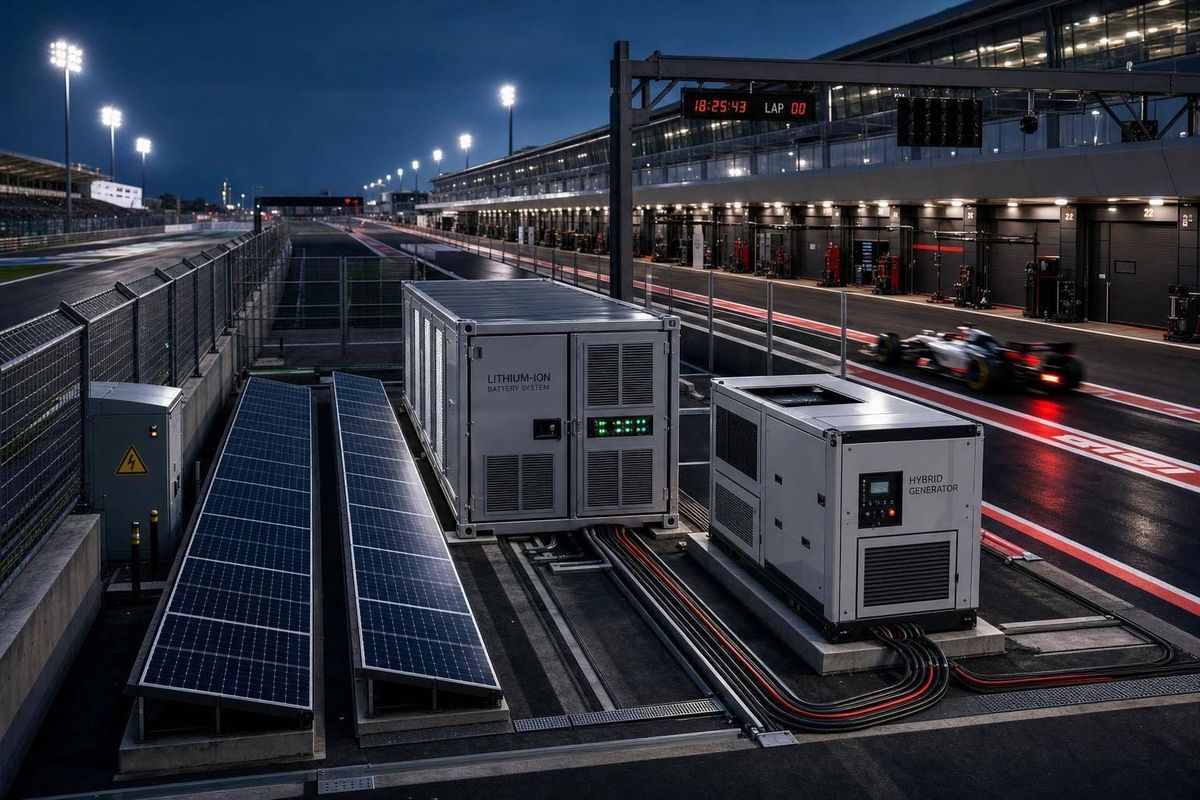
Yes - but only in part right now. I’d sum it up like this: some F1 venues can cover a good share of site power with cleaner electricity, batteries, and hybrid backup, but full coverage across every race weekend is still out of reach.
Here’s the core point in plain English:
- Permanent tracks have the best shot because they usually have fixed grid links and more room for solar, batteries, and support gear.
- Street races have less room and more limits because they depend more on temporary setups.
- Peak demand is the big problem. An F1 site doesn’t just power the cars’ garages. It also runs broadcast, IT, timing, hospitality, cooling, and race support systems.
- Supply is tight. Clean electricity is also needed for homes and heating.
- Cost is still a barrier. Lower-carbon fuel cited in the article costs about $5.36 to $6.70 per liter when converted from £4.00 to £5.00, versus about $1.97 per liter from £1.47 for diesel at the same rough exchange level. That’s about 2.7x to 3.4x higher.
What this means for you: if you’re asking whether F1 can flip a switch and run every race site on renewable power, the answer is no. If you’re asking whether some parts of some venues already can, the answer is yes.
| Venue type | Main power setup | Best chance of cleaner supply | Main limit |
|---|---|---|---|
| Permanent circuit | Grid + on-site systems + backup | Higher | Grid supply during peak demand |
| Street circuit | Temporary systems + backup | Lower | Space, permits, and temporary infrastructure |
So my takeaway is simple: F1 can run some race-site loads on renewable power at some venues, but not every site, not every load, and not all weekend long. The gap comes down to power access, peak load, storage, and cost.
The Race To Net-Zero: How F1 Is Embracing Electrification | The Performance Layer
sbb-itb-7c68254
How Much Power Does an F1 Race Site Actually Need?
An F1 race site uses a lot of electricity because many systems are running at the same time for the full race weekend.
What counts as race-site power
Race-site power includes the paddock, garages, pit lane, hospitality, timing, and broadcast operations. These are the main areas where the heaviest loads are packed into one location.
Why paddocks and broadcast compounds draw so much power
The paddock and broadcast compound use the most power because they bring together the event’s most energy-hungry operations, and they can’t afford downtime. If one part drops out, it doesn’t just cause a small issue. It can disrupt team work, live feeds, and race control functions all at once.
Base load vs. peak load during a race weekend
Base load is the steady level of demand that stays on through the weekend. Peak load is the higher spike that shows up during setup, practice, qualifying, and race day.
That difference matters a lot. Power systems have to be built for peak periods, not the average load across the weekend. And that peak demand is the main barrier to renewable operation, especially when clean power is already committed to homes and heating.
That’s why meeting peak demand usually takes a mix of grid supply, temporary generation, and storage.
Which Renewable and Low-Carbon Power Systems Are Already Used at F1 Events?
F1 race sites already use a mix of renewable grid electricity, battery-backed temporary power, and hybrid generators for high-demand areas. With that kind of load, power planning comes down to one thing fast: keeping everything running without compromise.
Renewable grid power vs. on-site generation
When a venue can tap renewable electricity from the local grid, it can cut the race site's footprint without making major changes to the circuit itself. That's a big deal, because circuits aren't blank slates. They're busy, fixed spaces with tight event demands.
That also helps explain why most race-site setups use a hybrid supply instead of relying on a single source. One part may come from the grid, another from temporary systems on-site, with backup built in so core operations don't go dark.
Temporary hybrid systems for paddocks and hospitality
The main constraint is access to clean power. It's not just about how much power the event needs. It's about how much lower-carbon electricity is available at that venue, and whether there is enough backup capacity to support it when demand spikes.
So in practice, race-site power planning puts reliability first and emissions second. That may sound blunt, but it's the reality of live events. If a paddock, broadcast area, or hospitality zone loses power at the wrong moment, the whole weekend can feel it.
Where cleaner race-site power is already in use
Several permanent circuits have already moved toward cleaner supply by combining grid connections with on-site solar and battery storage in the paddock and hospitality areas. That mix gives venues more room to cut fuel use while still covering heavy event loads.
What works at one circuit may not work at another, though. The right setup depends a lot on grid access and venue type. A permanent circuit with strong utility links has different options than a site that leans more heavily on temporary event infrastructure.
How Grid Connections and Venue Type Decide What Is Possible
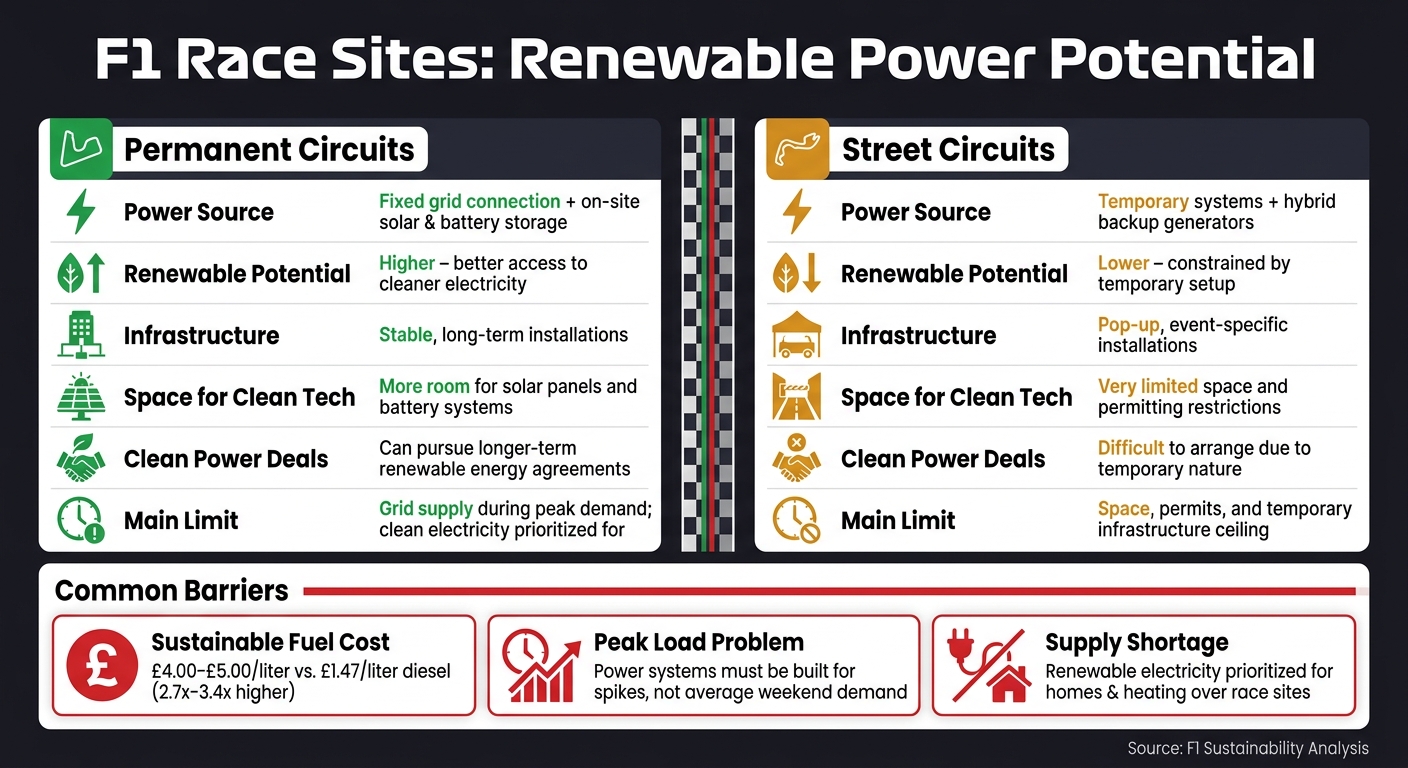
F1 Race Sites: Permanent Circuits vs. Street Circuits – Renewable Power Potential
The gap between a permanent circuit and a street circuit comes down to one thing: power access. From there, everything else follows.
If a venue has a fixed grid connection, it has a better shot at using cleaner electricity. If it runs on temporary setup, the options shrink fast. That single difference shapes what a race site can and can't do.
Permanent circuits have a clear advantage
Permanent circuits have better grid access, which gives them a more realistic path to cleaner electricity. But there’s still a catch. Renewable supply remains the main limit, and clean electricity is often assigned first to homes and other core services.
So even when a permanent venue is in a better position, it still can’t assume that enough low-carbon power will be there on race weekend.
Street races face tighter limits
Street circuits have a tougher setup from the start. They depend on temporary power infrastructure, often have very little room to work with, and need to stay within local permitting rules.
That mix makes it much harder to scale clean electricity the way a permanent venue can. It’s a bit like trying to build a stable power plan on a pop-up site. You can do some of it, but the ceiling is lower.
Permanent circuits vs. street circuits: power options compared
The split is pretty simple.
- Permanent circuits can use fixed grid connections and work toward longer-term clean-power deals.
- Street circuits rely on temporary infrastructure and run into tighter space and permitting limits.
In both cases, today’s renewable supply still doesn’t fully cover race-site demand. And when grid access is weak, storage and backup stop being side issues. They become the main bottleneck.
What Still Prevents Full Renewable Operation at Every F1 Race Site?
Even at tracks where renewable power can work on paper, supply and cost still decide what happens in practice. The main issue isn't the idea itself. It's access. Clean electricity, energy storage, and sustainable fuel are all in short supply because many other sectors need them too.
Supply and cost are still the biggest limits
Renewable electricity is still being directed first to homes and heating. At the same time, sustainable fuels are also needed in aviation and shipping, which leaves a smaller pool for race-site use. That's the bottleneck.
"The answer at the moment is that we don't have enough [renewable energy] and there's other sources that would need that energy first - a lot of houses to make electricity and to warm those houses."
The fuel cost gap is hard to ignore too. Sustainable fuel used for demonstration runs has been priced at about £4.00 to £5.00 per liter, compared with about £1.47 per liter for standard diesel - around 2.7 to 3.4 times higher. F1 can handle that hit better than junior series, but the price still makes broad use harder to scale.
So while renewable operation is possible in some parts of an event, it still can't cover every race-site power need at every round. For now, limited supply and higher costs keep full renewable coverage out of reach across the whole calendar.
Conclusion: Can F1 Run Race Sites on Renewable Power?
The short answer: partly.
Some venues can do a lot more than others, but not every race on the calendar can run the same way. The main hurdle isn't ambition. It's access to clean electricity and enough backup capacity when demand spikes or supply dips.
That changes the picture from one venue to the next. Permanent circuits usually have the best shot at running on renewable power because they have more stable infrastructure and better grid access. Street circuits are a different story. They still tend to rely on hybrid backup.
As clean generation, storage, and backup capacity grow, more venues should be able to lean on renewable electricity. For now, though, full coverage is still uneven.
FAQs
Why can’t every F1 race site run fully on renewable power yet?
The biggest roadblock is limited supply. Renewable electricity often goes first to core needs like powering and heating homes, which means there’s less left for race venues.
On top of that, running every F1 site entirely on renewable power isn’t simple. It comes with logistical hurdles and high costs linked to cleaner tech and the infrastructure needed to support it.
How much power does an F1 paddock actually need?
The available information does not provide a single total power number for an F1 paddock.
What it does cover is power use in the cars themselves. For example, the MGU-K is set to deploy 350 kW from 2026.
But that’s not the same as the full electrical load of an F1 paddock, which would also need to include:
- motorhomes
- garages
- technical support infrastructure
So if you're looking for the combined electrical demand of the whole paddock, that figure isn’t given in the source.
What makes street circuits harder to power cleanly?
Street circuits are tougher to power cleanly because they depend on public infrastructure instead of purpose-built racing venues. On top of that, they need large temporary setups for the paddock and trackside operations.
Those temporary areas often don’t have permanent electrical systems in place. So organizers have to rely on high-output temporary power. And that makes it harder to bring renewable energy into the mix.