F1 race weekend emissions fall 35%: key sources
Freight, team travel and paddock power drove a 35% fall in F1 race weekend emissions; aviation remains hardest to cut.
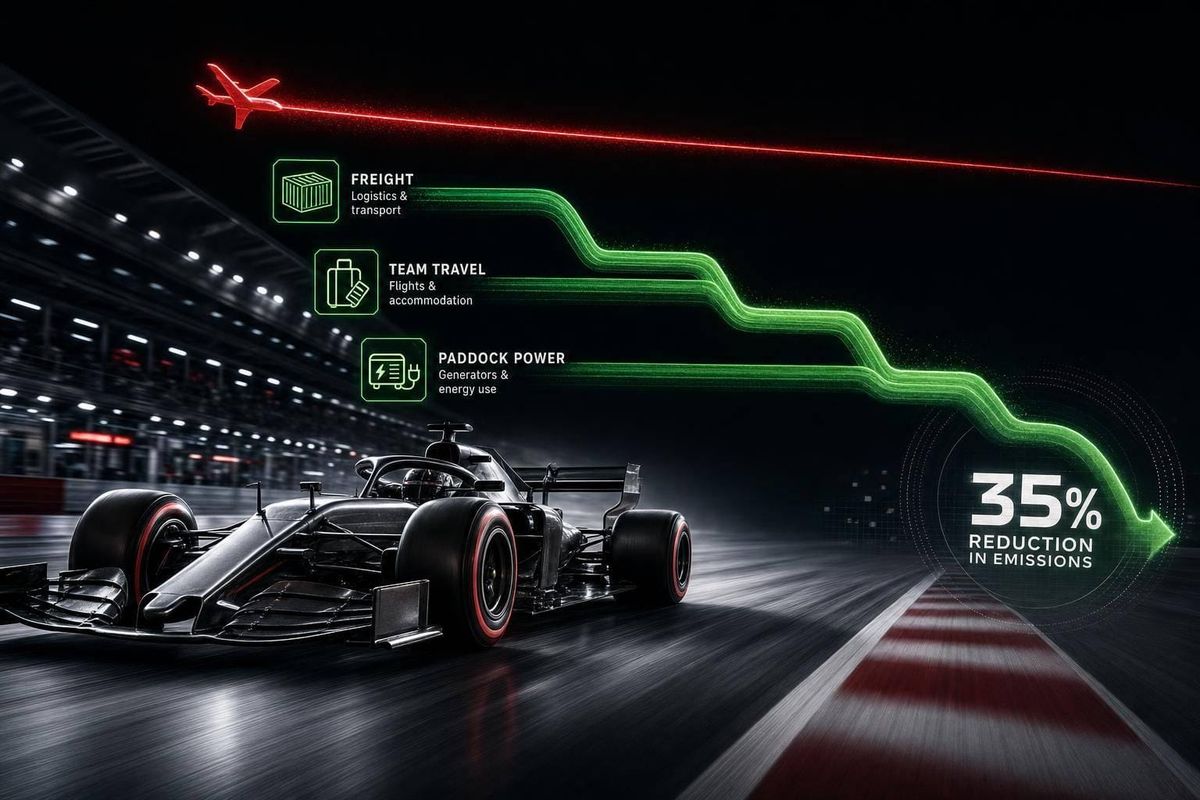
If you want the short answer, here it is: freight and travel did most of the work because they were the biggest parts of F1’s footprint to begin with. Then came paddock power, broadcast, support series, and circuit services, where fuel swaps and central power systems cut emissions hard at some events.
Here’s the full picture in simple terms:
- Freight and logistics: less air freight, more sea and road shipping, plus HVO trucks
- Team travel: fewer people at the track because more work moved off-site
- Paddock and circuit energy: central power hubs, HVO100, batteries, and some solar
- Broadcast and support series: less travel and less kit moved to circuits, but live crews still stay on-site
- Circuit services and hospitality: temporary generator fuel changes and, at some tracks, fixed solar systems
The main takeaway: even after this drop, the hardest problem is still aviation and global freight. And that explains why the next cuts will be tougher.
| Source | Main reason emissions fell | What still limits cuts |
|---|---|---|
| Freight | More sea/road shipping, HVO trucks | Urgent parts still fly |
| Travel | Remote work, fewer people on-site | Teams still need track staff |
| Paddock power | Central power hubs, HVO100, batteries | Backup power still needed |
| Broadcast/support series | More remote production | Live crews and power needs stay high |
| Circuit services | HVO generators, some solar | Street tracks and weak grids limit options |
I’d sum it up like this: F1 cut the easier big-ticket sources first, and the footprint is now more concentrated in planes, freight, and live race support.
How Formula 1 is driving innovation on and off the track
sbb-itb-7c68254
1. Freight and logistics
Freight has long been the biggest source of emissions during a Formula 1 race weekend. Before the latest cuts, it made up about 45% to 49% of total operational emissions. That share started to shift once F1 relied less on air freight and used more sea and road transport.
The biggest drop came from changing how cargo gets from race to race. F1 moved to a multimodal strategy, sending non-time-sensitive equipment by sea on flyaway races instead of putting so much on planes.
DHL also rolled out trucks powered by HVO (hydrotreated vegetable oil). It’s a drop-in biofuel, which means it can be used in place of regular diesel, and it can cut lifecycle emissions by up to 83% compared with conventional diesel.
Calendar planning helped too. By grouping races more logically by region, F1 cut the distance freight needs to travel between events. That said, some cargo still has to go by air. When FIA testing and team development timelines are tight, urgent parts can’t wait.
So even after these changes, freight still leads the weekend emissions footprint. Team travel comes next.
2. Team travel and remote operations
Before Formula 1 stepped up its push on emissions, business travel was the second-biggest source of race weekend emissions after freight. That includes team staff, F1 employees, and commercial partners flying to each event.
The biggest drop here has come from remote operations. Formula 1’s Media and Technology Centre (M&TC) in Biggin Hill now takes care of a large share of the broadcast and technical work that used to happen at the circuit. In plain English, that means many people who once had to be on-site can now stay at the factory and work from afar. Fewer people on planes each race weekend means fewer travel-related emissions.
Teams have limits too. FIA sporting rules cap trackside operational staff at 60 people per team. That rule was put in place for cost control, but it also sets a floor on how much teams can shrink travel without hurting race operations. So while fewer people may be flying, a race weekend still leans on a lot of on-site power once the paddock is up and running.
3. Paddock power and circuit energy
Before the recent cuts, paddock power and circuit energy accounted for about 7.3% of Formula 1’s total carbon footprint. That’s well below freight or travel. Still, it’s one of the areas where F1 has made some of its biggest percentage cuts. Once freight and travel are on the table, on-site energy is the next big place to push.
The biggest change has been the move away from separate diesel generators used by individual teams. In their place, F1 has rolled out centralized energy hubs that power the full paddock. It has also expanded the use of HVO100 across more event power needs. On top of that, large battery energy storage systems (BESS) are showing up more often. These systems help smooth out spikes in demand, so generators don’t have to run as much.
Austria gives the clearest example. In July 2023, Formula 1 used a centralized power hub at the Red Bull Ring. It paired HVO100 with a 600-square-meter solar array to power the paddock, including team motorhomes and the International Broadcast Centre. The payoff was big: a 90% reduction in carbon emissions for paddock operations, with about 339 tonnes of CO₂e saved versus the 2022 event. That’s a huge cut for this part of the footprint, even if the total tonnage saved is smaller than what F1 can cut in freight or travel. The simple reason is that this category starts from a much smaller base.
Even then, results aren’t the same at every circuit. A venue tied to a coal-heavy grid gets less from grid electricity than one with a cleaner power mix. Heat matters too. Races in places like Qatar, Singapore, or Bahrain can drive energy demand much higher than a milder European round. And there’s another limit built into the sport: broadcast and timing systems need near-zero failure tolerance. So even when grid power is there, backup generators often stay on standby. That puts a cap on how low paddock and circuit-energy emissions can go.
The next layer of emissions comes from support-series and broadcast operations.
4. Support series and broadcast operations
Support series and broadcast operations sit inside F1's Event Operations category, which has, in the past, made up about 7.3% of the sport's total carbon footprint. That's a smaller share than freight or travel. Still, it became more visible once F1 moved more production work off-site.
Remote production helped cut crew travel and trimmed the amount of broadcast equipment sent to each circuit. TV compounds also switched to HVO, which cut emissions from on-site generators.
At the same time, Formula 2 and Formula 3 add to the same paddock footprint. They bring more freight, more staff movement, and more power demand.
There’s also a hard limit here. Live transmission still needs triple-redundant power, and that’s non-negotiable. When local grids aren’t strong enough, synchronized diesel generators still have to stay in the mix.
That leaves circuit services and on-site hospitality.
5. Circuit services and on-site hospitality
Circuit services and hospitality sit within Event Operations. It’s a smaller part of F1’s footprint than freight or travel, but it has dropped at a faster pace. The main reason is simple: temporary power is easier to clean up than planes, trucks, or hotel stays.
Unlike freight and travel, this part of the event changes from race to race. That makes it easier to swap in lower-carbon power setups. The biggest move has been replacing fossil diesel in temporary generators with HVO, which can cut carbon emissions by up to 90% compared with standard diesel. The same approach also helps in hospitality zones, where temporary power demand is often at its highest.
Permanent circuits have another option: they can put money into fixed renewable systems. Silverstone installed about 2,700 solar panels and also switched its generators to HVO. Bahrain added more than 7,000 panels that generate 5 MW. In other words, this is one area where venue design matters just as much as fuel choice.
That said, not every circuit has the same room to act. Street circuits like Las Vegas and Singapore can’t install permanent solar systems. On top of that, weaker grids often can’t handle peak hospitality demand, especially from kitchens and air conditioning. So even after major cuts, circuit services at these venues still rely heavily on temporary power.
How F1's Emissions Mix Has Shifted
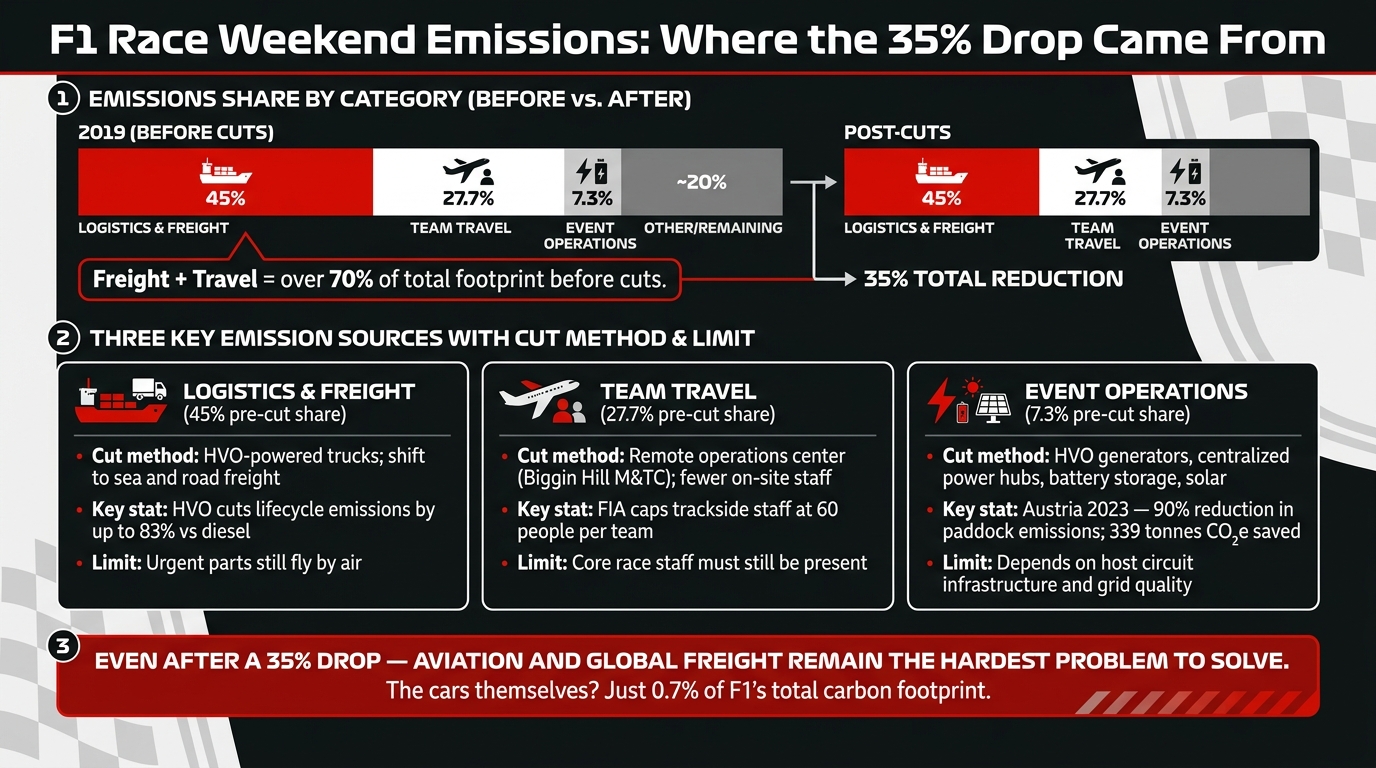
F1 Race Weekend Emissions: Where the 35% Drop Came From
Taken together, these changes reshaped the emissions mix more than any single move on its own. Before the cuts, freight and travel made up more than 70% of the total footprint. So when F1 made broad changes in those areas, the total dropped the fastest.
Here’s how the mix changed across the main race weekend sources:
| Category | Pre-Cut Share (2019) | Primary Change | Change Type |
|---|---|---|---|
| Logistics & Freight | 45% | HVO-powered trucks; more sea and road freight | Fuel-based |
| Team Travel | 27.7% | Remote operations center; fewer on-site staff | Structural |
| Event Operations | 7.3% | HVO generators; circuit solar/grid power | Operational |
Logistics and freight were the biggest piece in 2019 at 45%, which is why changes there mattered so much. Swapping in HVO-powered trucks and leaning more on sea and road freight changed a large share of the total.
Team travel was the next big source at 27.7%. F1 cut part of that by using a remote operations center and sending fewer staff to the track. That’s a deeper shift than a fuel swap. It changed how the work gets done.
Event operations, at 7.3%, moved through on-site changes like HVO generators and circuit solar or grid power. Those cuts were easier to make because temporary power systems are simpler to change than a global freight setup or the travel needs of team personnel.
So while team travel and logistics still make up most of what’s left to cut, the footprint isn’t packed into the same places it was in 2019. Smaller sources shrank faster, while the hardest parts - moving equipment around the world and getting people to races - still sit at the center.
The next question is what F1 had to accept to keep cutting each source.
Tradeoffs in Cutting Each Emission Source
Those cuts changed the emissions mix, but each source came with its own cost. And the biggest cuts tend to come with the toughest tradeoffs.
| Emission Source | Cut | Limit |
|---|---|---|
| Freight & Logistics | Largest share of the footprint | Duplicate equipment sets and higher capital cost |
| Team Travel | Fewer staff flying each race | Less technical depth at the track |
| Paddock Power & Circuit Energy | Repeatable across venues | Depends on host circuit infrastructure |
| Support Series & Broadcast | Broadcast work can be centralized | Live operations still need physical crews |
The pattern is pretty simple: the biggest gains usually come from the hardest operational shifts.
Freight cuts deliver the largest savings. But they also mean duplicate equipment sets and higher upfront capital costs, which are harder for smaller teams to absorb.
Paddock power cuts are the easiest to standardize across venues. The catch is that they depend on host circuit infrastructure.
Remote operations cut travel emissions, but there’s a tradeoff. Fewer people on-site means less technical depth at the track.
Broadcast work can move into centralized setups, which helps. But live operations still need physical crews on the ground.
So the toughest reductions still sit in freight, travel, and live operations.
Conclusion
The 35% drop came mostly from cuts to freight and travel, with extra help from cleaner paddock power and circuit operations.
The biggest gains came from two areas. Biofuel trucks are expected to cut land freight emissions by at least 60% compared with diesel. At the Austrian Grand Prix, centralized power cut paddock, pit lane, and broadcast emissions by 90%.
Even so, one problem still towers over the rest. Aviation makes up most of what remains, while the cars themselves account for just 0.7% of the total footprint. Put simply, the sport’s main carbon issue isn’t the racing machines. It’s the planes, the travel, and the movement of equipment around the world.
That’s why the first 35% came from practical changes in day-to-day operations. The next round of cuts will be tougher, because they depend far more on freight, travel, and aviation.
FAQs
Why were freight and travel the biggest sources of emissions in the first place?
Freight and travel were the biggest sources because F1 has to move heavy, specialized equipment and large teams across a global 24-race calendar.
For years, much of that movement relied on air freight. On top of that, building and then taking down trackside infrastructure at each circuit meant even more energy-heavy transport for both people and materials.
Why are aviation and urgent air freight still so hard for F1 to cut?
Because Formula 1’s global schedule moves huge volumes of equipment across continents on tight deadlines. When teams need urgent shipments, like last-minute part replacements or fast turnarounds between race weekends, air transport is often the only option that works.
Some less time-sensitive freight can move by sea. But those options still come with limits on timing and performance, plus high costs. So cutting back on aviation is a slow, step-by-step challenge.
How much more can cleaner paddock power and circuit energy reduce emissions?
Cleaner paddock power and circuit energy can cut emissions further, though the exact drop depends on how many sites switch to renewables. Teams have already cut facility and fuel emissions by 25% since 2019.
Using cleaner power for paddock operations, temporary infrastructure, and climate control can shrink the footprint tied to setup, teardown, and race weekend services. That also helps support F1’s net-zero 2030 goal.