F1 Teams Cut Aero Spend Under Cost Cap
How the F1 cost cap shifted aero work toward facility investment, testing control and faster delivery — not obvious cuts in aero spending.
Fewer F1 upgrades don’t prove lower aero spending. I compare eight teams by where their money goes, how often they update their cars, and how well they turn test results into race-ready parts - not by upgrade counts alone.
The cap went from a $135 million base in 2025 to $215 million in 2026, but the new total includes costs previously left out. That doesn’t mean more money for aero. Testing also has its own limit: the first-place constructor gets 70% of the base allocation, versus 115% for the 10th-place team.
My takeaway: <u>judge delivery, not spending headlines</u>. In-house testing can cut delays, frequent updates can add production costs, and repairs can take money and factory time away from development. Without team-level cost data, I can’t rank aero spending returns.
Quick Comparison
| Team | Development focus | What I look at |
|---|---|---|
| Red Bull | Testing and iteration | Whether test gains reach the car reliably |
| Mercedes | Facilities and concept fixes | Time from test data to finished parts |
| Ferrari | Design and production at Maranello | Whether updates arrive without rework |
| McLaren | In-house testing | Control over testing schedules and delivery |
| Aston Martin | Integrated Silverstone campus | Handoffs between design, testing, and production |
| Alpine | Frequent small updates | Production demands versus gains on track |
| Williams | Factory and systems upgrades | Whether production can keep up with testing |
| Haas | Smaller updates and outside partners | Correlation and partner delivery schedules |
Across all eight, I focus on the same question: does each update deliver its predicted gain without wasting parts, budget, or time?
The 2026 F1 Budget Cap: Why It’s Not What You Think
sbb-itb-7c68254
1. Red Bull Racing
Red Bull’s edge is process speed, not a clearly documented change in its aero budget. Under the cap, its aerodynamic advantage shows up more in how development moves forward than in visible spending cuts. Its on-site wind tunnel allows faster iteration, but there’s no proof that it cuts aero spending.
That access can help the team time its updates better. It doesn’t prove Red Bull has reduced major redesigns or its total development effort. The comparison is whether faster iteration leads to more reliable updates, not whether the team simply spends less.
2. Mercedes
Mercedes takes a different route to the same goal: more control over testing and less time turning data into parts.
Aero spending allocation
Mercedes spent about $86 million upgrading its facilities to support long-term development under the cost cap. The published evidence does not show how much of that investment went toward correcting concepts, aligning simulation results with test data, or making small updates.
Update cadence and design-to-production capacity
With its own wind tunnel, Mercedes can test, stop, rework, and retest on its own schedule within the regulations. Keeping design and testing close together shortens the path from data to new parts, helping the team deliver concept fixes and small updates sooner.
Under the cap, control over that process can matter as much as direct aero spending. It cuts the delay between a finding and a usable upgrade. Mercedes’ edge lies in faster iteration, not a publicly documented aero spending cut: the cap rewards teams that turn development cycles into track performance with fewer wasted runs.
3. Ferrari
Aero spending and update efficiency
Ferrari faces the same pressure from the cost cap, but there’s no documented evidence that it shifted spending. The team has not disclosed how it divided its 2026 aero budget among testing, simulation, correlation, and parts production.
General improvements in simulation don’t prove Ferrari reduced its own aero spending. Upgrade counts don’t establish savings, either. Without disclosed costs, Ferrari’s return on aero spending cannot be measured directly.
The better test isn’t how often Ferrari updates its car. It’s whether each upgrade reaches the car without rework.
Design-to-production capacity
Ferrari’s design, wind tunnel, and manufacturing base in Maranello helps its large works team turn test findings into production changes quickly. Keeping these functions together also helps the team rework parts promptly when testing reveals a problem.
For a large works team, the question is whether design changes reach production quickly and cleanly. The same trade-off appears at McLaren, where development speed matters as much as package size.
4. McLaren
McLaren’s change centers on control over development time, not a documented cut in aero spending.
Aero spending allocation
The sources do not break out McLaren’s aero budget. Its in-house wind tunnel points to more control over development, rather than a confirmed reduction in aero costs.
Design-to-production capacity
McLaren’s in-house tunnel shortens the path from test result to finished part. Engineers can pause testing, revise a design, and restart without waiting for a rented slot. This shortens the update loop, although the sources do not quantify McLaren’s development pace.
The payoff is less time lost to outsourced testing windows and rework, not lower spending.
Return on aero spend
The sources show tighter control over testing, but they do not report a measured return on aero spending. McLaren’s case illustrates how the cost cap rewards faster development loops more than larger update counts.
5. Aston Martin
Facility investment and aero workflow
Lawrence Stroll’s roughly $300 million investment in Aston Martin’s Silverstone campus brought design, production, and testing on-site, reducing reliance on outside facilities. That shifts the team’s aero advantage from outsourced testing to closer in-house coordination.
Design staff and the wind tunnel now sit in adjacent buildings, shortening handoffs between design, testing, and production.
Tom McCullough said the new layout mainly improves communication.
The investment focuses on infrastructure and integration, not more wind-tunnel usage. It improves workflow but doesn’t show a clear reduction in aero spending.
6. Alpine
Aero spending allocation
After Aston Martin’s campus overhaul, Alpine presents a different trade-off: more frequent updates mean more manufacturing work. The team favors frequent small upgrades, but each part change adds production demands and uses space under the cost cap. Alpine’s aero budget is not public, so its return on spending cannot be measured directly.
Update cadence
The supplied material describes frequent floor and wing revisions during 2022–2024, with minor changes often arriving nearly every race weekend. It does not provide package-by-package costs or measured gains.
Frequent updates do not prove efficient spending. A fix that corrects a problem serves a different purpose from an update that adds downforce. The two should not be counted together.
Alpine’s story is therefore more about update frequency than facilities.
Design-to-production capacity
Alpine’s Performance, Engineering, and Aerodynamics structure aims to shorten design-to-track time. That goal alone does not show that it has worked.
The supplied information does not quantify staffing, wind-tunnel or CFD allowances, or production throughput. Without those figures, it cannot establish a delivery-speed edge. In-house production does, however, give Alpine more control than Haas’s outsourced chassis approach.
7. Williams
Aero spending and production capacity
Williams is using cost-cap flexibility to fund infrastructure upgrades. But its larger ATR allowance can’t make up for slower production. Older manufacturing systems still delay the step from test result to race-ready part.
The issue is less about how much Williams can test and more about turning aero gains into parts it can race.
Update cadence
In early 2024, Williams lacked a third chassis, so damage could drain both budget and factory time.
That meant repairs and spare-part production competed directly with aerodynamic development.
Value for spend
Fewer updates don’t necessarily mean better value. At Williams, delays can come from capacity limits rather than a choice to hold back spending.
Haas faces the same cost-cap pressure, but with a different bottleneck: not factory scale, but how much production the team can control.
8. Haas
Aero spending allocation
Since 2023, Haas has operated at the FIA cost cap. That has shifted its aero spending from keeping the team afloat to making step-by-step improvements. Its modular upgrade approach favors smaller, interchangeable parts over major redesigns, putting money into refining existing concepts. The update schedule reflects that choice.
Update cadence and performance per dollar
Haas is moving away from a few major upgrade packages each season toward more regular floor and wing tweaks. Correlation comes first: upgrades must show gains on the car before the team commits to production. The focus is race pace and tire wear, rather than peak downforce that might not translate to the track.
Design-to-production capacity
Dallara handles chassis production, while Ferrari supplies components. These partnerships give Haas specialist support, but less in-house production flexibility than larger teams. Relying on outside facilities also makes testing slots harder to control.
For Haas, those limits reinforce the cost cap’s push toward controlled, repeatable updates rather than big seasonal resets.
Cross-Team Comparison: Spending and Delivery
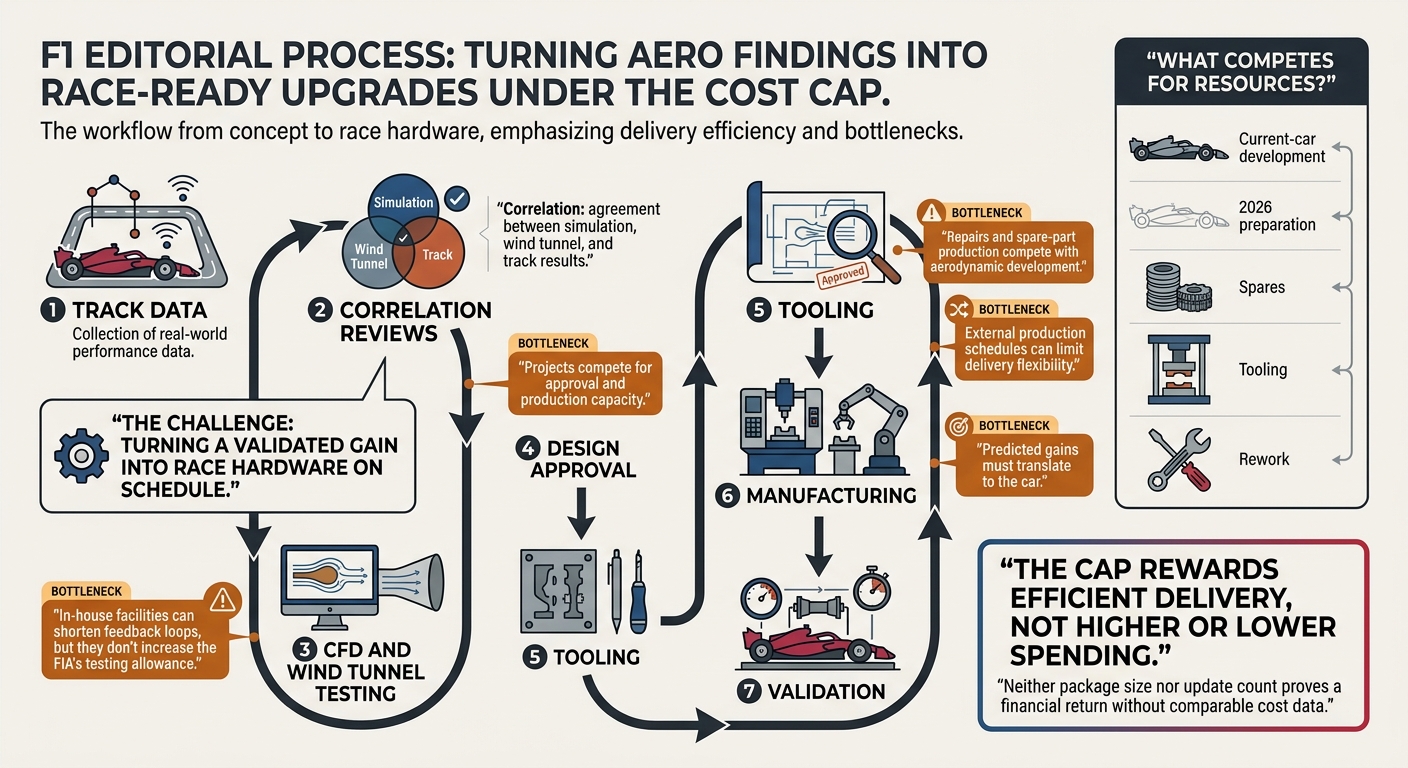
F1 Aero Development: From Track Data to Race-Ready Parts
Across the grid, the cost cap forces teams to balance lap-time gains now against investment in tools and facilities that shorten the next development cycle.
Aero Resource Allocation
Aero budgets split between developing the current car and improving the machinery behind the next upgrade. The table below shows where teams direct that spending - and what competes for the same funds.
| Development model | Teams | Main spend priority | What it displaced |
|---|---|---|---|
| Established front-running operations | Red Bull, Mercedes, Ferrari | Refinement and concept correction | Current-car refinement competes with redesigns and 2026 preparation |
| Infrastructure-led development | McLaren, Aston Martin | In-house testing | Facility investment competes with immediate delivery |
| Update-led midfield operation | Alpine | Modular upgrades | Recurring production competes with facility work |
| Infrastructure catch-up | Williams | Systems modernization | Better tools compete with immediate parts |
| Lean partner-based operation | Haas | Controlled upgrades | Current-season development competes with regulation-reset work |
Update Timing and Size
Mercedes and Ferrari interrupted step-by-step refinement to correct their concepts. McLaren concentrated gains into larger packages, while Alpine favored frequent, smaller changes. Williams’s limited production capacity and Haas’s planned deferrals show that slower delivery can stem from either resource limits or a deliberate choice.
The opening of 2026-specific aerodynamic testing on January 1, 2025, added another demand on team resources: updating the current car while preparing for the new regulations.
Return on aero spend
Small changes that perform as testing predicts can reduce waste. Major concept corrections may deliver more performance, but they also use more design and manufacturing capacity. Neither package size nor update count proves a financial return without comparable cost data.
McLaren’s Austria 2023 package illustrates a large performance step, but its gains alone do not establish performance per dollar.
For midfield teams, faster delivery matters only if the cap also leaves room for spares, tooling, and rework.
The main bottleneck is no longer finding performance. It’s turning a validated gain into race hardware on schedule.
Delivery bottlenecks
More staff and testing help only if teams can approve, tool, build, and validate parts quickly. Large organizations can develop concepts in parallel, but those projects still compete for approval and production capacity. Lean teams have less room for parallel work and spare production.
In-house facilities can shorten feedback loops, but they don’t increase the FIA’s testing allowance. Track data inform correlation reviews, followed by CFD and wind tunnel testing, design approval, tooling, manufacturing, validation, and race introduction.
| Development model | Delivery advantage | Potential bottleneck |
|---|---|---|
| Red Bull, Mercedes, Ferrari | Established technical and production resources | Coordinating concept changes, rework, and 2026 preparation |
| McLaren, Aston Martin | Greater control over testing and handoffs | Turning test findings into validated hardware |
| Alpine | Enstone design and production base | Maintaining delivery through organizational change |
| Williams | Investment in long-term systems | Aging manufacturing capacity |
| Haas | Lean operation with specialist partners | External production schedules and limited parallel capacity |
The team-by-team development choices below reflect this trade-off between spend control and delivery speed.
Development Trade-Offs by Team
The cost cap rewards steady gains and punishes expensive resets. Mercedes and Aston Martin show both sides of that trade-off: facility spending can help teams deliver updates sooner, but the transition comes with costs.
| Team | Advantage | Drawback | Conditions for success |
|---|---|---|---|
| Mercedes | Facility investment strengthens testing capacity. | Customers leaving could mean lost revenue and shared data. | Keep development moving during infrastructure upgrades. |
| Aston Martin | The new Silverstone tunnel shortens iteration cycles and improves communication. | A transition period before testing moves fully in-house. | Link testing, design, and production successfully. |
For both teams, the main gain is less delay between a finding and a usable part, not more wind-tunnel time.
Owning a tunnel gives teams more control over scheduling. It does not change ATR limits: the FIA’s Aerodynamic Testing Restrictions still govern permitted use. That scheduling freedom shortens the gap between spotting a problem and retesting the fix.
Owning a tunnel lets a team pause, revise, and retest without waiting for a rented slot.
The same trade-off shapes how quickly teams turn validated gains into race-ready parts.
Conclusion: Spending Control and Reliable Updates
Across the grid, what matters isn’t who spends the least, but who spends best. Cost-cap compliance can mean shifting costs, not cutting aero spending. Teams can move work into other cost centers while keeping their aero ambitions intact. The split between race-ready parts and experimental aero work remains unclear, so budget totals alone don’t show value.
Under the cost cap, reliable correlation - agreement between simulation, wind tunnel, and track results - reduces wasted parts and saves budget for future updates. The best programs bring predicted gains to the track rather than simply producing more parts. That efficiency matters most when a team needs to turn a validated gain into a race-ready part fast.
Two bottlenecks keep coming up: staffing limits at large teams and factory capacity at smaller ones. Without internal budgets and measured returns, spending rankings and update counts tell us little. The cap rewards efficient delivery, not higher or lower spending.
FAQs
How are wind-tunnel investments treated under the cost cap?
Wind-tunnel investments count as capital expenditure, separate from limits on teams’ operating budgets. The FIA has previously granted special allowances for teams to build new facilities, helping level the playing field.
These projects update what teams can do, but running costs still face financial limits. Separately, the FIA’s Aerodynamic Testing Regulations (ATR) restrict wind-tunnel use based on championship standings.
How can fans judge whether an aero upgrade worked?
Fans can assess an aerodynamic upgrade by watching how a team performs relative to its rivals. Faster lap times, better handling, and more consistent race-day performance can all point to progress.
Strict cost and testing caps mean teams must balance immediate gains with long-term development. AI and simulations help predict improvements, but results on the track can signal better aerodynamic efficiency and a more competitive operating window.
When is delaying an aero upgrade the smarter choice?
Delaying an aero upgrade makes sense when long-term development outweighs small short-term gains. Under the cost cap, teams need to weigh performance per dollar before committing to an upgrade.
Waiting can be the better choice when fixing reliability or race execution issues delivers more value than risky aero updates. Teams may also need to save resources for critical events later in the season or balance work on the current car with new designs for future regulations.