F1 Drop-In Fuel: Does Waste Recycling Cut Emissions?
Assess whether waste-based drop-in F1 fuel truly lowers lifecycle emissions by checking feedstock, accounting boundaries, and verified carbon intensity.
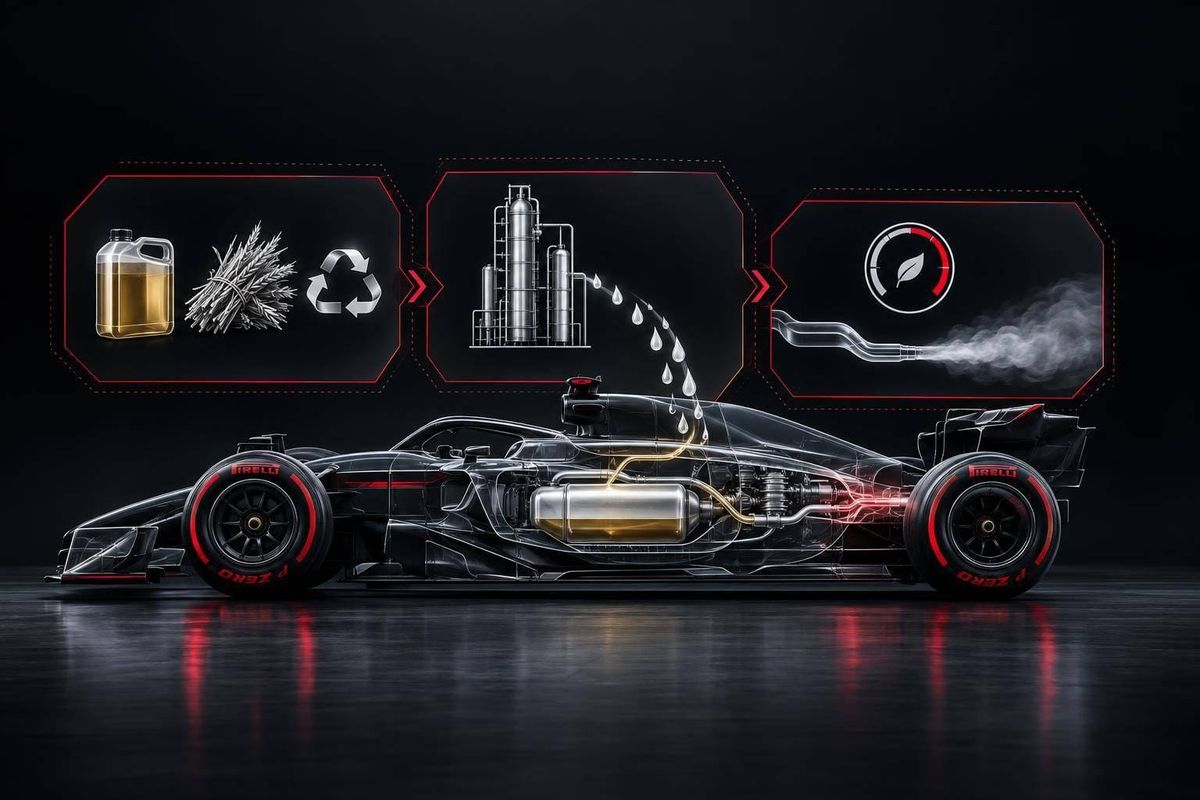
Waste-based F1 fuel can cut emissions - but recycled inputs alone don’t prove it. I’d check its verified lifecycle emissions against fossil gasoline, measured in grams of CO₂-equivalent per megajoule (g CO₂e/MJ). “Drop-in” means engine compatibility, not lower carbon emissions.
Here’s what I’d look for:
- Carbon source: Biomass, waste plastic, and newly extracted fossil fuels need different accounting. All release CO₂ when burned.
- Waste’s alternative fate: Credits for avoided landfill or incineration need a documented basis.
- Production emissions: Collection, transport, drying, hydrogen, and conversion can erase the savings.
- A fair comparison: Feedstock records, independent checks, and matching accounting boundaries let you judge the claimed percentage reduction.
- Road-use limits: Track performance doesn’t prove that fuel can retain its emissions savings at larger volumes and an affordable price.
My bottom line: <u>check the whole fuel chain, not just the recycled label</u>.
F1 Waste-Based Fuel: Check the Whole Carbon Chain
What Does Fuel Lifecycle Accounting Include?
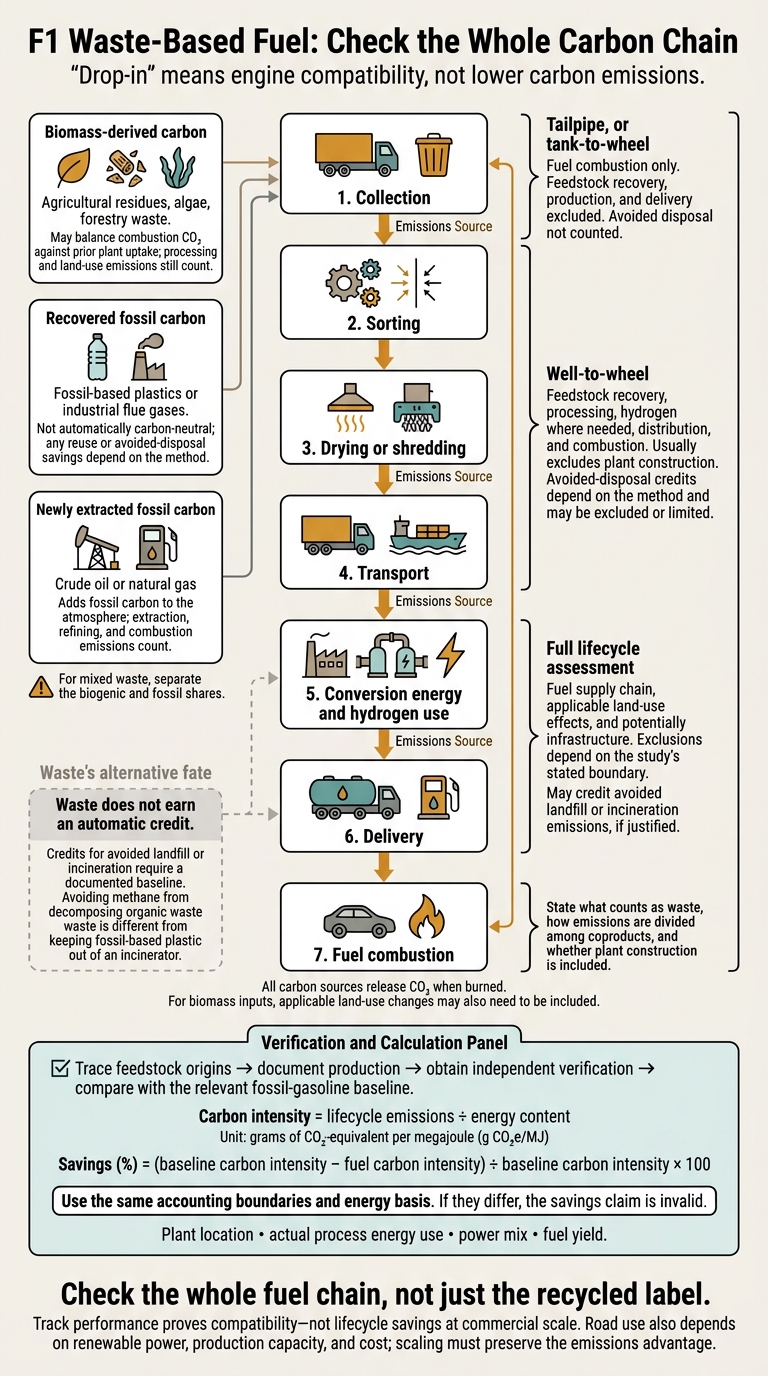
The accounting boundary shapes the result. Clearly state whether the study uses well-to-wheel or full lifecycle accounting. Define what counts as waste, how emissions are divided among coproducts, and whether plant construction is included.
Recycling waste cuts emissions only when the credited savings exceed the emissions from processing it. These boundary choices determine whether recycled feedstocks produce actual emissions cuts.
From Waste Collection to Fuel Combustion
The fuel chain covers collection, sorting, drying or shredding, transport, conversion energy, hydrogen use, and delivery. For biomass inputs, the assessment may also need to include land-use changes.
| Accounting method | Included stages | Typical exclusions | Avoided disposal |
|---|---|---|---|
| Tailpipe, or tank-to-wheel | Fuel combustion | Feedstock recovery, production, and delivery | Not counted |
| Well-to-wheel | Feedstock recovery, processing, hydrogen where needed, distribution, and combustion | Usually plant construction | Depends on the method; may be excluded or limited |
| Full lifecycle assessment | Fuel supply chain, applicable land-use effects, and potentially infrastructure | Depends on the study’s stated boundary | May credit avoided landfill or incineration emissions, if justified |
With the boundary set, the assessment needs to show where savings come from - and where production adds emissions.
Waste does not earn an automatic credit. The assessment must show what would otherwise happen to the material. Avoiding methane from decomposing organic waste is different from keeping fossil-based plastic out of an incinerator.
How Biomass and Fossil Carbon Are Counted
All three carbon sources below release CO₂ when burned. Lifecycle accounting treats them differently based on their origin, not just their exhaust emissions. Calling an input waste does not make the fuel low-carbon. Its carbon source and the credit assigned to its alternative fate determine the emissions savings.
| Carbon source | Origin | Combustion emissions | Accounting treatment |
|---|---|---|---|
| Biomass-derived carbon | Agricultural residues, algae, forestry waste | Releases CO₂ | May balance combustion CO₂ against prior plant uptake; processing and land-use emissions still count |
| Recovered fossil carbon | Fossil-based plastics or industrial flue gases | Releases CO₂ | Not automatically carbon-neutral; any reuse or avoided-disposal savings depend on the method |
| Newly extracted fossil carbon | Crude oil or natural gas | Releases CO₂ | Adds fossil carbon to the atmosphere; extraction, refining, and combustion emissions count |
Biogenic carbon does not cancel emissions from drying, transport, conversion, or hydrogen use. Recovered fossil carbon remains fossil carbon. For mixed waste, check whether the assessment separates the biogenic and fossil shares rather than labeling the entire input renewable.
sbb-itb-7c68254
Where Waste-Based Fuel Cuts or Adds Emissions
Replacing Fossil Inputs and Avoiding Waste Disposal
Once lifecycle boundaries are set, the key comparison is what the feedstock replaces: a fossil input or an actual waste-treatment route. Any credit for avoiding waste disposal must rest on a documented baseline.
Emissions from Transport, Drying, Hydrogen, and Conversion
Transport, drying, hydrogen use, and conversion all add emissions once that baseline is set. These emissions can wipe out the carbon advantage, even with F1 drop-in compatibility.
Whether the waste route still produces fewer lifecycle emissions than fossil fuel depends on plant location, actual process energy use, the power mix, and fuel yield.
How to Check F1 Fuel’s Lifecycle Emissions
Once you’ve mapped where emissions come from, check whether the fuel actually cuts them. Compare its verified lifecycle carbon intensity with the relevant fossil-gasoline baseline, using the same method and energy basis.
Start with traceability. Without it, the carbon-intensity figure has no reliable basis.
Check Feedstock Origins and Production Records
Ask for records that trace the feedstock’s origins, document fuel production, and show independent verification.
Calculate Savings on the Same Energy Basis
Carbon intensity = lifecycle emissions ÷ energy content
Unit: grams of CO₂-equivalent per megajoule (g CO₂e/MJ)

Savings (%) =
(baseline carbon intensity − fuel carbon intensity)
÷ baseline carbon intensity × 100
The comparison must use the same boundaries and energy basis. If these differ between the baseline and the fuel, the savings claim is invalid.
Conclusion: Recycled Inputs Alone Do Not Prove Savings
Recycled inputs can cut lifecycle emissions, but they do not eliminate tailpipe CO₂. Demonstrations on the track or road show how a fuel performs - not whether it cuts lifecycle emissions. Those savings depend on which fossil fuel it replaces, the energy used for collection and processing, whether production runs on surplus low-carbon electricity, and how the fuel compares with the fossil-fuel baseline across its lifecycle.
Sebastian Vettel’s Goodwood run showed drop-in compatibility, not automatic lifecycle savings at commercial scale.
For road use, production economics matter as much as engine compatibility.
F1 Performance and Road-Fuel Production
F1 can absorb high fuel costs. Road use, however, depends on renewable power, production capacity, and cost. As production scales up, the fuel must retain its lifecycle emissions advantage over fossil fuel.
FAQs
Is turning waste into F1 fuel better than recycling it?
Not necessarily. Fuel production and material recycling play different roles in F1’s circularity goals. Fuel lifecycle analysis accounts for combustion CO2 offset by carbon captured or avoided during production. But producing and transporting that fuel still generates emissions [4][5].
Recycling carbon fiber can cut lifecycle emissions by up to 90% by replacing virgin material production. Both approaches support F1’s 2030 Net Zero roadmap [4].
How can I verify F1 fuel’s emissions claims?
A full lifecycle analysis tracks inputs from extraction through disposal. It compares the carbon captured during production with the CO2 released during combustion, while also accounting for emissions from fuel production.
Starting in 2026, F1 will use 100% sustainable, carbon-neutral fuel made from non-fossil sources, such as captured CO2, bio-feedstocks, or waste. Teams also use telemetry and simulations to track fuel flow and consumption against regulatory limits and sustainability benchmarks.
Could scaling up waste-based fuel erase its carbon savings?
Not necessarily. Lifecycle analysis counts greenhouse gas emissions across the entire chain, from raw material collection to combustion. Emissions savings occur when carbon captured or emissions avoided through bio-feedstocks and municipal waste offset emissions from racing.
Energy-intensive refining adds emissions, too. As production grows, renewable energy and efficient logistics will be key to maintaining a net-zero footprint by 2030.