Red Bull Racing origin story: Jaguar sale to win plan
How Red Bull transformed Jaguar’s F1 team into a race winner through leadership change, technical hires, driver development and investment.
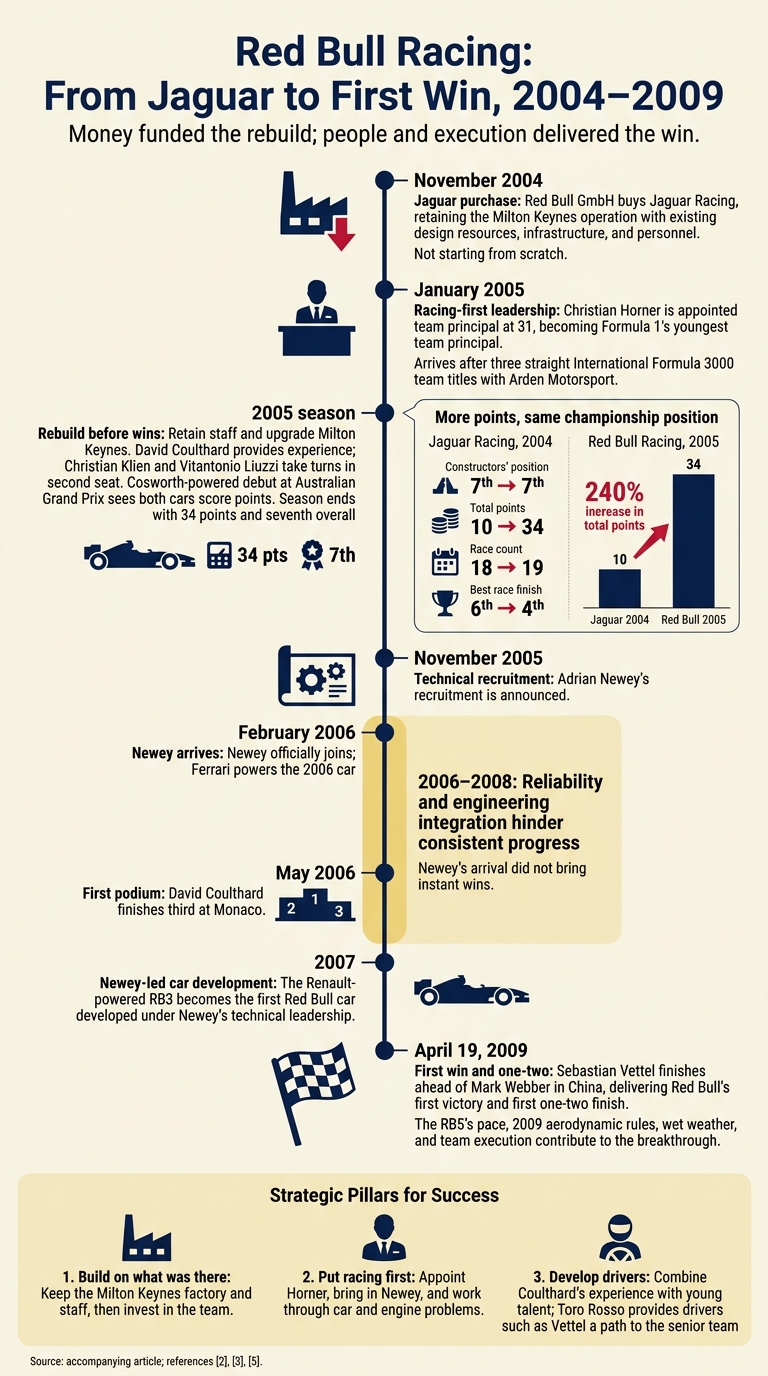
Red Bull turned Jaguar’s team into a race winner - not just by spending money, but by changing who led it and how it worked. From the November 2004 purchase to its first win on April 19, 2009, the rebuild took more than four years.
I see three choices behind that progress:
- Build on what was there: Keep the Milton Keynes factory and staff, then invest in the team.
- Put racing first: Appoint Christian Horner, bring in Adrian Newey, and work through car and engine problems.
- Develop drivers: Pair David Coulthard’s experience with young talent, while Toro Rosso gave drivers such as Sebastian Vettel a path to the senior team.
The early numbers tell part of the story: points rose from 10 for Jaguar in 2004 to 34 for Red Bull in 2005 - a 240% increase, but the team still finished seventh. A first podium followed in 2006, then Vettel led Mark Webber home in China in 2009.
My takeaway: <u>money funded the rebuild; people and execution delivered the win.</u> It was a step-by-step process, not an overnight turnaround.
Red Bull Racing: From Jaguar to First Win, 2004–2009
F1 Origins | The Story Of Red Bull Racing
sbb-itb-7c68254
2004: Red Bull Buys Jaguar Racing
Jaguar’s poor results from 2000–2004 and Ford’s shrinking presence in Formula 1 pushed Ford to rethink its approach. As Jost Capito put it:
"When Jackie Stewart’s team became the Jaguar works team, the blue oval disappeared from F1... Now we need a long-term strategy for making the project a success."
Cosworth Racing also cut 30 jobs as demand from Jaguar’s program fell. Red Bull’s next task was to build a faster, leaner team from what remained.
Investment Commitments and Factory Inheritance
Red Bull GmbH bought Jaguar Racing in November 2004. The main asset was the Milton Keynes operation, which already had design resources, infrastructure, and personnel in place. The factory’s history stretched from Paul Stewart Racing through Stewart GP and Jaguar Racing.
Red Bull wasn’t starting from scratch. The test was who it put in charge and where it spent its money.
Ownership Under Jaguar and Red Bull
| Area | Jaguar under Ford | Red Bull after the sale |
|---|---|---|
| Ownership | Ford Motor Company, operating through Jaguar. | Red Bull GmbH. |
| Brand goal | Promote Jaguar; Ford’s blue oval disappeared from F1. | Promote the Red Bull brand through team ownership. |
| Spending context | Cosworth Racing cut 30 jobs after demand from Jaguar’s program fell. | Bought an existing base. |
Keeping Milton Keynes gave Red Bull a place to begin changing how the team worked.
2005: Leadership, Drivers, and Spending
With ownership settled, Red Bull turned to changing how the team worked. Rebuilding came first in 2005, ahead of immediate results.
Christian Horner’s Appointment and Responsibilities
Red Bull appointed Christian Horner in January 2005. At 31, he became Formula 1’s youngest team principal, arriving after three straight International Formula 3000 team titles with Arden Motorsport.
Horner cut out Jaguar-style corporate habits and pushed for a leaner team that put racing first.
David Coulthard, Christian Klien, and Vitantonio Liuzzi
The driver lineup supported that reset. David Coulthard gave engineers an experienced reference point, while Christian Klien and Vitantonio Liuzzi took turns in the second seat as Red Bull developed talent.
Budget Priorities and Team Culture
Red Bull put money into retaining staff and upgrading Milton Keynes before spending on senior technical hires. That made 2005 a bridge year: keep the inherited car running while paying for the rebuild.
Those spending choices shaped the 2005–09 car-development phase.
2005–2009: Results and Car Development
2005 Results and the 2006 Monaco Podium
Red Bull’s early investments took time to pay off. The team debuted at the 2005 Australian Grand Prix with both cars scoring points, but finished its first season in seventh place. Its points total climbed, while its championship position stayed the same.
| Metric | Jaguar Racing, 2004 | Red Bull Racing, 2005 |
|---|---|---|
| Constructors’ position | 7th | 7th |
| Total points | 10 | 34 |
| Race count | 18 | 19 |
| Best race finish | 6th | 4th |
David Coulthard took third at Monaco in May 2006, earning Red Bull’s first podium. That marked a step forward, but reliability problems, team coordination, and the car’s sensitivity to different tracks still held back its pace.
Adrian Newey’s Arrival and Technical Leadership
Red Bull also needed stronger technical leadership. The team announced Adrian Newey’s recruitment in November 2005, and he officially joined in February 2006. The 2007 RB3 became the first Red Bull car developed under his technical leadership.
Along the way, Red Bull switched engine suppliers from Cosworth to Ferrari, then to Renault. Newey’s arrival didn’t bring instant wins. The team still had to resolve reliability and engineering integration problems through 2008.
| Date | Development milestone |
|---|---|
| November 2004 | Red Bull purchases Jaguar Racing. |
| 2005 season | Cosworth-powered debut; 34 points and seventh overall. |
| November 2005 | Newey’s recruitment is announced. |
| February 2006 | Newey arrives; Ferrari powers the 2006 car. |
| May 2006 | Coulthard takes third at Monaco. |
| 2007 | Renault-powered RB3 begins Newey’s technical era. |
| 2006–2008 | Reliability and engineering integration hinder consistent progress. |
| April 19, 2009 | Vettel and Webber deliver Red Bull’s first win and one-two finish in China. |
China 2009: Red Bull’s First Win
By 2009, Red Bull’s rebuilding work had produced race-winning pace. On April 19, Sebastian Vettel finished ahead of Mark Webber in China, giving the team its first victory and first one-two finish.
Wet weather helped, but the RB5’s pace and the 2009 aerodynamic rules made the win possible. In China, leadership, car development, driver performance, and team execution finally came together.
Conclusion: How Red Bull Built a Race Winner
Red Bull inherited a usable base. Sharper leadership and technical discipline turned it into a contender.
The same approach shaped its junior-team pipeline, making cost-efficient talent development part of the race plan.
Money was only the starting point. Leadership, structure, and talent development built a system that produced speed instead of simply buying it - and delivered Red Bull’s first win in China in 2009.
FAQs
How did Red Bull balance spending with culture change?
After acquiring Jaguar, Red Bull built a leaner team focused on performance, cutting inefficiencies tied to the manufacturer-led works project. Performance came before cost-cutting. The team stressed accountability and direct collaboration between chassis and engine departments. That approach helped it make better use of resources: small changes across the car removed about 44 pounds (20 kg) of excess weight, rather than relying on broad budget adjustments.
Why did Newey’s arrival take years to deliver wins?
Adrian Newey’s arrival didn’t lead to immediate wins. After acquiring Jaguar Racing, Red Bull still had to address problems with its team structure and car development.
Building a team that could fight for championships took time. Red Bull needed long-term investment in infrastructure, changes to how the team worked, and time to put Newey’s design expertise into practice.
The team also had to adjust to rule changes while balancing performance on the track with longer-term technical development.
How did Toro Rosso support Red Bull’s winning plan?
Toro Rosso was created after Red Bull acquired Minardi in 2005. The team gave young drivers a place to develop and served as a testing ground for technology. Red Bull used it to assess drivers like Daniel Ricciardo and Jean-Éric Vergne in competition before considering them for promotion to the senior team.
In 2018, Toro Rosso became the first testing ground for Honda power units, helping Red Bull bring the technology into its championship-winning cars.