F1 telemetry protocols: sensor to pit wall
How F1 telemetry turns sensor readings into actionable pit-wall data—timing, integrity, and latency matter more than volume.
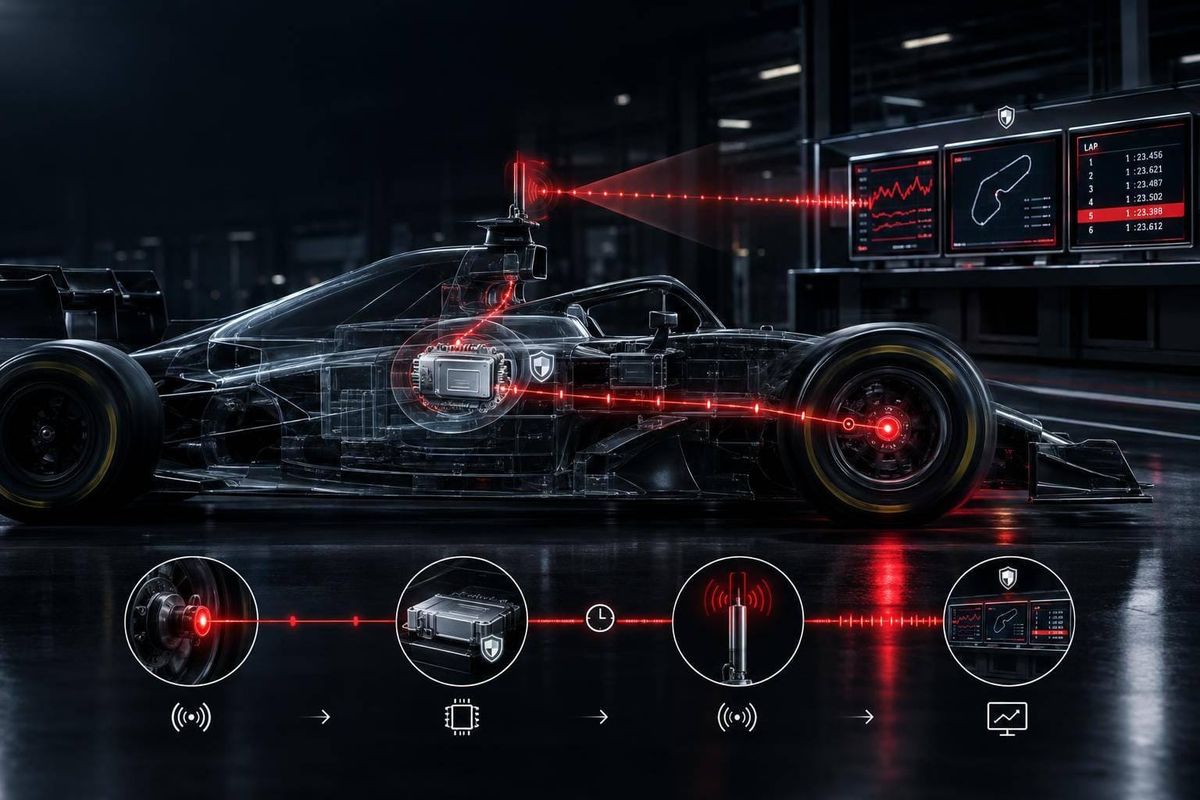
F1 telemetry sends data - not driving commands - to the pit wall. I focus on three checks that make a reading useful: when it was measured, whether it arrived intact, and whether it arrived in time to act.
With 300–600 sensors and about 30 MB of live telemetry per lap, sending every reading live isn’t the goal. The goal is to get the right readings to engineers while the car’s onboard systems keep control.
Here’s the path I follow:
- On the car: Sensors and control units turn measurements into timestamped packets.
- Over the radio: Selected channels reach trackside receivers, subject to delays and missing packets.
- At the pit wall: Software checks, orders, and converts readings for displays and alarms.
- After the session: Onboard logs can supply detail absent from the live stream.
- Within the rules: Public sources describe one-way monitoring, but don’t disclose teams’ packet formats or radio protocols.
My main takeaway: <u>a received number isn’t automatically ready to use</u>. Engineers need timing, context, and data checks before it can support a pit call or fault diagnosis.
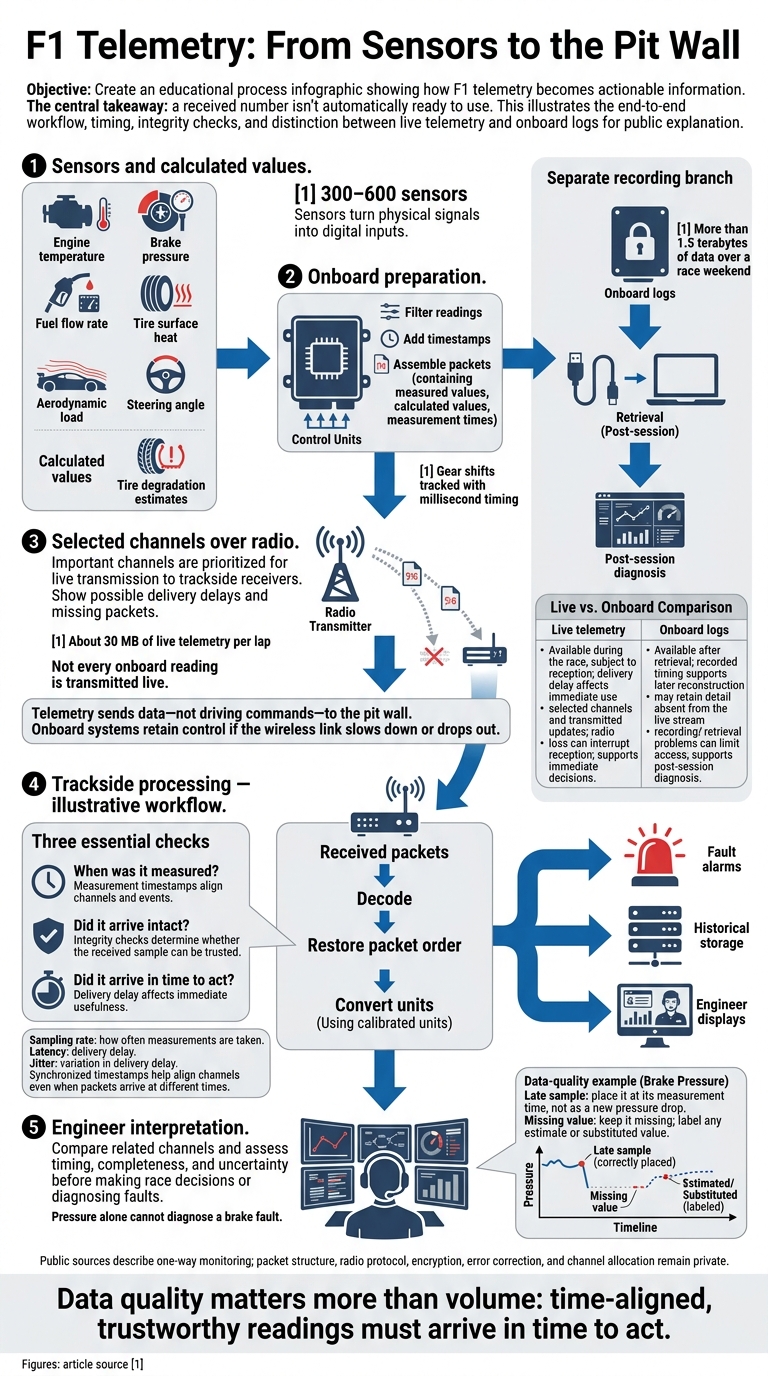
F1 Telemetry: From Sensors to the Pit Wall
How onboard data becomes telemetry packets
Sensor readings and calculated values
Sensors turn physical signals into digital inputs, tracking engine temperature, brake pressure, fuel flow rate, tire surface heat, aerodynamic load, and steering angle. These raw readings are paired with calculated values, such as tire degradation estimates. The data then moves to the car’s control units for cleaning and preparation before transmission.
Control units and onboard networks
The control units filter the digitized sensor data, add timestamps, and assemble it into packets. This bundles the sensor outputs for transmission.
Packet assembly and encoding
Gear shifts are tracked with millisecond timing. Combining measured values, calculated values, and timestamps makes the data usable in seconds. The assembled packets then travel over the radio link to the pit wall.
sbb-itb-7c68254
F1 Telemetry: Explained! 📡 #DellTechnologies
Radio links, timing, and data integrity
Once packets leave the control units, the radio link determines what reaches the pit wall in real time.
The car-to-trackside radio link
Modern cars generate more than 1.5 terabytes of data over a race weekend, but only a small slice reaches the pit wall live. The link gives priority to the most important channels rather than sending every reading in real time.
Useful telemetry needs both the measurement and the time it was taken. Without a timestamp, engineers struggle to place a reading in the sequence of events.
Sampling rates, delays, and synchronized clocks
Sampling rate is how often measurements are taken. Latency is the delivery delay, while jitter is variation in that delay. Synchronized timestamps help engineers align channels, even when packets arrive at different times.
Bandwidth alone can't keep timing data usable. Drifting timestamps or late packets do more than delay delivery: they can strip readings of the context engineers need to interpret them.
Protocol choices and missing data
Live telemetry has limits, so protocol choices affect which data the pit wall can rely on. The trade-off is detail versus update speed: sending more data means slower updates.
The stream must keep readings in sequence across laps so engineers can link cause and effect. Missing or delayed data can blur those relationships. Trackside receivers decode the stream and send it to engineer dashboards.
Trackside processing and race decisions
From receivers to engineer displays
Packets reaching the pit wall aren’t ready for engineers to use straight away. Trackside systems first need to validate them and put them in order. Teams don’t fully disclose their architectures, so the workflow below is illustrative.
Trackside software decodes telemetry, checks its integrity, restores packet order, and converts channel values into calibrated units. It then sends the results to alarms, storage, and engineer displays.
Received packets → Decode → Validate → Restore packet order → Convert units
                                                               ├─ Fault alarms
                                                               ├─ Historical storage
                                                               └─ Engineer displays
How data quality shapes race decisions
Illustrative brake-pressure walkthrough: A received sample is checked for integrity and measurement time before its pressure appears on a trace. If a packet arrives late, the display should place it at its measurement time, not treat it as a new pressure drop. A missing value should remain missing; any estimate or substituted value should be visibly labeled.
A brief pressure change needs context. Engineers must compare it with related channels, such as steering angle and gear shift timing. Pressure alone cannot diagnose a brake fault. Predictive models can flag failures early, but they must not hide missing or uncertain inputs. These processing rules help determine whether engineers can act on telemetry immediately or use it only for later analysis.
Live telemetry versus onboard logs
Live reception and onboard recording produce different records. Live data helps engineers make race decisions, while onboard logs help them reconstruct events later. Public information doesn’t specify each team’s storage capacity or retrieval methods, so those details shouldn’t be assumed.
Comparing live packets with the full onboard record shows where the two differ.
| Aspect | Live telemetry | Onboard logs |
|---|---|---|
| Availability | During the race, subject to reception | After retrieval |
| Timing | Delivery delay affects immediate use | Recorded timing supports later reconstruction |
| Detail | Selected channels and transmitted updates | May retain detail absent from the live stream |
| Failure exposure | Radio loss can interrupt reception | Recording or retrieval problems can limit access |
| Analytical use | Immediate use | Post-session diagnosis |
FIA rules and private protocol details
Equipment rules, data access, and transmission limits
Public rules set the limits of the telemetry stream, but they don’t explain how it works behind the scenes. Public material describes telemetry as a one-way monitoring stream from the car to trackside systems, without specifying the transport stack.
What public rules disclose
| Topic | Publicly documented | What remains private |
|---|---|---|
| Telemetry | Scale and one-way monitoring flow | Packet structure, radio protocol, encryption, error correction, and channel allocation |
Public FIA material leaves these packet-level details unspecified; teams control the implementation within the rules. Trackside systems can act only on data that the live stream delivers in time and in order.
Conclusion: What makes telemetry useful
From the car to the pit wall, telemetry works only when calibrated sensors, onboard processing, packet encoding, and trackside validation keep every sample time-aligned and actionable.
A packet’s arrival doesn’t mean its data is ready to use. Data quality matters more than volume. Protocol choices balance latency, bandwidth, and reliability. Engineers need to know when a reading was taken and whether they can still trust it - not just see a number on a screen. That determines whether the reading can guide tire calls, pit timing, or fault diagnosis.
Telemetry helps engineers make decisions; onboard systems still control the car and must keep working if the wireless link slows down or drops out. Engineers need to trust each reading, place it in time, and act before it goes stale.
FAQs
How do teams prioritize telemetry channels?
Teams need to monitor performance in real time without compromising long-term data integrity. AI-driven normalization and stream processing filter and rank data, routing it along two paths: a hot path for immediate monitoring of tire wear, engine temperatures, and ERS status, and a cold path for in-depth analysis.
Message brokers and edge computing put the metrics needed for split-second decisions first while buffering secondary data. This keeps critical alerts from being missed, even during overseas races with high latency.
How do engineers spot faulty sensor readings?
Onboard systems use error-detecting codes and redundant channels to spot and correct corrupted data. Pit-wall systems flag anomalies, missing segments, and corrupted packets.
Machine learning compares live data with pre-race models and simulations [2], while Elevation Charts check data against track profiles. The Standard Electronic Control Unit (SECU) flags mismatches between driver inputs and hardware responses, helping engineers pinpoint failing sensors or subsystems [3].
When is telemetry too old to act on?
In modern Formula 1, telemetry arrives too late to guide an immediate tactical adjustment once the window for a pit stop or energy deployment change has closed [3]. Even a 300-millisecond delay, sometimes seen at remote circuits, can mean missing the chance to act [2].
That data still helps teams with long-term analysis after the session [3].