F1 Tire Timeline - From Cross-Ply to Radial
How F1 tires evolved from cross-ply to radial (1950s–mid‑1980s), and why radials became the standard as cars gained downforce.
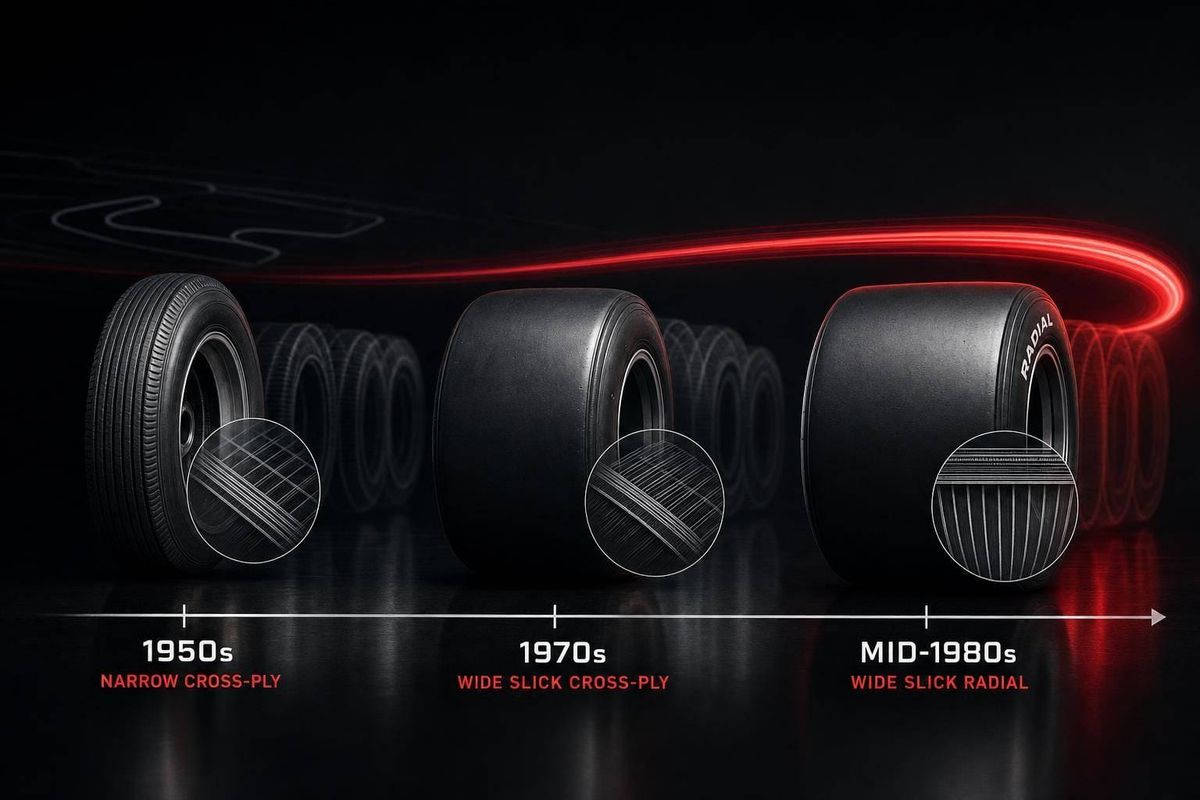
F1 changed tire design because the cars changed first. From 1950 to the mid-1970s, cross-ply tires ruled the grid. After Michelin and Renault introduced radial tires on July 16, 1977, teams shifted over bit by bit, and by the mid-1980s radials had taken over.
Here’s the short version:
- Cross-ply tires worked well in early F1 because cars had less grip, less downforce, and lower cornering load.
- Radial tires kept the tread flatter under load, which helped as speed, downforce, and turbo power grew.
- The switch did not happen in one season.
- Teams had to change suspension, setup, and geometry to make radials work.
- By the mid-1980s, radial construction had become the grid standard.
If I boil the whole story down to one lesson, it’s this: once F1 cars started putting more force through the tires, cross-ply design had less room left, and radials became the better fit.
| Tire type | Main trait | Best fit for | Main limit |
|---|---|---|---|
| Cross-ply | Tread and sidewall flex together | Early low-downforce F1 cars | More heat and less tread control under load |
| Radial | Sidewall flexes separately from tread | Late-1970s and 1980s F1 cars | Needed setup changes to work well |
A few facts stand out:
- Cross-ply tires were the F1 norm for about 25+ years
- Radials entered modern F1 at Silverstone in 1977
- Early radial attempts before that could fail after about 10 km of hard running
- The move from cross-ply to radial took about one decade to finish across the field
So if you want the plain answer, here it is: radials won because they handled heat, load, and downforce better when F1 became faster and more demanding.
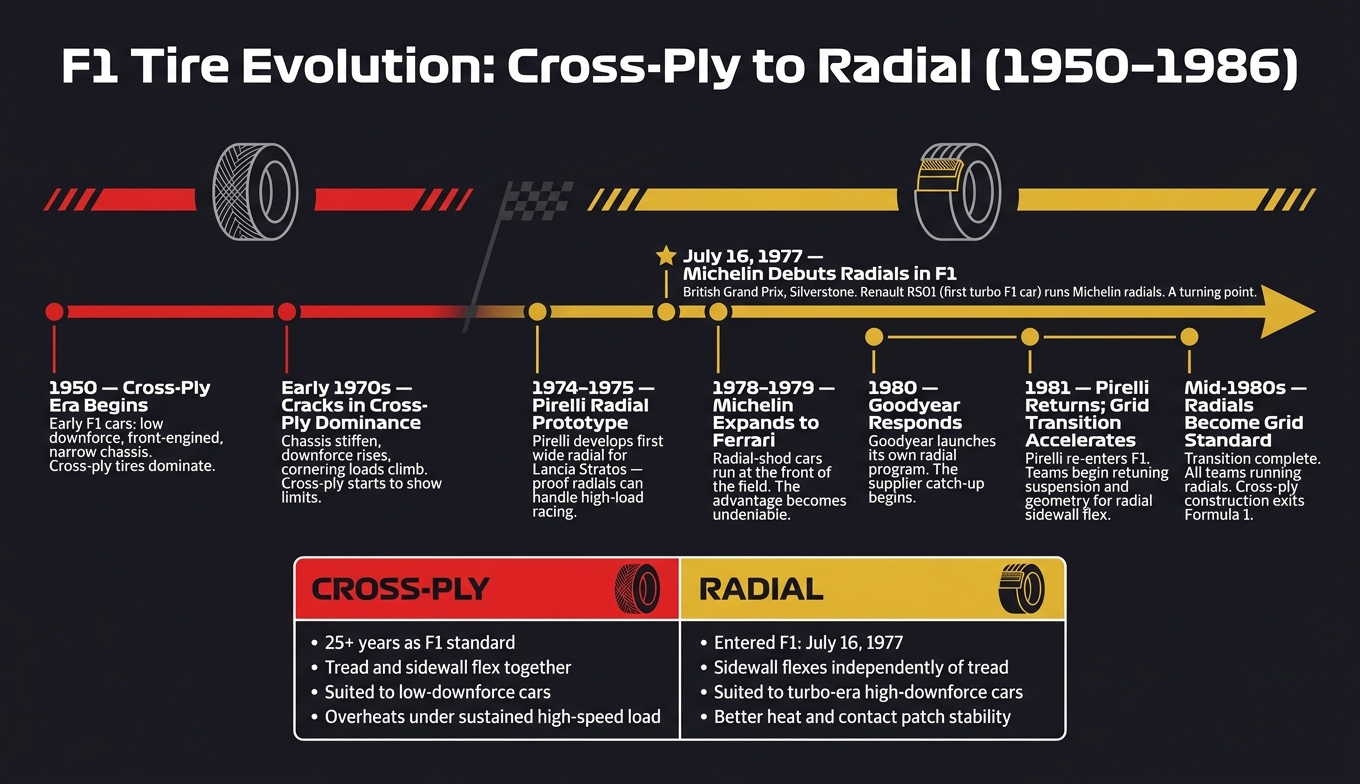
F1 Tire Evolution: Cross-Ply to Radial (1950–1986)
Every Tyre Manufacturer in Formula 1 History Explained
sbb-itb-7c68254
1950 to the Mid-1970s: The Cross-Ply Era
Cross-ply tires were the standard choice across the grid in the 1950s and 1960s. That matched the cars of the time: front-engined, narrow, and running with very little aerodynamic downforce.
Why Cross-Ply Worked for Early F1 Cars
Cross-ply casings flexed as a single unit, and that worked well for the lower cornering loads early F1 cars had to deal with. At that stage, the setup made sense.
By the early 1970s, though, things started to shift. Chassis got stiffer, downforce increased, and cornering loads climbed. Tires now had to handle lateral forces with more control, and the same stiffness that had made cross-ply tires dependable started to hold them back. Before the mid-1970s, radial tires simply weren't ready for Formula 1. They were too narrow and too fragile for the loads involved, and some failed after about 10 km of hard running.
The Early Supplier Landscape
The early championship years included several tire makers, such as Pirelli, Dunlop, Firestone, Englebert, and Goodyear. That competition led to steady gains in compounds and durability.
Even so, none of those brands managed to break cross-ply's grip on the grid. So cross-ply tires stayed on top until radials were finally ready to challenge them in the late 1970s.
1977 to 1980: Michelin and Renault Bring Radials to F1
On July 16, 1977, Michelin made its Formula 1 debut at the British Grand Prix at Silverstone with Renault's RS01 - the first turbocharged car in Formula 1. That mattered for one simple reason: the RS01 delivered torque in a much sharper way than the naturally aspirated cars around it. And that put extra strain on tire casings that cross-ply construction just wasn't built to handle.
Michelin's fix was a wide radial with a low-profile, slick-like footprint, made for Formula 1 loads. Radials helped keep the tread flatter under load. In plain English, that gave Renault a steadier contact patch as turbo torque hit harder and downforce climbed. It was an early sign of where the sport was headed, and the rest of the grid would soon have to deal with it.
Early Team Choices: Renault, Ferrari, and Michelin's Growing Reach
Renault moved first. Ferrari came later, on its own schedule. By 1978–79, Michelin had worked its way to the front of the grid.
The rest of Formula 1 didn't switch all at once, though. Through 1980, much of the field still ran cross-ply tires, and many teams had yet to rework their setups for a different tire construction. That made the shift uneven for a while: some teams were already leaning into the new direction, while others were still sorting out how to make it work.
Key Milestones: 1977 to 1980
| Year | Event |
|---|---|
| July 16, 1977 | Michelin debuts radial tires in Formula 1 with Renault and the RS01 |
| 1974–1975 | Pirelli develops the first wide radial for the Lancia Stratos, showing radials could work in high-load racing |
| 1978–1979 | Michelin expands to Ferrari; radial-shod cars run at the front of the field |
| 1980 | Goodyear starts its radial response |
1981 to the Mid-1980s: How the Grid Moved to Radials
By 1981, the debate had changed. The question was no longer whether radials worked, but which teams could move fastest. The grid didn’t switch to radials all at once. It took time, and by 1981 the main issue left was durability under Formula 1 loads.
The wide radial helped make that shift possible. It paired radial construction with a low-profile, wide footprint, which made it usable for faster F1 cars. Pirelli also returned to Formula 1 in 1981, adding another supplier during this changeover.
Goodyear's Response and the Supplier Catch-Up
Goodyear answered with its own radial program, which cut into Michelin's early lead. But this wasn’t just a supplier story. Teams were starting from different chassis platforms, so adoption stayed uneven across the field.
That changed the battle. It moved from pure tire development into car setup. In plain English: the tire mattered, but so did the car underneath it.
What Teams Had to Change on the Car
Once tire shapes changed, the suspension had to follow. Teams had to retune suspension and geometry to work with radial sidewall flex.
That meant the switch wasn’t as simple as bolting on a new set of tires and heading out of the garage. A radial asked the car to behave in a different way, so teams had to rethink how the chassis responded.
Team and Supplier Adoption by Season
Adoption did not move evenly across the grid. From 1981 to 1986, teams changed over one by one rather than all in the same season.
Why Radials Won and What the Shift Changed in F1
Cross-Ply vs. Radial: Performance Differences on Track
On track, radials gave drivers a more stable and consistent contact patch under high lateral and vertical loads. That showed up in the car almost at once: handling became more predictable, and grip had more room to grow.
| Feature | Cross-Ply | Radial |
|---|---|---|
| Contact patch stability | Less consistent under high lateral load | More stable and predictable |
| Sidewall behavior | Stiff; tread and sidewall plies integrated | Flexible sidewall, independent of tread belt |
| Heat management | Prone to overheating at sustained high speeds | Better resistance to heat buildup |
| High-downforce compatibility | Limited potential | Greater potential for extreme vertical loads |
The construction difference mattered a lot. A cross-ply tire tied the tread and sidewall together more tightly, so the tire had a harder time keeping the contact patch steady when forces climbed. A radial separated those jobs more cleanly. The sidewall could flex while the tread stayed more controlled. In F1 terms, that meant a tire that dealt better with cornering load, speed, and downforce.
When the Transition Was Complete
Once teams had sorted out suspension and geometry, there was no going back. The radial era had taken over.
That didn't happen in one clean step, though. Teams had to rethink chassis and suspension setup because tire construction and dimensions had changed. So the move spread over time, season by season, instead of flipping all at once.
Conclusion: The Cross-Ply to Radial Timeline in One Technical Lesson
That shift explains the timeline above. Radials won because their construction was the better structural match for what Formula 1 had become. As downforce climbed, teams needed a tire that could keep a consistent contact patch under loads that cross-ply construction just couldn't handle. From there, the rest of the car had to follow that new base.
FAQs
Why did radial tires take so long to replace cross-ply tires in F1?
Radial tires didn’t take over Formula 1 right away. The main problem was simple: the early versions weren’t built for the sport’s brutal demands.
In the mid-1970s, radial tires were too narrow to deliver enough grip. On top of that, they wore out fast under the heavy power and cornering loads of F1 racing. Cross-ply tires, by comparison, could better handle that punishment at the time.
That started to change in 1975. Pirelli developed a wider radial tire with a lower sidewall, and that design was a much better fit for top-level racing.
What changes did teams need to make to their cars for radial tires?
Teams had to rethink suspension geometry and chassis setup because radial tires behaved very differently from cross-ply tires. They flexed in a different way, built grip differently, and changed how the car reacted through corners and under load.
That meant old setups built around stiff, wide cross-ply designs no longer worked. Teams had to back away from those ideas and tune the car so the new tires could cope with high-speed loads without wearing out too fast or failing.
How did rising downforce make cross-ply tires less effective?
As Formula One cars produced more downforce, they pressed the tires harder into the track. That extra vertical load gave drivers more grip, but it also put far more strain on the tires. And that strain started to push old cross-ply designs close to the edge.
Cross-ply tires were stiff by nature. Under higher cornering speeds and heavier aerodynamic loads, they had a tougher time dealing with heat and shape changes. That’s why radial construction became a better match for modern high-downforce racing.