Broadcast Costs Shape F1 Fan Demographics
Higher broadcast fees don't kill F1 fandom - they shift who watches live, favoring older, wealthier, core fans.

Yes - higher broadcast costs tend to sort live F1 viewers by income, age, and level of interest. In plain terms: when live races sit behind paid TV or streaming, core fans stay, while many newer and more casual fans shift to highlights, clips, or no coverage at all.
Here’s the short version:
- F1 has more than one audience. Global fan surveys skew younger and more online, while TV audience data tends to skew older.
- Price changes who watches live. Paid access does not just cut total reach. It often pushes the live audience toward people with more money and stronger habits.
- The effect is not the same in every country. The U.K. and Germany saw live reach drop after free TV gave way to paid access. The U.S. grew under a paid model from the start, so the pattern looks different.
- Casual fans feel the most pressure. A die-hard fan may see $99.99/year for F1 TV Pro as acceptable. Someone who only wants a few races may not.
- Household setup matters. Families can split costs. A single viewer usually cannot.
If I boil the article down to one point, it’s this: broadcast pricing does not erase F1 fandom - it changes which fans watch live and which fans settle for highlights.
| Market | Main live access path | Main effect |
|---|---|---|
| United States | ESPN/ABC, bundles, F1 TV Pro | Younger growth, but paid access still filters out some casual fans |
| United Kingdom | Sky Sports | Lower reach than free-TV era; live audience leans more committed |
| Germany | Sky Deutschland | Big drop from the RTL era; sharper split between core and casual viewers |
| Italy | Pay TV after stronger free-TV access | Older core audience stayed more than lighter viewers |
So if you want the direct answer: broadcast costs shape F1 fan demographics most at the live-viewing level, not at the fandom level as a whole. People may still follow the sport, but many stop paying to watch every race live.
What research shows about F1's audience baseline
Before pricing enters the picture, the research already makes one thing clear: F1 does not have one single audience. Different studies describe different groups of people, so the numbers don’t line up neatly.
The main global fan surveys point to a younger audience and a higher share of women than broadcast data does. But there’s a catch: both are built on self-selected samples.
Broadcast ratings paint a different picture. F1’s annual audience reports measure reach - meaning anyone who watched at least 15 minutes of a race broadcast during the season. That number can top 1.5 billion worldwide, while broadcast-based audience measures tend to skew older, often 40-plus. The gap exists because these sources are measuring different populations with different tools. And that matters. Pricing pressure doesn’t land the same way on a casual viewer as it does on a die-hard fan.
The comparison below shows where the numbers split.
| Study | Year | Geography | Sample / Method | Avg. Age | Female Share | Principal Limitation |
|---|---|---|---|---|---|---|
| Global Fan Survey (Motorsport Network/Nielsen/Formula 1) | 2021 | Global (187 countries) | 167,000+ self-selected | 32.4 | 18.3% | Likely overrepresents core fans |
| Global Fan Survey (Motorsport) | 2017 | Global | 197,000+ self-selected | 35.8 | 10% | Pre-dates the full Netflix-era growth |
| F1 Annual Audience Report | 2023 | Global | Broadcast audience data (reach) | ~40+ | Not typically specified | Measures viewing, not fan identity |
| ESPN/ABC U.S. Reports | 2022–23 | United States | Nielsen TV ratings | ~35–36 | Strong growth in 18–34 and female demos | Market-specific; not global |
Why age and gender figures differ across studies
The main issue is simple: broadcast viewing is not the same thing as survey response.
Broadcast ratings count anyone whose TV was tuned to a race. That can include people in bars, people in a living room where someone else picked the channel, or casual viewers who stopped by for a short stretch. Fan surveys pull in people who went looking for the survey and chose to fill it out. That group tends to lean younger, more online, and more closely tied to the sport outside race weekends.
English-language digital surveys also miss many older and less connected viewers who still watch often on regular TV. That pushes reported fan ages lower than what broadcast data tends to show.
What newer U.S. fan data adds to the picture
U.S.-specific data stands out in one clear way: about 40% of American F1 fans started following the sport within the previous two to three years. That group skews younger than the global average. ESPN and ABC ratings from 2022–23 also showed strong growth in the 18–34 group and among female viewers.
Still, this needs to be read with care. The U.S. remains a growing F1 market, so a younger profile makes sense. Older European markets, where fans have followed the sport for decades, tend to show steadier and older age patterns. Using U.S. growth data as proof of a global shift would go too far. It shows where F1 is adding new fans, not what the whole world looks like. That split matters because subscription prices tend to hit casual and newer fans first.
sbb-itb-7c68254
How subscription costs filter access to live F1
In the U.S., live F1 viewing is sold in a way that narrows access by price, not just by platform. That hits harder here because most live races sit behind paid access. Roughly 85% of F1's live race broadcasts in the U.S. need either a pay-TV bundle or a standalone streaming plan. Only a small number of races air live on free-to-air ABC.
The main ways to watch are pretty close on what they offer, but not on cost, commitment, or how many people in a home can use them. Here's how the main U.S. access routes compare in 2026. The last column is an analytical read, not a direct measurement.
| Access Model | Direct Price (Monthly) | Commitment | Session Coverage | Household Sharing | Effect on Audience (Analytical Interpretation) |
|---|---|---|---|---|---|
| Free-to-Air (ABC) | $0.00 (antenna ~$20–$50 one-time) | None | Select live races only | Not applicable | Lowest barrier; reaches casual and first-time viewers most broadly |
| F1 TV Pro (Standalone) | $12.99/mo or $99.99/yr | Low (monthly) or annual | Full live + archive | Restricted by IP | Attracts committed core fans; less appealing to occasional viewers |
| Sports-Only Bundle (e.g., Venu Sports) | ~$49.99/mo | Moderate | Live races via ESPN | 2–3 streams | Filters for general sports fans; excludes casual F1-only viewers |
| Full Live TV Bundle (e.g., YouTube TV, Hulu + Live TV) | ~$82.99/mo | High (often annual) | Full ESPN/ABC coverage | Family/home-based | Skews toward older, higher-income households with existing subscriptions |
There’s another catch: every option except an antenna also needs broadband, which usually runs about $70–$90 per month in the U.S.
Why casual viewers feel more price pressure
The cost doesn’t land the same way for everyone. It depends on how often someone watches.
A fan who tunes in for every practice, qualifying session, and race across the season can spread the cost of F1 TV Pro - $99.99 per year - across well over 100 hours of live coverage. That works out to less than $1.00 per race weekend.
A casual viewer is dealing with a different equation. If someone only wants the big-name weekends - Miami, Las Vegas, and Monaco, for example - the price can feel steep fast. For a household watching spending, it’s hard to justify paying for a full plan when free highlights are sitting right there.
The U.S. example: advertised price versus total household cost
The headline price leaves out the bigger problem: what a new household has to spend to get live access from scratch.
On its own, F1 TV Pro at $12.99/month or $99.99/year can look pretty reasonable. But for a new cord-cutter, first-month costs can climb past $150 once broadband and a live TV bundle enter the picture.
For households already paying for YouTube TV or Hulu + Live TV - about $82.99 per month - ESPN access is already part of the package. But that doesn’t mean the cost disappears. It just gets buried inside a much bigger bill, often alongside dozens of channels the viewer may never watch.
That’s a different kind of price pressure. Instead of blocking access with a single high fee, it pushes people to pay for an entire TV package just to follow one sport. For viewers who want F1 and nothing else, that’s a tough sell.
Which fan groups face the biggest cost barriers
Once price sets the main hurdle, the next question is simple: who gets hit the hardest? In live F1, age, income, and household setup shape that answer.
Younger viewers - especially those ages 18–34 - are one of F1’s fastest-growing audience groups. But for students and lower-income households, paying for live F1 means stacking it against other monthly subscriptions. That makes it one of the first things people cut. The issue isn’t lower interest. It’s a tighter budget. So when it comes to live F1 access, age and income act as the first big filters.
For higher-income households, the math looks different. Core fans in this group are more likely to keep paying even when prices go up. Casual fans, though, are more likely to step back and stick with free highlights instead.
Family households sit somewhere in the middle. The same subscription can feel expensive to one person and almost negligible to another, and a lot of that comes down to how many people use it. A family can spread the cost across several viewers. A single adult can’t.
| Household Type | Cost effect |
|---|---|
| Younger viewers / students | More price-sensitive; more likely to rely on highlights when live access is expensive |
| Single adults | Cannot split the cost of standalone services; higher per-person barrier |
| Families with children | Shared subscriptions lower the per-viewer cost |
Country differences, the core-casual divide, and what the evidence can prove
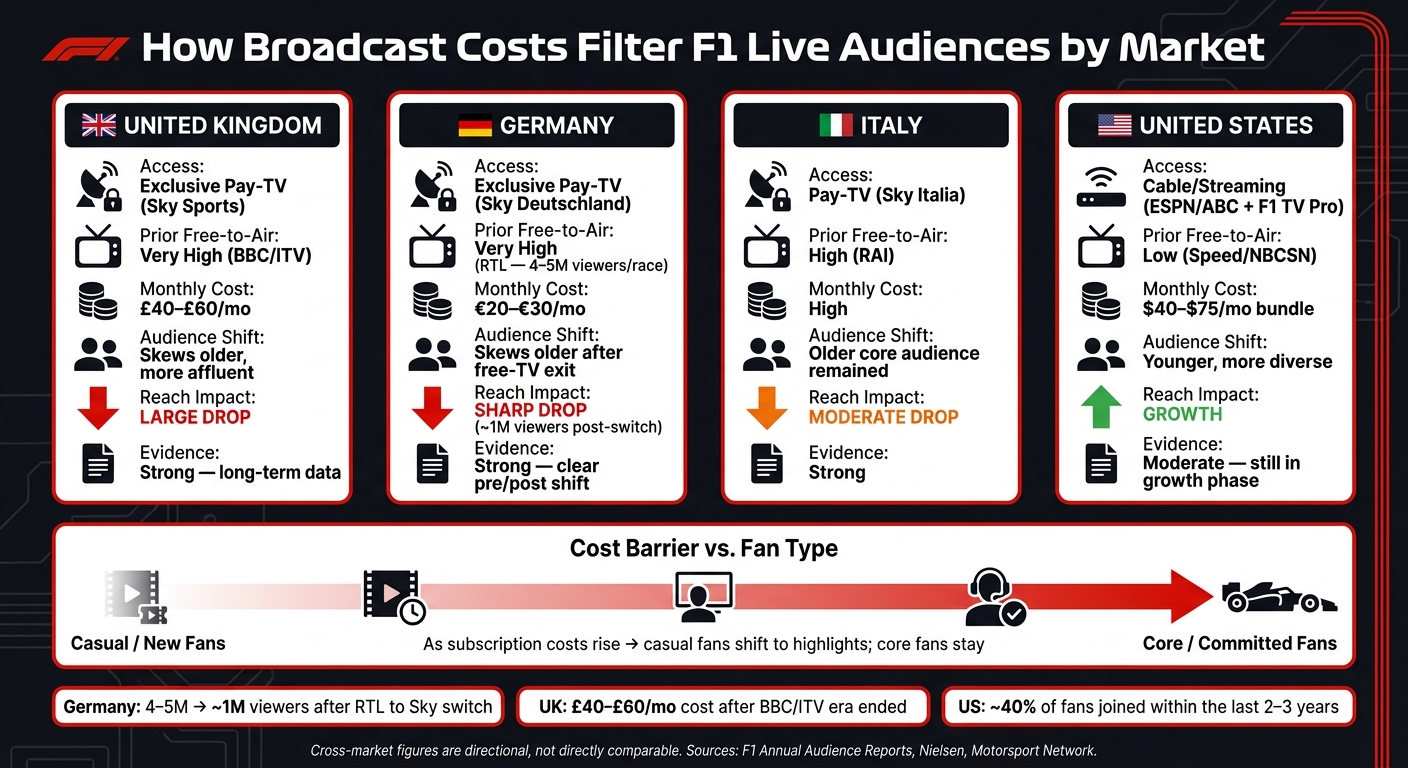
F1 Live Viewing Access: Cost vs. Audience Filter by Market
Those same price filters don’t hit every market the same way. Each country came into F1 with a different broadcast setup, and that starting point matters a lot.
Market structure shapes F1 viewership just as much as household budgets do. The U.K., Germany, and Italy all saw reach shrink after premium rights replaced free-to-air coverage. In Germany, audiences on RTL averaged 4–5 million viewers per race before Sky Deutschland took over exclusive rights. After the switch, that figure fell to roughly 1 million. In the U.K., the move from BBC and ITV to Sky Sports pushed monthly costs to about £40–£60. In both cases, total reach fell, while the audience that stayed skewed more toward committed, higher-income viewers.
The U.S. took a different route. F1 grew here almost entirely during the cable and streaming era, so American fans never had a free-to-air baseline to lose. That growth happened inside a paid setup, which means many U.S. fans entered F1 through bundles and streaming from the start. Because of that, younger and more diverse fans came in through paid access rather than being shut out by the loss of free coverage.
The table below shows how that starting point shapes the audience mix.
Why country comparisons need caution
Sticker price is only part of the story. Local wages, broadband access, and pay-TV habits all shape whether a plan feels affordable or out of reach. So while the table below helps frame the major markets, cross-market figures should be read as directional, not as exact one-to-one comparisons.
| Market | Primary Access Model | Prior free-to-air access | Monthly cost pressure | Demographic tilt | Evidence Strength |
|---|---|---|---|---|---|
| United Kingdom | Exclusive Pay-TV (Sky Sports) | Very High (BBC/ITV) | Very High (£40–£60/mo) | Skews older, more affluent | Strong - long-term data |
| Germany | Exclusive Pay-TV (Sky Deutschland) | Very High (RTL) | High (€20–€30/mo) | Skews older after FTA exit | Strong - clear pre/post shift |
| Italy | Pay-TV (Sky Italia) | High (RAI) | High | Older core audience remained | Strong |
| United States | Cable/Streaming (ESPN/ABC) | Low (Speed/NBCSN) | Moderate ($40–$75/mo bundle) | Younger, more diverse | Moderate - still in growth phase |
Treat cross-market figures as directional, not directly comparable.
Across markets, the pattern keeps showing up in slightly different ways: premium access narrows the live audience toward core fans.
Broadcast costs do not erase F1 fandom; they sort it
The evidence points to correlation, not strict causation. Premium access shifts live viewing toward older, higher-income, more committed fans. As costs go up, casual viewers often move to highlights, clips, or recaps instead of watching races live. Subscription models don’t make F1 fandom disappear, but they do favor people who are already invested or can handle the monthly bill.
FAQs
Why do paid broadcasts change who watches F1 live?
Paid broadcasts are changing F1 viewership by moving the sport away from standard cable and toward a digital-first subscription model.
That shift does more than change where people watch. It also changes how they watch. Instead of a single TV feed, fans can get extra features like real-time telemetry, multi-view screens, and other interactive tools that standard cable usually doesn’t offer.
In the United States, that tends to split the audience into tiers. Casual viewers might stick with free practice sessions or lighter access options. More dedicated fans are more likely to pay for premium packages that offer deeper data and more control over the viewing setup.
There’s a clear upside here for fans who want more from each race weekend. But there’s also a tradeoff. This model can lean toward urban, tech-savvy audiences with strong internet connections and devices that handle streaming well. For some rural fans, access can be tougher, especially when broadband is slower or less reliable.
Which fans are most likely to stop paying for live F1?
Fans most likely to stop paying for live Formula 1 are the ones feeling subscription fatigue most sharply. That often includes viewers who once got races through a cable package and now feel like they’re paying for yet another service on top of everything else.
More casual, newer fans may be at risk too. If an exclusive streaming setup starts to feel like a hassle - or the price just doesn’t feel worth it anymore - they’re more likely to tune out and cancel.
Why does the impact of broadcast costs vary by country?
Because countries don’t all operate the same way when it comes to internet access, media markets, and licensing deals. In the U.S., F1 has leaned into a digital-first, subscription-based setup built around fast internet and connected platforms.
In other markets, long-established regional broadcasters or split-up streaming options are still more common. And where streaming infrastructure isn’t as strong, regular TV still carries more weight, which changes how access and pricing are handled.