Why F1 cuts ground effect for 2026
Explains why 2026 rules reduce underfloor downforce to curb porpoising, widen ride-height window, and aid passing with active aero.
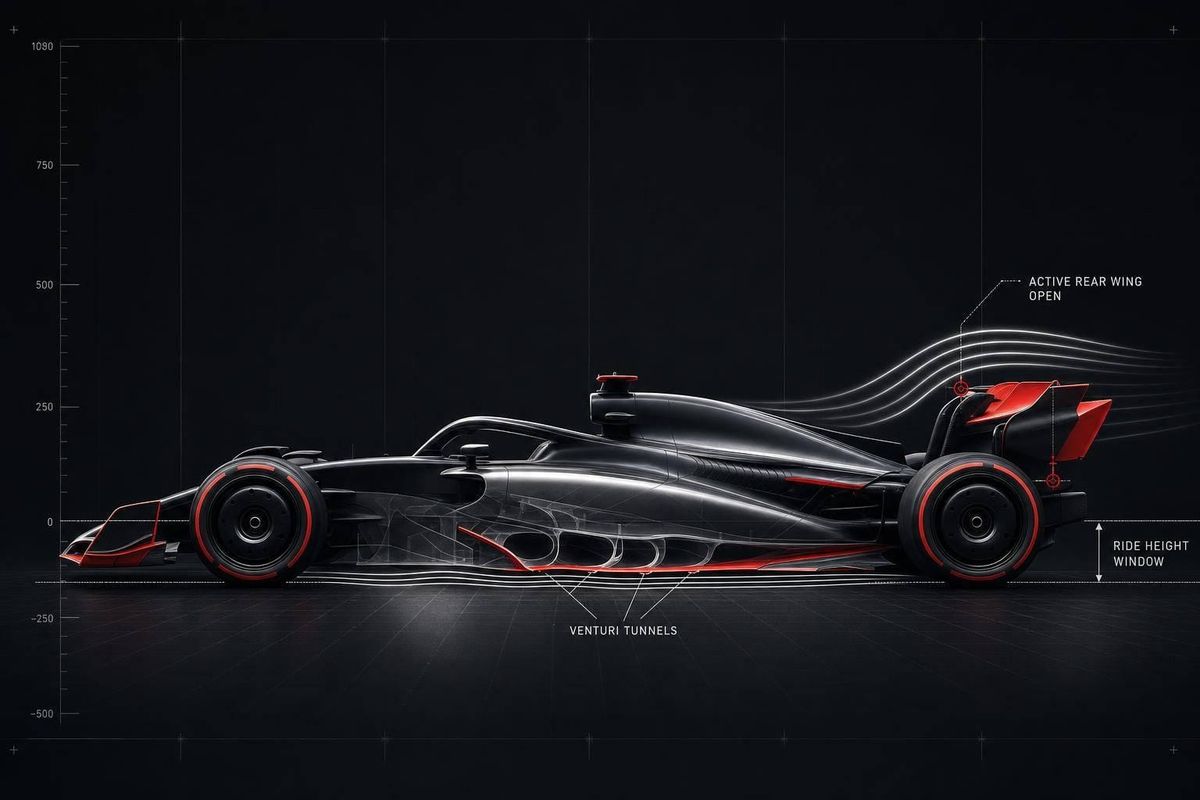
F1 is cutting back the floor’s role in 2026 because the old cars were too sensitive to ride height. I’d sum it up like this: the 2022–2025 rules made teams chase underfloor downforce so hard that they ended up with stiff cars, harsh bouncing, and a setup window that was too small.
Here’s the short version:
- Porpoising exposed the problem. If the car ran too low, airflow under the floor could stall and trigger violent bouncing.
- The fix cost lap time. In 2022, lifting the car by just 10 mm could cost up to 10% of total downforce.
- The floor did too much work. Ground effect could account for 60%+ of total downforce on these cars.
- So 2026 shifts load away from the floor. The new car gets a partially flat floor, shallower tunnels, a smaller diffuser, and active wings.
- The goal is simple: make the car less sharp over bumps, easier to set up, and better at following other cars.
I also see a second goal in the rules: improve racing in two ways at once. First, less floor sensitivity should help cars stay steadier in dirty air through corners. Second, active aero and Manual Override Mode should help passing on straights by adding low-drag wing settings and up to 350 kW of electrical boost for the car behind.
A few numbers show how far the reset goes:
- Downforce: about 30% lower
- Drag: up to 55% lower
- Car width: 1.9 m
- Weight: 768 kg
- Wheelbase: 3,400 mm
- Top speed threshold noted for override use: up to 209 mph (337 km/h)
| Area | 2022–2025 cars | 2026 cars |
|---|---|---|
| Main downforce source | Underfloor-heavy | More split between floor and wings |
| Ride-height window | Very small | Less punishing |
| Bumps and curbs | Can upset aero fast | Should be less sharp |
| Straight-line passing | DRS | Active aero + Manual Override Mode |
My takeaway: F1 is not getting rid of ground effect. It’s just cutting its share of the job so the cars are less peaky, less bounce-prone, and less dependent on one exact ride height.
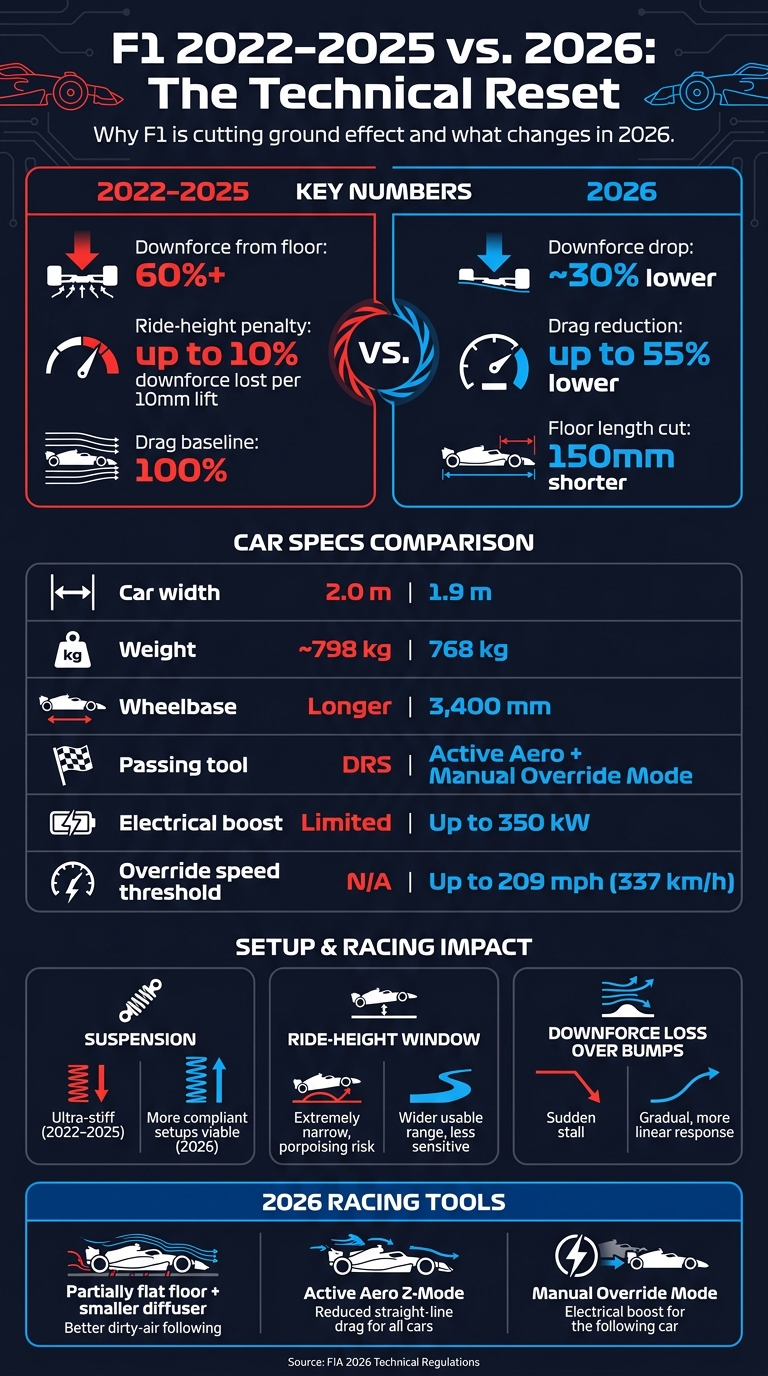
F1 2022–2025 vs 2026 Cars: Key Technical Changes Explained
What porpoising taught F1
Porpoising vs. mechanical bouncing
Porpoising is an aerodynamic oscillation, not normal bumpiness. When the floor gets too close to the track, the airflow under the car stalls, downforce drops, the car lifts, and then the whole cycle starts again.
Mechanical bouncing is different. That’s the suspension skipping over bumps. A stiff setup can make both problems worse, but only porpoising starts with the floor itself.
That’s why porpoising turned into more than a setup headache. It became a design issue and a safety issue, and it showed how narrow the 2022–2025 operating window had become.
Why safety became a regulation priority
That difference mattered because fixing porpoising came with a harsh lap-time penalty. More to the point, the issue was the performance hit tied to the fix.
In 2022, some teams found that raising the car by 10 millimeters could cost up to 10% of total downforce, and ground-effect floors can produce more than 60% of a modern F1 car’s total downforce. That’s a brutal trade. No team wanted to hand that away while rivals kept leaning on the edge.
The FIA stepped in with Technical Directive 039 (TD039). It brought in the Aerodynamic Oscillation Metric (AOM) and forced teams to lift ride heights once oscillations passed a set limit.
For 2026, the aim is different. Instead of forcing teams into that same trade, the plan is to make the floor less sensitive at ride heights teams can actually use. In plain English: the 2026 floor rules are meant to break that trade-off.
sbb-itb-7c68254
How the 2026 floor changes the car
Flatter floors, shallower tunnels, and a changed diffuser role
The 2026 floor is being reshaped to get away from that ride-height trap. Under the new rules, the floor is flatter, the tunnels are shallower, and the diffuser is smaller. The goal is simple: make the car less sensitive to ride height. On top of that, the floor is 150 mm shorter, which cuts the surface area available for ground effect. In this setup, the diffuser shifts into a supporting role instead of acting as the main source of downforce.
That change moves more of the load to the wings and active aero. In plain English, the downforce curve should be far less sudden. Instead of the floor dropping off a cliff when the car gets too close to the track, grip should fade in a more gradual and predictable way. That gives drivers a car that’s easier to handle right at the limit and less affected by small pitch or ride-height changes.
There’s a clear trade-off. Total downforce is expected to drop by about 30%, so cornering speeds will come down. But drag could fall by as much as 55%, which should help keep the cars fast on the straights.
Ride height and setup flexibility
With the Venturi-tunnel concept, teams had almost no room to play with ride height. Go too low, and porpoising became a risk. Go higher, and you gave away a big chunk of downforce. That’s why engineers leaned so hard toward ultra-stiff suspension setups: the car had to hold a very exact height over the track.
The 2026 floor should give teams a bit more breathing room. Because the underside is less sensitive to pitch, the usable ride-height window should be wider, without such a harsh downforce penalty. That means softer, more compliant setups are back on the table. And that matters. It should help the car deal with curbs and bumps better, while also giving engineers more freedom when setting ride height.
| Setup Factor | 2022–2025 Era | 2026 Era |
|---|---|---|
| Suspension stiffness | Ultra-stiff to control ride height | More compliant setups are viable |
| Downforce loss over bumps | Sudden, abrupt stall | Gradual, more linear |
| Ride-height tolerance | Extremely narrow window | Wider usable range |
The Complete Guide to the 2026 F1 Aerodynamics Regulations
How the 2026 rules aim to improve racing
The 2026 technical package goes straight at two racing issues that have annoyed fans and engineers for years: cars that fall apart when they try to follow through corners, and cars that still have a hard time passing on the straights. Those are two different problems, so the rules split the fix in the same way: one set of changes for corner following, another for straight-line passing.
How less floor sensitivity helps cars follow closely
Cornering in traffic is where lower floor sensitivity matters most. When a car sits in dirty air, a ground-effect floor can lose downforce fast. The 2026 floor is meant to be less sensitive, so the car should stay more stable and predictable when it's following another car.
The narrower 1.9 m car should help too. A smaller car leaves a smaller wake, which gives the driver behind less disturbed air to deal with through fast corners. Just as important, that lower sensitivity is meant to ease the same narrow setup window that made the 2022–25 cars so tough to race closely.
Active aero and Manual Override Mode handle straight-line passing
Following better in corners doesn't automatically lead to overtakes. That's why the 2026 package has a separate fix for the straights. DRS is out, and active aerodynamics plus Manual Override Mode take its place.
On straights, every car can switch into a low-drag Z-Mode, where the front and rear wing elements flatten to cut resistance. The main passing tool, though, is Manual Override Mode. A following car can use up to 350 kilowatts of electrical power at speeds up to 209 mph (337 km/h), while the leading car's energy deployment starts to drop off at a lower threshold.
That creates a real straight-line speed gap. The idea is similar to DRS, but instead of opening a wing flap, the gain comes from electrical energy. It also adds something DRS never did: a driver has to manage battery energy well enough to have the boost ready when it matters.
| 2026 Measure | Racing Problem Targeted | How It Works |
|---|---|---|
| Partially flat floor & smaller diffuser | Corner-following in dirty air | Reduces underbody sensitivity to turbulence |
| Active aero (Z-Mode) | Straight-line drag reduction | Wing elements flatten on straights for all cars |
| Manual Override Mode | Straight-line passing | Gives the following car an electrical boost |
| Narrower car (1.9 m width) | Wake reduction | Smaller wake for the car behind |
Once the aero is less fragile, the next thing to watch is how the car reacts on turn-in, over bumps, and on its tires.
What drivers and teams can expect in 2026
Balance and driver feel
With the floor less sensitive to ride height, the biggest shift is how the car builds grip and gives it back. For drivers, that should mean a more progressive balance right at the limit.
Here’s why that matters. If the underfloor reacts less to pitch and ride-height changes, then a bump or curb is much less likely to stall the floor and cause a sudden drop in downforce. That’s the same issue that made porpoising so dangerous in 2022. In plain English: the car should feel less snappy and less likely to bite without warning.
Teams also get more freedom with suspension setup. Engineers can run more compliant suspension without worrying as much about an aerodynamic stall. On track, that should let drivers attack curbs harder and carry a bit more confidence when they’re pushing flat-out.
The real test for the 2026 rules
Even if the car feels better to drive, that alone won’t decide whether the rules work. The 2026 rules need to improve the racing itself. They’ll only deliver if they do all of the following at the same time:
- Cars can follow more closely through corners without losing front-end stability or getting nervous over bumps
- Overtaking chances improve through Manual Override Mode and active aero
The lighter, shorter car should help too. At 768 kg with a 3,400 mm wheelbase, it brings a level of agility the current generation just doesn’t have.
But there’s still a catch. Better racing won’t come from the rulebook alone. It depends on how teams read the rules, where they find performance, and how fast drivers get used to managing two distinct aero states in a single lap. The first race weekend of 2026 should give everyone a clear read on how much these rules have changed the racing.
FAQs
Why is F1 reducing ground effect for 2026?
F1 is cutting back on ground effect in 2026 because today’s cars are extremely sensitive. To make downforce, they need to run at very low and very exact ride heights. The problem is that when the car drops out of that narrow window, things can get ugly fast.
That’s where porpoising comes in. The car can start bouncing violently as airflow under the floor stalls and returns again and again. It’s hard on drivers, hurts lap time, and can make the car much less settled.
So for 2026, the FIA wants simpler, flatter floors and higher ride heights. The goal is a car that’s less fragile from an aero point of view and safer to drive, while still helping close racing with new active aerodynamics.
Will the 2026 cars be easier to drive?
Not necessarily.
The 2026 rules should make the cars less punishing. Teams will be allowed to run higher ride heights, use simpler underfloors, cut weight, and work with a shorter wheelbase. That mix could make the cars more agile and ease some of the strain that comes with today’s low, stiff setups.
That said, they won’t be easy to drive.
Drivers will still face a tough job. They’ll need to manage active aerodynamics and deal with changing power delivery. So while the cars may be more forgiving in some ways, they could also demand more precision in others.
How will the 2026 rules improve overtaking?
The 2026 rules are built to make overtaking easier, with active aerodynamics and support from the new power units.
Drivers will be able to switch the front and rear wings between two setups:
- Straight Mode for lower drag on the straights
- Corner Mode for more downforce in the turns
They'll also have a Manual Override Mode for attacking. That gives them an extra 0.5 megajoules and as much as 350 kW.
There’s another big change in traffic. The cars are being designed to keep about 90% of their downforce when following another car, up from 70%.