FIA 3-Star Rules: F1 Team Compliance Guide
Build an audit-ready FIA Three-Star EMS: one scope, assigned owners, source records, audits, and final checks.

If I want FIA Three-Star approval, I need more than a policy file. I need a working system, clean records, and proof that the team follows the same rules at the factory, in freight, and at the track.
Here’s the short version:
- Set one scope for all included sites and workstreams
- Assign owners for each control, record, and target
- Track the same data the same way across energy, travel, freight, water, waste, and suppliers
- Keep source proof like invoices, meter logs, fuel records, and disposal records
- Run internal audits and log issues, fixes, and sign-off
- Check boundaries and totals before filing
- Keep reporting after approval so the EMS stays active
In plain English: the FIA wants proof, not promises.
A weak file usually fails for two reasons:
- Missing records
- Mismatched reporting boundaries
That’s why I’d treat the application as the last step, not the first. If the data, owners, and review cycle are already in place, the submission is much easier to build.
A few facts stand out from the article:
- The FIA reviews both systems and records
- Teams must show the EMS is used in day-to-day work
- A final check should cover 5 core items: scope, calculations, source records, owners, and open variances
Bottom line: if I can trace each number back to source proof and show who owns each control, I’m in far better shape for the audit and the reports that follow.
FIA 3-Star Compliance: Step-by-Step System Guide
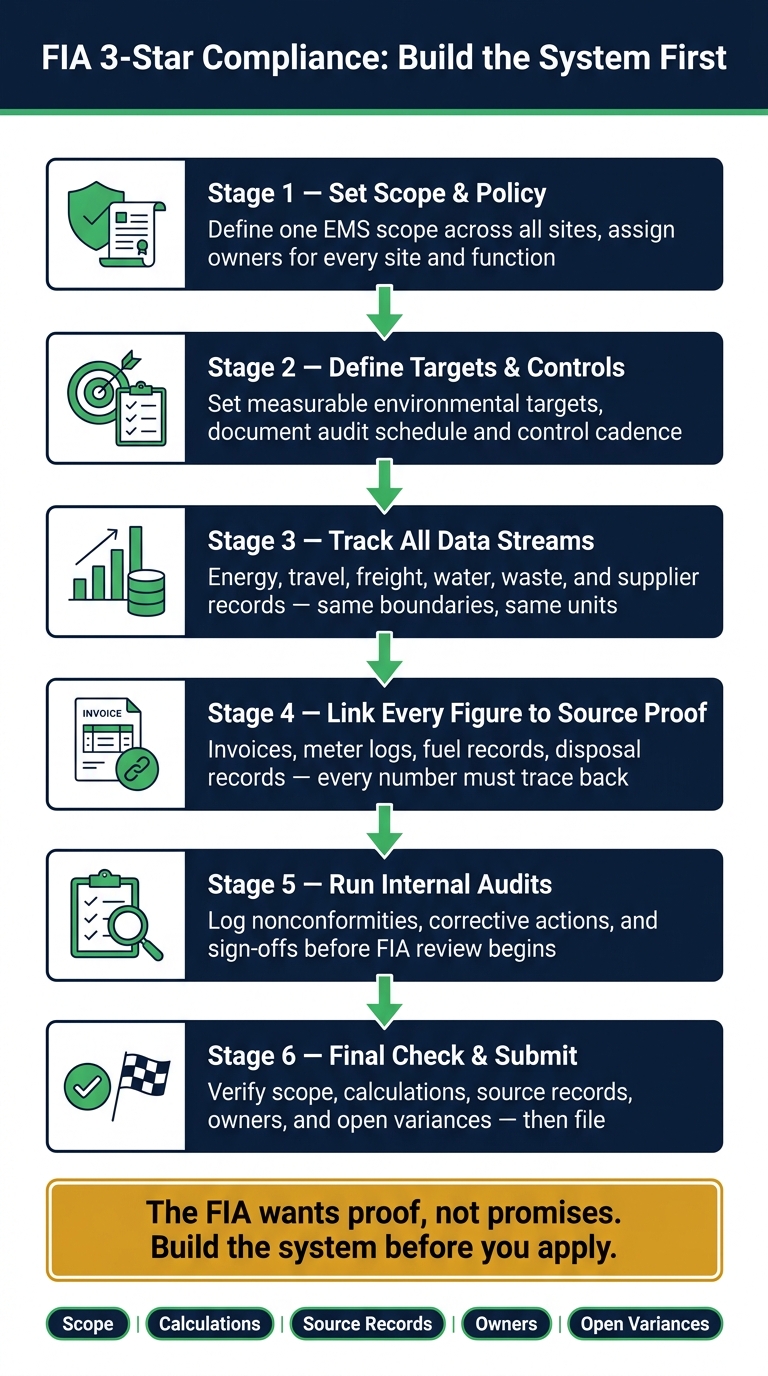
Build the Compliance System Before You Apply
FIA Three-Star accreditation needs to work like an operating system across factory, race, and logistics work. In plain English: build the system first, then file the application.
Set Up Policy, Scope, and Accountability
Start with one environmental policy, define the EMS scope, and assign an owner for each site and function. Every role should connect to a control, document, or target so accountability is clear on paper and in day-to-day work.
That also means naming who owns each control and spelling out how each one will be checked. If nobody owns a control, it usually slips. If no one knows how it will be verified, it turns into guesswork.
Define Targets, Controls, and Internal Audit Rules
Set measurable environmental targets, put controls in place for each major impact, and document the internal audit schedule. The goal is to turn the framework into routine controls with a clear cadence, assigned auditors, and defined criteria.
"Compliance briefings are crucial to ensure that every aspect of the car and team operations meets the stringent standards set by the FIA, the sport's governing body." - Jim Pullman
Internal audit findings and operational feedback should feed straight into the review cycle. Use input from drivers, operations teams, and event staff to update procedures, close gaps, and carry fixes into the next event.
Keep records of nonconformities, corrective actions, and sign-off so the audit trail is complete before the FIA review starts.
Once the system is in place, gather the energy, travel, freight, water, and waste records the FIA will review.
sbb-itb-7c68254
Track the Data the FIA Will Expect to See
Once your controls are in place, the next job is simple in theory and messy in practice: get everyone reporting the same way.
That means setting standard boundaries, reporting periods, units, and calculation methods across every department. When teams use one shared reporting framework, factory, race, travel, freight, waste, water, and supplier data line up far better. It also helps cut common reporting problems like missing invoices, duplicate freight entries, unclear travel records, and waste categories that don’t match from one report to the next.
Energy, Utilities, and Emissions Records
Keep energy, utility, and emissions records tied to source evidence. In plain English, every figure should trace back to something concrete, like an invoice, meter reading, fuel record, or emissions file.
It also helps to use one calculation method across reporting periods. If the method keeps changing, the numbers stop being easy to compare, and review gets harder than it needs to be.
Travel, Freight, and Race Logistics Data
Record travel and freight data the same way across departments and locations. This is where things often drift. One team logs flights one way, another tracks freight with different labels, and soon the data turns into a patchwork.
Shared digital reporting tools help keep each figure under the same rules and make it easier to trace every entry back to its source.
Waste, Water, and Supplier Records
Treat waste, water, and supplier records with the same level of care as the rest of your compliance data. That means clear classifications, steady reporting, and supporting evidence that can back up each number.
Handled well, this data set does more than fill boxes. It helps you complete the application, get ready for the audit, and keep recurring reports in order.
Complete the FIA Application, Audit, and Reporting Cycle
Once your records are in order, the last step is turning them into the FIA submission file and a clear audit trail. At this point, the job shifts from collecting information to packaging it properly for the FIA application, the audit file, and the management-review cycle.
From Initial Evaluation to Formal Application
Start with an internal readiness review. Do this before you file anything.
The goal is simple: make sure the policy, scope, controls, and evidence are complete. In practice, that means checking that your energy, travel, freight, waste, and water records are linked to source documents and cover the full reporting period.
If something doesn’t tie back cleanly, fix it now. It’s much easier to sort out a missing invoice, log, or meter record before the formal application goes in.
Prepare for the Three-Star On-Site Audit
Build the audit file around the records an auditor will need to trace and verify. That includes source records, boundary definitions, control logs, nonconformities, and corrective actions.
Each finding should be logged clearly, with an owner assigned to it. Then track the correction through to the next review. That way, the audit file shows not just what went wrong, but what was done about it.
Run Recurring Reporting and Management Review
After the audit, the reporting cycle keeps the EMS active between reviews. This part matters because the system can’t just sit on a shelf until the next checkpoint.
Keep reporting on a fixed schedule throughout the season. After each event, update energy, freight, waste, and water records using a shared reporting process. Then review the gaps, close what’s still open, and roll those fixes into the next management review.
Common Failure Points and Final Readiness Check
At submission, the biggest risks are missing evidence and boundary mismatches.
Data Gaps, Boundary Errors, and Weak Evidence
Travel, freight, energy, waste, and supplier records often fail review when source documents are missing or don't line up with each other. It sounds basic, but this is where many teams stumble. One spreadsheet says one thing, an invoice says another, and suddenly the numbers don't hold up.
Use one reporting boundary definition for every included site and operation across the full reporting period. If boundaries shift from one location or dataset to another, totals get skewed. That's how small reporting issues turn into big problems.
Before submission, match energy totals against invoices or meter logs. Do the same for waste totals by checking them against disposal records. That last pass can catch gaps that are easy to miss when you're moving fast.
Final Internal Check Before Submission
Before filing, run one last internal check on:
- scope
- calculations
- source records
- owners
- unresolved variances
This final review should happen before filing, not during a last-minute scramble. The goal is simple: make sure the numbers, records, and people responsible all line up.
FAQs
What does FIA 3-Star approval cover?
The FIA 3-Star Environmental Accreditation is the top sustainability recognition in motorsport from the governing body. It gives teams a clear way to track, manage, and improve how they handle their impact.
To earn it, teams need to show strong data tracking and clear policies for energy use, freight and logistics emissions, waste reduction, and more circular use of materials. That includes reusing carbon fiber and other parts instead of discarding them after a single use.
How do teams prove their data is audit-ready?
Teams show their data is audit-ready by keeping a searchable compliance dossier that follows each stage of development and operations. That file set usually includes approved CAD drawings, version-controlled technical directives, analysis reports, material certificates, and manufacturing records.
They also rely on standardized frameworks to track material lifecycle data and keep reporting consistent from one system to the next. On race weekends, teams file declarations of conformity and record any repairs or modifications. The FIA then checks those records against telemetry and physical inspections.
What usually causes a 3-Star application to fail?
A 3-Star application usually falls short when a team can't present a clear, practical plan for meeting Formula 1’s sustainability goals, especially the 2030 net-zero CO2 target.
It can also fail when the team doesn't have the technical know-how, funding, or staff needed to compete at Formula 1 level. The same goes for teams that can't show a positive societal impact from taking part.