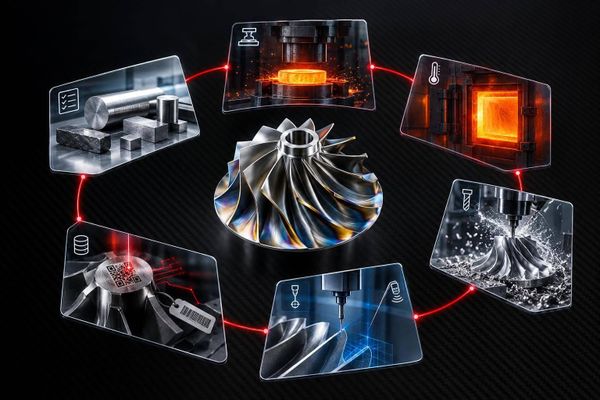
F1 Turbocharger Alloys: Material Timeline
F1 turbo materials timeline: nickel on the hot side, aluminum on the cold side, steel shafts — and tighter, named alloys for 2026 rules.
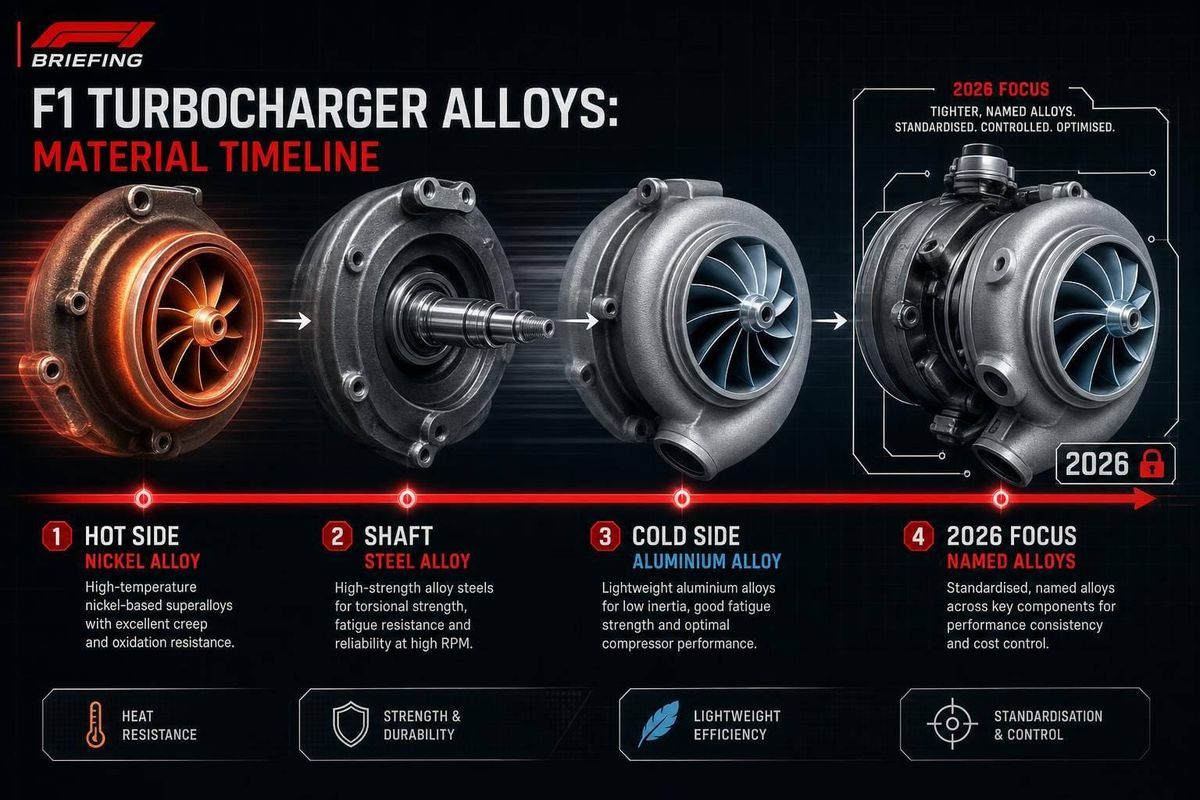
F1 turbo materials changed less than you might think: the hot side moved to nickel alloys, the cold side stayed light with aluminum, and steel kept the shaft alive at up to 125,000 rpm.
If you want the short answer, here it is:
- 1977–1982: early turbo cars leaned on steel, cast iron, and simple compressor alloys
- 1983–1985: the hot side shifted toward nickel superalloys as exhaust heat pushed to about 900–1,050°C (1,650–1,920°F)
- 1986–1988: nickel alloys stayed the main answer, while ceramics appeared in a few Honda turbo parts to cut inertia
- 2014–2025: FIA rules pushed teams into a tight split: Inconel-type nickel alloys for turbine parts, steel for shafts, and aluminum or Al-Li for compressor wheels
- 2026: the rules narrow the material list even more, with named Inconel 625/625 LCF/718 hot-side grades and aluminum-based compressor alloys capped at 2.5% lithium
Put another way: heat picks the turbine material, weight picks the compressor material, and fatigue picks the shaft material.
The big pattern stayed the same across both F1 turbo eras. Teams chased three things at once:
- heat resistance
- low rotating mass
- durability under high rpm and boost
That is why nickel took over the exhaust side, aluminum stayed on the compressor side, steel held load-bearing jobs, titanium stayed limited, and ceramics never became common.
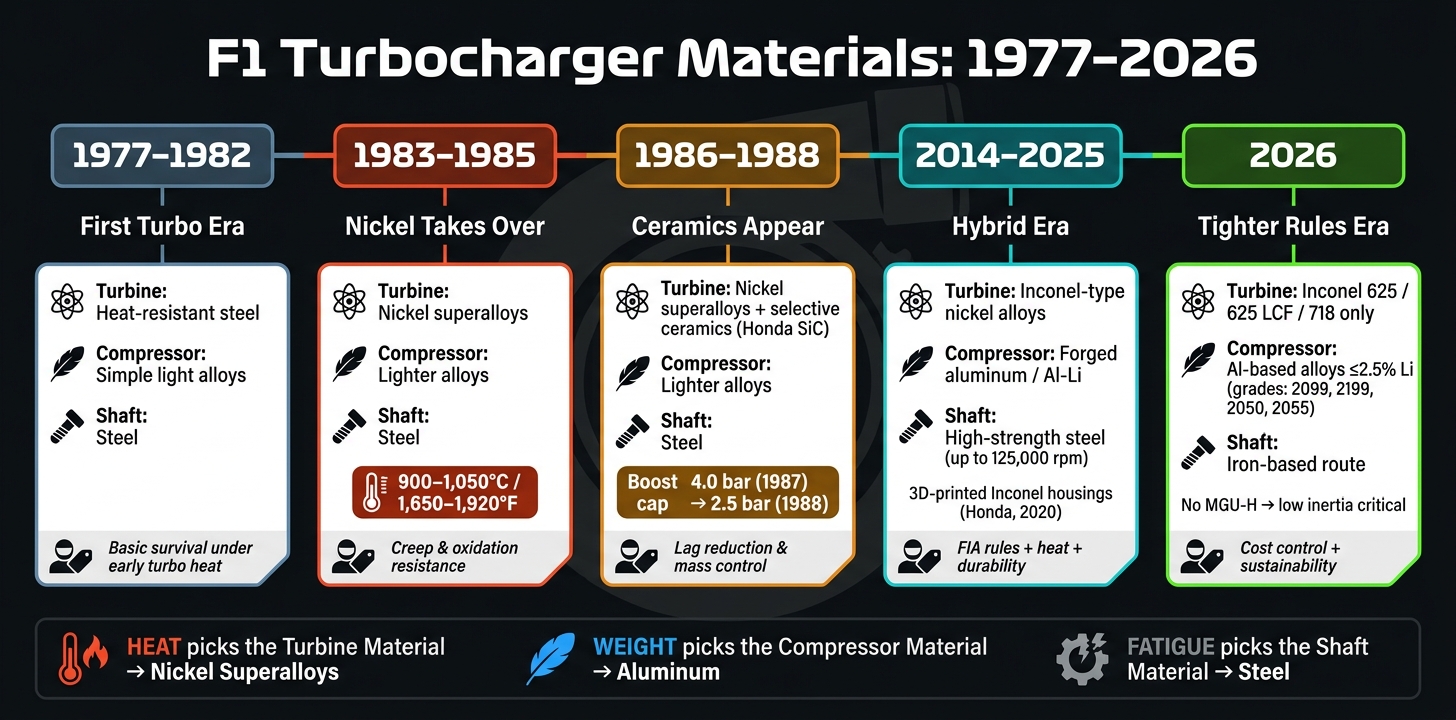
F1 Turbocharger Materials Timeline: 1977–2026
Quick Comparison
| Period | Turbine Side | Compressor Side | Shaft | Main Driver |
|---|---|---|---|---|
| 1977–1982 | Heat-resistant steel | Simple light alloys | Steel | Basic survival under early turbo heat |
| 1983–1985 | Nickel superalloys | Lighter alloys | Steel | Better creep and oxidation resistance |
| 1986–1988 | Nickel superalloys; some ceramics | Lighter alloys | Steel | Lower lag plus heat control |
| 2014–2025 | Inconel-type nickel alloys | Forged aluminum / Al-Li | High-strength steel | FIA rules, heat, and repeatable durability |
| 2026 | Named Inconel grades only | Aluminum-based alloys only | Iron-based route stays in play | Tighter rule control and no MGU-H |
If you read modern F1 turbo talk, this is the filter I’d use: Where does the part sit, how hot does it get, how fast does it spin, and what does the rulebook allow? Once I apply those four checks, most material choices make sense fast.
sbb-itb-7c68254
Turbocharger Materials Basics: Heat, Speed, and Component Demands
An F1 turbocharger isn't one single piece. It's a set of parts, and each one works in a very different set of conditions. That's the whole reason one alloy can't handle every job.
Turbine, Compressor, Shaft, and Housing: Different Parts, Different Alloys
At a practical level, each turbocharger part deals with its own main risk. The turbine fights heat. The compressor fights inertia. The shaft deals with fatigue. And the housing has to keep its shape while handling stiffness, heat flow, and tight packaging.
The turbine wheel has one brutal job: survive extreme heat without creeping out of shape. Creep is the slow deformation that happens when high temperature starts to wear metals down over time.
The compressor wheel has a different goal. It needs to be as light as possible so rotational inertia stays low and the turbo can spool fast.
Then you have the shaft and housings. These parts need fatigue strength and dimensional stability, while also surrounding each wheel and managing the push and pull between heat transfer, stiffness, and packaging.
Heat Load vs. Weight: Why Nickel Suits Hot Zones and Aluminum Suits Cold Ones
The main trade-off is simple: heat resistance versus weight.
Nickel superalloys work on the hot side because they can handle creep and oxidation at extreme temperatures. Aluminum works on the compressor side because it keeps mass down. Titanium also has a place in lower-temperature, weight-sensitive parts when engineers want more strength than aluminum can give, without stepping into hot-side material territory.
| Material Class | Typical Turbo Location | Key Strength | Main Limit |
|---|---|---|---|
| Nickel superalloy (e.g., Inconel) | Turbine wheel, hot-side housing | Creep and oxidation resistance at extreme heat | Higher weight adds rotational inertia |
| Steel (high-grade) | Shaft, structural hardware | Fatigue strength and dimensional stability | Heavier than titanium; lower heat tolerance than nickel superalloys |
| Titanium alloy | Compressor-side hardware, select housings | Low density with good strength | Not suitable for the hottest turbine-side conditions |
| Aluminum alloy | Compressor wheel, cold-side housing | Lowest weight | Unsuitable for turbine-side heat |
Those trade-offs shaped the first turbo era's material choices.
Late 1970s to 1988: The First F1 Turbo Era
Early Turbo Years: Steel and Nickel Solutions Under Rising Exhaust Heat
When Renault rolled out the RS01 in 1977, Formula 1 stepped into its first turbo age. The car used a cast-iron cylinder head, a choice made for one simple reason: turbocharging brought much higher cylinder pressure and heat. That change quickly made one thing clear - some alloys could cope with the turbine side, and some just couldn't.
As boost climbed in the early 1980s, turbine-side temperatures hit 900–1,050°C. At that point, steel started running into creep and oxidation trouble. So teams began to split materials by job: nickel-based alloys for the hot side, lighter alloys for the compressor side.
Mid-to-Late 1980s: Nickel Superalloys Take Hold, Ceramics Appear Selectively
Once steel ran out of headroom, nickel alloys moved in. By the mid-1980s, nickel-based superalloys were the standard answer on the hot side. Inconel-family alloys, including Inconel 713C and 718, became the go-to choice for turbine wheels and hot-side housings because they kept their strength, resisted oxidation, and handled thermal cycling much better than steel.
Ni-Resist iron also showed up in exhaust manifolds and hot housings, with temperature capability up to about 950°C (1,740°F).
Honda went a step beyond that with its RA168E-family turbo engines. It used silicon-carbide ceramic turbine wheels and ceramic bearings, not only to deal with heat, but also to cut inertia and help the turbo spool faster. That mattered because a lighter turbine can react with less delay. Ceramics had a clear upside here: they were lighter than nickel superalloys and could live with temperatures that pushed most metals hard. The catch was brittleness and hard-to-make parts, which kept them limited to a small set of uses.
Why Teams Changed Materials During the 1980s
The material shift wasn't just about survival. Higher boost meant more turbine heat and more turbo lag, so teams were chasing two things at once: better heat resistance and less rotating mass. In plain English, they needed parts that wouldn't cook themselves and turbos that wouldn't feel lazy coming on boost.
The FIA later stepped in with a boost cap - 4.0 bar in 1987, then 2.5 bar in 1988 - which cut peak load in the last two seasons. Even so, the material choices made in those years set the pattern for the next turbo age.
The timeline below shows that shift pretty clearly: the hot side got tougher, while the cold side stayed lighter.
| Era | Turbine Material | Compressor Material | Housing Material | Main Reason for Change |
|---|---|---|---|---|
| Early turbo (1977–1982) | Heat-resistant steel | Simpler alloys | Steel, cast iron | Survive initial boost and thermal load |
| Mid turbo (1983–1985) | Nickel superalloys (Inconel-family) | Lighter alloys | Ni-Resist iron, nickel-alloyed steel | Creep and oxidation resistance |
| Late turbo (1986–1988) | Mature nickel superalloys; selective ceramics | Lighter alloys | Nickel-alloyed housings | Lag reduction and mass control |
2014 to 2025: Hybrid-Era Turbocharger Alloys Under FIA Rules
When F1 brought back turbo hybrid power units in 2014, the FIA kept the same basic hot-side/cold-side split that had already worked in the 1980s. The logic didn’t change. Heat-heavy parts still needed one class of metal, and weight-sensitive parts still needed another. The rules just locked that pattern in place.
What the FIA Rules Steered Teams Toward
The FIA drew clear lines around materials. Exhaust-contact parts, including the turbine housing and waste-gate exit housing, had to use cobalt-, iron-, or nickel-based alloys. On the compressor side, rotating parts had to use aluminum-, titanium-, or iron-based alloys, while compressor casings were limited to aluminum or magnesium.
That setup nudged teams in a very clear direction: nickel-based superalloys on the hot side, aluminum-based parts on the cold side.
Turbine Side vs. Compressor Side: Inconel, Steel, Aluminum, and Titanium
Turbine wheels and housings used nickel-based superalloys - typically Inconel-type materials - because they fit the cobalt/iron/nickel rule and can survive 900–1,000°C+ exhaust temperatures while resisting creep and oxidation. In plain English, these parts sit where the heat is brutal, so teams stuck with metals that could take the punishment lap after lap.
Turbo shafts used high-strength steel. That fits the iron-based alloy rule and gives teams the torsional strength needed at speeds up to 125,000 rpm. It’s a slim part, but it has a hard job: link the hot turbine side to the cold compressor side without twisting itself into trouble.
Compressor wheels usually used forged aluminum alloy, sometimes aluminum-lithium, because low rotating inertia helps spool-up. Titanium is allowed, but it was seldom the best trade-off. That’s the key point. A lighter wheel helps the turbo react faster, and in F1, that kind of response matters.
Honda’s turbine housing is a good example of how teams kept pushing manufacturing methods without changing the material family itself. From 2020, Honda used 3D-printed Inconel turbine housings on its V6 hybrid power unit. That let engineers fine-tune wall thickness and internal cooling passages while still staying inside the nickel-based alloy rule.
So the end result wasn’t a wild hunt for new metals. It was a tight, repeatable material map.
| Component | Common Material Family | Thermal Demand | Weight Impact | Why It Remained Favored |
|---|---|---|---|---|
| Turbine wheel | Nickel-based superalloy (Inconel-type) | Very high; 900–1,000°C+ exhaust gas | Moderate; denser than aluminum but manageable | Creep and oxidation resistance; fits the Co/Fe/Ni rule |
| Turbine housing | Nickel-based superalloy (Inconel-type) | Very high; direct exhaust contact | Static component; weight less critical than for rotating parts | Same regulatory requirement; additive manufacturing can refine geometry |
| Turbo shaft | High-strength steel (iron-based alloy) | Moderate; bridges hot and cold sides | Slender geometry keeps weight low | Fatigue life and torsional strength at 125,000 rpm |
| Compressor wheel | Forged aluminum alloy (Al or Al-Li) | Low; cooled by intake airflow | Light rotating mass | Minimizes inertia for fast spool-up; titanium is allowed but rarely the best trade-off |
| Compressor housing | Aluminum or magnesium alloy | Low | Static mass; less performance-critical | Directly mandated; good stiffness and corrosion resistance |
Why Material Choices Stabilized in Modern F1
Three things pushed teams toward the same answers: tighter rules, more heat from the MGU-H, and a limited upside from riskier materials. Put simply, exotic options looked interesting on paper, but the gain was often too small to justify the durability gamble.
That fixed material map sets the starting point for the 2026 changes that come next.
What Changed, What Stayed the Same, and What 2026 Could Bring
The Full Timeline at a Glance
By 2026, the biggest shift wasn't the physics. It was the rulebook.
The pattern stayed pretty steady over time: as power density and exhaust temperatures climbed, hot-side parts moved toward nickel-based superalloys. Meanwhile, the compressor side kept chasing low mass and fast response, which is why aluminum stayed the main pick and titanium showed up only now and then. That carried straight into 2026: the same hot-side/cold-side split, but with tighter limits.
The hybrid era baked that split into the regulations. Work moved away from new alloy families and toward geometry, cooling, CFD, FEA, and additive manufacturing.
You can see that tighter grip in the approved material list. For 2026, the FIA narrows the list even more. On the exhaust side, only Inconel 625, 625 LCF, and 718 are allowed for primaries, secondaries, and related parts. Compressor wheels must use aluminum-based alloys with up to 2.5% lithium, with approved grades including 2099, 2199, 2050, and 2055; TiB₂ additive content is limited to 0.3% by volume. In plain English, teams get a smaller, more controlled set of materials, shaped by cost control and sustainability as much as outright performance.
Key Points for Reading Future F1 Power Unit Developments
The 2026 removal of the MGU-H changes the target again. Without electric control over shaft speed, teams will lean more on low mass and geometry to deal with turbo lag. That's why aluminum and aluminum-lithium look like the clear answer on the compressor side.
A simple way to read future turbo changes is through four filters:
- Component
- Temperature
- Rules
- Design goal
If a part sits in direct exhaust flow, it lives near or above 1,000°C, or about 1,800°F. That points straight to nickel alloys. The 2026 rules also spell out exact Inconel grades and aluminum-lithium compositions, so any claim about a "new" alloy has to be checked against that list. And the target matters. Lower inertia, longer durability, and reduced mass don't all push engineers in the same direction, even when they're working inside the same approved alloy families.
The heat-versus-mass trade-off that shaped these choices in the 1980s still drives them in 2026. The alloy names are tighter, the manufacturing methods are more advanced, and the rules are stricter, but the core physics stays the same.
FAQs
Why didn’t titanium become common in F1 turbos?
Titanium never became common in F1 turbocharger parts for one main reason: extreme heat.
It works well when low weight and high strength matter. But inside a turbo system, the job is much harsher. Turbocharger parts sit in the path of very hot exhaust gases and deal with heavy thermal and mechanical stress at the same time.
That’s where titanium falls short. In these conditions, nickel-based alloys and steel grades tend to do a better job because they cope with heat from the exhaust stream more effectively.
How did the MGU-H affect turbo material choices?
The MGU-H changed turbocharger material choices because it sat right on the turbo shaft and had to survive an extreme mix of very high speeds and intense heat. That forced teams to use advanced, hard-wearing materials that could take both thermal stress and heavy mechanical loads.
It also made the cooling system more complex. With the MGU-H gone in 2026, teams can simplify thermal management, trim weight, and reduce some of the pressure on material selection in those parts of the power unit.
Will the 2026 rules change turbo lag?
The 2026 rules don’t directly spell out what happens to turbo lag. But taking out the MGU-H changes the engine setup in a big way.
Before, the MGU-H could spin the turbo and help cut lag. Without it, teams have to lean on the MGU-K for energy recovery instead. That shifts the whole balancing act around energy deployment and heat management.
In plain English: the turbo can no longer get that same direct electric assist from the MGU-H. So engineers will need to find new ways to manage response, while also keeping thermal stress under control.