F1 Weather Tools: 6 Inputs Teams Track
Wet-race wins hinge on stacking radar, spotters, sector deltas, onboard video, FIA updates and driver radio — act when multiple signals align.
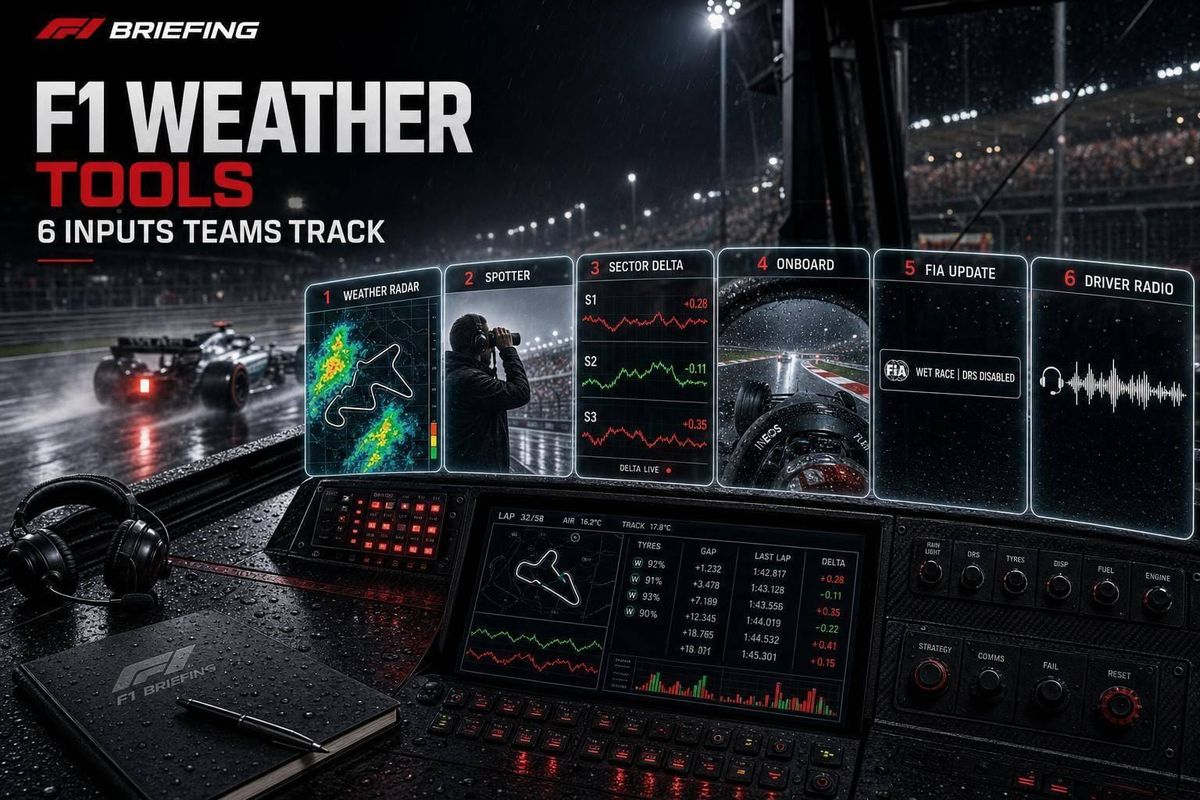
One bad weather call can cost a race in a single lap. In F1, teams do not wait for one perfect signal. They stack six inputs to decide when to pit: radar, spotters, sector times, onboard video, FIA messages, and driver radio.
Here’s the short version:
- Radar shows if rain is heading toward the track and when it may arrive.
- Spotters and marshals show which corners are getting wet right now.
- Sector times and lap deltas show when grip loss is starting to hurt pace.
- Onboard video shows spray, dry lines, wheelspin, and braking stability.
- FIA reports confirm official track status, flags, and sector warnings.
- Driver feedback tells the team what the car feels like corner by corner.
A few numbers make the point clear:
- At the 2023 Dutch Grand Prix, staying on slicks after rain hit cost about 23 seconds in one lap.
- Pirelli places the slick-to-intermediate crossover at about 110% to 112% of dry lap time.
- A pit stop often costs about 24 seconds, so the timing has to be right.
The main idea is simple: teams usually act when two or more signals point the same way. One signal says, “watch it.” A cluster says, “box now.”
Quick Comparison
| Input | What it tells the team | Main use in the call |
|---|---|---|
| Weather radar | Incoming rain, path, timing | Decide whether to pit now or stay out |
| Spotters and marshals | Wet corners, standing water, grip loss | Check local track risk |
| Sector times and lap deltas | Where lap time is dropping | Spot the crossover point |
| Onboard video | Spray, dry line, car behavior | Confirm what the track looks like |
| FIA messages | Official warnings, flags, sector notices | Confirm race status and hazards |
| Driver feedback | Grip, balance, aquaplaning, tire feel | Final check before the stop |
If I had to sum it up in one line, I’d say this: F1 weather calls are not about guessing the sky. They are about matching live weather signs with live lap-time loss before the pit window closes.
sbb-itb-7c68254
Why Teams Never Rely on One Signal Alone
Every input a team uses has a blind spot.
Radar can track a rain cell to within about 500 meters of the circuit and update about every 60 seconds. That’s useful. But it still can’t tell a team whether that rain is actually taking grip away in one corner.
Sector times help from the other side. They can show that performance is dropping, but they can’t explain the cause. A slower sector might come from rain, a lock-up, traffic, or something else entirely.
That’s why teams stack signals instead of leaning on just one. Radar, lap deltas, and sector splits show that conditions are shifting. Spotter reports, onboard video, and driver radio show where it’s happening and what it feels like in the car. One set of inputs gives the outline; the other fills in the picture.
Speed matters just as much as accuracy. Radio and onboard video are close to instant. Sector times come in by segment. Radar updates with a short lag. So teams usually treat fast-moving signals as the trigger and slower ones as confirmation.
A simple example: a driver saying there are drops on the visor may be the first warning. Then the timing screen and radar help answer the next part - is this just a brief shower, or is the track moving into a real change? That’s a big reason teams pair quick alerts with slower confirmation before making a pit call.
Cross-checking is what turns a hunch into a decision. Before switching tires, strategists usually want at least two signals pointing the same way, such as:
- a rain cell over the circuit
- slower sector times
- driver reports of lost grip
And when the signals don’t match, that matters too. Mixed inputs often mean the conditions are patchy, borderline, or still changing.
The 2016 Brazilian Grand Prix is a good example. Teams kept revising their calls, and Max Verstappen’s strategy changed again and again as grip and rain intensity moved around. No single input could have carried those choices. It took a constant loop of radar checks, timing comparisons, and live driver feedback.
Next comes the broadest live signal: radar portals.
1. Weather Radar Portals
Radar gives teams their first broad look at incoming rain. It’s usually the first screen strategists check, and for good reason: it helps them judge whether to pit now or stay out for one more lap.
At many events, teams rely on dedicated mobile Doppler radar units placed near the circuit to produce rain data tied to that track, not just the general area. A Météo France high-definition mobile radar can generate a new map every minute, with about 100-meter resolution, and detect light rain within roughly 12–19 miles (20–30 km) of the circuit. That gives strategists circuit-specific detail that a generic forecast just can’t match.
On the pit wall, that radar feed turns into something teams can act on. Pit-wall portals replay the last 30 minutes of rain movement and help meteorologists project where the cell will arrive next, sector by sector. From that feed, they map the rain’s direction, speed, and likely arrival time for each part of the track. That’s the kind of timing detail that can swing a call from “box now” to “take the risk and do one more lap.”
Radar becomes most important when teams are deciding whether to move to intermediates or full wet tires. A pit stop usually costs about 24 seconds, so getting that call wrong is expensive, and that price can decide a race. Radar helps narrow the crossover window, but it doesn’t make the decision on its own. Teams still have to judge how fast the track is drying or getting wetter. That’s the catch: radar shows what’s coming, not what the drivers are dealing with on the asphalt right now.
2. Trackside Spotters and Marshal Reports
Radar tells teams what may arrive next. Spotters and marshals tell them what’s happening right now, corner by corner. That matters because track conditions can shift faster than radar updates.
Spotters positioned at key vantage points report which corner got hit first, how severe the standing water is, and whether grip is coming back or still dropping. Marshals at fixed posts report standing water, drainage, and grip loss. Race control then turns those reports into flags and timing-screen messages. When a slippery-surface flag appears and spotter reports point to the same part of the circuit, strategists get the confirmation they need to act.
The main advantage is immediacy. Teams need ground-truth confirmation before they box, not after. Spotter reports matter most during the tire crossover window, when slicks are too risky but full wets still aren’t needed. During the 2021 Russian Grand Prix, pitting for intermediates was the right call because the 24-second pit-stop loss was offset by the pace gained from better grip as conditions got worse. Ground reports shortened the path from “conditions are changing” to “box now.”
Spotters and marshals give teams corner-level grip detail, while radar gives the bigger picture on rain timing. When spotter reports and race control line up, teams stop just watching the weather and start checking the clock. Once the ground truth is clear, they turn to timing data to see if the shift is already showing up in lap times.
3. Sector Times and Lap Deltas
Radar and spotters can warn a team that weather is moving in. Sector times show if that change is already slowing the car down.
F1 timing systems split each lap into three sectors with trackside timing loops, and those splits are recorded to the thousandth of a second. Teams also track mini-sectors, which break the lap into smaller pieces. That makes it much easier to see grip shifts corner by corner.
The color coding helps teams read the picture fast:
- Purple means the fastest sector of the session
- Green means a personal best
- Yellow means the driver is slower than their own benchmark
That sounds simple, but it tells teams a lot. A string of yellow mini-sectors through one corner complex can show grip falling away in that part of the track. A split pattern can say even more. If Sector 2 turns yellow while Sectors 1 and 3 stay green, that can point to a local shower or a grip drop hitting only one section of the circuit.
Teams don't usually react to one poor sector by itself. The real trigger is a pattern: two or three laps in a row where the same sectors keep drifting yellow, or mini-sector deltas keep getting worse. At that point, engineers compare the timing with tire wear, fuel burnoff, traffic, onboard video, and driver feedback. That's where sector splits earn their keep. They show where the problem is happening, whether it's rain in one section, a drying line, or grip loss in a few corners, not just that the lap as a whole is changing.
Sector deltas also help teams spot the crossover window as it happens, one part of the lap at a time, instead of waiting for a full-lap average. When the delta trend drops hard, the window is opening, and the box call may need to come during the lap, not after it. If those deltas keep turning yellow in the same place lap after lap, the team knows this isn't about the forecast anymore. It's about timing.
4. Onboard Visuals and Pit-Wall Video Feeds
Sector deltas show engineers where grip is shifting. Onboard cameras and pit-wall video feeds show them what that shift looks like in the moment. So once timing starts to move, video becomes the fastest reality check.
F1 cars can carry up to five onboard cameras, and over a full race weekend the championship can broadcast from about 170 on-car cameras across the grid. Teams also monitor their own private feeds. Those feeds are a bit ahead of the public broadcast because they skip the broadcast delay, which means the pit wall can still make a call in the same lap.
The pit wall pulls several live feeds into one screen setup: onboard, trackside, pit-box, and broadcast cameras, all lined up with timing, GPS, weather, and race control data. Mercedes' remote mission control center sees the same displays too, so engineers back at the factory are looking at the same picture as the crew at the track.
Strategists usually watch for four things:
- Spray behind the car
- Whether a dry line is starting to appear on the racing line
- How early the driver can get on the throttle at corner exit without clear wheelspin
- How settled the car looks under braking
That matters because the onboard camera sits close to the driver's view. It can show the front tires, curbs, run-off areas, and even the sky ahead. On tracks where conditions change corner by corner, the pit wall can watch the onboard as the car heads into a suspect section, compare that image with what the driver is saying, and react within a lap or two. When the picture lines up with the lap times, the team has a much better read on whether the track has changed.
Onboard cameras also use humidity sensors and fresh film to keep the image clear in rain. Each camera carries roughly 4 meters of film, which helps keep the feed usable when the weather turns messy.
Still, teams have to guard against visual bias. One dramatic shot can make a corner look worse than it is and push people toward an early tire switch. That's why engineers wait for patterns across several laps and check the video against sector times, driver comments, and radar before they commit. A wet-looking corner, by itself, isn't enough. It only matters when the timing and the driver's report back it up.
If the visuals are pointing in the same direction as the timing data, teams then move to official FIA reports for confirmation.
5. FIA Weather Reports and Race Control Signals
When timing screens and video suggest the track is turning, teams look to FIA messages to confirm the official view. The big advantage is precision. The FIA doesn’t just say rain is coming; it can point to the exact part of the circuit where the issue sits.
The most useful alerts call out the exact sector. The FIA sends near real-time bulletins to pit walls with rainfall intensity, track temperature, and wind, along with sector-specific warnings such as "TRACK SURFACE SLIPPERY IN TRACK SECTOR 12". That gives engineers a much tighter read on what to change. Instead of adjusting for the whole lap, they can fine-tune brake bias, pace targets, and driver instructions for one section of track.
Once rain probability moves above 40%, the FIA can declare a Rain Hazard and send alerts such as "LOW GRIP CONDITIONS". At that point, flags help show whether the problem is moving from a caution into something that could slow or neutralize the race.
The key signals are straightforward:
- The yellow flag with red stripes means the surface is slippery.
- The white flag with a red saltire cross means precipitation.
Under a safety car or VSC, the roughly 24-second pit-stop loss gets smaller, so teams will often bring in both cars in quick succession. That can swing the call from wait one more lap to box now.
Still, FIA reports aren’t perfect. Fixed trackside weather stations and set reporting intervals can miss very local showers or microclimate shifts between corners. One part of the track can be getting slick while another still looks fine on paper. That’s why top teams use official bulletins as the baseline, then check them against radar, sector times, onboard cameras, and driver feedback before making the tire call. When FIA messages line up with radar and what the driver is saying, the pit wall can commit within a lap.
That official baseline only matters if the driver feels the same change in the car.
6. Driver Feedback
Radar and FIA bulletins can tell a team that rain is falling. They can't tell an engineer that Turn 3 is slippery on entry, or that standing water is throwing the car around from Turns 7 to 9. Only the driver can feel entry grip, standing water, and the car's balance in that moment. Mercedes engineers have described F1 drivers as the "most sensitive sensor" on the car, and in wet or mixed conditions, that job becomes even more important. That's why radio is often the first warning, before the data screens fully reflect what's happening.
Driver radio matters because it's both fast and precise. A driver can report grip changes corner by corner straight to the pit wall, often within 60–100 seconds. Say the driver says the car is sliding everywhere, and at the same time the strategist sees the last sector delta move from +0.2s to +0.9s versus earlier laps. That can trigger an immediate call, sometimes before any official weather update says much at all.
The detail in the message matters just as much as the timing. Drivers don't just say the track is "bad." They separate overheating intermediates from aquaplaning on a straight, and they can point out uneven grip across the car. Each one suggests a different move. Aquaplaning reports are treated like red flags and can push a team toward full wets. Overheating inters point the other way. They suggest the track may be drying enough to start thinking about slicks. Pirelli has said that in wet testing, drivers' subjective impressions of aquaplaning and grip are:
"an essential part of the testing process."
This feedback also helps lock in the tire crossover call, the point where a switch becomes a net gain. Engineers listen for lines like a driver saying they could go slicks now, then check that against lap deltas from cars already running another tire. If slicks are 1–2 seconds faster, the crossover is there. If the gap is still small and the track is only patchily damp, teams may wait. An early stop can backfire fast. At crossover, even a one-lap difference can swing the result by as much as 10 seconds.
Teams also factor in each driver's bias. Some drivers are more willing to take risks. Others want more margin. Engineers build that into their read of the radio and ask pointed follow-ups on braking, traction, and which corners changed. That helps turn a gut feel into something the pit wall can use with confidence. In that sense, driver radio becomes the last check before the team turns all six inputs into a tire call.
How Each Input Drives Race Decisions
Teams don’t pit because of one clue. They pit when several signals line up. A single alert usually means “watch it.” A cluster of alerts means “act now.”
Here’s how each feed connects to the call on the wall:
| Input | Primary Race Call |
|---|---|
| Weather radar | Pit timing; stay-out window |
| Spotters & marshal reports | Localized hazard warnings; out-lap risk |
| Sector times & lap deltas | Crossover point confirmation; box now trigger |
| Onboard visuals & pit-wall feeds | Standing water; SC/VSC risk |
| FIA weather reports & race control | Session status; restart planning |
| Driver feedback | Final crossover confirmation; out-lap grip guidance |
Those feeds only matter if they push the team from warning to action.
The crossover point is where all six inputs start saying the same thing. Sector deltas show where time is being won or lost. Driver radio tells the pit wall whether that pace shift can hold. Radar shows how long the weather window might stay open. Put those together, and the call gets much clearer.
At the 2020 Turkish Grand Prix, the crossover from full wets to intermediates came within the first 10 laps, which triggered a wave of stops across the field. Teams that read all six inputs well moved early. Teams that leaned too much on one feed - or waited for perfect data - gave away positions they couldn’t get back.
Safety Car and red flag risk makes the picture even more tense. If onboard shots show thick spray or cars running wide, and spotters report standing water in fast sections, a team may pit before race control steps in. At the 2021 Belgian Grand Prix, only two laps behind the Safety Car were completed before a red flag stopped any meaningful racing.
After the stop, the focus shifts. Spotter updates and FIA calls matter most on the out-lap. They tell the driver where puddles are building, whether yellow flags are out, and if a Virtual Safety Car is active. That can turn a sketchy first lap on new tires into a controlled one.
What Teams Look for Across All Six Inputs
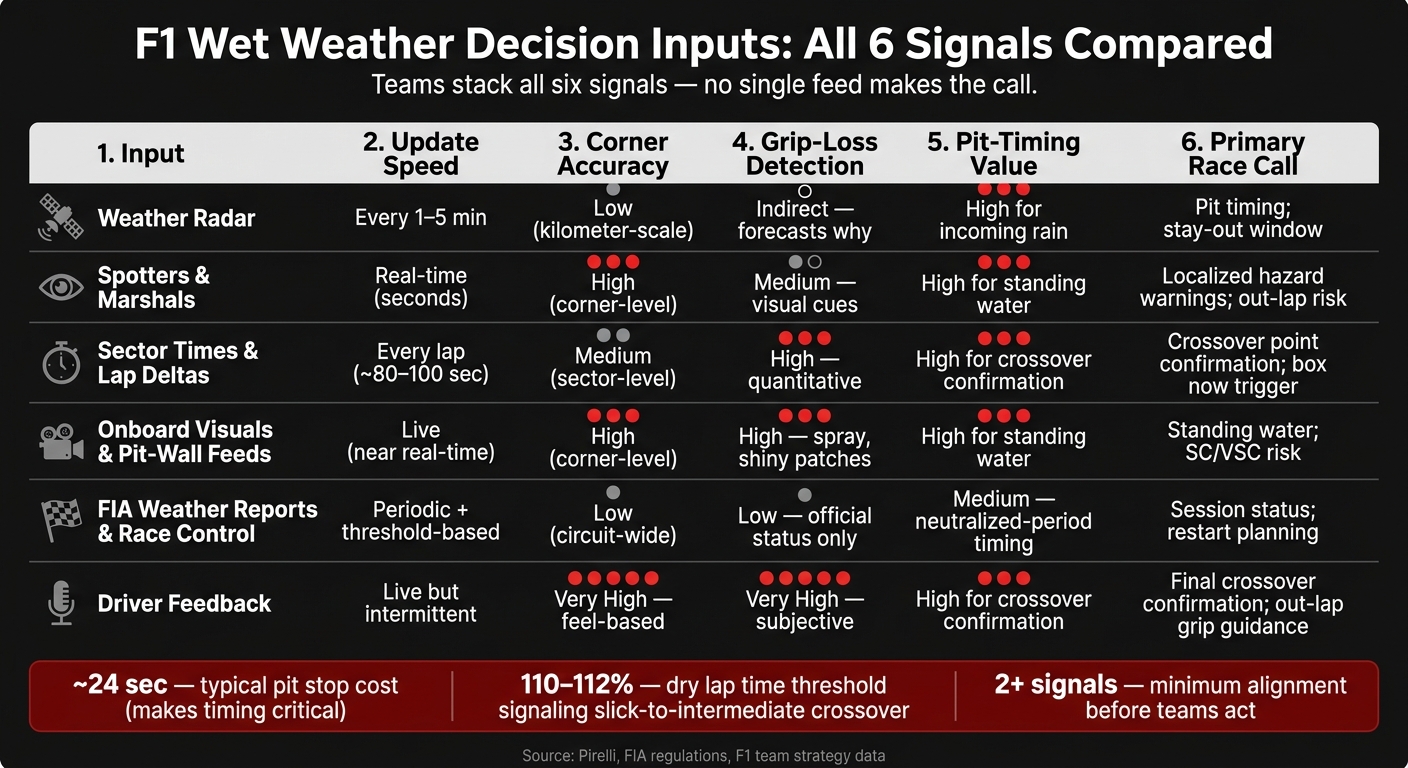
F1 Wet Weather Decision Inputs: All 6 Signals Compared
Teams judge these feeds by one simple thing: what question does each input answer?
| Input | Update Speed | Corner Accuracy | Grip-loss detection | Pit-timing value |
|---|---|---|---|---|
| Weather radar | Every 1–5 min | Low (kilometer-scale) | Indirect (forecasts why) | High for incoming rain |
| Spotters & marshals | Real-time (seconds) | High (corner-level) | Medium (visual cues) | High for standing water |
| Sector times & lap deltas | Every lap (~80–100 sec) | Medium (sector-level) | High (quantitative) | High for crossover confirmation |
| Onboard visuals & pit-wall video feeds | Live (near real-time) | High (corner-level) | High (spray, shiny patches) | High for standing water |
| FIA weather reports & race control | Periodic + threshold-based | Low (circuit-wide) | Low (official status only) | Medium (neutralized-period timing) |
| Driver feedback | Live but intermittent | Very high (feel-based) | Very high (subjective) | High for crossover confirmation |
Here’s the short version. Radar spots rain before it hits. That makes it the first warning sign.
Once the water is actually on the circuit, the job shifts. Spotters and onboard video become far more useful because they show what’s happening at specific corners. You can see spray, dark patches, and the kind of shine on the asphalt that makes teams nervous fast.
Then come the confirmation tools. Sector deltas and driver feedback help answer the big call: has the crossover point arrived or not? One shows it in the numbers. The other shows it in the car and in the driver’s hands.
That input map sets up the next question: where fans can study F1 strategy in more depth.
Where Fans Can Learn More About F1 Strategy
If you want to dig deeper into how teams turn live weather inputs into race calls, F1 Briefing covers race strategy, technical analysis, team dynamics, and behind-the-scenes context. It’s a solid next step if you want to see how those signals turn into pit-wall decisions.
Conclusion
No single feed makes a wet-race call. Teams get it right by pulling together radar, spotters, sector deltas, onboard video, FIA messages, and driver feedback. The edge comes from stacking all six and moving first.
That matters because the crossover point can change lap by lap. At Zandvoort in 2023, shifting rain kept moving that point, and some drivers stopped four to seven times because the track just wouldn’t settle.
Zandvoort was a good reminder of how fast that window can slide. In Formula One, the best weather strategy comes from fast signal stacking, not perfect prediction.
FAQs
How do teams know the tire crossover point?
Teams spot the tire crossover point by mixing live telemetry with predictive models.
Engineers watch tire wear, surface temperatures, grip, sector times, weather updates, and fuel use. Then they stack that live data against past trends and race simulations. That helps them see the moment when the current tires will become slower than a fresh set, which is usually when the pit call comes in.
Which weather input matters most during a race?
The most important weather input during an F1 race is the real-time rain and track-condition outlook.
Why does that matter so much? Because radar-style forecasts show when rain is about to get heavier or start backing off. That gives teams a narrow but critical read on the track at the exact moment it matters.
In practice, that helps them decide if they should change tire types and when to pit. Get that call right, and a driver stays in the right grip window. Get it wrong, and they can lose a chunk of time on the wrong tires.
Why can one bad pit call cost so much time?
In Formula 1, one bad pit call can cost a lot of time because the margins are tiny. Strategy shifts lap by lap, and teams have to read live telemetry, tire wear, weather, and track position all at once.
If a team gets the timing wrong, the driver might miss the best pit window, give up track position, run into traffic, or stay out too long on worn tires. And once that happens, the damage can spread fast. Pace drops, options shrink, and the final result can take a hit.