FIA Circuit Approval: Permanent vs Street Tracks
A calendar slot doesn't equal approval — check Grade 1 licenses, approved layouts, and the finished track build before an event.
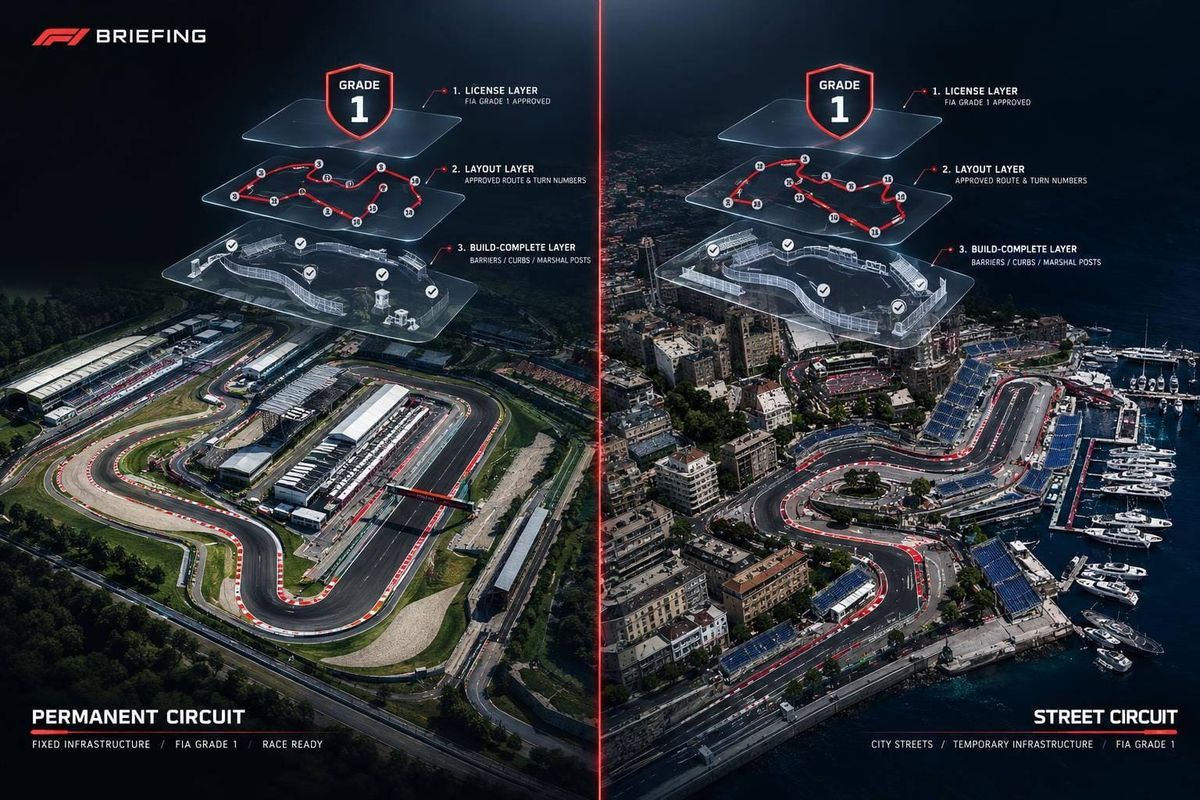
Permanent and street circuits both need an FIA Grade 1 license to host Formula 1. I’d check the licensed layout, expiration date, and conditions first - not just whether the track appears on the calendar. A calendar slot is not circuit approval.
Both types face checks on track design, barriers, runoff, medical facilities, and emergency access. The difference is how they meet those requirements: permanent tracks maintain a fixed site, while street tracks rebuild temporary installations for each event.
Quick Comparison
| Approval factor | Permanent circuits | Street circuits |
|---|---|---|
| F1 license | Grade 1 for the approved layout and direction | Same requirement |
| Design limits | Space planned into the site | Space constrained by roads and buildings |
| Safety checks | Surface, barriers, runoff, and emergency routes | Same checks, plus temporary installations |
| Event readiness | Maintain the approved facilities | Recreate the approved build |
| Calendar status | Listing alone does not confirm approval | Same rule |
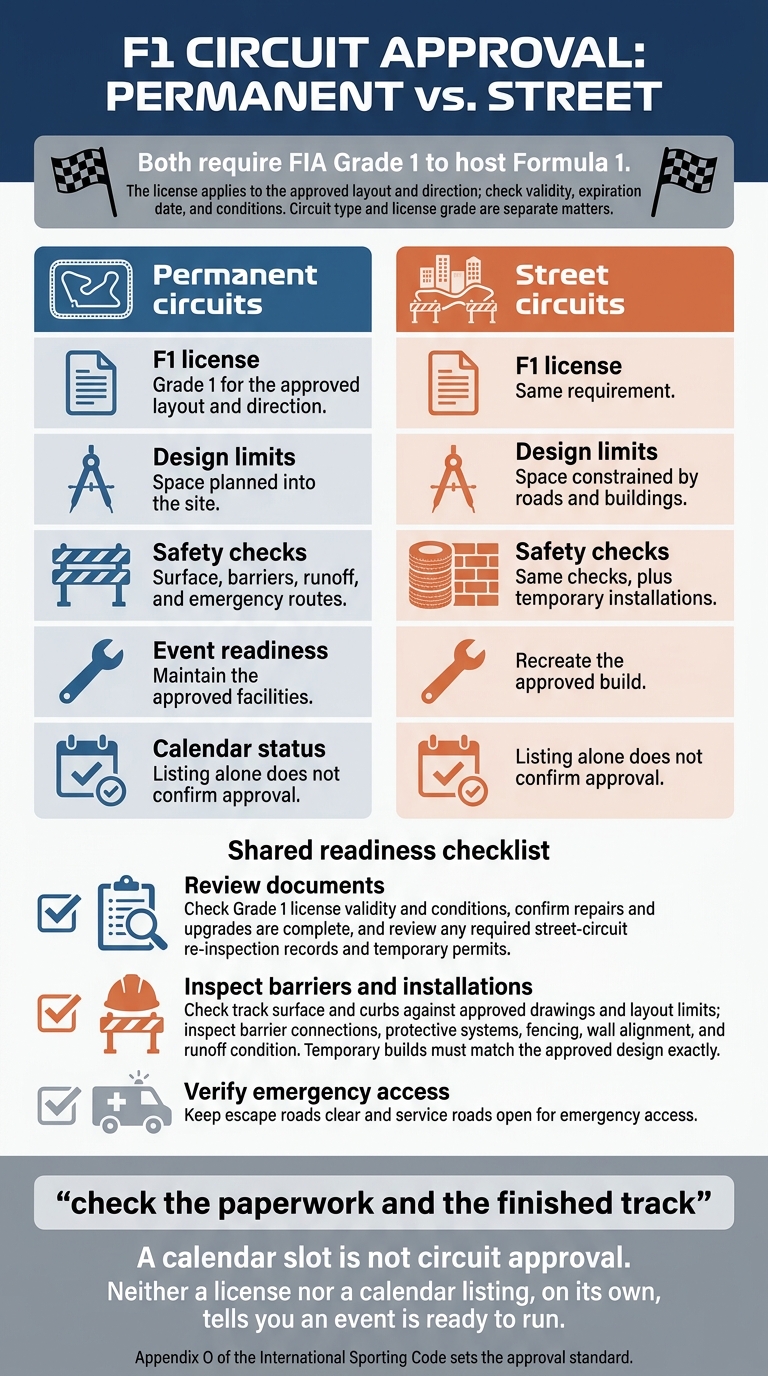
My takeaway: <u>check the paperwork and the finished track</u>. Neither a license nor a calendar listing, on its own, tells you an event is ready to run.
FIA Circuit Approval: Permanent vs Street Tracks
Inside FIA Circuit Homologation: From Blueprints to Race-Ready
sbb-itb-7c68254
Circuit License Grades and F1 Eligibility
Once the layout is approved, the next step is to check what the circuit is licensed to host.
Grade 1 and Other Circuit Grades
Circuit type and license grade are separate matters. Both permanent and street circuits can qualify for Grade 1 - the FIA grade required for Formula One. For Grades 1 to 4, the FIA bases its grading on technical criteria, not whether the circuit is permanent or street-based.
The grade alone does not authorize event use. The current layout and license conditions still determine what is permitted.
License Terms, Validity, and Layout Changes
Check the current license, approved layout, permitted vehicles, conditions, and expiration date with the FIA and the national sporting authority. Confirm any proposed modification before using it under the current license.
Even a technically approved circuit can remain provisionally listed while contract, legal, or financial terms are unresolved.
In 2004, Magny-Cours remained provisional pending a new contract.
How Permanent and Street Circuits Gain Approval
Design Review and Safety Assessment
Once the license grade is established, the circuit goes through event-specific approval. For both permanent and street circuits, the FIA checks that the track meets the approved layout and safety requirements before approving it for Formula 1.
Infrastructure Inspections and Required Repairs
A circuit stays provisional until inspections, required repairs, and contractual or legal requirements are complete. Only then can its status change to confirmed.
Pre-Event Circuit Checks
Circuit approval and calendar approval are separate steps. Even after a circuit gets approval, the calendar still needs ratification. The FIA World Motor Sport Council approves the final calendar, along with any timetable or sporting-rule changes.
Track Design, Barriers, and Escape Routes
Once the license grade is set, inspectors check that the approved layout has enough room for barriers, runoff, and emergency access.
Track Width, Length, and Geometry
FIA baseline figures set minimum widths for the track, start/finish line, and service road, along with limits for track length, overhead clearance, and pit-lane speed.
| Feature | Requirement |
|---|---|
| Min Track Width | 39.4 feet (12 meters) |
| Start/Finish Width | 49.2 feet (15 meters) |
| Max Track Length | 4.35 miles (7 kilometers) |
| Vertical Clearance | 13.1 feet (4 meters) |
| Service Road Width | 9.8 feet (3 meters) |
| Pit Lane Speed | 49.7 mph (80 km/h) |
Permanent circuits can plan these margins into the site. Street circuits must fit them around existing roads, buildings, and junctions. Meeting the numbers alone isn't enough - the layout also needs room for barriers and escape space.
Wall Placement and Protective Barriers
There's no single wall setback for every circuit. Inspectors assess whether the barrier layout works within the space available.
Runoff, Escape Roads, and Service Routes
Each route serves a different purpose: runoff slows a car, escape roads give it a way out of a corner, and service routes keep recovery and emergency vehicles separate from racing traffic.
Structures and Emergency Access
Vertical clearance applies to bridges, gantries, and overhead access routes. The circuit must also keep access clear for response crews, recovery vehicles, and track operations.
Conclusion: Approval and Event-Readiness Checklist
Once grading and layout are approved, the final check is whether the circuit is ready to run as built. Appendix O of the International Sporting Code sets the approval standard. A calendar listing does not mean a circuit is event-ready, and every new facility still needs an FIA inspection.
The readiness check starts with paperwork and ends with the physical build:
- Review documents: Check Grade 1 license validity and conditions, confirm repairs and upgrades are complete, and review any required street-circuit re-inspection records and temporary permits.
- Inspect barriers and installations: Check the track surface and curbs against approved drawings and layout limits. Inspect barrier connections, protective systems, fencing, wall alignment, and runoff condition. Temporary builds must match the approved design exactly.
- Verify emergency access: Make sure escape roads remain clear and service roads stay open for emergency access.
Permanent circuits must maintain compliance through upkeep; street circuits must recreate the approved build for every event.
FAQs
What track changes trigger a new FIA inspection?
The FIA requires new inspections and approvals when a track undergoes physical changes, such as moving concrete walls, modifying crash barriers, or changing the pit lane’s layout. These checks confirm that the updates still meet safety standards. Before and during event weekends, changes are reviewed through official FIA documentation to verify that the circuit meets its licensing requirements [2].
How does the FIA assess safety with limited runoff?
The FIA uses advanced AI simulations to pinpoint high-risk areas, including tight corners and the ends of long straights. Designers then place energy-absorbing barriers in these spots instead of tire walls [2].
TecPro barriers reduce impact forces and help prevent a car’s nose from penetrating the barrier. SAFER barriers spread impact energy over time. Both systems help tracks meet safety standards where runoff space is limited [2].
What happens if a street circuit fails its final inspection?
If a street circuit fails its final inspection, it cannot host the event until safety and layout problems are fixed and verified by the FIA. These could include misplaced barriers, inadequate escape routes, or shortcomings in track infrastructure and medical facilities.
The event stays on hold until the FIA confirms the circuit meets Grade 1 safety standards and gives final approval.