How F1 Teams Assign Pit Crew Roles
How F1 teams test and assign pit‑crew roles using drills, split timing, video review, and backups for repeatable fast pit stops.
F1 teams do not hand out pit crew jobs by rank or guesswork. I’d sum it up like this: they test each mechanic, match them to one task, track split times and mistakes, and keep backups ready in case something goes wrong.
Here’s the short version:
- Teams build roles around strength, timing, hand control, and shop experience
- They want repeatable stops, not one lucky fast stop
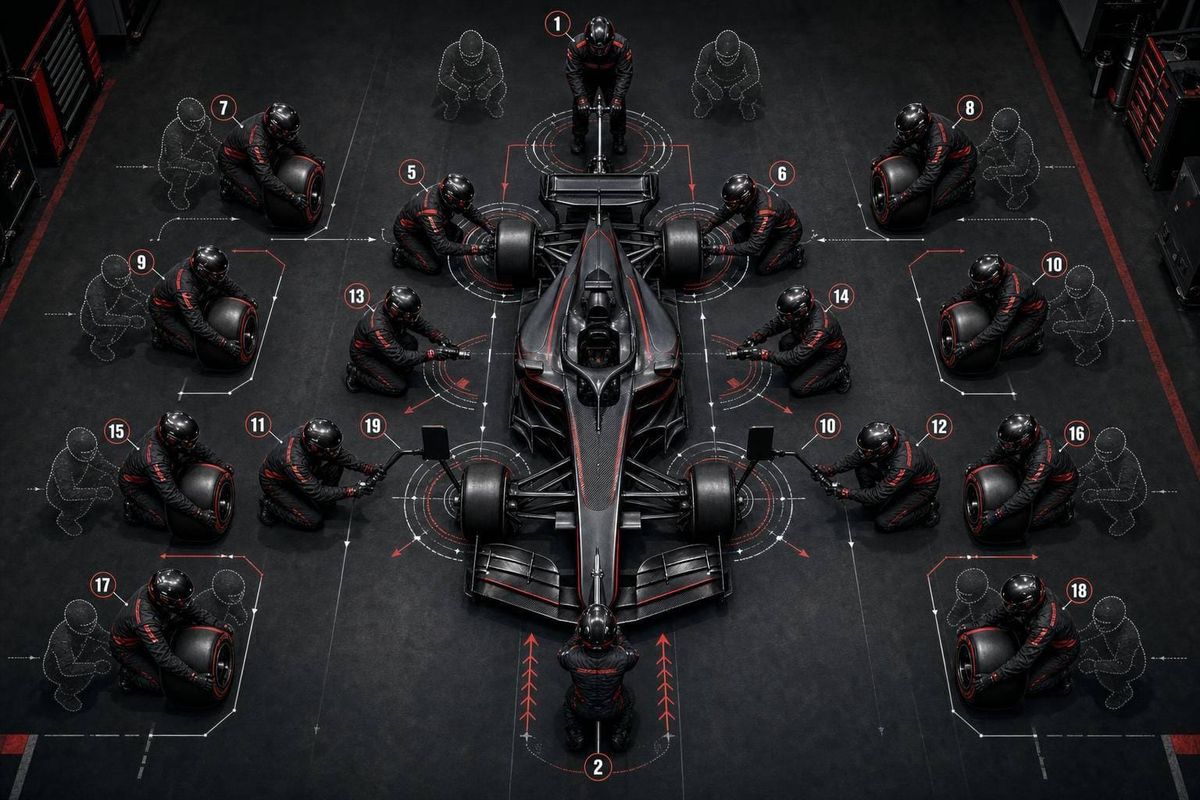
- A full stop usually uses 20 to 23 crew members
- Top 2025 averages were Ferrari: 2.31 seconds, Red Bull: 2.42 seconds, and McLaren: 2.75 seconds
- Teams review video, timing splits, and error logs to confirm each assignment
- Most mechanics train for one main role and one backup role
- Mid-season changes happen when the data shows a pattern, not after one bad stop
In other words: the job goes to the person who can do it cleanly again and again under pressure. A jack role needs burst power. A gunner role needs clean alignment and timing. A release role needs calm judgment and awareness of pit-lane traffic.
What stands out to me is that teams treat pit stops like a repeat system. They test people in drills, add noise and fatigue, compare results to each mechanic’s baseline, and swap roles if the numbers slip. That is how a 2-second stop stops looking like chaos and starts looking planned.
What does everyone do in a Formula 1 Pit Crew?
sbb-itb-7c68254
Step 1: Match each role to its physical and technical demands
Teams start by mapping the demands of each role, then pairing those demands with the people on hand. In practice, that means looking at the mechanics and technicians already employed, trying them in different spots, and testing who fits each job best.
Which roles need strength, speed, or hand control
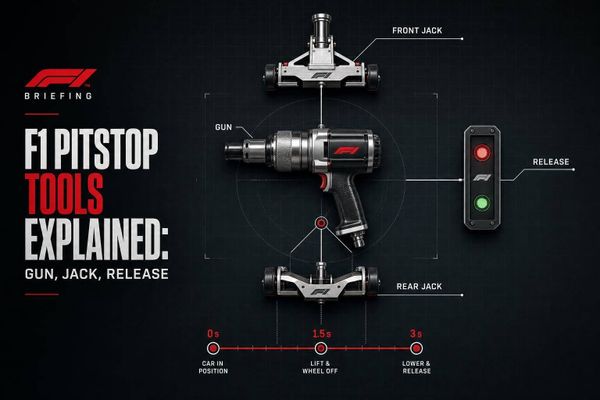
The physical demands change a lot from one position to another. Front and rear jack operators need burst power and sprint speed. Teams want mechanics who can lift the car in about 0.3–0.5 seconds from first contact, with as little variation as possible across dozens of drills.
Tire carriers deal with a different kind of strain. They sprint about 50–65 feet (15–20 meters) while carrying wheel assemblies that can weigh more than 45–55 lb (20–25 kg). Then they have to stop cleanly in the marked zone without clipping hoses or bumping into other crew members. That calls for strength, yes, but also core control and single-leg balance.
Wheel gunners show the clearest split between power and precision. The gun provides the torque. The gunner has to place it cleanly on the first pass and let go at the exact right instant. Formula 1 describes gunners as the
"calm center" of the stop.
Teams check this with reaction-light tests, hub alignment drills, and high-speed video. That footage shows whether the gun path stays clean and repeatable. But the physical side is only the first filter. Teams also want to know if a mechanic's instincts line up with the role.
How workshop experience shapes role fit
Workshop jobs often show which mechanics already know the parts, spacing, and failure points that matter in a live stop. A mechanic who spends the week building hubs, wheel nuts, and brake ducts already knows how easy it is to damage or misalign those parts. So when those same components show up during a stop, that person tends to move with more care and confidence.
Mercedes has said it uses the first pit stop practice of the year to let mechanics try different roles. That helps the team spot natural fits before assignments are locked in for the season.
Some patterns show up again and again:
- Suspension and front-end mechanics often fit front tire carrier or stabilizer roles because they know what is fragile around the upright.
- Wheel and brake technicians often make strong gunner candidates.
- Gearbox and rear-of-car mechanics are often at ease in the tight space at the back of the car, which makes them a good match for rear jack or rear tire roles.
Once the fit is clear, teams move on to testing candidates and building a depth chart.
Step 2: Pick candidates and build a depth chart
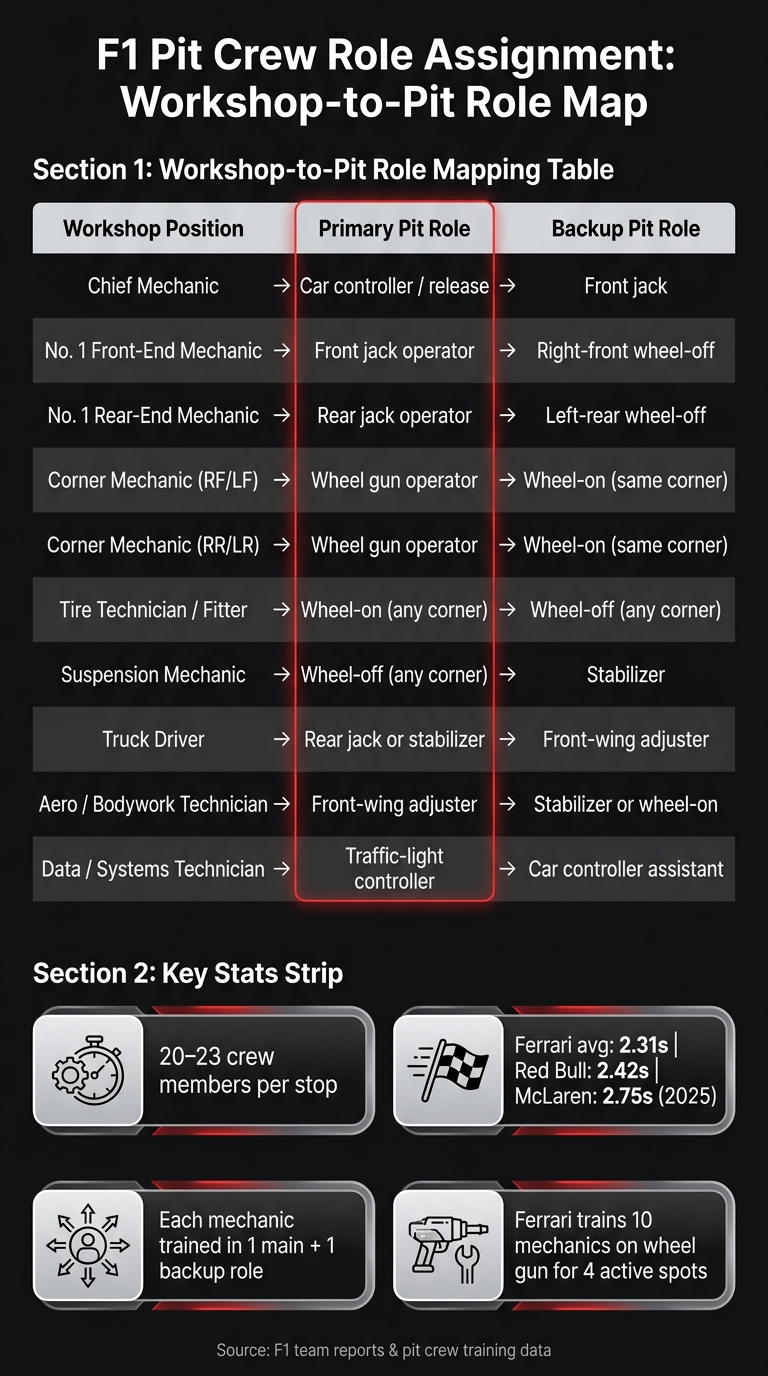
F1 Pit Crew Role Assignment: Workshop Position to Pit Role Mapping
How teams spot natural fits during screening
Once teams have a rough idea of who might fit, they shift from general screening to role drills and a working depth chart. Before any formal drill starts, they look at traveling mechanics and technicians for body type, movement, and role fit.
Red Bull sporting director Jonathan Wheatley says the team looks within its traveling crew, focusing on "their build and movement." That review is backed by physios and performance staff, who help flag the best options for each job before formal drills begin.
Then the staff looks at what each pit-stop role asks for in practice. Garage work tends to make things clear fast. You can see who deals well with heavy parts, who stays calm in tight spaces, and who can work cleanly under pressure. That trims the list before role trials start.
After that, candidates rotate through job drills. Jack operators work on smooth, clean lifts. Gunners deal with misfires. Tire techs practice moving around the gunner without getting in the way.
Why every mechanic needs a backup role
Most pit-crew mechanics are trained for at least two jobs: a main role and a backup role. That's how teams stay covered across a long season. Ferrari's Diego Ioverno has said the team keeps ten people trained on the wheel gun, including extra backups beyond the active group, for a task that uses only four people in a stop.
That depth matters when something goes wrong. If a jack operator strains a shoulder on Saturday, the team doesn't need to panic. The backup can step in because they've been drilling the role too.
The map below shows the usual workshop-to-pit-role pattern.
| Workshop Position | Primary Pit Role | Backup Pit Role |
|---|---|---|
| Chief Mechanic | Car controller / release | Front jack |
| No. 1 Front-End Mechanic | Front jack operator | Right-front wheel-off |
| No. 1 Rear-End Mechanic | Rear jack operator | Left-rear wheel-off |
| Corner Mechanic (RF/LF) | Wheel gun operator | Wheel-on (same corner) |
| Corner Mechanic (RR/LR) | Wheel gun operator | Wheel-on (same corner) |
| Tire Technician / Fitter | Wheel-on (any corner) | Wheel-off (any corner) |
| Suspension Mechanic | Wheel-off (any corner) | Stabilizer |
| Truck Driver | Rear jack or stabilizer | Front-wing adjuster |
| Aero / Bodywork Technician | Front-wing adjuster | Stabilizer or wheel-on |
| Data / Systems Technician | Traffic-light controller | Car controller assistant |
These role maps lean on what people already do in the workshop. They also spread the toughest physical jobs across stronger staff, while keeping high-pressure call-making roles with senior team members.
Step 3: Use drill data to confirm roles and build repeatability
What teams measure in every practice stop
At this stage, teams stop guessing and start measuring.
They move from general screening to split-by-split timing and video review. Every practice stop is filmed, and coaches break it into micro-segments - small timing splits - at each station. Teams track reaction, wheel-off, wheel-on, and tightening splits at each station. That matters because each mechanic is graded on their own split. So when one stop drags, coaches can trace the delay to one role instead of blaming the full crew.
Then the video comes in. Timing tells teams what happened. Video helps show why it happened.
Coaches go frame by frame to check footwork, hand placement, body angle, and release timing. They're watching for the little things a stopwatch can't show: a mechanic who pauses before engaging the gun, reaches across their body, or needs a second adjustment on the wheel nut. Those details help teams decide whether the issue comes down to technique, training, or a role change.
Teams also log errors and time loss across the full season to shape training and equipment changes. The same data helps them spot who may need a backup role before race weekend.
How teams test mechanics under race-like pressure
Teams don't start with chaos.
Factory drills come first to build clean technique before pressure is added. Once a mechanic can repeat the right movement again and again, race-weekend drills add noise, heat, strict time targets, and short recovery between reps - all meant to mirror what a Grand Prix pit lane feels like.
The point isn't only to find the fastest person on one good rep. It's to find the mechanic who keeps delivering when the room gets loud, the pace tightens, and fatigue kicks in. Teams lock in roles only after repeated race-like reps show that the fit holds under pressure, fatigue, and disruption.
That's what gives a lineup staying power when a team has to rotate people, cover absences, or reshuffle mid-season.
Step 4: Handle backups, rotation, and mid-season changes
How teams prepare for failures, fatigue, and equipment problems
Once drill data locks in the lineup, teams build redundancy around the roles most likely to crack under pressure. Modern F1 teams plan backup coverage for the jobs most prone to failure, especially the front and rear jacks, along with other failure-sensitive roles. Each reserve practices the same steps and can step in for a starter without throwing off the rest of the crew.
This goes beyond keeping extra people nearby. It gives the team the authority to make a swap, so a chief mechanic can replace a primary operator during a race weekend if needed.
The long F1 season makes that kind of planning a must. With double-headers and triple-headers packed into the calendar, travel fatigue builds fast. Some teams cut back factory pit-stop practice after a heavy travel stretch to manage fatigue and protect repeatability. Top teams also keep reserve crew members ready to rotate in when a regular mechanic is injured, tired, or just not performing at their normal level.
Well-known failures have shown why redundancy has to exist in the process itself, not only in the people doing the job. Ferrari's 2018 Bahrain unsafe release showed how a sensor fault in the pit-light system can trigger a safety failure even when the crew is trained correctly.
When teams reshuffle roles during the season
When slow releases or mistakes start showing up again and again, teams revisit role assignments instead of waiting for a bigger problem. A mid-season change almost never happens because of one bad stop. Teams look for patterns, such as repeated slow releases, uneven reaction times, tool problems linked to one operator, or a mechanic who seems less sure under pressure.
If the data points to a switch, teams usually work through it in post-race debriefs. Coaches review multi-camera footage and timing data against each mechanic's baseline. If a move makes sense, teams test the replacement between races and compare split times, release consistency, and error rates against the current operator.
A mechanic might post a faster time on one clean rep and still lose out if they can't match that pace over and over during race conditions. That's the trade-off teams care about most: not just speed, but repeatability when the pressure is on.
The table below shows how teams plan coverage for the roles that matter most:
| Critical Role | Primary Coverage | Backup Coverage | Trigger Conditions | Likely Failure Modes |
|---|---|---|---|---|
| Wheel gun operator | Lead mechanic assigned to one side | Cross-trained reserve mechanic | Repeated slow releases, tool reliability issues, fatigue | Slow wheel removal/fit, misalignment, delayed stop |
| Front jack operator | Dedicated front jack mechanic | Secondary jack-trained reserve | Missed timing, physical strain, confidence loss | Late lift, unstable car positioning |
| Rear jack operator | Dedicated rear jack mechanic | Secondary jack-trained reserve | Repeated procedural errors, equipment problem | Car not released cleanly, unsafe lowering |
| Release controller | Safety-focused mechanic or coordinator | Reserve controller | Communication breakdown, missed checklist step | Unsafe release, failed procedural check |
Cross-training makes those changes possible without forcing a full crew reset.
Conclusion: Fit, data, and adjustment build the best pit crews
A fast, dependable pit crew starts with role fit. Each job in the crew asks for a different mix of strength, timing, movement, and technical skill. So teams first spell out what each role needs, then place mechanics where their shop work, body movement, and ability to stay calm under pressure line up with that job.
But that match can't live on gut feel alone. It has to be proven. Drill data shows whether a mechanic can hit the same result again and again across repeated stops. That's what confirms the assignment.
After teams lock in the right roles, they still need protection against disruption. That's where depth and cross-training matter. Depth charts, cross-training, and mid-season swaps help keep one weak link from throwing off the whole unit. When teams treat pit crews like systems they can track, adjust, and retrain, fast stops stop feeling lucky and start feeling normal. Fit, repetition, and backup planning turn pit stops into a repeatable edge.
FAQs
How do teams know when to change a pit crew role?
Teams make these calls through data-based analysis and steady performance tracking. With sensors and high-speed cameras, they measure split times for each role to find bottlenecks, weak spots, or rising error rates.
They may also switch roles when practice sessions or race debriefs point to ongoing performance problems or physical strain. Rotation and cross-training make those changes easier when someone falls short or isn’t available.
Why do mechanics train for backup pit stop jobs?
Mechanics train for backup roles so the team can keep things running when key crew members are out.
That cross-training matters. When people can step into more than one job, the team can adjust fast to absences or mid-season lineup changes without slowing pit stops, losing precision, or throwing off crew coordination.
Which pit crew roles are hardest to perform consistently?
The hardest roles to perform well, lap after lap, are usually the jack operators and wheel-gun operators.
The rear jack operator has a tough job. They need to catch the car’s momentum and line up EXACTLY with the lift point. The front jack operator deals with the same kind of pressure, but with one extra problem: the car pitches forward under braking.
The four wheel-gun operators work in a high-pressure spot too. Even a tiny bit of misalignment can cost time.