How FIA Conducts Post-Race Car Inspections
Step-by-step guide to post-race scrutineering: parc fermé, weight and plank checks, fuel/data review, and stewards' rulings.
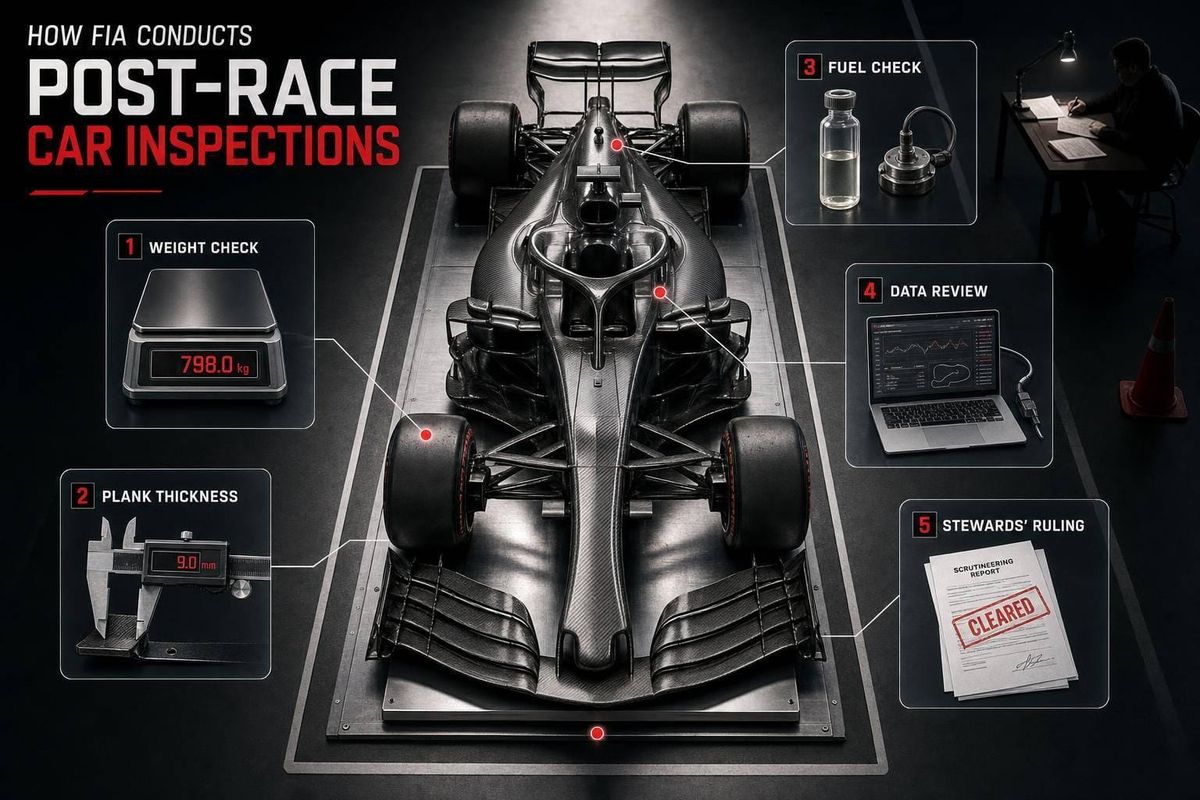
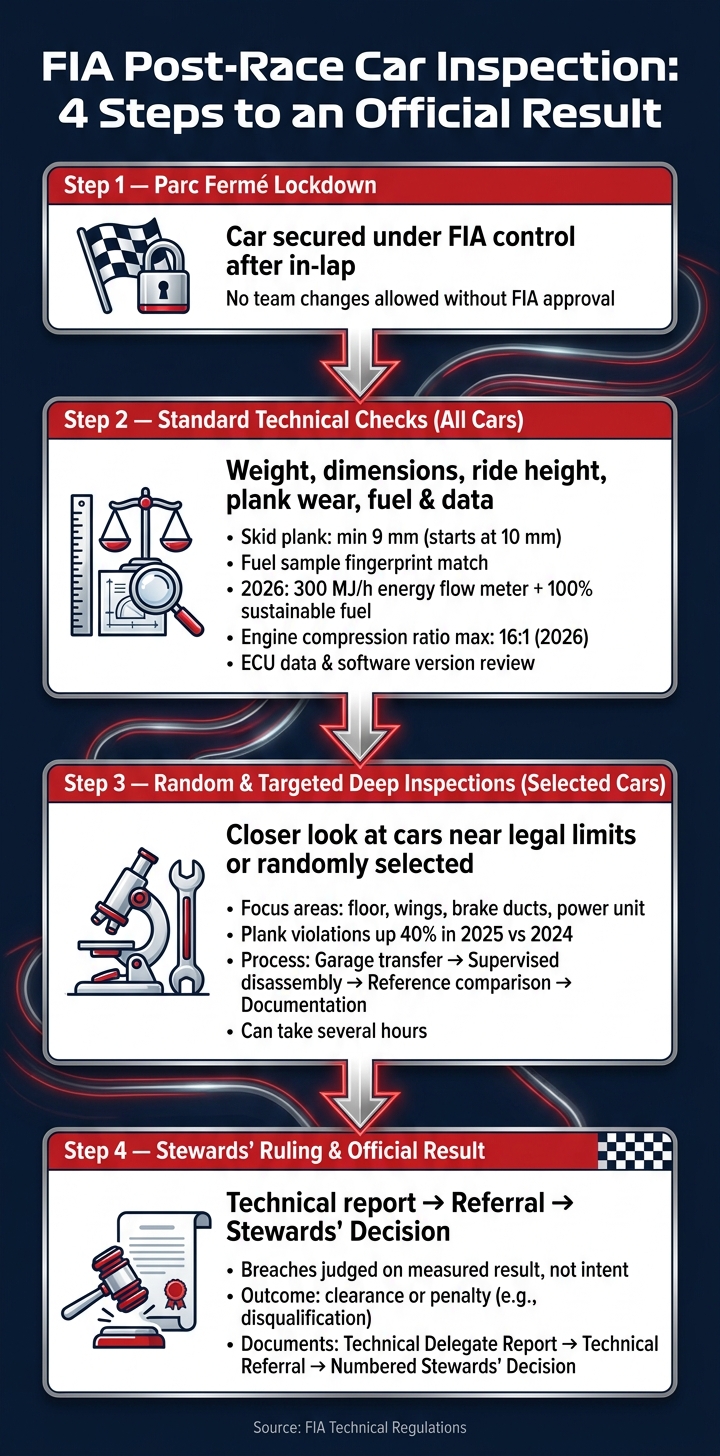
A Formula 1 race is not official at the checkered flag. I’d sum it up this way: the FIA locks cars in parc fermé, checks weight and plank wear first, reviews fuel and data, and then sends any problem to the stewards for a ruling.
Here’s the short version you can use right away:
- Step 1: Cars go straight to parc fermé after the finish, and teams can’t change them without FIA approval.
- Step 2: Officials run standard checks on every car, including weight, dimensions, ride height, floor area, and fuel/data review.
- Step 3: Some cars get extra inspection, either at random or because a reading is close to the limit. That can mean a supervised partial teardown.
- Step 4: FIA delegates file a report, and the stewards decide whether the car is legal or if a penalty applies.
A few facts stand out:
- The skid plank starts at 10 mm and must still measure at least 9 mm after the race.
- In 2026, fuel checks include a 300 MJ/h energy flow meter and 100% fuel from non-fossil sources.
- Technical cases are judged by the measured result, not by whether the team meant to break the rule.
If you want the whole process in one line, I’d put it like this: lock the car, measure it, inspect anything close, then let the stewards rule.
FIA Post-Race Car Inspection Process: 4 Steps Explained
Why did the FIA inspect Ferrari more than Mercedes?
sbb-itb-7c68254
Step 1: From the Checkered Flag to Parc Fermé
After the checkered flag, each car does an in-lap and goes straight to parc fermé under FIA control. From that point on, teams can't make any changes unless the FIA approves them. The car has to remain in the same condition it was in when it finished the race.
In-Lap Procedures and Access Restrictions
That rule matters right away. If anyone tries to alter the car before or during inspection, it can be treated as an attempt to get around the rules.
Driver and Car Weighing After the Finish
One of the first things checked after the in-lap is the weight of the car and driver. The FIA does this early for a simple reason: the combined weight has to meet the minimum limit before any fluids are drained or any parts are handled. Once that first measurement is done, officials can move on to deeper technical checks.
Initial Checks in the Scrutineering Bay
Next comes the underfloor scan, and this is where tiny margins can decide whether a car is legal. The 10 mm skid plank is allowed to wear by no more than 1 mm, which means 9 mm is the minimum legal thickness. Teams can't confirm plank wear through live telemetry. ONLY the FIA's post-race physical scan counts.
From there, the FIA moves into the standard technical checks that apply to every car.
Step 2: Standard Technical Checks Applied After Every Race
FIA technical delegates then carry out the standard post-race checks. This happens after every race, no matter where a car finished and even if there’s no sign of anything wrong.
The point is simple: these routine checks set the baseline before the FIA decides if a car needs a closer look.
Weight, Dimensions, and Ride Height Measurements
Officials use FIA scales to confirm weight and laser scans to verify dimensions. They also check ride height and floor clearance, because even tiny changes can affect both legality and downforce.
Plank Wear, Underfloor Checks, and Floor Legality
The underfloor gets the closest attention because ground-effect cars run extremely low to the track. FIA officials use laser scans to measure the skid plank thickness at specific regulated points.
The rule is tight. The plank starts at 10 mm and must still be at least 9 mm after the race. If it drops below that mark, the car can be disqualified. There’s no gray area here.
In 2025, McLaren's Las Vegas disqualifications showed how fast a tiny wear margin can wipe out a result.
Fuel, Electronics, and Logged Data Checks
Officials also take fuel samples and compare them with the reference-fuel fingerprint to spot illegal additives. Starting in the 2026 season, all F1 cars must run 100% sustainable fuel, and the FIA now uses a single 300 MJ/h fuel energy flow meter built by Allegra. That replaces the earlier two-part 100 kg/h system used in 2025.
"Any device, system, or procedure, the purpose of which is to change the temperature of the fuel-flow meter is forbidden." - FIA World Motor Sport Council
After that, officials review ECU data, sensor logs, and software versions against approved references. They also check engine compression ratios against the 2026 maximum limit of 16:1. If anything doesn’t match, that car can move into targeted scrutiny.
Step 3: Random and Targeted Inspections on Selected Cars
Once the routine checks are done, the FIA turns up the pressure on a smaller group of cars. At that point, the goal shifts from a broad sweep to a closer look at places where teams are most likely to be right on the edge.
How the FIA Selects Cars and Areas for Extra Scrutiny
A car can be picked for deeper inspection in two ways: pure random selection or a routine-check measurement that lands close to the legal limit. Even if a car clears the first round, one borderline number can still put it back under the microscope.
The FIA usually zeroes in on the areas where teams tend to push hardest: front and rear wings, the floor, brake ducts, and fuel- or power-unit-related systems.
Floor and plank checks have drawn extra attention lately. Plank violations rose 40% in 2025 compared with 2024. That matters because the floor is one of the easiest places to chase performance without making the change obvious at first glance.
What Happens During a Supervised Partial Teardown
If a car is chosen for a deeper check, it goes back to the team's garage under FIA supervision. The mechanics do the hands-on work, while technical delegates watch each step and compare the parts with the team's reference specifications.
The process follows a fixed sequence:
- Garage transfer
- Supervised disassembly
- Reference comparison
- Documentation
Inspectors may remove parts from the floor, brake ducts, or power unit and check them against the submitted reference specs. This isn't a quick once-over. It can take several hours.
Routine Checks vs. Deep-Dive Inspections: A Side-by-Side Comparison
The main difference comes down to scope. Routine checks confirm that a car appears legal on the standard items. Deep-dive inspections go after the parts most likely to hide a breach.
| Feature | Routine Post-Race Checks | Targeted Deep-Dive Inspections |
|---|---|---|
| Scope | Standard weight and visual checks for all finishers | Selected cars and specific systems or components |
| Time Required | Minutes to an hour | Several hours, often delaying official results |
| Tools Used | Scales, basic measuring jigs, and visual observation | Laser scans, physical disassembly, and software data logs |
| Level of Disassembly | Minimal, mostly external | Partial teardown of components such as the floor or brake ducts |
| Regulatory Purpose | General compliance verification | Verifying compliance in high-risk areas |
Step 4: How Findings Become Official Decisions
From Technical Report to Stewards' Ruling and Penalties
Once the FIA finishes its checks, the findings turn into a formal case.
Technical delegates put together a formal report. If the car is legal, officials clear it and the classification stays as it is. If they find a breach, a Technical Referral sends the case to the stewards. At that point, the stewards may call in team representatives before they issue a formal ruling.
One point matters more than most people think: technical breaches are judged on the car's measured state, not intent.
How to Read FIA Post-Race Documents Like an Analyst
The paperwork shows, step by step, how a measured issue turns into an official outcome.
FIA post-race documents usually follow a familiar sequence:
- The Technical Delegate's Report shows which cars and components were checked.
- A Technical Referral sends the case to the stewards if officials find a non-compliance.
- The final ruling appears in a numbered Stewards' Decision, which sets out the breached regulation, the measurements recorded, the team's response, and the final penalty or clearance.
If you're reading the documents in order, late-issued, higher-numbered files often contain the final technical ruling.
Conclusion: The Four Stages of FIA Post-Race Inspections
FIA post-race inspections move from checks to reports to steward decisions, and that ruling sets the official result.
FAQs
Why can race results change after the finish?
Race results can change after the checkered flag because the FIA runs post-race technical inspections, known as scrutineering, to make sure every car stayed within the rules during the event.
If officials spot a technical issue, even one that wasn't deliberate, it can lead to a penalty or disqualification. And when that happens, the official classification gets updated, so the drivers behind move up.
What usually triggers a deeper FIA inspection?
Deeper FIA post-race inspections usually start with data-led signals or things officials can plainly see during the race.
That can include:
- unusual pace
- heavy or repeated track contact
- odd aerodynamic movement or behavior
Podium finishers often go through standard checks. Other cars can also be picked, either to test the inspection process itself or to look into suspected technical issues.
If those first checks point to a breach, the FIA can step things up. That may mean a more invasive inspection, including full disassembly of the car.
Can a team be penalized for an accidental breach?
Yes. In Formula 1, technical compliance is enforced with a zero-tolerance approach. That means penalties are based on the car’s condition, not what the team meant to do.
So even if there was no deliberate rule-breaking, a technical violation can still lead to a penalty. That can range from a fine for a small procedural issue to disqualification for a more serious infringement.