How HR Shapes F1 Team Performance
HR transforms F1 results by recruiting hybrid specialists, aligning technical teams, reducing burnout, and strengthening leadership.
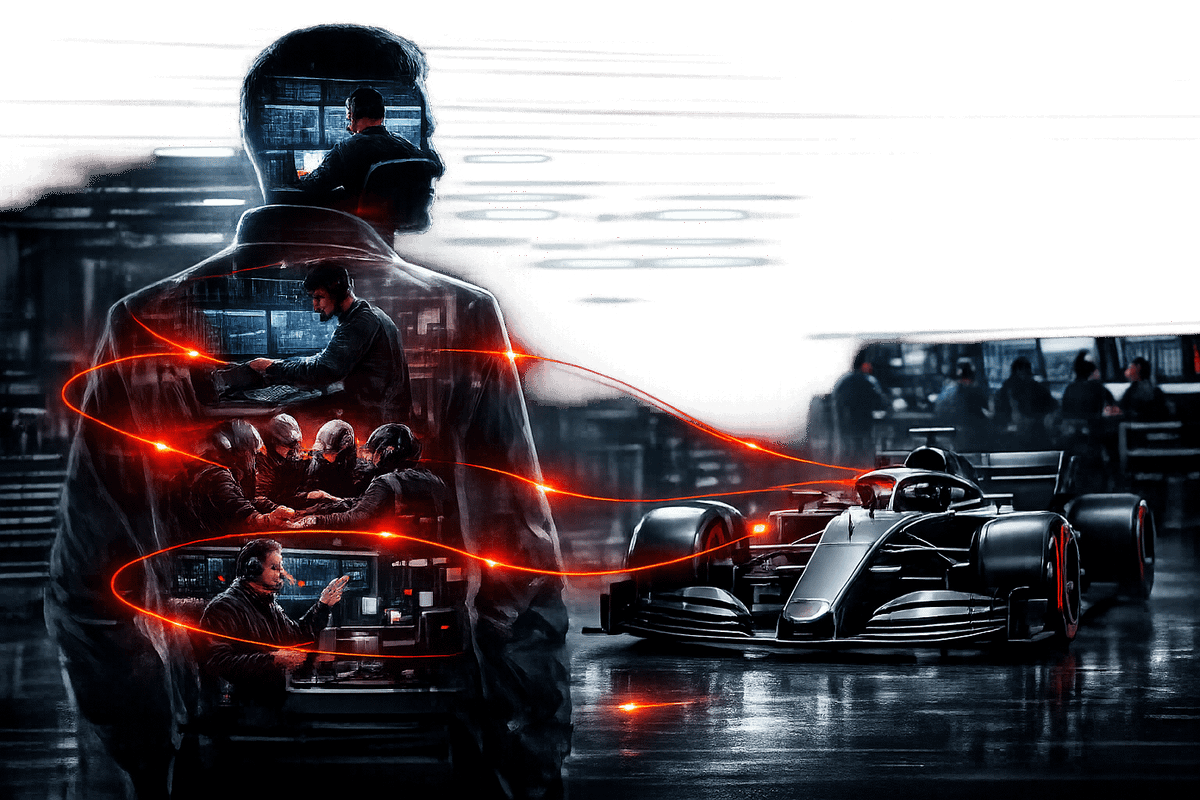
In Formula 1, success isn’t just about fast cars or advanced technology - it’s about people. Human Resources (HR) plays a critical role in ensuring that teams operate at their best, especially with the 2026 regulation changes reshaping the sport. Here’s how HR drives performance on and off the track:
- Recruitment for New Challenges: With the shift to hybrid and electric technologies, teams are hiring experts in areas like battery systems and active aerodynamics. Partnerships with universities are helping teams find top-tier talent early.
- Balancing Teams: Works teams like Red Bull and Audi integrate engine, chassis, and aero development, requiring more in-house staff. Customer teams, like Cadillac, rely on external suppliers, keeping their workforce leaner.
- Performance Management: HR ensures departments work in sync, using data-driven tools to track team and driver output while addressing mental and physical demands.
- Team Dynamics: Open communication and psychological safety are prioritized to handle the cognitive demands of 2026’s technical updates, from active aerodynamics to energy management systems.
- Leadership and Change: With rapid technical and operational shifts, HR supports leaders in managing disruptions and fostering collaboration across departments.
HR’s influence extends beyond hiring - it’s embedded in every aspect of team performance, from recruitment to leadership, ensuring F1 teams are ready to meet the challenges of the sport’s future.
F1 HR Manager Reveals How to Get a Motorsport Job
sbb-itb-7c68254
Talent Acquisition and Workforce Composition in F1
Building a winning Formula 1 team starts long before the lights go out on race day. It begins with careful, forward-thinking recruitment strategies. With the 2026 regulations reshaping the sport, teams are now prioritizing expertise in hybrid and electric technologies to stay competitive in this evolving landscape.
Recruiting Specialists for High-Pressure Roles
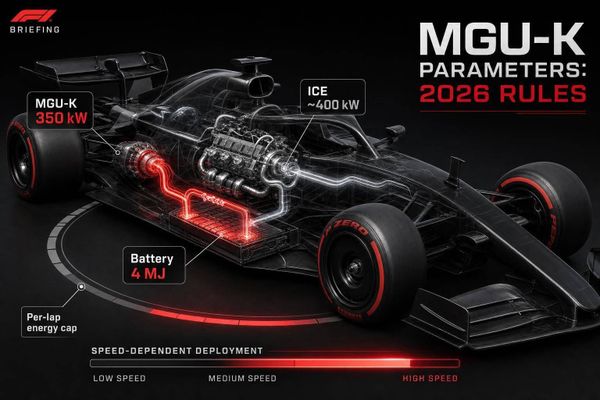
The 2026 technical regulations introduce significant changes, including an upgraded MGU-K capable of delivering three times the energy and advanced active aerodynamics that adjust wing behavior based on track conditions. To meet these demands, teams are forging partnerships with universities to tap into top-tier engineering talent early. These collaborations allow universities to tackle real-world challenges while giving F1 teams a direct pipeline to skilled graduates.
As Bradley Lord from Mercedes explained:
"We're going to see, certainly in the early races... quite a decent chunk of unpredictability and chaos. Simply because we're all still learning and the learning curve is very, very high."
In such a demanding environment, HR teams face the critical task of identifying candidates who not only excel under pressure but also demonstrate the ability to learn and adapt quickly. This deliberate approach to recruitment lays the groundwork for building a workforce capable of navigating the sport's steep learning curve.
Balancing Permanent Staff and External Contractors
Beyond hiring specialists, how teams structure their overall workforce plays a pivotal role in maintaining long-term competitiveness. While specialized recruitment drives innovation, the broader composition of a team - balancing in-house staff and external contractors - determines its ability to sustain that innovation.
Not every team has the capacity to handle all aspects of development internally. The 2026 regulations highlight a divide between "works" teams, which produce their own power units, and customer teams, which rely on external suppliers for engines while focusing their internal resources on chassis and aerodynamics.
Red Bull, for instance, has embraced the works model by partnering with Ford to establish a power unit operation in Milton Keynes. Audi has taken an even more integrated approach, acquiring the Sauber team to unify engine, chassis, and aerodynamic development under one program spanning Bavaria and Hinwil. On the other hand, Cadillac is entering the 2026 grid with Ferrari power units but plans to transition to in-house GM-built engines by 2029, gradually reducing its reliance on external suppliers.
Works teams benefit from closer coordination and control but require a larger workforce, while customer teams remain leaner but are subject to the priorities of their suppliers. As journalist Pablo Elizalde observed:
"F1 is edging back towards a manufacturers' era... only teams that control the full technical process can consistently exploit the margins at the front."
For HR departments, this means making strategic decisions about which capabilities to develop internally and which to outsource. These choices can have a lasting impact on a team's ability to compete at the highest level for years to come.
Performance Management and Continuous Improvement
Once the right talent is secured, the next hurdle is ensuring that performance remains consistent and evolves over time. In Formula One, this isn't about annual evaluations. It's a constant, data-driven process that unfolds between every race weekend. Here’s how F1 teams sustain peak performance through ongoing strategies.
Feedback Loops Between Races and Factories
F1 teams thrive by seamlessly linking their trackside operations with factory development. On race days, track crews adapt to real-time conditions, while engineers at the factory provide critical support using telemetry, radios, and AI tools. These two fronts must work in perfect harmony. For instance, the upcoming 2026 technical regulations - featuring a 30% downforce reduction and a 55% drag reduction - will demand rapid adjustments to recover lost lap time as teams refine their car designs.
HR plays a surprisingly vital role here. By ensuring that factory upgrades to power units align with trackside chassis improvements, HR helps eliminate inefficiencies. This alignment ensures no department works in isolation, which is crucial in a sport where even small gaps between departments can cost valuable time.
"In a championship where marginal gains often come from the seams between departments, 2026 promises to be the moment where those seams matter more than ever." - Motor Sport Magazine
Using HR Data to Track and Improve Team Performance
Between races, HR teams analyze performance metrics to identify areas for growth. Tools like "Driver-Extraction Offset" and "Team-Circuit Fit Scores" (scored from 0 to 100) provide insights into where improvements are needed. For example, top drivers like Max Verstappen (+1.8 offset) and Lewis Hamilton (ranging from +1.5 to +1.7) consistently outperform their peers, whose scores typically fall between –0.3 and +0.5.
These metrics also help teams contextualize results. For instance, finishing fifth at a circuit with a 45/100 fit score might indicate the team is performing at its limit, while the same result at an 85/100 fit circuit could signal underperformance. As one analysis explains:
"A team finishing P5 at a 45/100 fit circuit is hitting their ceiling, not underperforming. A team finishing P5 at an 85/100 fit circuit is having a bad weekend, and now you can ask whether it's the driver, the setup, or strategy." - Podium Prophets
This level of detail allows HR to fine-tune training programs, reassign roles, and allocate resources more effectively.
Reducing Errors and Preventing Burnout
Data-driven insights also guide teams in addressing the intense physical and mental demands of F1. The sport’s grueling schedule and high-pressure environment take a toll on everyone involved. To combat this, HR departments focus on ergonomic tool designs to minimize errors and injuries, while optimizing logistics to ensure team members can recover during packed schedules, especially sprint weekends.
The 2026 regulations will add new layers of complexity. With the shift to a 50/50 internal combustion engine (ICE) and electric power split, as well as the introduction of Overtake Mode, both drivers and engineers will face increased cognitive challenges. Simone Resta, Deputy Technical Director at Mercedes, highlights the implications:
"It's going to be quite different... potentially quite more unpredictable in the way that the drivers will use the energy to overtake." - Simone Resta, Deputy Technical Director, Mercedes
To manage this, teams are implementing structured debriefs, monitoring workloads, and providing psychological support. These measures ensure that everyone - from drivers to engineers - can perform at their best without compromising their well-being.
Team Culture and Leadership in F1
Beyond just crunching numbers or tracking performance, HR plays a key role in shaping the mindset that drives technical mastery in Formula 1.
Building a High-Performance Team Culture
In Formula 1, success isn’t just about having the fastest car - it’s about how well hundreds of experts work together under immense pressure. HR’s job? To create a culture where collaboration across departments isn’t just encouraged; it’s essential.
This becomes even more crucial with the 2026 regulation changes. With a mandated 50/50 split between internal combustion and electric power, engine and chassis teams can’t afford to work in silos anymore. Every decision - whether it’s shaving off a gram of weight, tweaking aerodynamics, or optimizing energy deployment - requires seamless coordination between departments. These new rules will push teams to the edge, where the smallest misalignment could mean the difference between winning and losing.
HR also ensures that teams bounce back quickly from both triumphs and setbacks. In a sport that’s all about relentless progress, fostering resilience and adaptability is key. A strong culture, built on honest feedback and trust, helps teams tackle tough technical challenges head-on.
Encouraging Psychological Safety
Promoting psychological safety is another critical HR focus. Why? Because open communication isn’t just nice to have - it’s a necessity. When engineers or drivers hesitate to voice concerns, those unspoken issues can snowball into race-day disasters.
This is especially relevant given the 2026 technical updates. With active aerodynamics, a 300% increase in battery power (from 120kW to 350kW), and energy harvesting capped at 8.5MJ per lap, the cognitive load on teams is skyrocketing. Drivers and engineers must feel comfortable giving unfiltered feedback about how the car behaves, without worrying about blame. As Bradley Lord from Mercedes F1 put it:
"We're all still learning and the learning curve is very, very high. So it's going to be quite exciting."
To address this, HR designs debrief sessions that emphasize learning over fault-finding. They also create clear communication channels so technical staff can raise concerns early - helping prevent small design flaws from becoming major setbacks.
Leadership Development and Managing Change
The 2026 reset isn’t just a technical hurdle - it’s a leadership challenge too. HR-driven programs are equipping team principals and department heads with the tools they need to navigate these disruptions. Emotional intelligence and change management skills are no longer optional; they’re critical for maintaining team cohesion and psychological safety during such transformative times. Chris Papadopoulos, Managing Director of Volante Rosso and former Renault engineer, summed it up perfectly:
"This is now the most high-stakes, high-technology game of people trying to outdo each other."
Take the FIA’s new "Straight Line Mode" zones, for example. Teams only find out about these zones four weeks before each race. Leaders must now rely on flexible decision-making frameworks instead of rigid strategies, and HR-led training helps sharpen these rapid-response skills.
Additionally, the move toward "works integration" - where teams like Ferrari, Mercedes, and Audi design power units and chassis as a single, cohesive system - requires a whole new leadership approach. Managing unified technical pipelines demands leaders who can ensure accountability and smooth coordination while navigating rapid changes in both technology and team dynamics.
HR Structures and Their Effect on F1 Team Performance
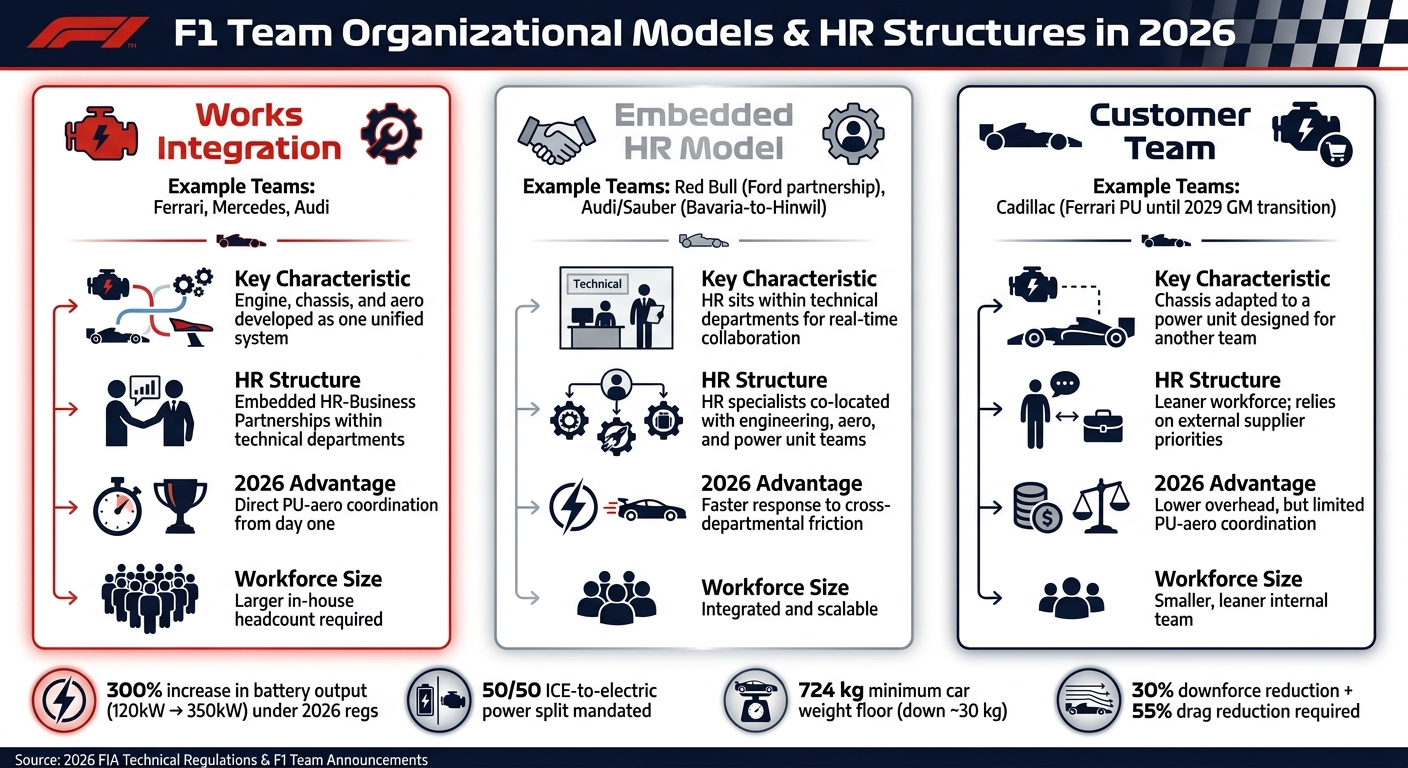
F1 Team Organizational Models: Works vs. Customer Teams in 2026
In Formula 1, the way HR functions are structured can directly influence how teams adapt and compete, especially as the sport evolves with the 2026 regulations. From recruiting specialized talent to embedding HR within technical operations, these strategies help teams stay ahead in one of the most demanding sports environments.
Specialist HR Roles in Motorsport
Today’s F1 HR departments are packed with specialists who understand the unique challenges of motorsport. Take Talent Acquisition Specialists, for instance. Their role isn’t just about filling positions - it’s about finding experts in areas like chemical engineering, battery technology, and active aerodynamics. These skills are becoming increasingly important as teams prepare for the 2026 regulation changes.
Then there are Learning and Development (L&D) Managers, whose work is critical for keeping teams competitive. With the 2026 cars requiring a complete rethink of engineering approaches, these managers create programs to share knowledge quickly, run simulation debriefs, and promote cross-functional training. Their goal? To ensure teams adapt without losing valuable time.
HR also supports cutting-edge roles like Virtual Strategy Engineers, who rely on AI to make split-second decisions during races. A great example comes from January 2025, when Mercedes-AMG PETRONAS F1 collaborated with Imperial College London to develop a Race Strategy Reinforcement Learning (RSRL) model. In simulations of the 2023 Bahrain Grand Prix, this model consistently outperformed the industry baseline, achieving an average finishing position of P5.33 compared to P5.63. HR’s involvement in scaling and supporting such teams is crucial for maintaining this competitive edge.
Embedded HR-Business Partnerships
Beyond recruitment and training, HR’s integration into technical operations has become a game-changer. In F1, where every second counts, embedding HR within technical teams ensures smoother collaboration and faster problem-solving.
Audi’s approach to F1 offers a great case study. By acquiring Sauber and launching their "Bavaria-to-Hinwil" integration program, Audi created a unified structure where engine, chassis, aero, and operations teams work as one. This setup allows decisions about battery placement, power unit cooling, and exhaust routing to be made in tandem with aerodynamic design. Instead of delays caused by siloed teams, embedded HR partnerships keep communication seamless and accountability clear.
These strategies show how HR structures can give teams a technical and strategic edge. Whether it’s through integrated development models or specialized roles, HR is playing a bigger role than ever in shaping F1 success.
| Organizational Model | Key Characteristic | 2026 Advantage |
|---|---|---|
| Works Integration (e.g., Ferrari, Mercedes, Audi) | Engine, chassis, and aero developed as one system | Direct PU-aero coordination from day one |
| Embedded HR-Business Partnership | HR sits within technical departments | Faster response to cross-departmental friction |
| Customer Team Model | Chassis adapted to a PU designed for another team | Limited coordination; aero philosophy constrained by external PU priorities |
Conclusion: HR as a Core Asset in Formula One
In Formula One, races are often won or lost by fractions - whether it’s a second, a degree, or a kilogram. This high-stakes environment highlights one undeniable truth: the human element is a critical advantage.
The upcoming 2026 regulation changes drive this point home. Teams will face a 300% increase in battery output, a reduced car weight floor of 724 kg (about 1,596 lbs, trimming 66 lbs), and revamped aerodynamic requirements. These shifts are too extensive for any single department to handle alone. Success will hinge on integrating technical innovation with top-tier team performance, and that’s where a strong HR strategy comes into play.
Adapting to these changes isn’t just about engineering breakthroughs - it’s about rethinking how teams manage talent. Drivers are no longer just racers; they are becoming strategic energy managers, juggling Overtake Mode and active aero systems in real time. Supporting this evolution requires HR to step up with tailored coaching, detailed debriefs, and role-specific training programs.
The teams that will excel in 2026 and beyond won’t just have the fastest cars - they’ll have the most cohesive, adaptable, and well-prepared human teams. From recruitment strategies and workforce development to fostering team unity and embedding HR within every layer of operations, the role of HR is inseparable from a team’s competitive success. In the end, navigating this steep learning curve is as much about people as it is about machines.
FAQs
What new skills will F1 teams need most for 2026?
In 2026, Formula 1 teams will face new challenges requiring expertise in energy management, active aerodynamics, and advanced simulation techniques. Engineers will need to refine strategies for harvesting and deploying battery energy, as power units will feature a balanced 50/50 split between combustion engines and electric motors.
Active aerodynamics will also play a key role, demanding a deep understanding of dual-mode wing setups that can adjust dynamically for performance and efficiency. Meanwhile, data scientists with skills in real-time simulations and AI-driven modeling will be critical. Their work will focus on optimizing tire performance and managing energy use throughout the race, ensuring teams stay competitive under these evolving technical demands.
How do works teams and customer teams staff differently?
Works teams, which handle the design and construction of their own power units, need larger, interconnected technical departments to oversee both chassis and engine development - particularly with the upcoming 2026 regulations. In contrast, customer teams concentrate on chassis integration and depend on works manufacturers to supply their engines. Although all teams operate within FIA cost caps, these differences in staffing highlight their unique technical and operational needs.
How can HR reduce mistakes and burnout during the season?
HR teams play a crucial role in reducing errors and preventing burnout during the high-stakes F1 season. One effective approach is using neurofeedback and biometric monitoring to benchmark drivers' mental performance. These tools evaluate and enhance cognition, stress management, and endurance, helping drivers stay mentally agile for split-second decisions under pressure. According to F1 Briefing, such techniques are essential for sustaining team performance in a sport defined by its intense technical and physical demands.