Prost GP: How Sponsorship Loss Led to Bankruptcy
How sponsorship loss, costly engine deals, and leadership failures sank an F1 team and reshaped financial rules.

Prost GP’s story is a lesson in financial fragility. The Formula One team, founded by four-time World Champion Alain Prost in 1997, collapsed into bankruptcy by 2002. Why? Over-reliance on sponsorships, poor financial decisions, and internal mismanagement created a perfect storm of instability. Here’s what went wrong:
- Financial Dependence on Sponsors: Prost GP relied heavily on a few key sponsors, like Gauloises. When these sponsors pulled out, the team couldn’t cover its rising costs.
- Costly Engine Deals: A paid engine deal with Peugeot, rather than a free supply, drained resources. Later, switching to Ferrari-badged Acer engines added further strain.
- Leadership Issues: Alain Prost’s dual role as owner and team principal concentrated decision-making, leading to risky and often flawed choices.
- Declining Performance: Poor results on the track made it harder to attract new sponsors, creating a vicious cycle of reduced funding and worsening competitiveness.
Prost GP’s fall highlights the risks of financial mismanagement in Formula One. While the sport has since introduced financial regulations to stabilize teams, independent constructors still face challenges balancing costs and revenues.
The Business Model: Revenue and Costs
Revenue Streams
Prost GP's income primarily came from sponsorship deals and prize money tied to its performance in the Constructors' Championship. The team leaned heavily on a handful of key sponsors to keep operations running. This made their financial health highly vulnerable - any reduction in sponsor support could instantly disrupt their budget.
Key Expenses
On the expense side, the financial strain was immense. Formula One teams face substantial fixed costs, including staff salaries, ongoing car development, and the need to maintain a presence across the globe. The logistics of transporting cars, equipment, and personnel to races worldwide only added to the financial burden, leaving almost no cushion for unexpected challenges.
Dependency on Sponsors
With rising costs, the team's heavy reliance on just a few sponsors became a significant risk. Losing even one major sponsor created a domino effect, leading to severe budget gaps. To make matters worse, declining performance made it harder to retain or attract new sponsors, creating a vicious cycle of financial instability.
sbb-itb-7c68254
2002 F1 Australian GP - Prost GP bankruptcy & team's assets buyout by Phoenix Finance Ltd/D.A.R.T.
Timeline of Sponsorship Loss and Financial Decline
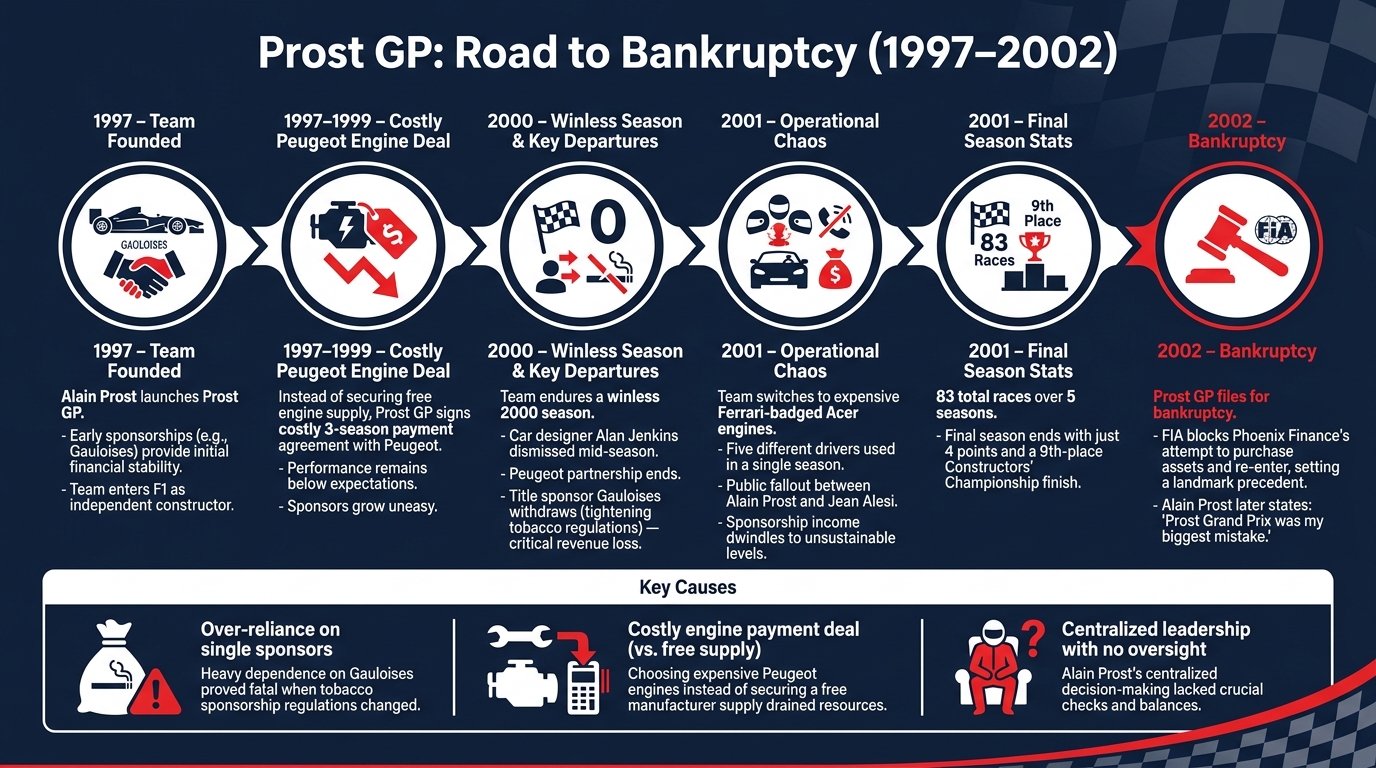
Prost GP: Timeline of Sponsorship Loss & Financial Collapse (1997–2002)
Prost GP's reliance on sponsorships created a fragile financial foundation, which began to crumble as performance issues and strategic missteps unfolded over the years.
Early Stability and On-Track Challenges
In the beginning, steady sponsorships provided a degree of financial stability, even though the team's performance on the track was below expectations. Formula One teams rely heavily on sponsorship funding, and Prost GP's early backers gave the team just enough resources to stay operational. However, as the team's results failed to impress, sponsors began questioning the value of their investment. This lack of confidence among financial partners left the team increasingly exposed to the risk of losing crucial funding.
Major Sponsorship Withdrawals
As the team's on-track performance stagnated, key sponsors began pulling out, dealing significant blows to Prost GP's budget. Each withdrawal created a larger funding gap, forcing the team to scale back on car development and other critical areas. This, in turn, further weakened their competitiveness, making it even harder to attract new sponsors. The cycle of poor performance leading to sponsor loss became a downward spiral, with each season bringing more financial instability and fewer resources to reverse the trend.
Final Seasons and Bankruptcy
By the team's final seasons, sponsorship income had dwindled to unsustainable levels, leaving massive budget shortfalls. Despite shrinking revenues, essential costs like staff salaries, car development, and logistics remained unchanged, creating mounting financial pressure. With no viable way to recover, Prost GP's financial situation reached a breaking point. In 2002, the team filed for bankruptcy, a direct result of years of financial struggles compounded by the loss of sponsorship and declining performance.
Strategic Missteps and Outside Pressures
Prost GP's downfall can be traced to a mix of poor internal decisions and challenging external circumstances. While sponsorship troubles played a role, issues within team management and strategy significantly worsened the financial strain.
Internal Strategic Decisions
One of the team's biggest mistakes was the engine deal with Peugeot. Instead of opting for a five-season free engine supply, Prost GP signed a costly three-season payment agreement. This decision became even riskier when the team pursued a national identity strategy, leaving them vulnerable when the Peugeot partnership ended after a winless 2000 season. The situation worsened in 2001 with the switch to Ferrari-badged Acer engines, the dismissal of car designer Alan Jenkins mid-season in 2000, and a revolving door of five drivers in 2001 - all of which further destabilized the team’s operations.
External Factors
The tightening of tobacco advertising regulations dealt another blow, as title sponsor Gauloises withdrew at the end of the 2000 season. This created a significant revenue shortfall, compounding the team’s financial troubles.
Governance and Ownership Issues
Alain Prost’s dual role as owner and team principal concentrated all decision-making in his hands. This structure proved problematic, as highlighted by his public fallout with Jean Alesi after the 2001 German Grand Prix. Prost’s history of contentious departures from teams - on four separate occasions - underscored the challenges of his leadership style. These governance issues disrupted team cohesion and accelerated the financial decline already exacerbated by sponsorship losses.
"Prost Grand Prix was my biggest mistake." - Alain Prost
These combined missteps and external pressures set the stage for the challenges examined in the lessons and legacy section.
Lessons and the Legacy of Prost GP
The financial struggles faced by Prost GP had both immediate and long-lasting effects on Formula One, reshaping the sport in several ways.
Immediate Consequences
Prost GP's bankruptcy in early 2002 led to the liquidation of its assets. An attempt by Phoenix Finance to purchase these assets and secure a spot on the 2002 grid was blocked by the FIA. This decision established an important precedent: owning the physical assets of a bankrupt team didn’t guarantee re-entry into the championship. Over its five-season run from 1997 to 2001, Prost GP participated in 83 races but ended its final season with just 4 points and a 9th-place finish, marking the abrupt end of an ambitious endeavor.
Long-Term Legacy
The collapse of Prost GP exposed the fragile financial foundation of independent teams reliant on a single major sponsor. In response, Formula One's governing bodies gradually introduced measures to address these vulnerabilities. By 2026, the FIA had incorporated Financial Regulations (Section D) into its core rulebook, formally recognizing that financial stability is as critical as technical and sporting regulations.
"The new power unit regulations... accented cost reduction, simplification and financial sustainability in order to make it possible and attractive for newcomers to join the sport at a competitive level." - FIA Official Statement
Today, Formula One distributes its commercial income - including hosting fees that exceed $125 million per event - across 11 teams, offering a far more stable financial framework compared to Prost GP's reliance on sponsorship deals. The addition of Cadillac as the 11th team in 2026, the first entirely new entry since 2016, reflects the improved entry conditions under these financial safeguards.
These changes provide valuable lessons for teams navigating the competitive and financially demanding environment of modern Formula One.
Key Lessons for Modern Teams
Prost GP's downfall highlights the dangers of over-reliance on a single sponsor. The team's collapse wasn’t just about losing a major backer like Gauloises; it was the lack of a financial safety net to weather the storm. This serves as a cautionary tale for today’s independent teams, many of which still face similar risks.
The flawed engine deal with Peugeot further illustrates this point. Instead of securing a free supply arrangement, Prost GP opted for a costly payment deal, creating a fixed expense that became unmanageable during tough times. In contrast, today’s regulatory environment offers more flexibility. By 2029, six power unit manufacturers - Mercedes, Ferrari, Audi, Honda, Ford, and GM/Cadillac - are expected to operate, giving independent teams more negotiating power when forming technical partnerships. Cadillac’s entry strategy demonstrates this shift; by starting with Ferrari power units while developing its own GM Performance Power Unit for 2029, the team avoids total reliance on a single supplier.
Leadership structure also plays a critical role. At Prost GP, concentrating decision-making power in one individual left the team vulnerable to high-risk choices without proper oversight. Modern teams benefit from distributed leadership models and robust financial checks, which can mean the difference between thriving and folding in the high-stakes world of Formula One.
Conclusion: The Fragility of Independent Teams in Formula One
Prost GP's story serves as a cautionary tale about how quickly a Formula One team can collapse when its financial foundation hinges on a single revenue stream. Despite an encouraging start in 1997, the team’s fortunes declined sharply, culminating in a winless 2000 season and eventual closure after just 83 races. The departure of Gauloises wasn’t just the loss of a sponsor - it was the loss of their primary sponsor, leaving the team financially crippled.
The engine situation only made matters worse. What began as a factory-backed partnership with Peugeot turned into an expensive liability, forcing Prost GP to switch to Ferrari-badged Acer engines - an arrangement they could barely afford. Even Alain Prost himself acknowledged the gravity of the missteps, stating, "Prost Grand Prix was my biggest mistake." This saga highlights how reliance on a single revenue source and poor financial decisions can spell disaster for an independent team.
While Formula One has taken steps to address these vulnerabilities, such as introducing the FIA's Financial Regulations and welcoming manufacturer-backed teams like Cadillac and Audi, the risks for independent teams remain. Operating on razor-thin margins, they are still highly exposed to disruptions like the sudden loss of a title sponsor or unforeseen cancellations. For instance, the cancellation of the 2026 Bahrain and Saudi Arabian Grands Prix reportedly cost the sport over $100 million, a financial hit that could devastate a smaller team.
Prost GP’s downfall wasn’t due to a lack of competitiveness but rather an inability to manage financial risks - a stark reminder of the fragility that can undermine even the most ambitious teams. Today’s Formula One landscape reflects lessons learned from their failure, with a stronger focus on diversified revenue streams and tighter financial controls aimed at preventing similar fates.
FAQs
How did losing Gauloises trigger Prost GP’s collapse?
The departure of Gauloises, a major sponsor, dealt a significant blow to Prost GP's finances. Losing this important source of funding left the team grappling with operational challenges, ultimately contributing to prolonged financial troubles and eventual bankruptcy.
Why was the Peugeot engine deal so financially damaging?
The Peugeot engine deal turned out to be a costly misstep, largely due to the introduction of new power unit regulations. These rules, designed to cut costs and encourage more eco-friendly practices, ironically resulted in more complicated and expensive development processes. On top of that, eliminating specific energy recovery systems added new technical hurdles, pushing manufacturing expenses even higher.
Could today’s F1 financial rules have saved Prost GP?
The current F1 financial rules, including the cost cap planned for 2026, aim to promote financial stability and create a more balanced playing field. These measures might have provided support to a team like Prost GP, which struggled financially. However, it's important to note that the team's bankruptcy stemmed from a combination of unique circumstances and factors that extended beyond just financial regulations.