Red Bull Racing 2005-2009: Team Start and Grid Place
A midfield F1 team reshaped leadership, engineering, and drivers to leap from backmarker to 2nd in five seasons.
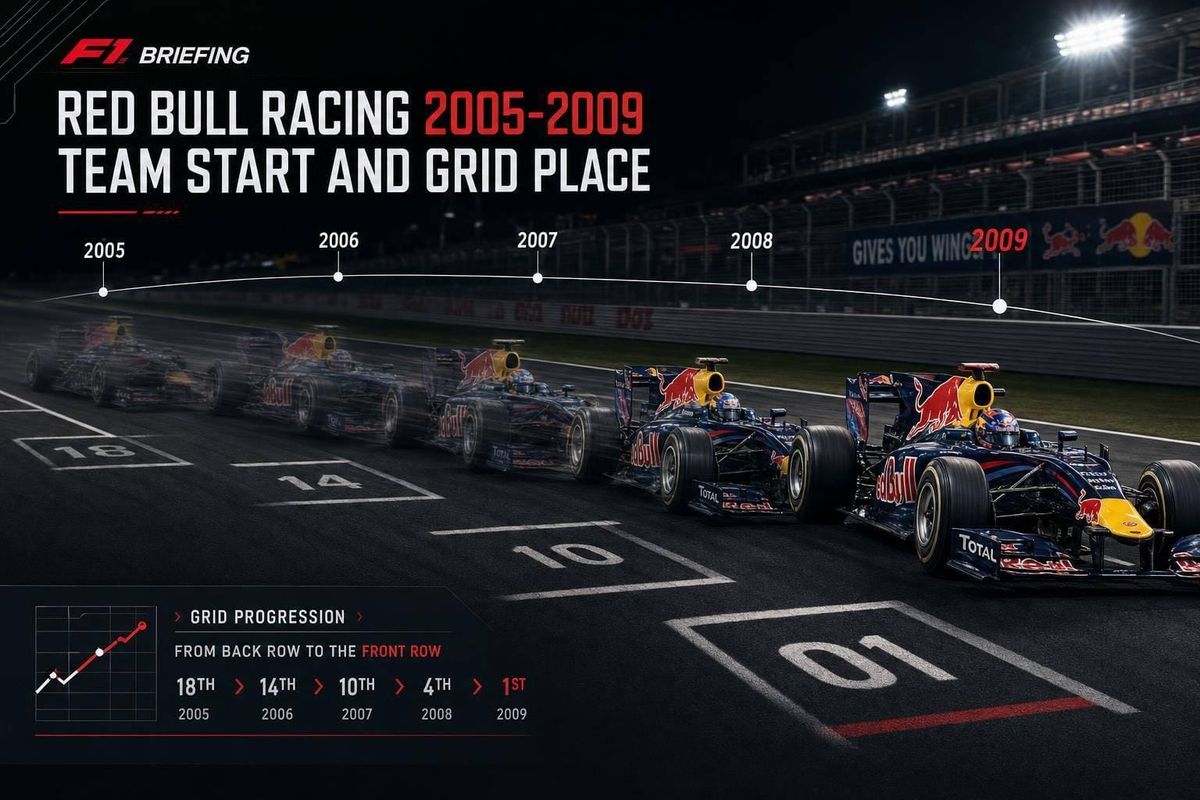
Red Bull went from Jaguar’s old 2004 base to 2nd in F1 by 2009. In five seasons, I can sum up the story like this: new ownership in 2005, Horner in charge, Newey shaping the cars, and the RB5 turning that build-up into 6 wins and 153.5 points in 2009.
If you want the short answer, here it is:
- Team start: Red Bull bought Jaguar before the 2005 season
- Main leaders: Christian Horner ran the team; Adrian Newey joined from 2006
- Engine path: Cosworth (2005) → Ferrari (2006) → Renault (2007-2009)
- Grid place by year: 7th, 7th, 5th, 7th, 2nd
- Big result: first win in China 2009
- End point: 153.5 points, 6 wins, and 2nd in the Constructors’ Championship in 2009
What stands out to me is that the climb was not smooth. Red Bull stayed in the midfield for most of this run, had reliability trouble in 2007, slipped back to 7th in 2008, and then made a huge jump in 2009 when new aero rules suited the RB5.
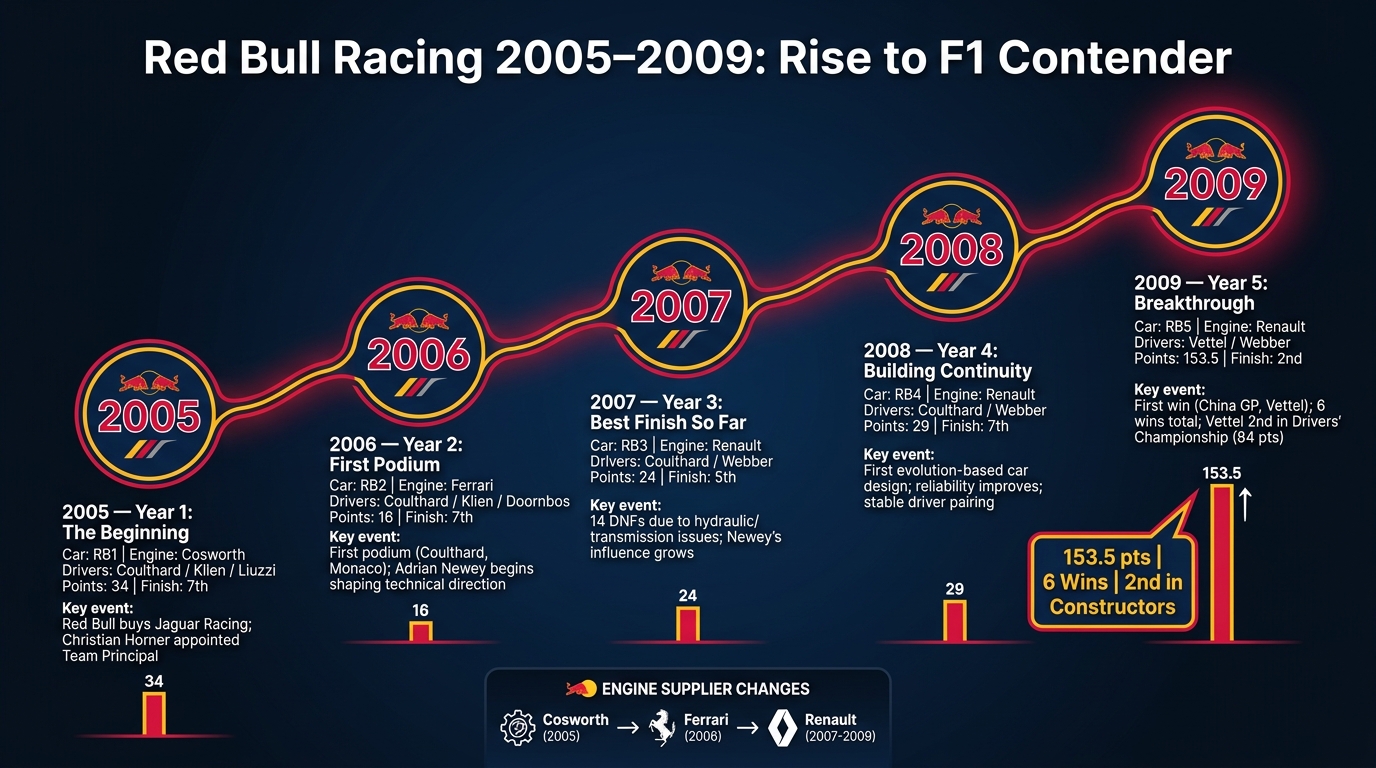
Red Bull Racing 2005–2009: From Midfield to 2nd in F1
F1 Team History: Red Bull Racing (Part 1)
sbb-itb-7c68254
Quick Comparison
| Season | Car | Engine | Main Drivers | Points | Constructors' Finish |
|---|---|---|---|---|---|
| 2005 | RB1 | Cosworth | Coulthard / Klien / Liuzzi | 34 | 7th |
| 2006 | RB2 | Ferrari | Coulthard / Klien / Doornbos | 16 | 7th |
| 2007 | RB3 | Renault | Coulthard / Webber | 24 | 5th |
| 2008 | RB4 | Renault | Coulthard / Webber | 29 | 7th |
| 2009 | RB5 | Renault | Vettel / Webber | 153.5 | 2nd |
So if you’re asking what “team start and grid place” means here, I’d put it simply: how Red Bull began in 2005, who shaped it, and where it finished on the F1 grid each year from 2005 to 2009.
1. Team Launch in 2005: Ownership Change, Key Staff, and the RB1
From Jaguar Racing to Red Bull Racing
Red Bull bought Jaguar Racing in late 2004 and kept the Milton Keynes headquarters for 2005. What they took over wasn't a front-running team. It was a back-of-the-grid operation that needed work from top to bottom before better results could show up.
Christian Horner, Helmut Marko, and the early management model
Red Bull appointed Christian Horner as Team Principal, with control over day-to-day operations and recruitment. Helmut Marko oversaw Red Bull's driver-development program, including the Red Bull Junior Team, which was already backing young drivers by 2005.
The split was pretty clear from the start. Horner ran the race team. Marko focused on driver development and longer-term planning. That setup became Red Bull's early management model.
RB1, Cosworth power, and the launch-year technical package
The RB1 was Red Bull Racing's first car. It used Cosworth power and sat in the midfield. More than anything, it was built to give the team a stable starting point rather than outright speed.
That mattered in 2005. The RB1 was a cautious launch-year package, aimed at setting a baseline the team could build from. Red Bull's first season was about stability, not pace, and that baseline helped set up the step-by-step gains that came in 2006 and 2007.
2. Season-by-Season Progress, 2005-2008: Drivers, Cars, and Constructors' Positions
2005: Debut season, Coulthard as lead driver, and 7th in the constructors' standings
David Coulthard gave the new team an experienced lead driver and a steady point of reference. In the other seat, Red Bull rotated Christian Klien and Vitantonio Liuzzi, which showed the team was still working out its long-term driver plan.
The RB1 delivered a steady first year. It wasn't a front-running car, but it was solid enough for Red Bull to score 34 points and finish 7th in the Constructors' Championship. For a debut season, that gave the team a clear starting line and a useful benchmark for what had to come next.
| Drivers | Engine | Points | Constructors' Rank |
|---|---|---|---|
| Coulthard, Klien, Liuzzi | Cosworth V10 | 34 | 7th |
2006-2007: Ferrari engines, first podium, and Adrian Newey's growing influence
With the team through its first season, the next step was simple in theory and hard in practice: turn stability into pace.
In 2006, Red Bull switched to Ferrari engines and introduced the RB2. The change didn't bring an instant jump. The team scored 16 points and remained 7th in the standings. Still, there was one big moment: Coulthard's podium at Monaco, Red Bull Racing's first.
The bigger change was happening behind the scenes. Adrian Newey was starting to shape the team's technical direction, and that influence showed up more clearly with the RB3 in 2007, alongside a move to Renault engines. On raw pace, the car looked like a step forward. On Sundays, though, dependability got in the way.
Both cars recorded 14 DNFs, with most of those retirements tied to hydraulic and transmission issues after the late Renault switch. So the 2007 story had a bit of a split personality: the car looked better on paper before it became dependable on track.
Horner said the late Renault decision triggered early transmission problems in 2007.
Even with those failures, Red Bull moved up to 5th in the Constructors' Championship with 24 points, its best finish so far.
| Season | Car | Engine | Points | Podiums | DNFs | Constructors' Finish |
|---|---|---|---|---|---|---|
| 2006 | RB2 | Ferrari V8 | 16 | 1 | - | 7th |
| 2007 | RB3 | Renault V8 | 24 | 2 | 14 | 5th |
2008: RB4 and the year before the leap
After two seasons of uneven progress, Red Bull needed a car that could turn technical gains into cleaner race results.
The RB4 didn't bring a jump in the standings. Red Bull dropped back to 7th with 29 points. But that finish doesn't tell the whole story. In 2008, the team evolved the previous car instead of starting over, and that shift mattered. With more continuity in the design group and Renault power still in place, the engineers had a steadier base to work from.
"The new car - for the first time in our short history - is an evolution. With continuity in the design group, this winter has been the smoothest that I've seen." - Christian Horner, Team Principal, Red Bull Racing
Coulthard and Webber also gave the team a steady driver pairing, which helped with feedback through the season. The RB4 was built to deal with the reliability problems that had hurt Red Bull in 2007, and 2008 gave the team something it had been missing: continuity. That stable base would matter a lot for the RB5.
| Year | Constructors' Finish |
|---|---|
| 2005 | 7th |
| 2006 | 7th |
| 2007 | 5th |
| 2008 | 7th |
3. 2009: RB5, Vettel and Webber, and 2nd Place in the Constructors' Championship
Why the RB5 raised Red Bull's competitive level
The 2009 aero reset favored cars that could make efficient downforce work, and the RB5 nailed that formula with a steady Renault package. After the more settled RB4, this was the first Red Bull car that turned steady progress into pace at the front.
By the second half of the season, Red Bull had become Brawn GP's main rival.
Vettel and Webber as a front-running driver pairing
Sebastian Vettel's move to Red Bull in 2009 pushed the team to a new level. He finished 2nd in the Drivers' Championship with 84 points and four wins, only 11 points behind Jenson Button.
Mark Webber gave Red Bull strong support on the other side of the garage. He scored two wins, 69.5 points, and finished 4th in the standings.
That balance mattered. Vettel brought top-end speed, and Webber kept points coming. Put the two together, and Red Bull stayed in the title fight.
First wins and 2nd in the constructors' championship
Red Bull's first Formula 1 win came at the 2009 Chinese Grand Prix, with Sebastian Vettel taking the victory. From there, the team kept closing the gap to Brawn GP, which had won six of the first seven races and held a 26-point lead after Round 7.
By the end of the season, Red Bull had taken six wins. Brawn GP finished with eight. In the Constructors' Championship, Brawn ended on 172 points, while Red Bull finished 2nd with 153.5 points - an 18.5-point gap.
Season totals below are from the 2009 championship standings.
| Metric | Brawn GP | Red Bull Racing |
|---|---|---|
| Total Points | 172 | 153.5 |
| Race Wins | 8 | 6 |
| Lead Driver | Jenson Button | Sebastian Vettel |
| Lead Driver Points | 95 | 84 |
| Second Driver | Rubens Barrichello | Mark Webber |
| Second Driver Points | 58 | 69.5 |
| Constructors' Standing | 1st | 2nd |
That breakthrough opened the door to the next step: turning one big jump into a team that could win year after year.
4. What Changed Across 2005-2009: Grid Trend, Rival Context, and Lasting Legacy
Constructors' ranking trend from 2005 to 2009
Red Bull's climb didn't happen in a straight line. The team went 7th, 7th, 5th, 7th, and then all the way to 2nd.
Here’s how that showed up in the Constructors' standings:
| Season | Chassis | Engine | Key Drivers | Points | Constructors' Finish |
|---|---|---|---|---|---|
| 2005 | RB1 | Cosworth | Coulthard / Klien / Liuzzi | 34 | 7th |
| 2006 | RB2 | Ferrari | Coulthard / Klien / Doornbos | 16 | 7th |
| 2007 | RB3 | Renault | Coulthard / Webber | 24 | 5th |
| 2008 | RB4 | Renault | Coulthard / Webber | 29 | 7th |
| 2009 | RB5 | Renault | Vettel / Webber | 153.5 | 2nd |
The biggest jump came at the end. Red Bull went from 29 points in 2008 to 153.5 in 2009. That's a massive swing, and it shows just how well the new aero rules matched the team's design direction. The RB5 wasn't just a better car. It was the moment Red Bull's long build-up clicked.
Even so, the path wasn't smooth. The results bounced around a bit, but the team kept stacking the right pieces year after year.
Why Red Bull became a contender
A few things came together at the right time. The ownership stayed steady. Christian Horner gave the team a clear direction. Adrian Newey led the car side. And keeping Renault power from 2008 into 2009 gave the design group more continuity.
That matters more than it might seem. In Formula 1, if too many parts change at once, progress can stall. Red Bull avoided that trap.
Newey later said the team's reliability problems came from design, manufacturing, and operations faults, not from some intentional choice to sacrifice dependability for speed.
The driver plan also paid off. Red Bull used Scuderia Toro Rosso as a runway for Sebastian Vettel, then moved him up to the main team for 2009. That wasn't luck. It was a clear call, and it worked.
Conclusion: Why 2005-2009 was the base of Red Bull's winning era
Put it all together, and 2009 looks less like a surprise and more like the result of four years of work.
Red Bull didn't start from zero in 2005. The team took over Jaguar's base, which had scored only 10 points in 2004, and turned that operation into a title contender within five seasons. By 2009, the main parts were in place: stronger leadership, better engineering, and the Vettel-Webber pairing.
The 2009 results tell the story well enough: 2nd in the Constructors' Championship, six wins, and Vettel finishing 2nd in the Drivers' Championship. That season was the payoff. Red Bull had turned a new ownership setup into a team that could win races.
FAQs
Why was 2009 such a big turning point for Red Bull?
For Red Bull Racing, 2009 marked a turning point. New technical regulations reshaped the grid, and Red Bull used that shift to move to the front of the field.
Brawn GP set the pace early in the season. But as the year went on, Sebastian Vettel and Mark Webber kept getting closer. Then came the 2009 Chinese Grand Prix, where Red Bull secured its first-ever 1–2 finish. That result made something clear: this was no longer a team with occasional flashes of speed. Red Bull had become a steady race-winning force.
How important was Adrian Newey to Red Bull’s rise?
Adrian Newey played a big part in Red Bull Racing’s climb after he became technical chief officer in 2006. He arrived with title-winning experience from Williams and McLaren, and he pushed the team to a higher engineering level.
By 2008, that impact was starting to show. Red Bull worked to fix its mechanical and hydraulic issues, which had held the team back. Newey’s focus on fine detail and steady improvement helped move Red Bull into the front group by the end of 2009.
Why did Red Bull change engine suppliers so often from 2005 to 2009?
In Red Bull Racing’s early years, changes in engine suppliers came down to shifting technical needs and the team’s push for more stability in the car’s design.
The late move to Renault in 2007 created reliability issues, most of them tied to transmission integration and overall performance. Sticking with Renault for 2008 gave the team more continuity. It also gave the designers room to focus on better hydraulic systems and push the car’s development instead of scrambling around another engine change.