Safety Car Strategy: When to Pit and When to Stay Out
Decide whether to pit under a Safety Car by weighing tire wear, track position, race phase and weather—pits can save ~10–12s.
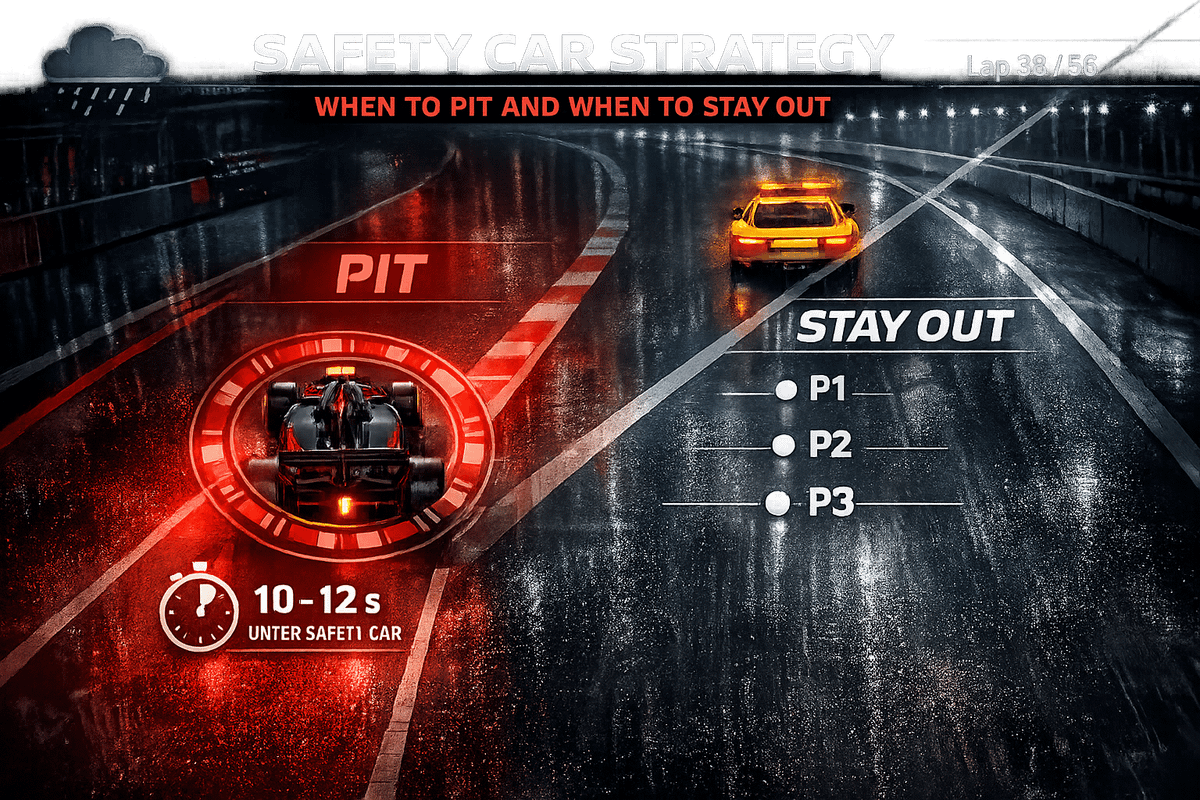
The Safety Car can completely change the outcome of a race by closing gaps between cars and reducing pit stop times. Deciding whether to pit or stay out during this period depends on several factors:
- Tire Condition: Worn tires may need replacing, but fresh tires aren't always the best choice if track position is critical.
- Track Position: On tracks where overtaking is difficult, holding your position might be more effective than pitting.
- Race Phase: Early Safety Car periods allow for more flexibility, while late ones leave little room for error.
- Weather: Sudden changes, like rain, can force teams to switch tire compounds, overriding other strategies.
Key takeaway: Pitting during a Safety Car can save up to 10–12 seconds compared to a green-flag stop, but the decision must align with tire wear, race conditions, and track position. Teams rely on real-time data and fast communication to make the right call under pressure.
Formula One Safety Car Race Strategy - Explained
sbb-itb-7c68254
Safety Car Pit Windows: Timing the Stop
Timing a pit stop during a Safety Car period can make or break a race. Teams must act quickly, as the dynamics shift dramatically compared to green-flag conditions. Normally, a pit stop costs between 18 and 28 seconds of race time. But under a Safety Car, this loss drops significantly - teams may only lose about 10 seconds relative to competitors. This time-saving advantage is why the pit wall becomes a hive of activity the moment the Safety Car is deployed.
When to Pit During a Safety Car
The ideal time to pit is when your tires are nearing their limit and you're already close to a planned stop. If fresh tires won’t drop you behind slower cars, pitting can be a smart move.
Mario Isola, Pirelli's Director of Motorsport, highlighted this after the 2025 Qatar Grand Prix: "All the strategic choices in today's race were conditioned by the arrival of the safety car". In that race, Max Verstappen pitted on lap 7 of 57 during a Safety Car period, saving around 10 seconds compared to a green-flag stop. Meanwhile, McLaren's Oscar Piastri and Lando Norris stayed out to protect their track position. However, a mandatory 25-lap tire life limit forced them to pit later under green-flag conditions, costing them the lead on laps 42 and 44. Verstappen's decision proved decisive.
To avoid hesitation, teams often establish Safety Car windows - specific lap ranges where pitting immediately is critical. But if holding your current position is more advantageous than fresh tires, a different strategy might be necessary.
When to Stay Out During a Safety Car
Sometimes, staying out is the better call, especially if track position is crucial. On circuits where overtaking is difficult, even losing a couple of spots in the pit order can be costly. If your tires are in good shape and can last the stint, maintaining your position makes sense.
Another factor is pit lane congestion. When multiple teams react simultaneously to a Safety Car, the pit lane can become chaotic. Delays caused by traffic or an unsafe release can erase any potential gains from fresh tires. As McLaren's Operations Director Charlie Hooper put it:
"It's no-good breaking a world record if the next pit stop is five seconds!"
In such cases, staying out and preserving clear track position can be the smarter, lower-risk choice.
Tire Wear, Compounds, and Stint Length
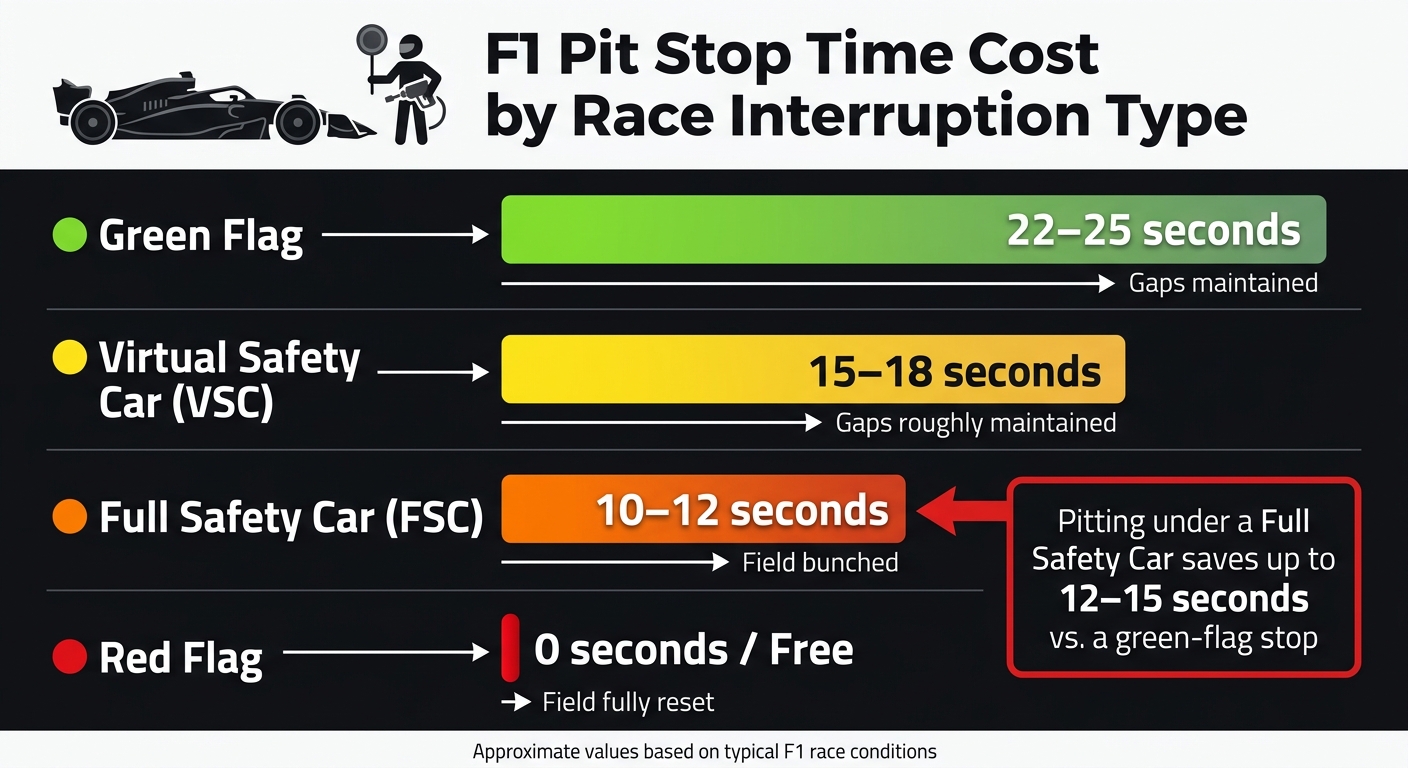
F1 Pit Stop Cost by Race Interruption Type
Reading Tire Wear and Degradation
When a Safety Car comes out, one of the first things engineers focus on is the state of the tires. Two key issues - blistering (caused by heat damage beneath the surface) and graining (surface tearing due to sliding) - help determine whether the tires can handle a restart or need to be replaced immediately. These observations often shape the team's strategy during a Safety Car period.
Interestingly, the slow laps behind a Safety Car don’t always help a worn tire recover. For example, if a tire is heavily grained, the reduced speeds might not generate enough heat to smooth out the surface. This means a tire that looks borderline in the data could actually perform worse once racing resumes.
How Tire Compounds Affect the Decision
Tire compound choice plays a big role in strategy during a Safety Car period. Softer tires heat up quickly, delivering excellent grip right after the restart - perfect for gaining positions into the first corner. On the other hand, harder compounds are more durable but can be tricky to warm up at the slower speeds behind the Safety Car, leaving a driver vulnerable during the initial laps.
A Safety Car period also provides a cost-effective chance to meet the mandatory two-compound rule, which requires drivers to use at least two different compounds in dry races. Mario Isola, Pirelli's Director of Motorsport, highlighted this during the 2025 Qatar Grand Prix:
"The compound considered to be the best compromise between getting good grip right from the start, and also maintaining an adequate performance level throughout the duration of the stint, was the medium."
Isola also noted that harder compounds can sometimes outperform expectations late in a race:
"The lap times showed that in some cases it [the C1 compound] offered better performance than the C2 medium in the final laps."
These characteristics, combined with real-time tire data, directly influence whether teams decide to pit during a Safety Car period.
Calculating Whether Tires Can Last to the Finish
Once tire wear and compound behavior are understood, teams calculate whether the current set can survive the remaining laps. It’s a straightforward comparison: if the expected tire life falls short of the laps left in the race, a pit stop is unavoidable. The question then becomes whether to pit during the Safety Car period (at a lower cost) or risk a full-cost stop later.
Here’s a quick breakdown of how different race interruptions affect pit stop costs:
| Interruption Type | Pit Stop Cost (Approx.) | Field Impact |
|---|---|---|
| Green Flag | 22–25 seconds | Gaps maintained |
| Virtual Safety Car | 15–18 seconds | Gaps roughly maintained |
| Full Safety Car | 10–12 seconds | Field bunched |
| Red Flag | 0 seconds | Field fully reset |
If the car is already within the optimal pit window, stopping under the Safety Car is the smarter move. For marginal one-stop strategies, this is the perfect opportunity to switch to fresh tires. The slower laps during the Safety Car period ease the wear on the new set, increasing the likelihood they’ll last to the end without requiring an additional stop.
Track Position and Restart Dynamics
Why Leaders Often Stay Out
When a Safety Car is deployed, it immediately erases any lead the front-runner has built, as all the cars bunch up. This creates a dilemma for the leader: pitting would mean giving up track position to competitors. On tracks where overtaking is notoriously tough - like Singapore, with its narrow, winding street layout - holding onto the lead often outweighs the benefits of fresh tires. In these situations, track position becomes more valuable than new rubber, simply because there’s little opportunity to pass.
Leaders often opt to stay out, prioritizing their position over the potential speed boost from fresh tires. Meanwhile, midfield teams see this as a golden opportunity to shake up the race dynamics.
How Midfield Teams Use the Safety Car
For teams in the midfield, a Safety Car period can be a game-changer. With the field compressed, they suddenly find themselves much closer to cars that were previously 15–20 seconds ahead. Add fresh tires into the mix, and the restart becomes a chance to challenge rivals who would otherwise be out of reach.
Take Max Verstappen’s incredible recovery at the 2026 Australian Grand Prix as an example. Starting from P20, he utilized four Virtual Safety Car (VSC) periods to work his way up to P6. Each time the field bunched up, he closed significant gaps, making the most of his opportunities. His fastest lap of 1:22.091 highlighted the advantage he gained. For midfield teams, the decision to pit depends on balancing the benefits of fresh tires with the need to manage stint lengths effectively. Even if they lose a position or two, the improved pace often helps them regain ground.
Managing Cold Tires on the Restart
Tire performance during a restart is another crucial factor, regardless of whether a driver pits or stays out. Behind the Safety Car, cars circulate at roughly 40% of their usual racing speed, causing tire temperatures to drop significantly. Cold tires are more likely to suffer from graining, where the rubber peels unevenly, leading to reduced grip.
To counteract this, drivers weave, brake hard, and accelerate sharply to generate heat in their tires. The race leader, who controls the pace of the restart, faces additional challenges. A sudden acceleration can create a concertina effect, forcing trailing cars into risky situations as they react to the varying speeds. Managing this balance is critical to maintaining control and avoiding chaos as the race resumes.
Weather Conditions and Strategy Adjustments
Weather changes can turn a race on its head, adding complexity to pit strategy and forcing teams to think fast.
Switching Tires in Wet or Drying Conditions
Weather is one of the trickiest factors in racing, and a Safety Car period can be a golden opportunity to adapt. Normally, a green-flag pit stop costs around 22–25 seconds, but during a full Safety Car, that drops to just 10–12 seconds. This time difference is critical when conditions suddenly shift, making tire changes during a Safety Car much less punishing.
But it’s not just about timing - understanding the track surface is key. For instance, if rain begins but parts of the track remain dry, switching to intermediates too soon could mean losing grip as the track dries. On the flip side, staying on slicks when water starts pooling increases the risk of aquaplaning. Teams rely on tools like trackside sensors, driver feedback, and onboard cameras to decide on the right tire compound. In these moments, weather can completely override earlier pit strategies - a sudden rainstorm can render fresh dry-weather tires useless, highlighting how quickly teams must adapt under pressure.
The 2026 regulations have introduced a helpful tweak: higher tire warmer temperature limits for intermediate tires. This change allows drivers to get better grip immediately after a pit stop on damp tracks, especially during Safety Car restarts, reducing the risks tied to cold tires.
Using Weather Forecasts to Time the Stop
While reacting to weather changes is essential, predicting them can offer a significant edge. Teams closely monitor real-time weather radar and hyper-local forecasts to find the crossover point - the exact moment when changing tire compounds becomes necessary. This data, combined with tire wear analysis, helps strategists decide whether to pit during a Safety Car or wait it out. If the timing doesn’t align with a Safety Car, teams face a tough choice: pit under green-flag conditions and lose more time or gamble on another Safety Car appearing.
Rainy conditions often lead to more Safety Car or Virtual Safety Car (VSC) deployments because reduced grip and increased spray elevate the risk of incidents. This feedback loop plays into strategy - the worse the weather, the more likely a neutralization period, which makes bold weather-based strategies more appealing. However, when forecasts predict unpredictable weather throughout the race, teams often take a more cautious approach. In such scenarios, timing luck can sometimes outweigh outright speed. And then there’s the wildcard: a Red Flag situation. This resets the race entirely, allowing free tire changes and erasing any strategic advantage built through careful planning.
Real-Time Decision Making: Data and Communication
When a Safety Car comes into play, teams have just seconds to process a flood of critical data and make decisions. Any delay could cost them a podium finish.
Key Data Points Teams Track
Strategy engineers depend on real-time data flowing in from the car, the pit wall, and remote operations centers. They monitor several critical metrics, including:
- Gap to the car ahead and behind: This determines if a pit stop can be made without losing position.
- Tire degradation rates: Measured as time lost per lap, this helps assess whether the current set of tires can last until the end.
- Remaining tire sets: Knowing how many fresh sets are available is crucial for planning.
- Race progress percentage: This helps gauge how much of the race remains and influences strategy.
- Valid Finish check: This binary indicator confirms whether the car can complete the race on its current tires while meeting the two-compound rule.
The type of Safety Car deployed also plays a huge role. A Full Safety Car (FSC) erases time gaps entirely and reduces pit stop costs to about 10–12 seconds. On the other hand, a Virtual Safety Car (VSC) only cuts pit stop costs to around 15–18 seconds and keeps gaps mostly intact. This difference can completely change the strategy, determining whether the team opts to pit or stay out. These metrics directly shape the timing and coordination of pit stops as well as the communication between drivers and engineers.
| Metric Monitored | Why It Matters |
|---|---|
| Gap to Leader / Behind | Determines if pitting can happen without losing position |
| Tire Degradation Rate | Assesses if the current set can make it to the end of the race |
| Safety Car Status | Defines the actual time cost of a pit stop under FSC or VSC conditions |
| Valid Finish Check | Confirms compliance with the two-compound tire rule |
A great example of this was seen during the 2026 Australian Grand Prix. By correctly interpreting live gap data, a team transformed an ordinary pit stop into a near-free one, showcasing how data-driven decisions can lead to race-winning outcomes.
Driver and Engineer Communication
While data is crucial, it’s the communication between the driver and engineer that puts this information into action. Drivers provide feedback that telemetry can’t always capture, such as unexpected understeer, a sudden loss of rear grip, or energy management issues that haven’t yet shown up in lap times. During a Safety Car period, radio exchanges must be quick, clear, and decisive.
Teams rely on encrypted digital two-way radios, supported by AI monitoring systems and TETRA networks, to ensure seamless communication between the driver, pit wall, and remote operations center. When a Safety Car is deployed, engineers typically share gap data and tire information, while drivers update the team on how the car feels. This two-way exchange - blending objective data with the driver’s real-time input - is what ultimately shapes the final call.
Avoiding Pit Lane Congestion
When a Safety Car triggers multiple teams to pit simultaneously, the pit lane can become a chaotic bottleneck. To avoid this, teams monitor rivals’ pit strategies in real time and use predictive models - like Monte Carlo simulations and reinforcement learning tools - to pinpoint the best entry and exit windows. AI-powered crew training also helps minimize time spent in the pit box, reducing the chances of a double-stack situation where two cars from the same team queue for service.
This becomes especially critical at circuits like Singapore’s Marina Bay, where narrow barriers and limited runoff areas make Safety Cars almost inevitable. In these cases, managing pit lane traffic effectively can be just as important as deciding when to change tires. By combining precise data analysis with efficient coordination, teams can execute strategies under Safety Car conditions with precision and speed.
Conclusion: Making the Right Call Under Pressure
Key Takeaways on Safety Car Strategy
Crafting a winning Safety Car strategy requires balancing multiple variables - tire condition, track position, race distance, and the type of intervention. Get any of these wrong, and what seemed like a sure victory can slip away in seconds.
One of the biggest advantages during a full Safety Car period is the drastically reduced pit stop time - dropping from the usual 22–25 seconds during green-flag conditions to just 10–12 seconds. But this time-saving only pays off if it aligns with the pit window and tire requirements.
The nature of the circuit also plays a significant role. On street circuits like Singapore and Baku, where Safety Cars are almost guaranteed, teams must plan more conservatively. For example, strategists might aim for an 8-second winning margin instead of 20, knowing that Safety Cars can compress the field. Combining these on-track factors with robust data analysis is critical for refining pit stop strategies.
How Data and Analysis Drive Better Decisions
Beyond the basics, data and analysis elevate decision-making during Safety Car scenarios. While speed is essential, accuracy is non-negotiable. Leading teams rely on real-time data - like telemetry, gap analysis, tire degradation, and "Valid Finish" checks - to make split-second calls.
Modern tools like RSRL models, developed in collaboration with Imperial College London and Mercedes-AMG PETRONAS, take this a step further. For example, in simulations of the 2023 Bahrain Grand Prix, RSRL delivered an average finishing position of P5.33, outperforming the Monte Carlo baseline of P5.63. Its strength lies in capturing temporal dynamics - whether a car is closing in on a rival or losing ground - something that traditional static simulations often overlook.
"Safety cars are the one thing that separates F1 predictions from pure data analysis. You can model pace, degradation, and strategy perfectly and still get undone by a random incident on lap 30." - Podium Prophets
As discussed earlier, factors like tire wear, compound behavior, and weather adjustments all feed into this decision-making process. Explainable AI tools such as TimeSHAP and VIPER empower engineers to trust automated recommendations by showing why a model suggests a pit stop, rather than just flagging it. Ultimately, the best Safety Car strategies rely on clean data, swift communication, and the confidence to act decisively before the opportunity disappears. These elements underscore how precise, data-driven decisions are the foundation for success when racing under Safety Car conditions.
FAQs
How do teams know if pitting under a Safety Car will lose track position?
Teams evaluate track position during a Safety Car period by studying gaps between cars, reviewing telemetry data, and running race simulations. If making a pit stop would result in losing too many positions, they often choose to stay on track. On the other hand, if there’s enough of a gap to rejoin the race without losing much ground, they might take the opportunity to pit for fresher tires or to improve their strategic options. Factors like timing, the layout of the track, and the condition of the tires also heavily influence their decision-making process.
What’s the quickest way to predict tire performance after a Safety Car restart?
The fastest way to gauge tire performance after a Safety Car restart is by diving into real-time telemetry, race simulations, and current track conditions. These tools provide insights into crucial elements like tire wear, lap times, and the race's overall progression. This data helps teams understand how quickly tires are wearing down and allows them to adjust strategies on the fly.
How does a VSC change the pit decision compared to a full Safety Car?
A Virtual Safety Car (VSC) helps maintain stable gaps between cars by requiring drivers to slow down to roughly 70% of their usual pace. While pit stops during a VSC are faster compared to those made under normal racing conditions, they don’t offer the same level of advantage as stops during a full Safety Car (SC) period, where all gaps between cars are eliminated. Teams carefully consider factors like tire wear and track position since the time savings under a VSC are less pronounced, and the period usually lasts just 1 to 3 laps.