TERS vs. ERS: Differences in F1 Standards
Shift to kinetic-only ERS exposes energy shortfalls and super-clipping, forcing teams to rethink 7 MJ-per-lap energy strategies.
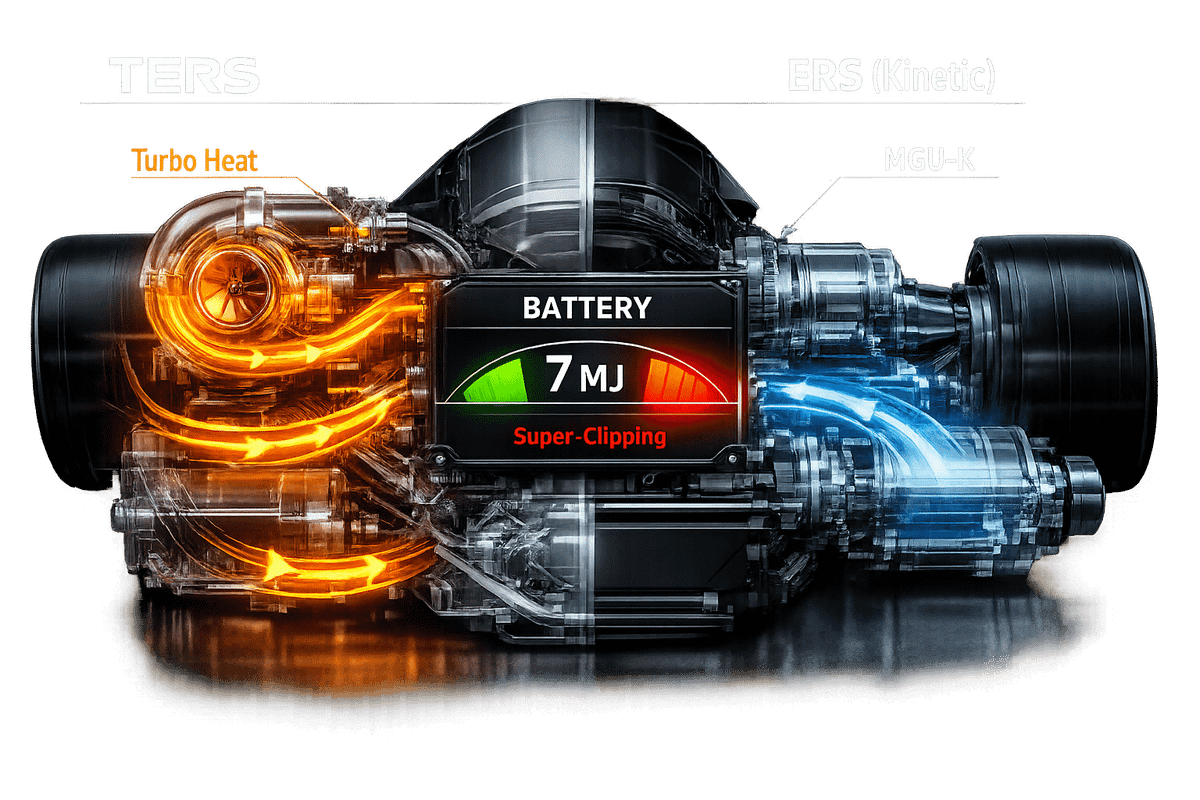
Formula 1’s energy systems have changed significantly for 2026. The Thermal Energy Recovery System (TERS), which used exhaust heat to generate power, has been removed. Now, the Energy Recovery System (ERS) relies solely on the Motor Generator Unit – Kinetic (MGU-K) to recover energy during braking. This shift simplifies power units but introduces challenges like reduced energy recovery and "super clipping", where cars lose speed on straights due to limited energy deployment.
Key Changes:
- TERS (MGU-H): Removed due to cost and complexity.
- ERS (MGU-K): Now the sole energy recovery system, with power output increased to 350 kW.
- Energy Limits: Recharge capped at 7 MJ per lap (down from 8 MJ).
- Power Split: 50:50 between the internal combustion engine and electrical energy.
Quick Comparison:
| Feature | Pre-2026 (TERS + ERS) | 2026 (ERS Only) |
|---|---|---|
| Energy Sources | Exhaust + Braking | Braking Only |
| MGU-K Power Output | 120 kW | 350 kW |
| Recharge Limit | Unlimited (TERS) | 7 MJ per lap |
| Complexity | High | Moderate |
This evolution impacts performance, strategy, and car design, making energy management a critical focus for teams in the 2026 season.
ERS: Components, Function, and Standards
Main Components of ERS
The current Energy Recovery System (ERS) is built around three key components: the MGU-K, the battery, and the ECU. Starting in 2026, the MGU-K will be the only recovery component. It captures kinetic energy from the rear axle during braking and converts it into electrical power, which is stored in the battery. The ECU plays a crucial role by managing the harvesting and deployment of energy. It monitors vehicle dynamics to optimize performance, such as detecting slow starts (below 30 mph) and initiating earlier MGU-K deployment to reduce collision risks. Together, these components are essential to the ERS's functionality and its impact on race performance.
How ERS Affects Performance
The MGU-K provides up to 350 kW of power in acceleration zones, drops to 250 kW outside these zones, and offers an additional "Boost" mode with 150 kW during races for overtaking or defending positions. This energy allocation is managed strategically, as teams must decide when and where to deploy the available power.
"This reduction in energy deployment should also free up energy for use elsewhere around the circuit, further reducing the need to recover energy and lead to unexpected changes in performance." - Craig Scarborough, Tech Illustrator and Pundit
These performance capabilities are tightly controlled by updated FIA regulations, ensuring a balance between strategy and fairness.
ERS Compliance and Regulations
Under the new FIA framework, the maximum energy recharge per lap will drop from 8 MJ to 7 MJ starting in 2026. This change aims to curb excessive energy harvesting, encouraging more consistent, flat-out racing. The updated regulations prioritize both performance and safety, with key adjustments set to debut at the Miami Grand Prix on May 3, 2026.
"Safety and sporting fairness remain the FIA's highest priorities. These changes have been introduced to address the issues identified in the opening events and to ensure the continued integrity and quality of the competition." - Mohammed Ben Sulayem, President, FIA
The table below outlines the critical compliance parameters for teams, highlighting the tighter energy recovery limits compared to earlier regulations:
| Regulatory Parameter | 2026 Standard |
|---|---|
| Maximum Recharge Limit | 7 MJ per lap |
| Peak Superclip Power | 350 kW |
| MGU-K (Acceleration Zones) | 350 kW |
| MGU-K (Non-Acceleration Zones) | 250 kW |
| Race Boost Cap | +150 kW |
| Superclip Duration | 2–4 seconds per lap |
| Circuits with Alternative Limits | Up to 12 per season |
Additionally, the FIA has the authority to impose lower energy limits at up to 12 circuits per season, depending on track layouts that naturally limit energy regeneration. To ensure fairness, all teams must reset their energy counters at the start of the formation lap, preventing any car from beginning with an advantage.
sbb-itb-7c68254
TERS: Thermal Energy Recovery in F1
The Role of TERS in Energy Recovery
TERS, or Thermal Energy Recovery System, played a crucial role during F1's double-hybrid era (2014–2025). It allowed teams to capture waste heat from exhaust gases and convert it into electrical energy. Alongside kinetic energy recovery from braking, this system provided engineers with a steady flow of electrical energy throughout a lap, enhancing performance and efficiency.
The MGU-H: Past Use and Removal
At the heart of TERS was the MGU-H (Motor Generator Unit – Heat). Positioned between the turbocharger and exhaust, it captured energy from hot exhaust gases and could even assist in spinning the turbocharger faster when needed, effectively eliminating turbo lag. While this made the MGU-H a marvel of engineering, its complexity and high cost eventually led to its removal.
When the FIA crafted the 2026 regulations, they aimed to attract new power unit manufacturers. The MGU-H, with its specialized design and expense, was seen as a hurdle for new entrants. As a result, it was scrapped, marking the end of thermal energy recovery in F1 and paving the way for major regulatory changes.
Regulatory Changes and TERS
With the removal of the MGU-H, TERS became obsolete, leaving the MGU-K (Motor Generator Unit – Kinetic) as the sole energy recovery system, focused on capturing energy from the rear axle.
"The rules set we have ended up with eliminated both systems [MGU-H and front MGU]. Leaving us with just the MGUK recovering energy from the rear axle." - Craig Scarborough, Tech Illustrator and Pundit
This shift posed a new challenge. Unlike the double-hybrid system, the MGU-K cannot recover energy as consistently, leading to a phenomenon called "super clipping". This occurs when a car suddenly loses electrical assistance on a straight, dropping to combustion power and causing a sharp reduction in speed. To mitigate this, the FIA reduced the maximum energy recharge limit from 8 MJ to 7 MJ per lap. Additionally, the number of circuits allowed to operate with lower energy limits increased from 8 to 12 per season. These changes not only reflect the absence of TERS but also force teams to rethink their energy recovery strategies moving forward.
The F1 2026 Power Unit Explained in 9 Minutes
TERS vs. ERS: A Direct Comparison
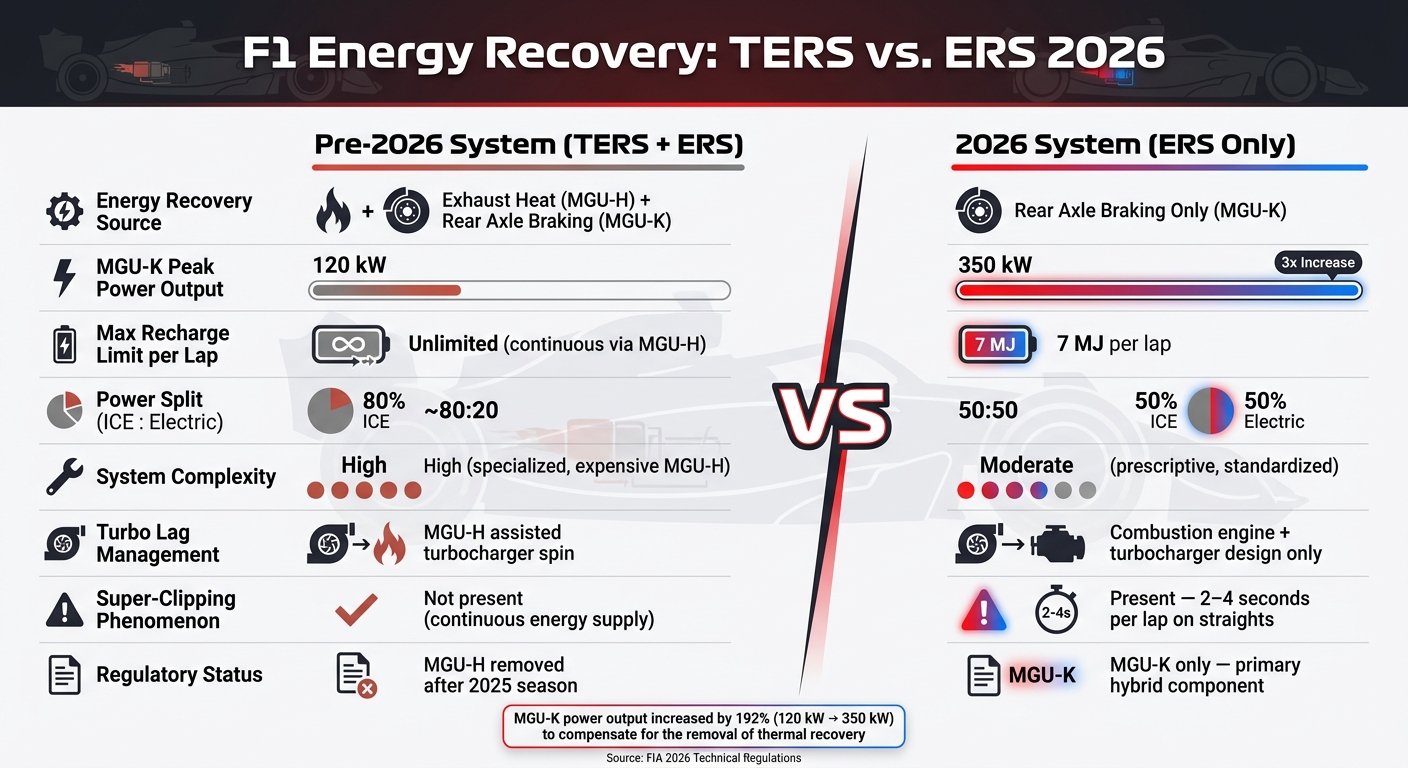
F1 Energy Recovery: TERS vs. ERS 2026 Key Differences
System Scope and Components
To understand how TERS and the 2026 ERS differ, it helps to think of TERS as a subset of the broader ERS system. Before 2026, ERS worked as a double-hybrid system, combining two energy recovery methods: thermal recovery through TERS (via the MGU-H) and kinetic recovery (via the MGU-K). This setup allowed engineers to generate electrical energy from two sources during a lap. Starting in 2026, ERS will rely entirely on the MGU-K, which harvests energy solely from braking.
| Feature | TERS (MGU-H, Pre-2026) | ERS (MGU-K, 2026 Standard) |
|---|---|---|
| Primary Energy Source | Exhaust heat / turbocharger | Kinetic energy / rear-axle braking |
| Peak Power Output | Variable (integrated into ERS) | 350 kW |
| Max Recharge Limit | Continuous recovery (no hard cap) | 7 MJ per lap |
| Complexity | High - expensive, specialized | Moderate - prescriptive, standardized |
| Regulatory Status | Removed for 2026 | Primary hybrid component |
Performance Differences
TERS offered continuous energy recovery, as the MGU-H could harvest exhaust heat even at full throttle. This meant the battery stayed charged throughout a lap, providing consistent power. In contrast, the 2026 MGU-K can only recover energy during braking. This creates a major limitation: on tracks with long straights and limited braking zones, there isn't enough braking to recharge adequately.
"The cars cannot recover enough energy around the lap to maintain the 50:50 power split." - Craig Scarborough, Tech Illustrator and Pundit
This limitation leads to super clipping - when the battery runs low on a straight, the car reverts to combustion power alone while the MGU-K works to recover energy. This causes a noticeable drop in speed. To minimize the impact, the FIA raised the peak regeneration rate to 350 kW, which reduces the clipping duration to about 2–4 seconds per lap. While this adjustment helps, it doesn’t fully solve the issue.
The shift from TERS to the updated ERS system also brings significant regulatory changes.
Regulatory Frameworks
TERS compliance was notoriously difficult to monitor. Operating at extreme speeds and temperatures, the MGU-H presented significant challenges for ensuring regulatory adherence. The 2026 ERS system, however, is much more structured. For example, the MGU-K’s deployment is capped at 250 kW in non-acceleration zones, like complex corners, while the full 350 kW is allowed in overtaking and acceleration zones. This zoning strategy is designed to prevent dangerous speed differences between cars with and without available energy.
New safety measures have also been introduced. The FIA now mandates automated systems under the 2026 rules, such as a low-power start detection system. This system automatically activates MGU-K deployment if a car shows unusually low acceleration at the start, addressing risks of collisions off the grid.
Unlike the TERS era, which lacked real-time enforcement mechanisms, the 2026 ERS framework reflects a far more operationally involved and safety-conscious approach.
What These Changes Mean for F1 Teams
Moving Toward ERS Optimization
With the phase-out of TERS, the MGU-K now carries the full responsibility for electrical recovery, increasing its output significantly from 120 kW to 350 kW. This shift has forced teams to rethink their power unit designs. One of the biggest challenges is battery thermal management. Handling a 350 kW system through rapid charge and discharge cycles generates a lot of heat, which teams must control while balancing strict weight and packaging requirements. Additionally, the removal of the MGU-H means turbo lag must now be addressed solely through combustion engine and turbocharger design - a new challenge compared to previous setups.
Interestingly, this change has also attracted new manufacturers like Audi and Ford. The simplified power unit design aligns more closely with road car technology, showing how these changes extend beyond the racetrack. These technical adjustments are also reshaping race strategies, particularly under the updated ERS regulations.
Preparing for 2026 ERS Rules
Race strategies for the 2026 season are now more dependent on the specifics of each circuit. The FIA has increased the number of races with lower energy limits from 8 to 12 per season, acknowledging that certain tracks don’t provide enough braking opportunities to recharge effectively. As a result, teams need to develop energy strategies tailored to individual circuits rather than using a one-size-fits-all approach. This shift is a direct result of relying solely on the MGU-K system and adapting to the new rules.
The changes to the energy recovery systems are also influencing driver behavior in unexpected ways. For example, managing super-clipping - when a driver is at full throttle but the car is recharging instead of deploying energy - has sparked frustration among drivers. Many feel that this added complexity takes away from the pure racing experience.
"The amount of energy management required... has led to complaints from the drivers that their skills were being diminished." - Andrew Benson, F1 Correspondent
To address these concerns, the FIA introduced rule adjustments in April 2026. The maximum recharge allowed per lap was reduced from 8 MJ to 7 MJ, and peak super-clip power was increased to 350 kW. These changes aim to shorten the clipping window and make energy management less demanding for drivers. Additionally, in wet conditions, teams are now required to scale back ERS deployment to reduce torque and improve car handling, adding yet another layer to race-day strategy.
"These changes have been introduced to address the issues identified in the opening events and to ensure the continued integrity and quality of the competition." - Mohammed Ben Sulayem, FIA President
Conclusion: TERS vs. ERS - Key Differences
TERS and ERS stand apart primarily due to their energy sources. As mentioned earlier, the shift from dual-recovery systems to a kinetic-only approach marks a significant change. TERS relied on the MGU-H to continuously harness energy from exhaust heat, ensuring a steady battery charge regardless of braking. In contrast, the 2026 ERS relies solely on the MGU-K, which recovers energy from rear axle braking, requiring teams to make careful trade-offs during braking and acceleration.
Previously, power distribution leaned heavily on the combustion engine, with an 80:20 split between engine and electrical output. However, the 2026 regulations mandate a 50:50 balance, made possible by tripling the MGU-K’s output from 120 kW to 350 kW. With TERS removed, the MGU-K now shoulders the entire burden of electrical energy generation, driving the need for stricter regulatory oversight.
| Feature | Previous Standards (with TERS) | 2026 Standards (ERS only) |
|---|---|---|
| Thermal Recovery (MGU-H) | Included | Eliminated |
| Kinetic Recovery (MGU-K) | 120 kW | 350 kW |
| Energy Source | Braking + Exhaust Heat | Rear Axle Braking Only |
| Power Split (ICE:Electric) | Approx. 80:20 | 50:50 |
| Max Recharge Limit per Lap | N/A | 7 MJ (revised from 8 MJ) |
The regulatory environment reflects this shift as well. TERS functioned without a per-lap recharge limit since exhaust heat recovery was passive. Under the 2026 ERS rules, the FIA imposes strict controls on energy harvesting, even setting specific power limits for different parts of the lap: 350 kW during acceleration zones and 250 kW elsewhere. This level of detailed regulation was unnecessary with TERS.
The move from dual-recovery to a kinetic-only system prioritizes simplicity and real-world relevance over intricate technical designs. This transformation has reshaped both technical and regulatory frameworks, creating new challenges like super-clipping, energy restrictions tied to specific circuits, and mid-season rule tweaks. Yet, it has also paved the way for manufacturers such as Audi and Ford to join the grid. These changes underscore how evolving regulations continue to shape F1 technology. Whether the 2026 framework strikes the right balance between thrilling racing and engineering progress is a question that remains at the forefront of the sport.
FAQs
Why did F1 remove the MGU-H for 2026?
Formula 1 has decided to phase out the MGU-H starting in 2026. This move aims to simplify power units while aligning more closely with the technology used in road cars. Despite being effective, the MGU-H has proven to be highly complex and hasn't gained traction among road car manufacturers over its 18-year lifespan.
The spotlight will now shift to the MGU-K, which plays a key role in energy recovery during braking. This change will significantly increase the electrical power's contribution, jumping from 20% to 50%. The MGU-K's output will also rise to 350 kW - almost three times its current capacity.
Will “super clipping” make races slower or change overtaking?
The 2026 Formula 1 regulations introduce a concept called "super clipping", which restricts energy harvesting to just 2-4 seconds per lap, with a maximum power output of 350 kW. This adjustment is designed to smooth out the intense power surges often seen during races.
The primary goal of this change is to enhance safety by limiting extreme closing speeds between cars, while still allowing for overtaking opportunities. While it’s not expected to slow down overall race times, it aims to create more consistent racing dynamics by reducing the dramatic performance fluctuations caused by energy management strategies.
Which tracks are most affected by the 7 MJ-per-lap energy cap?
Tracks featuring frequent braking zones - ideal for energy recovery - are the most impacted by the 7 MJ-per-lap energy cap. Although no specific circuits are mentioned, this regulation limits excessive energy harvesting. It encourages more consistent, flat-out driving, especially on tracks where energy management is typically more demanding.