Top 10 Drivers by Historical Lap Time Analysis
AWS machine-learning analysis of lap times normalizes car performance to rank the top 10 F1 drivers by raw qualifying speed across eras.
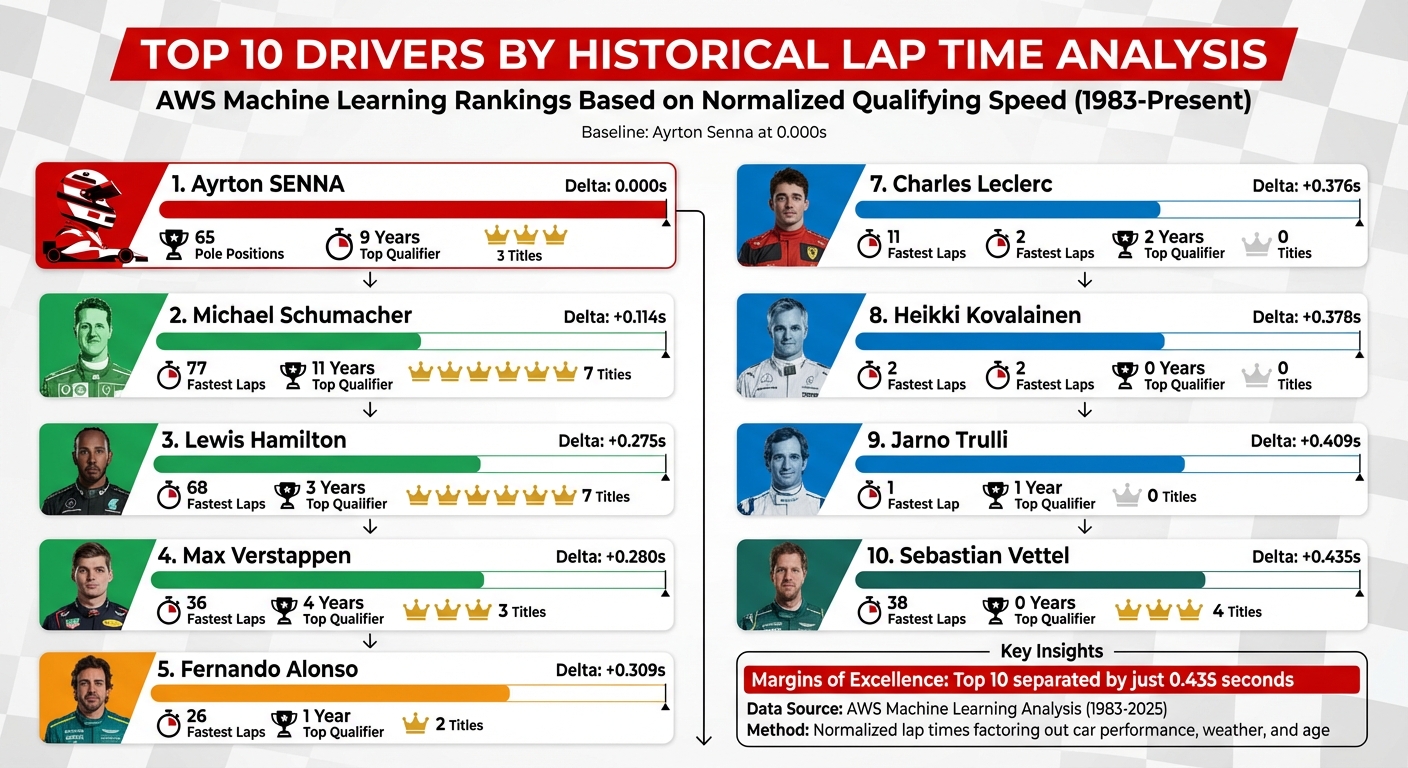
Formula 1 has always debated the "fastest" drivers, especially across different eras. Using machine learning, Amazon Web Services (AWS) analyzed historical lap times since 1983 to rank drivers based on raw qualifying speed, factoring out car performance. Ayrton Senna leads the list, with Michael Schumacher and Lewis Hamilton following closely. Here's the top 10:
- Ayrton Senna: Normalized delta of 0.000s, 65 pole positions, unmatched qualifying dominance (1985–1993).
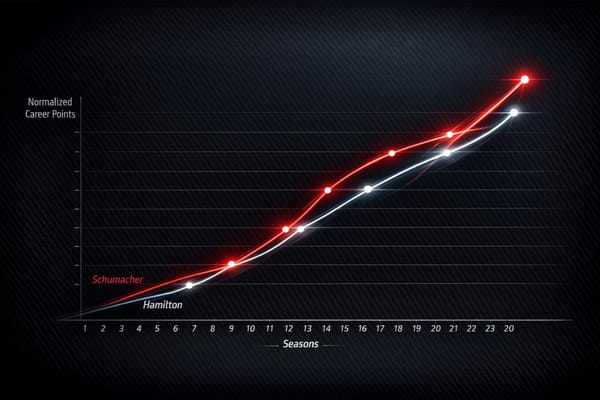
- Michael Schumacher: +0.114s, 77 fastest laps, 11 seasons as top qualifier.
- Lewis Hamilton: +0.275s, 68 fastest laps, record-breaking consistency over 18 seasons.
- Max Verstappen: +0.280s, 36 fastest laps, fastest-ever F1 lap at Monza in 2025.
- Fernando Alonso: +0.309s, 26 fastest laps, excels in races over qualifying.
- Nico Rosberg: +0.374s, 20 fastest laps, 2016 champion with consistent qualifying.
- Charles Leclerc: +0.376s, 11 fastest laps, known for raw single-lap speed.
- Heikki Kovalainen: +0.378s, strong qualifying against elite teammates.
- Jarno Trulli: +0.409s, 1 fastest lap, renowned for single-lap brilliance.
- Sebastian Vettel: +0.435s, 38 fastest laps, dominated during Red Bull's V8 era.
Key Takeaways:
- Senna remains the gold standard for qualifying speed, with Schumacher and Hamilton excelling in both qualifying and race-day performance.
- Modern drivers like Verstappen and Leclerc show how close today's competition is, with gaps measured in fractions of a second.
- AWS's machine learning model isolates driver skill by analyzing teammate comparisons, adjusting for factors like car performance, weather, and driver age.
This data-driven analysis offers a fresh perspective on Formula 1's all-time greats, highlighting their raw speed and consistency across decades.
Top 10 F1 Drivers Ranked by Historical Lap Time Analysis
The Fastest Lap In F1 History: Max Verstappen's Pole Lap | 2025 Italian Grand Prix | Pirelli
1. Ayrton Senna
Ayrton Senna tops the AWS machine learning rankings with a normalized time delta of 0.000 seconds, 65 pole positions, and an incredible streak of nine consecutive years (1985–1993) as the fastest qualifier.
Senna's era predates the widespread use of advanced telemetry, which meant his teammates often lacked the detailed data to analyze where he was gaining time. As Mark Hughes of The Race pointed out:
"the pre-telemetry part of Senna's career shows some enormous offsets, way bigger than would be the case in later years when team-mates were able to study telemetry and identify where the laptime was being won and lost".
This lack of technology often resulted in Senna outpacing his teammates by margins exceeding 0.5 seconds - a rare feat in modern Formula 1 competition.
What truly sets Senna apart is his ability to dominate across different car technologies. From the turbocharged beasts of the mid-1980s to the high-downforce, naturally aspirated cars of the early 1990s, he consistently delivered peak performance. This adaptability underscores the accuracy of the normalized lap time model in highlighting genuine driver skill.
The stats reinforce his reputation as a qualifying master. Senna achieved a 25.5% race win rate over 161 Grand Prix entries. Even more impressively, he is one of only two drivers in the analysis - alongside Charles Leclerc - to outqualify every single teammate over the course of his career. While his three World Championship titles and 41 race wins are remarkable achievements, it’s the normalized lap time analysis that truly captures his unmatched single-lap speed. This data solidifies Senna's position as the ultimate standard for qualifying brilliance.
2. Michael Schumacher
Michael Schumacher takes the second spot in the AWS machine learning analysis, with a normalized time delta of 0.114 seconds behind Ayrton Senna. This data-driven insight highlights his remarkable skill in qualifying, further supported by his career record of 77 fastest laps. Such achievements provide a solid foundation for understanding the longevity and progression of his performance.
From 1994 to 2002, Schumacher dominated as Formula 1's top qualifier for an impressive 11 years, with additional standout seasons in 2004 and 2005. His ability to remain at the top through the V10 and V8 engine eras demonstrates his consistent excellence and adaptability. During his initial career, spanning 1991 to 2006, Schumacher consistently delivered peak performance, navigating shifts in engine regulations and maximizing the potential of his machinery.
The analysis pinpoints 1996 as Schumacher's standout season. That year, he drove the underperforming Ferrari 310 against the championship-winning Williams cars, yet his ability to push the car beyond its limits was extraordinary. His absolute peak came in 2001, when his personal performance perfectly aligned with race results, showcasing his unparalleled synergy with the car.
The data also reflects a noticeable decline during Schumacher's Mercedes comeback from 2010 to 2012. While he remained competitive - ranking as the second-fastest driver in 2012 in some qualifying models - he was consistently outqualified by teammate Nico Rosberg throughout those three seasons. This stark contrast between his dominant first career and his solid yet less impactful return underscores how normalized lap time analysis effectively captures the evolution of a driver's performance over time.
Schumacher's brilliance wasn't limited to qualifying; his race-day execution was equally formidable. His ability to dominate across different teams, such as Benetton and Ferrari, and adapt through major technological shifts cements his legacy as one of the fastest and most versatile drivers in Formula 1 history.
3. Lewis Hamilton
Lewis Hamilton takes third place with a normalized delta of 0.275 seconds behind Ayrton Senna. This puts him a razor-thin 0.005 seconds ahead of Max Verstappen in fourth, highlighting just how evenly matched today's top drivers are when it comes to raw qualifying speed. It's this kind of precision that underscores Hamilton's record-breaking career.
Hamilton has clocked 68 fastest laps and holds the record for achieving fastest laps across 18 seasons.
What truly sets Hamilton apart is his consistency across different eras of car development. Mathematical models rank him as the best qualifier in 2009, 2012, and 2013, even though he didn’t clinch the championship in those years. His debut season in 2007 saw him outqualify teammate Fernando Alonso - an achievement matched only by Max Verstappen's debut against Daniel Ricciardo in 2015.
Hamilton's normalized qualifying pace is even more impressive considering the caliber of his teammates. He has competed against some of the strongest names in F1, including Alonso, Jenson Button, Nico Rosberg, and George Russell. Notably, he maintained a better qualifying record than Rosberg, who had previously outperformed Michael Schumacher during their time as teammates.
Unlike drivers who excel in either qualifying or race pace, Hamilton stands out as a balanced competitor, delivering top-tier performances in both. Even as he approaches his late 30s, his normalized lap time data shows no significant drop-off, defying the usual decline seen in aging drivers. With 7 World Championships (tying Michael Schumacher) and fastest laps at 27 different circuits - the most in F1 history - Hamilton's adaptability from the V8 era to the V6 Hybrid era cements his place among the sport's all-time greats.
4. Max Verstappen
Max Verstappen secures the fourth spot with a normalized delta of 0.280 seconds, just 0.005 seconds behind Lewis Hamilton, who ranks third. That tiny fraction of a second highlights the razor-thin margins that define elite competition. When you consider how mere hundredths of a second separate legends across different eras, it’s clear you’re looking at the absolute peak of driving precision.
What sets Verstappen apart is his steady trajectory of improvement throughout his career. Advanced mathematical models place him among the top drivers on the grid, with his performances in the 2023 and 2024 seasons breaking new ground. In September 2025, Verstappen etched his name in history by setting the fastest-ever F1 lap at Monza, clocking an average speed of 264.681 km/h (164.447 mph) and shattering the previous record.
Consistency is another hallmark of Verstappen’s career. He ranks sixth all-time in total fastest laps, with 36 to his name, translating to a 15.45% success rate. Verstappen has also been recognized as the top qualifying performer in four separate years: 2015, 2017, 2019, and 2023. Impressively, he and Lewis Hamilton are the only drivers to be ranked as the fastest qualifier in their rookie seasons, a testament to Verstappen’s exceptional speed right from the start.
Experts frequently emphasize his skill:
"Holding a high average over the course of a lap is assuredly the mark of a great driver in a quick car." - Stuart Codling, Journalist
What’s particularly striking about Verstappen is his ability to excel in both qualifying and race conditions. Unlike some drivers who shine in one area, Verstappen’s balanced skill set makes him a formidable competitor across the board. His consistent domination over teammates like Pierre Gasly, Alexander Albon, and Sergio Pérez underscores the challenges modern drivers face in narrowing performance gaps. All in all, Verstappen’s well-rounded brilliance reinforces the reliability of the normalized lap time framework when comparing drivers across different eras.
5. Fernando Alonso
Fernando Alonso takes the fifth spot with a normalized delta of 0.309 seconds - just 0.029 seconds slower than Max Verstappen. That razor-thin margin underscores the precision required at the elite level of Formula 1. Alonso’s enduring career and ability to adapt have been key to his success, even as the sport’s technical landscape has evolved.
According to Amazon Web Services' machine learning analysis, Alonso is one of only six drivers in F1 history to set a new "all-time high" for season performance ratings. He shares this distinction with legends like Juan Manuel Fangio, Alberto Ascari, Alain Prost, Michael Schumacher, and Max Verstappen. From 2007 to 2014, performance models consistently rated him as the best driver on the grid. His 2012 season with Ferrari is particularly memorable - despite driving a car that often wasn’t the fastest, he remained a strong contender for the championship.
What truly sets Alonso apart is his race-day brilliance. Known as a "racing specialist", his ability to score points and deliver results during races often surpasses his qualifying performance. As F1-Analysis.com explains:
"Alonso has one of the largest preferences towards races over qualifying of any driver. On the current grid, it is unique among top talents."
Though he was rated as the top qualifier for only one season, Alonso stood out as the top-performing driver overall in seven seasons: 2003, 2004, 2005, 2006, 2007, 2010, and 2012. This achievement places him in rare company, alongside icons like Michael Schumacher. Over his career, Alonso has recorded 26 fastest laps while driving for four different teams - Renault, McLaren, Ferrari, and Aston Martin - and consistently outshone highly skilled teammates, earning him ninth place on the all-time list.
Even during the tough McLaren-Honda years (2015–2018), when reliability issues plagued the team, Alonso’s performance ratings remained well above the grid average. Since his return to F1, his ratings have continued to exceed the grid average, showcasing his remarkable consistency over two decades. This sustained excellence secures Alonso’s legacy as one of Formula 1’s all-time greats.
6. Nico Rosberg
Nico Rosberg takes the sixth spot with a normalized delta of 0.374 seconds, marking him as one of the quickest drivers in Formula 1 over the past four decades. His career was defined by an extraordinary ability to deliver consistent performances during qualifying sessions - a skill that set him apart in the sport's history.
Rosberg's reputation as a qualifying expert is well-earned. He claimed top qualifier honors in five separate seasons (2007, 2008, 2010, 2011, and 2014) and impressively started every race from the front row during his 2016 championship-winning season. Notably, he thrived in head-to-head battles with fierce competitors like Lewis Hamilton. As pointed out by F1-Analysis:
"Rosberg edges out Hamilton as the best qualifier of this era overall... In qualifying they were closely matched. The stats indicate that Hamilton may have held a small edge in raw pace, with Rosberg being more consistent."
Throughout his career, Rosberg achieved 20 fastest laps, placing him 15th on the all-time leaderboard. In 2016 alone, he set the fastest lap in six races, earning the prestigious DHL Fastest Lap Award. Despite this, mathematical models ranked him sixth that season, making him one of only two world champions since 1980 - alongside Mika Häkkinen in 1999 - to finish outside the top five in the standings.
This highlights an important takeaway: while Hamilton may have had a slight advantage in outright speed, Rosberg's methodical approach to qualifying and his remarkable consistency were the cornerstones of his success. These qualities ultimately played a pivotal role in securing his world championship.
7. Charles Leclerc
Charles Leclerc secures seventh place in our historical lap time analysis, with a normalized delta of 0.376 seconds - just 0.002 seconds shy of Nico Rosberg and ahead of Sebastian Vettel, who recorded a delta of 0.435 seconds. This razor-thin difference underscores the intense competition at the pinnacle of Formula 1.
Leclerc has earned a reputation as a standout in qualifying sessions. Mathematical models identified him as the fastest qualifier on the grid in both 2018 and 2020. His 2020 season, in particular, was extraordinary. Despite Ferrari's struggles that year, Leclerc consistently outpaced teammate Sebastian Vettel by an impressive margin of around 0.5 seconds.
This exceptional qualifying ability makes him a formidable opponent in head-to-head battles with top drivers. While Max Verstappen currently leads in overall race performance, models suggest that Leclerc is his closest challenger when it comes to raw single-lap speed. Projections also indicate that Leclerc is likely to outqualify Lewis Hamilton during their 2025 season with Ferrari. With 11 fastest laps to his name through the 2025 Abu Dhabi Grand Prix, Leclerc continues to prove his consistency as one of the sport's elite qualifiers.
His seamless transition from Sauber to Ferrari further solidifies his status as one of Formula 1's fastest drivers over a single lap.
8. Heikki Kovalainen
Heikki Kovalainen lands in the eighth spot with a normalized delta of 0.378 seconds - just a hair behind Charles Leclerc (0.376 seconds) and ahead of Jarno Trulli (0.409 seconds). This ranking might raise a few eyebrows, especially since he outranks not only four-time world champion Sebastian Vettel but also Alain Prost, who sits in 20th place.
What earns the Finnish driver such a high position? It all comes down to his exceptional qualifying performances, particularly when matched against top-tier teammates. During his two seasons with McLaren (2008–2009), Kovalainen managed to keep his time gaps to Lewis Hamilton - who's ranked third on this list - remarkably small. F1 journalist Mark Hughes highlighted this achievement:
"Heikki Kovalainen – presumably on the basis of his relatively small qualifying deficits to Lewis Hamilton as a team-mate and close comparison with Jarno Trulli – [is] in at number 8 in this latest list."
This level of detail underscores how the AWS algorithm brings out nuances in driver performance that might otherwise go unnoticed.
Kovalainen stands out as a qualifying specialist rather than a well-rounded racer. During his career, he clocked two fastest laps, both in 2008, at the Australian and Bahrain Grands Prix. His Saturday prowess was particularly evident during his time at Caterham, where he regularly outpaced Trulli, a driver known for his own single-lap speed. His story is a prime example of how data-driven analysis can shine a spotlight on drivers whose careers might not have been as celebrated.
Thanks to advanced telemetry, Kovalainen was able to close the gap to his quicker teammates. These tools gave him the ability to dissect his laps, pinpointing where time was gained or lost, and helped him stay competitive against some of the best in the field.
9. Jarno Trulli
Jarno Trulli lands in ninth place with a normalized delta of 0.409 seconds, showcasing his incredible ability to deliver blistering single-lap speeds. While his career stats may not jump off the page, this analysis sheds light on what set the Italian driver apart. Trulli's performance underscores how raw qualifying speed can outshine overall career achievements.
In fact, an AWS-powered machine learning model determined that Trulli was the fastest qualifier on the grid during the 2003 season, even outperforming legends like Michael Schumacher and Fernando Alonso. Notably, Trulli is among the rare drivers to have outqualified Fernando Alonso across an entire season.
Throughout his career, whether driving for Renault or Toyota, Trulli consistently delivered standout qualifying performances. He often secured front-row starts, even when his race-day results didn’t quite match his Saturday brilliance. As Rob Smedley, Director of Data Systems for Formula 1, put it:
"A qualifying lap is a single lap, you've got two guys in the same car and they go out and do a single lap, and the better driver will end up with the better lap. There's not much ambiguity about that single data point."
Trulli’s ability to extract the absolute maximum from a single lap remains a testament to his skill, making him one of the most formidable qualifiers in the sport.
10. Sebastian Vettel
Sebastian Vettel secures the 10th spot with a normalized delta of 0.435 seconds behind Ayrton Senna. While this might suggest a gap in raw speed, Vettel's position reflects his dominance during specific periods of his career. As a four-time world champion, his success was particularly evident during Red Bull's high-downforce V8 era, where he was ranked second in 2011 and 2013.
Throughout his career, Vettel achieved 38 fastest laps, which translates to a 12.71% success rate during his stints with Red Bull and Ferrari. Statistical models analyzing the 2007–2016 period place him as the third-fastest qualifier of that era, just behind Nico Rosberg and Lewis Hamilton.
However, Vettel's performance occasionally faltered during major transitions. For instance, the shift to the hybrid era in 2014 saw him outqualified and outscored by teammate Daniel Ricciardo. His final years at Ferrari were equally challenging. While he held his own against Charles Leclerc in 2019, his performance in 2020 took a significant hit after learning his contract would not be renewed. Mark Hughes of The Race commented on this sudden decline:
"There is no way Vettel suddenly lost around half-second in ability between one season and the next. But the numbers paint that misleading picture."
Though Vettel never claimed the title of top qualifier in a season, his career highlights the limitations of focusing solely on raw qualifying speed. His ability to extract the most from his car during one of Formula 1's most aerodynamically complex periods showcases his skill and technical understanding of the sport.
Performance Comparison Table
Building on earlier analysis, this table highlights normalized metrics that compare each driver's performance across different eras. The AWS Lap Time Delta uses Ayrton Senna as the baseline at 0.000s.
| Driver | AWS Lap Time Delta | Career Fastest Laps | Fastest Lap Rate | Years as Top Qualifier | Championship Titles | Performance Profile |
|---|---|---|---|---|---|---|
| Ayrton Senna | 0.000s | 19 | N/A | 9 | 3 | Qualifying Specialist |
| Michael Schumacher | +0.114s | 77 | 25.08% | 11 | 7 | Even Split |
| Lewis Hamilton | +0.275s | 68 | 17.89% | 3 | 7 | Even Split |
| Max Verstappen | +0.280s | 36 | 20.60% | 4 | 3 | Even Split |
| Fernando Alonso | +0.309s | 26 | N/A | 1 | 2 | Racing Specialist |
| Nico Rosberg | +0.374s | 20 | 6.0% | 5 | 1 | Qualifying Specialist |
| Charles Leclerc | +0.376s | 10+ | N/A | 2 | 0 | Qualifying Specialist |
| Heikki Kovalainen | +0.378s | 2 | N/A | 0 | 0 | Qualifying Specialist |
| Jarno Trulli | +0.409s | 1 | N/A | 1 | 0 | Qualifying Specialist |
| Sebastian Vettel | +0.435s | 38 | 12.71% | 0 | 4 | Even Split |
This table provides a structured way to evaluate driver performance based on key metrics.
Michael Schumacher's numbers stand out, showcasing his dominance in both qualifying and race-day execution. With 11 seasons as the top qualifier (spanning 1994–2002 and 2004–2005) and a record 77 fastest laps, Schumacher's "Even Split" profile reflects his ability to consistently deliver across all aspects of racing.
The Performance Profile column highlights the distinct strengths of each driver. For example, Senna, Rosberg, and Leclerc shine as "Qualifying Specialists", excelling in one-lap pace. On the other hand, Fernando Alonso's "Racing Specialist" designation emphasizes his knack for extracting exceptional results during races, even when his qualifying stats don't lead the pack.
Heikki Kovalainen's placement in the table is noteworthy. Despite limited career highlights, his minimal time deficits to Lewis Hamilton during their McLaren years underline his impressive one-lap speed, regardless of overall race outcomes. Meanwhile, Jarno Trulli's data serves as a reminder that raw qualifying pace doesn't always translate to championship success. Trulli, for instance, outqualified Alonso consistently but never secured a title.
Conclusion
Historical lap data provides a fascinating lens through which to evaluate driver performance, offering insights that go beyond championship tallies. Take Michael Schumacher and Lewis Hamilton, for example - both boast seven world titles, yet the numbers reveal a subtle difference. Schumacher trailed Ayrton Senna by just 0.114 seconds in normalized lap times, while Hamilton followed behind. This gap sheds light on their unique driving styles: Senna's unrivaled one-lap mastery, Schumacher's versatility and dominance - evident in his record 77 fastest laps - and Hamilton's extraordinary consistency.
These fractions of a second also highlight the ever-evolving nature of Formula 1 technology. The introduction of telemetry systems revolutionized qualifying sessions, enabling teams to dissect lap times with precision, a luxury unavailable during Senna's era. Experts agree that with today's advanced telemetry, gaining even a 0.5-second edge has become a monumental challenge.
As we analyze the past to understand the present, it's clear that historical data plays a key role in shaping our view of driver excellence. Normalized lap time data not only supports the profiles outlined in our rankings but also reflects the broader evolution of Formula 1. Another trend emerges: the improvement in grid quality since 1970, making it harder for any driver to dominate qualifying year after year, as Senna and Schumacher once did. Meanwhile, Max Verstappen's record-setting 2023 season illustrates how modern drivers are pushing limits in ways previous generations could only dream of - even if the time gaps between competitors seem smaller.
For a deeper dive into race strategies, technical advancements, and driver performance metrics, check out F1 Briefing.
FAQs
How does AWS machine learning separate driver skill from car performance in F1 analysis?
AWS employs a machine-learning model to dive deep into lap-time data, comparing drivers' performances against their teammates. By analyzing drivers in the same car, on the same track, and under identical conditions, the model hones in on driver skill, separating it from the car's performance.
To ensure accuracy, the model filters out outliers - laps impacted by weather, technical problems, or other anomalies. It also accounts for variables like fuel load, tire types, and track-specific nuances. From this, a driver-skill factor is calculated, highlighting a driver's consistent edge over their teammate. Simultaneously, a car-performance factor is determined, representing the shared speed potential of the car. This approach provides a clear and fair assessment of a driver's ability, independent of the car's capabilities.
Why is Ayrton Senna often regarded as the fastest qualifier in F1 history?
Ayrton Senna is often regarded as the fastest qualifier in Formula One history, a reputation built on his extraordinary precision and blistering speed. Decades of qualifying data, meticulously analyzed and adjusted for variables like car performance and teammate comparisons, consistently place him at the top of the list. His record of 65 pole positions during his career stands as a testament to his dominance in this aspect of the sport.
What truly set Senna apart was his ability to push his car to its absolute limits, often delivering flawless laps under intense pressure. This rare combination of skill and mental fortitude has made his qualifying performances legendary, serving as an enduring standard for drivers across generations.
Why are lap time differences among modern F1 drivers so small?
Modern Formula 1 drivers often clock lap times separated by just fractions of a second, thanks to cutting-edge technology and tightly enforced regulations. Rules around aerodynamics, power units, and tires have leveled the playing field, ensuring cars perform at similar levels. This creates an environment where even the smallest edge can make a difference.
Drivers also benefit from shared telemetry data and advanced simulations, which help them refine their techniques and reduce inconsistencies. On top of that, data analysis adjusts for variables like fuel loads, ensuring lap times are compared under fair conditions. These tools and adjustments expose the true skill differences between drivers - differences that are often razor-thin. With these advancements and stricter rules, Formula 1 has never been more competitive.