Ultimate Guide to F1 Aerodynamics and Suspension
How F1 aerodynamics and suspension work together to control ride height, cure porpoising, and exploit 2026 active-aero rules.
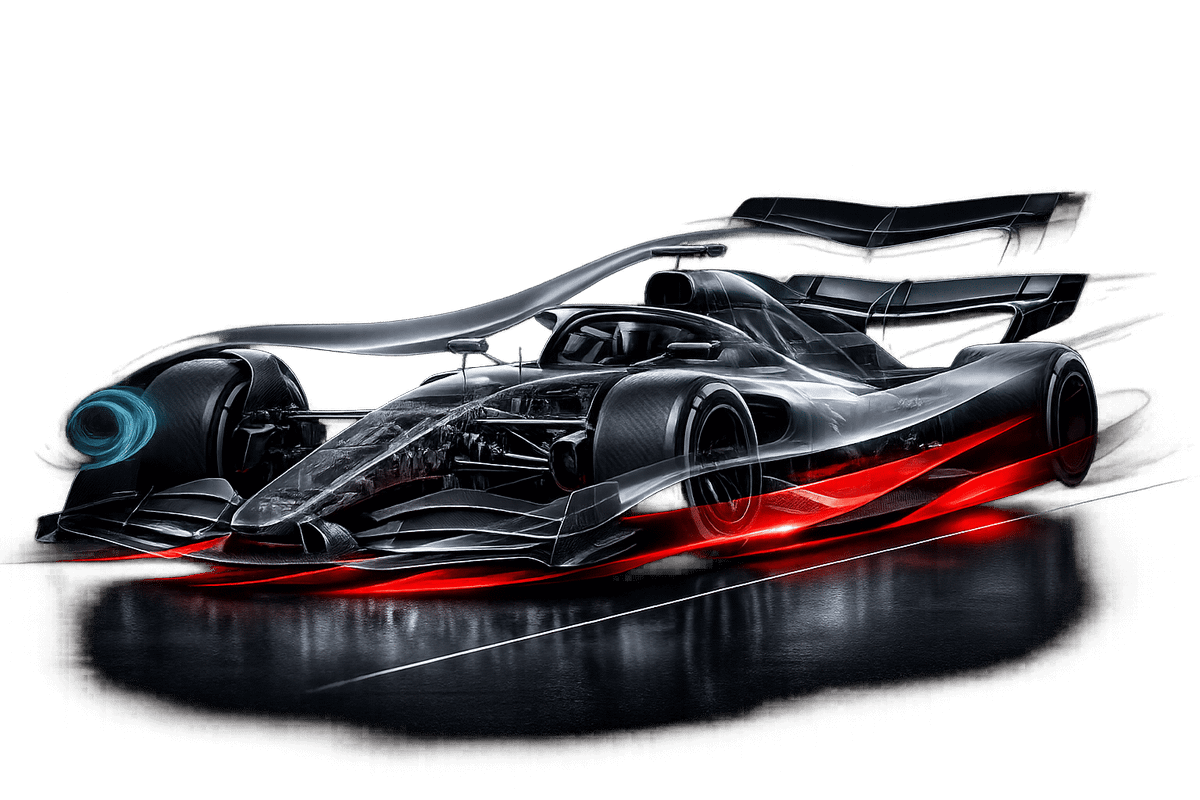
In Formula 1, aerodynamics and suspension are the secret weapons behind every race-winning car. These two systems work together to keep cars fast, stable, and glued to the track. Here’s the key takeaway: the suspension doesn’t just absorb bumps - it ensures the car stays at the perfect height for maximum downforce, while aerodynamics keeps drag low and grip high.
Why this matters:
- Ride height precision: Even a few millimeters off can ruin airflow and reduce grip.
- 2026 changes: New active aerodynamics (moveable wings) and stricter regulations demand smarter suspension setups.
- Ground effect dominance: The car’s floor creates most of the downforce, but it’s highly sensitive to changes in height, pitch, and roll.
This guide explains how F1 teams design and fine-tune these systems to handle challenges like porpoising, high-speed stability, and adapting to different tracks. From heave springs to active wings, every detail is engineered for performance.
If you’re curious about how suspension and aerodynamics shape F1 success, keep reading for a breakdown of the tools, strategies, and 2026 updates reshaping the sport.
F1 Aerodynamics and Suspension: Core Concepts
Key Aerodynamic Principles
In Formula 1, aerodynamics is all about finding the right balance between downforce and drag. Downforce pushes the car into the track, increasing grip without adding weight, while drag is the air resistance that slows the car down. The trick lies in maximizing downforce without generating too much drag, as every design tweak involves a trade-off between the two.
The modern era of F1 relies heavily on ground effect to generate downforce. By shaping the car's floor into Venturi tunnels, teams create a low-pressure area underneath the car, effectively pulling it closer to the track. This method is far more efficient than using wings alone. However, this system is incredibly sensitive to factors like ride height, pitch, and roll. Even a tiny change - just a few millimeters - can disrupt airflow under the car, causing a sudden loss of grip.
One of the most exciting changes in the upcoming 2026 regulations is the improvement in wake management. Following cars will retain around 90% of their downforce at a distance of 65 feet (20 meters) behind another car, a significant improvement over the roughly 70% retention seen under previous rules.
These aerodynamic demands influence every aspect of a car's setup, especially the suspension systems that ensure the car maintains optimal performance.
How F1 Suspension Works
The suspension in an F1 car is designed specifically to meet the demands of aerodynamics. Unlike traditional road cars, every F1 team employs a double-wishbone setup at each wheel. This design uses two triangular arms to precisely control the wheel's movement, allowing engineers to fine-tune essential parameters like camber angles, roll centers, and resistance to pitch under braking or acceleration.
Instead of conventional coil springs, F1 cars use torsion bars, which save space while performing the same function. The suspension also features advanced dampers with separate circuits to handle different types of movement: low-speed adjustments for chassis pitch and roll, and high-speed adjustments for absorbing sharp impacts. A heave spring, positioned between the left and right suspension, manages vertical movement and nose pitch independently of cornering forces. This ensures the car's floor remains at the ideal height to generate maximum downforce.
The choice between push-rod and pull-rod suspension configurations also plays a role. Push-rods are typically used at the front for easier packaging, while pull-rods are favored at the rear to lower the center of gravity and improve airflow to the diffuser.
How Aerodynamics and Suspension Affect Each Other
Aerodynamics and suspension are deeply interconnected, and their relationship is crucial for maintaining peak performance. The suspension's primary job is to keep the car's floor in the narrow range where ground effect is most effective. If the floor is too high, downforce drops off; if it's too low, the car risks bottoming out or experiencing porpoising.
As sports writer Dominika Jordan explains:
"Mechanical grip isn't separate from aero grip - it enables it. If the tires can't follow the road, you never build the energy in the floor and wings."
To stabilize the car's ride height, teams use anti-dive geometry at the front and anti-squat geometry at the rear. These setups resist pitch during braking and acceleration, keeping the floor steady. Anti-roll bars connect the left and right sides of the car, reducing lateral lean in corners while preserving the vertical stiffness needed for ground effect.
Every element of the suspension - spring rates, damper settings, and geometry - is designed with one goal in mind: to keep the car operating within its aerodynamic sweet spot, lap after lap.
sbb-itb-7c68254
Major Components and How They Work Together
Front Wing and Front Suspension
The front wing plays a dual role: it generates downforce and directs airflow to key areas like the floor, sidepods, and rear of the car. However, this effectiveness depends on the front suspension maintaining the wing's height above the track.
To achieve this, engineers use anti-dive geometry, which prevents the nose from dropping too much during heavy braking. This ensures the front wing doesn't get too close to the ground, which could disrupt airflow to the underfloor. Adjustments to caster angles, Ackermann geometry, and toe angles also help sharpen steering and stabilize the car when entering corners, further protecting the floor's ability to generate downforce.
The 2026 regulations introduce a game-changer: an active front wing. Unlike the static setups of the past, this two-element flap can automatically switch between "Corner Mode" for added downforce and "Straight Mode" to reduce drag. Mercedes Deputy Technical Director Simone Resta highlighted its importance:
"It's going to be quite different... every driver will be running moveable front and rear wings together, at many points in the lap, and they will be using the energy to help overtaking."
Additionally, the 2026 front wing is 100mm narrower than its 2022–2025 counterpart, which impacts how tire wake is managed and how much air reaches the underfloor. This narrower design works in tandem with advanced underfloor structures to maintain optimal downforce generation.
Underfloor Tunnels and Heave Control
The underbody of the car remains a critical area for performance. Venturi tunnels in the underfloor create a low-pressure zone, effectively pulling the car closer to the track to generate downforce. This effect, though powerful, depends on maintaining a precise ride height window. If the floor is too high, suction weakens; too low, and the car risks bottoming out or triggering porpoising.
This is where the heave spring comes into play. Positioned between the left and right suspension, it manages vertical movement and pitch without being affected by cornering forces. As sports writer Dominika Jordan explains:
"In the current ground-effect era, heave and pitch control are king. If you can keep the car's vertical dance tidy without beating up the tires, you get the best of both worlds - monster aero grip at speed, real mechanical grip when the wings go to sleep."
To further stabilize the car, teams employ rising-rate suspension systems that stiffen as compression increases. This setup prevents the floor from hitting the bump stops at high speeds while keeping the car flexible enough for slower corners. The 2026 rules aim to simplify underfloor designs, making them less sensitive and allowing cars to run slightly higher off the ground. Former Williams engineer Sammy Diasinos remarked:
"The floor has to be much simpler relative to the previous generation cars, which had hugely complex floors that generated a lot of downforce by having a carefully contoured floor very close to the ground."
Rear Wing, Diffuser, and Rear Suspension
The rear of the car combines the diffuser, wing, and suspension into a cohesive system. The diffuser accelerates air exiting from under the floor, creating suction that enhances downforce, while the rear wing adds additional aerodynamic grip. Together, they ensure the car remains balanced and efficient throughout a lap.
Pull-rod rear suspension is favored in this era because it allows for a lower rear deck and gearbox casing, improving airflow to the diffuser. Engineers also use anti-squat geometry, which angles the rear wishbones to resist squatting under acceleration. This prevents the diffuser from "choking" when the driver applies throttle out of a corner, ensuring consistent airflow.
An interesting example from the 2026 pre-season came during Ferrari's Bahrain testing in February. They introduced a "flow turning device" behind the exhaust on their SF-26. By positioning the differential 60mm behind the rear axle (the maximum allowed) and using steeply angled driveshafts, they created space for a vane that directed airflow from the diffuser to the underside of the rear wing. This clever design increased rear downforce without requiring a larger wing.
The 2026 regulations also remove the beam wing and replace the traditional DRS with a three-element active rear wing. Below is a comparison of the rear aero package across regulation eras:
| Feature | 2022–2025 Era | 2026 Era |
|---|---|---|
| Rear Wing | Static (with DRS) | Active, 3-element |
| Beam Wing | Present | Removed |
| Downforce Level | High (ground-effect focus) | ~30% reduction |
| Drag Level | High | ~55% reduction |
| Rear Suspension Style | Pull-rod | Pull-rod (optimized for active aero) |
How Teams Develop and Refine Aero-Suspension Integration
Design Tools: CFD, Wind Tunnels, and Simulation
Balancing suspension compliance with aerodynamic rigidity is one of the most complex challenges teams face, and they rely heavily on tools like CFD, wind tunnels, and simulations to get it right. These tools help protect the critical floor-to-track gap where ground-effect suction is at its peak, while refining suspension geometries to maintain a consistent ride height during braking and acceleration.
The 2026 regulations have added even more challenges. With active front and rear wings switching between "corner mode" and "straight-line mode" during a lap, teams now simulate dynamic aero loads to ensure the suspension can handle sudden shifts in downforce without destabilizing the car. Additionally, the reduction in maximum wheelbase from 141.7 inches (3,600 mm) to 133.9 inches (3,400 mm) has pushed teams to repackage heavier power units while maintaining aerodynamic performance. All of this happens in simulations before any manufacturing begins.
These simulations are not just theoretical - they form the foundation for real-time adjustments that teams make throughout the season to adapt to different track conditions.
In-Season Setup Changes
Once the cars hit the track, the focus shifts from design to execution. Engineers tweak both suspension and aerodynamics during race weekends to suit specific track layouts and surface conditions.
One key tool for in-season tuning is the heave spring. Stiffening it stabilizes the ride height at high speeds, which is essential at circuits like Silverstone or Suzuka, where cars frequently exceed 155 mph (250 km/h). On the other hand, at a track like Monaco, teams soften the springs and anti-roll bars to prioritize mechanical grip and kerb compliance, even if it compromises aerodynamic stability.
Here’s a breakdown of how setup priorities vary across circuits:
| Track Type | Suspension Priority | Aerodynamic Priority | Key Adjustment |
|---|---|---|---|
| Street Circuit (Monaco) | High compliance | Secondary to mechanical grip | Lower ARB stiffness; softer dampers |
| High-Speed (Silverstone) | High platform discipline | Maximum stability for high-G | High heave stiffness; aggressive camber |
| Low-Drag (Monza) | Stiff platform | Efficiency on straights | Tuned high-speed damping for chicanes |
| Mixed/Bumpy (Austin) | Compromise/Compliance | Consistent ride height | Careful bump stop/packer engagement |
Suspension tuning involves more than just springs. Low-speed damping controls how the car handles during braking and cornering, while high-speed damping absorbs impacts from kerbs and bumps. Anti-roll bars are another quick adjustment tool, allowing engineers to shift the car’s balance toward understeer or oversteer between sessions.
While these tweaks are crucial for race-day performance, they are guided by broader design philosophies that shape how teams approach aero-suspension integration over an entire season.
Team Design Philosophies
Teams use a mix of simulation data and race-day insights to refine their design philosophies, and the 2026 regulations have highlighted their differing approaches. For instance, Mercedes, Ferrari, and Red Bull have all chosen to maximize the new 133.9-inch (3,400 mm) wheelbase limit to increase floor area and generate more downforce. McLaren, however, opted for a wheelbase about 4 inches (10 cm) shorter to save weight and improve agility, even though it sacrifices some floor area for downforce.
Former Renault engineer Chris Papadopoulos summed up the competitive landscape:
"This is now the most high-stakes, high-technology game of people trying to outdo each other."
Teams also differ in how they channel air to the underfloor. Mercedes attaches the nose to the middle element of the front wing to boost airflow to the underfloor, while Ferrari and most others connect it to the bottom main plane. Ferrari’s approach focuses on mechanical packaging to unlock aerodynamic performance, as seen in their differential placement during 2026 Bahrain testing. Meanwhile, Mercedes has prioritized energy efficiency, with drivers like George Russell and Kimi Antonelli braking earlier to recharge the battery and deploy that energy for stronger exits out of corners.
As sports writer Dominika Jordan put it:
"The suspension is the hinge between these worlds, and the best cars make both happy most of the time."
There’s no single correct approach. What sets the top teams apart is how well their strategies - whether aero-focused, mechanically innovative, or weight-conscious - perform across a season filled with diverse challenges.
Exploring 2022 F1 Car Suspension | F1 TV Tech Talk | Crypto.com

Challenges and What Comes Next
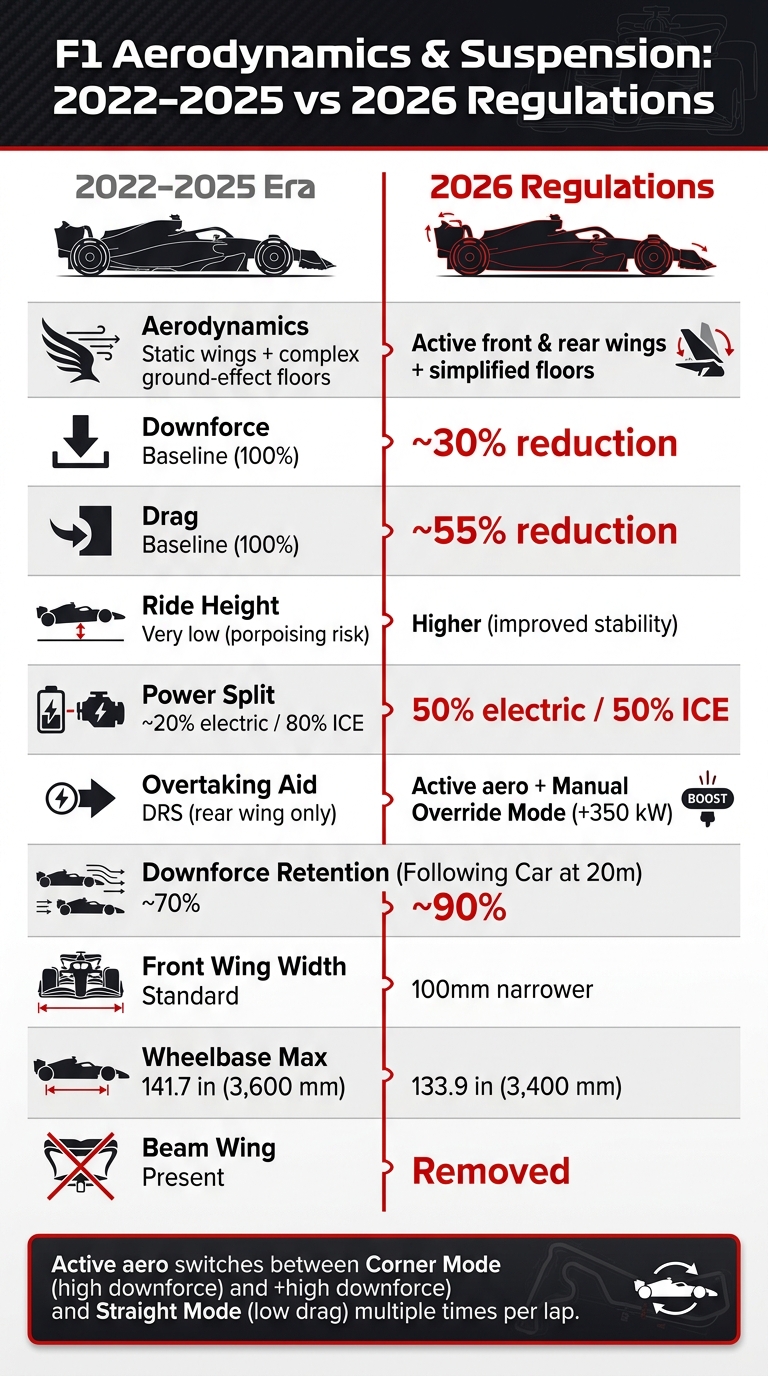
F1 2022–2025 vs 2026 Regulations: Aero & Suspension Changes
Porpoising and Ride Stability
Porpoising continues to be one of the toughest challenges in ground-effect Formula 1 cars. This phenomenon occurs when a car's floor generates excessive suction at a certain ride height, causing the car to suddenly drop, disrupt airflow, bounce back up, and repeat the cycle. The result? A violent oscillation that not only leaves drivers physically drained but also wrecks lap times.
The 2026 regulations aim to tackle this by requiring cars to run at higher ride heights and adopt simpler floor designs. Former Williams engineer Sammy Diasinos explained:
"The floor has to be much simpler relative to the previous generation cars, which had hugely complex floors that generated a lot of downforce by having a carefully contoured floor very close to the ground."
Even with these changes, teams still face the challenge of managing residual oscillations. They achieve this through high heave stiffness and finely tuned damping strategies. The trick is to eliminate the bounce without making the car so rigid that it struggles over kerbs, which would hurt both performance and driver comfort. These adjustments pave the way for further aerodynamic developments, as detailed in the next section.
Emerging Design and Regulation Trends
The 2026 regulations also bring significant changes to aerodynamics, addressing both performance and racing dynamics. One of the standout features is the introduction of active aerodynamics. Unlike the traditional DRS system, which only affected the rear wing for trailing cars, the new system adjusts both front and rear wings simultaneously. Drivers will switch between "Straight Mode" (low drag) and "Corner Mode" (high downforce) multiple times per lap. Mercedes Deputy Technical Director Simone Resta highlighted the implications:
"It's going to be quite different... every driver will be running moveable front and rear wings together, at many points in the lap, and they will be using the energy to help overtaking. It's going to be... more unpredictable."
This unpredictability adds complexity for engineers. Suspension systems now have to handle rapid load changes as the wings shift modes, making it even trickier to maintain the car's balance. Adding to the challenge is the 2026 power unit, which requires an even split between combustion and electric power. Drivers will need to carefully manage energy recovery during braking, as this directly affects how suspension loads build and release through corners.
Another key goal of the regulations is to improve overtaking opportunities. FIA Single-Seater Director Nikolas Tombazis noted that the 2026 cars are designed to retain about 90% of their downforce when following another car closely, a big step up from the 70% seen in the previous generation. Paired with the Manual Override Mode, which provides an extra 0.5 megajoules and up to 350 kW of power, these changes could significantly impact race dynamics.
| Feature | 2022–2025 Era | 2026 Regulations |
|---|---|---|
| Aerodynamics | Static wings, complex ground-effect floors | Active front/rear wings, simplified floors |
| Downforce | Baseline (100%) | ~30% reduction |
| Drag | Baseline (100%) | ~55% reduction |
| Ride Height | Very low (porpoising risk) | Higher (improved stability) |
| Power Split | ~20% electric / 80% ICE | 50% electric / 50% ICE |
| Overtaking Aid | DRS (rear wing only) | Active aero + Manual Override Mode |
With active aerodynamics becoming the norm and stricter energy management requirements, engineers face the challenge of fine-tuning suspension systems to maintain a new kind of dynamic balance. This shift highlights the ongoing effort to align aerodynamic advances with precise suspension setups throughout the Formula 1 season.
Conclusion
This guide has highlighted how aerodynamics and suspension are the backbone of F1 performance. Rather than competing for dominance, these systems work together to maximize efficiency on the track. As sports writer Dominika Jordan aptly said:
"In F1, the fastest line through a corner is drawn by both rubber and air - and the suspension holds the pen."
This synergy is what defines the cutting edge of F1 engineering. Suspension systems don’t just handle bumps; they also ensure the car maintains the perfect ride height for generating downforce. Even tiny variations in ride height can make or break lap times.
Every decision in car setup involves a delicate balance. A stiffer suspension setup helps keep the aerodynamic platform stable at high speeds but can be punishing over kerbs. On the other hand, a softer setup improves mechanical grip in slower corners but sacrifices aerodynamic consistency. The top teams excel by fine-tuning these elements to perform not just in qualifying but across the grueling length of a race. This constant balancing act pushes teams to innovate year after year.
Looking ahead to the 2026 regulations, these challenges will grow even more complex. With active aerodynamics, a lighter chassis, and a 50/50 energy split between combustion and electric power, suspension systems will face entirely new demands. They’ll need to adapt to dynamic load changes with unprecedented precision, leaving no room for error. For fans eager to follow how teams navigate these evolving challenges, F1 Briefing provides in-depth insights into technical updates, setups, and regulatory changes throughout the season.
FAQs
Why is F1 ride height so sensitive to lap time?
Ride height plays a massive role in Formula 1 performance because it directly affects aerodynamics - particularly the downforce generated by the car's floor and wings. Even the smallest adjustments to ride height can disrupt airflow, which in turn impacts grip and stability.
If the car sits too low, the airflow underneath can stall, leading to a loss of downforce. This can also trigger problems like porpoising, where the car bounces uncontrollably at high speeds. On the flip side, if the ride height is too high, the car sacrifices aerodynamic grip, which slows it down in corners.
To keep the balance just right, teams rely on precise suspension settings. These adjustments ensure the car maintains an optimal ride height, maximizing performance on the track.
How will 2026 active aero change suspension setup?
The 2026 active aero regulations are set to shake things up in F1, bringing moveable wings into the mix. These will operate in two modes: Straight Mode, which reduces drag for better top speed, and Corner Mode, which increases downforce to boost grip through turns. This shift in aerodynamics will demand significant changes to suspension setups.
Suspensions will need to handle varying loads caused by these aero modes, directly impacting critical factors like ride height, camber, and toe angles. The challenge? Ensuring stability and effective tire management while adapting in real-time to these aerodynamic shifts. The goal will be to maximize grip and performance, no matter which mode is active.
What causes porpoising, and how do teams stop it?
Porpoising in Formula 1 occurs when a car's ground-effect aerodynamics create instability, causing it to bounce up and down. This happens because excessive aerodynamic suction pulls the car closer to the track, only for it to rebound and repeat the cycle, leading to oscillations.
To address this, teams tweak several factors, including suspension stiffness, floor design, and damping systems. Recent rule changes, such as requiring flatter floors, also play a role. These adjustments help stabilize the car's ride height, minimizing bouncing while preserving downforce and grip.