How Drivers Influence F1 Rule Changes
Drivers’ real-time feedback prompted 2026 mid-season F1 rule tweaks to fix hybrid power issues and boost safety in starts and wet conditions.

Drivers in Formula One have historically had limited influence on rule-making. But in 2026, their feedback directly led to mid-season changes addressing critical safety and performance issues related to the new hybrid power units. Key problems included dangerous speed differences ("super-clipping"), unpredictable starts, and challenges in wet conditions.
These changes were driven by drivers' real-time feedback through informal channels like the Grand Prix Drivers' Association (GPDA), direct FIA meetings, and public pressure. Adjustments included reduced energy recharge limits, caps on boost mode, and improved wet-weather safety measures. While drivers still lack formal voting power, their role as on-track experts is becoming increasingly important.
Key Takeaways:
- Safety Issues: Drivers flagged risks like sudden power loss and unpredictable starts.
- Rule Changes: Adjustments in energy recovery, boost limits, and wet-weather protocols improved safety.
- Driver Input Channels: GPDA, team feedback, and media influence helped amplify drivers' concerns.
- Challenges: Drivers lack direct rule-making authority, relying on informal influence.
This shift highlights the growing importance of drivers' expertise in shaping F1's future while balancing safety and performance goals.
How F1 Rules Are Made and Where Drivers Fit In
The F1 Regulatory Process Explained
Creating and implementing F1 regulations is no small task. It involves a multi-step process overseen by three key entities: the FIA (F1's governing body), Formula One Management (FOM) (the commercial rights holder), and the F1 Commission, which includes team principals along with FIA and FOM representatives.
Here’s how it works: technical experts, such as team engineers and power unit manufacturers, collaborate within Technical Working Groups to finalize proposed changes. These proposals then go to the F1 Commission for a vote. If approved, the FIA World Motor Sport Council (WMSC) gives the final green light, officially adding the changes to the rulebook.
A real-world example? In 2026, after the first three races of the season, the FIA moved quickly to implement technical adjustments. The process included consultations on April 15–16, a stakeholder meeting on April 20, and an e-vote by the WMSC. This fast-tracked effort ensured the changes were in place for the Miami Grand Prix on May 3, 2026.
"The changes were approved at a meeting of the F1 Commission of team bosses, F1 and governing body the FIA on Monday... They must be rubber-stamped by a meeting of F1's legislative body, the FIA world council." - Andrew Benson, F1 Correspondent
While the framework is clearly defined, drivers often play a role in shaping regulations through less formal channels.
How Drivers Make Their Voices Heard
Unlike team principals or technical experts, drivers don’t have a direct say in the regulatory process. They lack voting rights on both the F1 Commission and the WMSC. Yet, despite this, their influence often finds its way into the decision-making process.
The Grand Prix Drivers' Association (GPDA) is their primary platform for collective action. For instance, in April 2026, GPDA director Carlos Sainz met with FIA Single-Seater Director Nicolas Tombazis during the Japanese Grand Prix. Their discussion focused on energy deployment limits and wet-weather tire blanket temperatures. Combined with broader safety concerns, this meeting helped pave the way for regulatory updates that were approved just weeks later.
Drivers also rely on their teams to pass feedback up the chain to the F1 Commission. However, this approach has its challenges. Team priorities, such as cost control or gaining a technical edge, can sometimes overshadow driver concerns about safety or race conditions.
Public pressure is another tool in the drivers’ arsenal. When drivers voice their frustrations or safety concerns in media interviews, it often sparks widespread attention. With millions of fans watching, these public critiques can be difficult for the FIA to ignore.
| Channel | How It Works | Formal Power? |
|---|---|---|
| GPDA | Drivers unite to lobby and meet directly with FIA officials | No |
| Team representation | Drivers share concerns with teams, who present them to the F1 Commission | Indirect |
| Media and public pressure | Drivers use interviews to highlight unsafe or flawed regulations | No |
| Direct FIA meetings | Drivers meet individually with key FIA figures | No |
This dynamic creates a fascinating tension. Drivers, with their firsthand experience at speeds exceeding 200 mph, are uniquely equipped to spot flaws in regulations. Yet, the formal decision-making structure often leaves them on the sidelines, relying on informal methods to make their voices heard.
Safety Rule Changes Driven by Drivers
Safety Problems Drivers Have Raised
When you're racing at over 200 mph, even the smallest hiccup in a car's behavior can spell disaster. Drivers, who experience these risks firsthand, have consistently highlighted two main safety concerns: physical hazards on the track and technical regulations that can lead to unpredictable car behavior. Their feedback has been a key driver in shaping safety measures over the years.
In 2026, the most pressing issue has been "super-clipping", a sudden deceleration on straights during energy recovery. This creates dangerous speed differences between cars. Carlos Sainz, acting as GPDA Director, emphasized the severity of the problem:
"Imagine going to Baku or Singapore, or Las Vegas and having these kind of closing speeds." - Carlos Sainz, F1 Driver and GPDA Director
Driver-Led Safety Reforms: Key Examples
History shows that driver input often leads to swift safety reforms, especially after tragic events. For instance, the deaths of Ayrton Senna and Roland Ratzenberger at Imola in 1994 spurred drivers to demand immediate changes. As a result, safety chicanes were added to high-risk areas at tracks like Circuit de Catalunya and Silverstone to reduce cornering speeds.
Fast forward to 2026, and the focus has shifted from altering tracks to refining software. A high-speed crash at the Japanese Grand Prix highlighted this need. Haas driver Oliver Bearman suffered a knee injury after a collision with Franco Colapinto. Bearman described the incident:
"Franco moved across in front of me to defend his position... with 50kph [speed delta], he did not leave me enough space and I had to avoid a much, much bigger crash." - Oliver Bearman, F1 Driver, Haas F1 Team
This crash, along with a near-miss at the Australian Grand Prix, pushed the FIA to act. By the Miami Grand Prix in May 2026, a series of safety changes were introduced.
What These Safety Changes Achieved
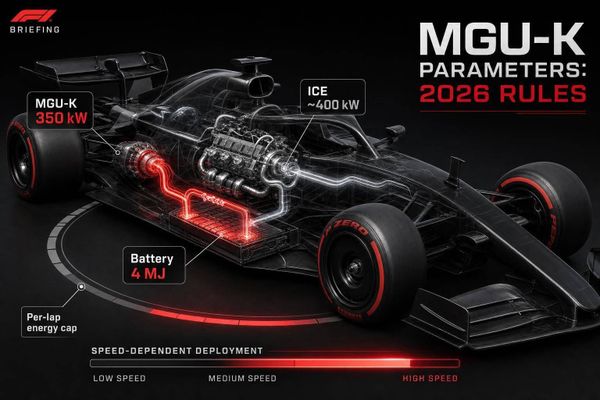
The reforms in 2026 directly addressed the dangers drivers had flagged. For example, the FIA reduced the energy recharge per lap from 8MJ to 7MJ, which cut the "super-clipping" phase to just 2–4 seconds per qualifying lap. Additionally, a new "boost" mode cap of +150kW was implemented to reduce sudden performance differences, while MGU-K deployment was limited to 250kW in non-acceleration zones.
Here’s a quick breakdown of the changes:
| Safety Issue | Rule Change | Implemented |
|---|---|---|
| Super-clipping (sudden slowing) | Energy recharge reduced from 8MJ to 7MJ; recovery rate increased to 350kW to shorten duration | Miami GP, May 2026 |
| Dangerous closing speeds | Boost mode capped at +150kW; MGU-K limited to 250kW in complex sections | Miami GP, May 2026 |
| Race start collisions | ECU-triggered power reduction, automated MGU-K cutoff, and flashing warnings | Miami GP, May 2026 (trial) |
| Wet weather traction loss | Increased intermediate tire blanket temperatures; capped electrical torque deployment | Miami GP, May 2026 |
While these changes slightly slowed lap times due to reduced energy recovery, they significantly improved safety. FIA President Mohammed Ben Sulayem explained:
"More than ever, the drivers have been at the heart of these discussions... Safety and sporting fairness remain the FIA's highest priorities." - Mohammed Ben Sulayem, President, FIA
From the chicanes of 1994 to the precision software tweaks of 2026, driver-led safety reforms have come a long way. Modern solutions focus on addressing the root causes of risks with technical adjustments, ensuring that iconic track layouts remain untouched while keeping drivers safer than ever.
F1s Drivers DEMAND Change From The FIA!
Technical Rule Changes Shaped by Driver Feedback
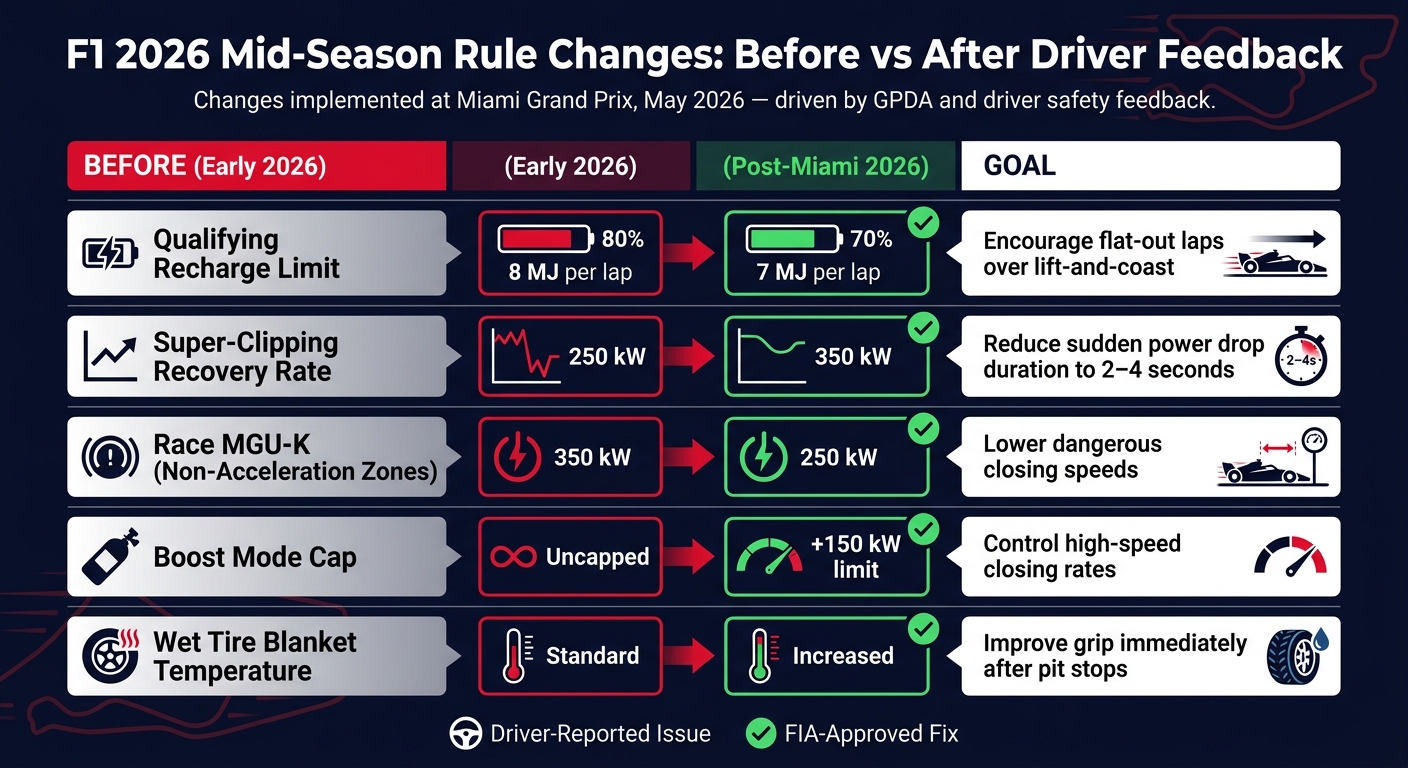
F1 2026 Mid-Season Rule Changes: Before vs After Driver Feedback
Problems with Hybrid Power Units and Energy Management
The 2026 power unit's design, which split power equally between combustion and electrical sources, seemed balanced in theory but created real challenges on the track. Drivers reported that the hybrid system interfered with their ability to push the car to its limits. Instead of driving flat-out, they had to rely on "lift and coast" techniques during qualifying to manage energy recovery effectively. This shift in focus altered traditional racing strategies. As McLaren's Lando Norris put it:
"For the first time in our lives, we are driving in a completely different way... you're not driving the car at the limit anymore, you're driving the power unit." - Lando Norris, F1 Driver, McLaren
One of the most noticeable issues was the abrupt power loss of around 470bhp on straights, which also impacted braking performance. For example, Suzuka laps recorded just 8.9 seconds of braking time, as the MGU-K system took over much of the deceleration effort. These challenges prompted regulators to step in with targeted adjustments.
How Regulators Responded to Performance Concerns
To address the issues raised by drivers, the FIA introduced a set of precise technical changes during the Miami Grand Prix in May 2026. Instead of a complete overhaul of the hybrid power unit system, the adjustments focused on refining energy limits and deployment rules. Mercedes Team Principal Toto Wolff described the approach:
"It's acting with a scalpel and not with a baseball bat. We all share the same objectives. It's how can we improve the product, make it out-and-out racing, and look at what can improve in terms of safety." - Toto Wolff, Team Principal, Mercedes F1
The key changes included reducing the qualifying energy recharge limit from 8MJ to 7MJ per lap and increasing the maximum energy recovery rate from 250kW to 350kW. These tweaks allowed drivers to spend less time harvesting energy and more time driving flat-out. For race conditions, MGU-K deployment in non-acceleration zones was capped at 250kW, with the full 350kW reserved for straight-line sections. Additionally, lower energy limits were expanded to apply at 12 circuits instead of just 8.
Results of Technical Rule Changes
The adjustments directly addressed the performance issues highlighted by drivers, shifting the focus back to pure racing rather than intricate battery management. Here's a quick look at the major changes:
| Key Adjustments Driven by Driver Feedback | Before (Early 2026) | After (Post-Miami 2026) | Goal |
|---|---|---|---|
| Qualifying recharge limit | 8 MJ per lap | 7 MJ per lap | Encourage flat-out laps over "lift and coast" |
| Super-clipping recovery rate | 250 kW | 350 kW | Reduce sudden power drop duration (2–4 seconds) |
| Race MGU-K (non-acceleration zones) | 350 kW | 250 kW | Lower dangerous closing speeds |
| Boost mode cap | Uncapped | +150 kW | Control high-speed closing rates |
| Wet tire blanket temperature | Standard | Increased | Improve grip in wet conditions |
Source:
While these changes slightly slowed overall lap times due to reduced energy recovery, the primary goal was to improve predictability and encourage consistent, aggressive driving. The FIA summed it up best: "The changes are aimed at reducing excessive harvesting and encouraging more consistent flat-out driving." For drivers, this means racing is once again about skill and strategy, not just battery management.
sbb-itb-7c68254
Drivers as Real-Time Safety Sensors: Specific Problems and Fixes
Drivers play a critical role in identifying safety issues on the track, acting as real-time sensors to highlight areas needing improvement. In 2026, their observations led to mid-season rule changes that addressed several pressing concerns.
Making Race Starts Safer
One significant issue raised by drivers involved the challenges posed by the 2026 power unit's design, which featured a near 50-50 split between combustion and electrical power. This configuration made turbocharger preparation more difficult, leading to unpredictable starts and dangerous speed differences. A close call during the Australian Grand Prix highlighted the problem when Liam Lawson (Racing Bulls) narrowly avoided colliding with Franco Colapinto (Alpine) after Colapinto's slow start created a hazardous situation.
To address this, the FIA introduced several measures. A low-power start detection system was implemented to flag underperforming cars at the start. Additionally, a key rule change allowed the MGU-K to deploy electrical power at speeds below 50 mph during slow starts, ensuring cars could maintain a minimum level of acceleration. To further enhance safety, new warning lights - flashing on both the rear and sides of the car - were added to alert trailing drivers to slower vehicles. These changes aimed to minimize risks during race starts and set the groundwork for future improvements.
Improving Safety in Wet Conditions
Drivers also raised concerns about racing in wet conditions, specifically regarding sudden torque delivery from hybrid systems and the ineffectiveness of rear light sequences in heavy spray. Carlos Sainz, an F1 driver and GPDA Director, emphasized the urgency of addressing these issues:
"As the GPDA, we have warned the FIA these accidents will happen a lot with this set of regulations and we need to change something soon if we don't want it to happen."
In response, the FIA worked with the GPDA and Nicolas Tombazis, the single-seater director, to implement changes ahead of the Miami Grand Prix (May 1–3, 2026). These included capping electrical deployment to prevent sudden torque spikes in wet conditions, shifting more reliance to the combustion engine for smoother power delivery. Tire blanket temperatures for intermediate tires were also increased, ensuring better grip immediately after pit stops. Additionally, rear light sequences were simplified to provide clearer, more consistent visual signals in poor visibility. While these updates addressed immediate concerns, the FIA continues to evaluate other aspects of wet racing safety.
Dealing with Extreme Cockpit Heat
Cockpit heat remains another area of concern, with drivers continuing to provide feedback on the issue. Although no specific protocols were detailed in 2026, the increasing complexity of power units means this challenge is likely to drive future regulatory changes. Driver input will remain essential as the FIA works to improve cockpit conditions.
The Future of Driver Input in F1 Rule-Making
Recent safety and technical reforms have sparked discussions about the role of drivers in shaping F1 regulations. While progress has been made, the question of how much influence drivers should have remains unresolved.
Why Drivers Still Lack Formal Power in Rule-Making
Even after the changes introduced in 2026, drivers still don't have an official role in drafting F1 rules. The current decision-making process involves the FIA, Formula One Management (FOM), and team principals, leaving drivers on the sidelines. Their input is filtered through team channels, which often weakens their direct influence.
"The drivers get paid plenty of money to drive them, so deal with it. In reality, the drivers' collective position is a bit more nuanced... they're the only people qualified to give feedback about how the cars work on track, but have no real platform to deliver it." - Jake Boxall-Legge, Author
Teams prioritize engineering, budgets, and commercial interests, which don’t always align with drivers' concerns about issues like dangerous speed differentials or car handling. Damon Hill, a former F1 World Champion, highlighted this disconnect:
"The drivers who are trying them in the Sims, we're all saying, 'this isn't going to work. It's going to be horrible.' ...and they just go, 'yeah, yeah,' they're not listening." - Damon Hill
Additionally, drivers’ individual priorities often prevent them from presenting a united front, limiting the Grand Prix Drivers’ Association's (GPDA) influence except during moments of crisis.
To address these challenges, new ideas are being floated to give drivers a more structured voice in decision-making.
Ways to Give Drivers a Stronger Role
One practical step is to formalize the informal consultations that already take place. For example, recent discussions where the FIA consulted GPDA directors before implementing mid-season changes showed how valuable direct engagement can be. Creating a formal driver advisory panel within the F1 Commission and incorporating an independent driver feedback phase into the regulatory process could ensure drivers' insights are heard early - especially when it comes to simulation data for technical rules.
This system would need to operate independently of teams to allow drivers to speak freely about their concerns. FIA President Mohammed Ben Sulayem acknowledged the importance of driver input after recent mid-season adjustments:
"More than ever, the drivers have been at the heart of these discussions, and I would like to thank them for their valuable input throughout this process." - Mohammed Ben Sulayem
However, any increase in driver involvement must align with the sport's broader goals, including safety, performance, and commercial viability.
Balancing Driver Input with Broader Sport Goals
Drivers aren’t asking for complete control over regulations - they understand the need for balance. The real challenge lies in integrating their feedback without compromising the sport’s other priorities, such as cost management and entertainment value.
The 2026 energy management rules illustrate this tension. These rules, shaped largely by manufacturer interests, led to a 470bhp speed differential between cars - a safety risk that drivers had flagged long before final decisions were made.
Mid-season changes, while sometimes costly - such as updates to power unit software or energy recovery systems - could be more efficient with structured driver input. As Mercedes Team Principal Toto Wolff explained:
"We all share the same objectives. It's how can we improve the product, make it out-and-out racing, and look at what can improve in terms of safety." - Toto Wolff
Incorporating drivers’ expertise into the regulatory process could lead to safer, more exciting racing while meeting the sport’s commercial and technical needs. Lessons from recent adjustments will likely shape future reforms, aiming to better integrate driver insights with regulatory goals.
Conclusion: Drivers as Key Contributors to F1's Development
Drivers act as the sport's frontline safety monitors and the spark for essential changes. They can identify on-track issues that no simulation or dataset can fully predict, such as dangerous speed differences that might escape purely technical analysis.
As seen through the safety and technical reforms discussed earlier, drivers' insights have consistently shaped F1's progression. From Senna's era to the mid-season adjustments in 2026, drivers have highlighted problems that led to faster and safer rule changes. Their firsthand experience provides a perspective that engineers or commercial stakeholders simply can't replicate.
However, a challenge persists: bridging the gap between what drivers experience and what they can formally influence. The 2026 season highlighted that when drivers unite and communicate clearly - whether through the GPDA or directly with FIA officials - the sport listens and adapts. The pressing question now is whether F1 can establish systems to proactively gather this input and address issues before incidents force a reaction.
For fans eager to explore the complexities of these rule changes, F1 Briefing delivers in-depth analysis on every aspect of the sport - covering how decisions are made, who drives them, and their impact on the racing action.
FAQs
Why don’t F1 drivers get a vote on rule changes?
F1 drivers don’t get a direct vote on rule changes because they aren’t officially part of the sport’s governance system. Instead, decisions on regulations are made by the FIA, F1, and team principals, with final approval coming from the F1 Commission and the FIA World Motor Sport Council. That said, drivers still play an important role by sharing feedback through the Grand Prix Drivers' Association. While their input can shape adjustments, the ultimate decisions rest with the governing bodies, which must weigh multiple competing interests.
What exactly is “super-clipping,” and why is it dangerous?
Super-clipping is an energy management technique used in Formula 1. Here's how it works: when a car is at full throttle, it temporarily reduces power from the internal combustion engine to divert energy toward charging its battery. This sudden drop in power results in an unexpected decrease in speed.
Why is this a problem? That abrupt speed change can catch other drivers off guard, leading to unpredictable speed differences between cars. This creates a higher risk of collisions - a concern that became a hot topic among drivers following several incidents during the 2026 season.
Could drivers ever get a formal role in F1 rule-making?
Currently, Formula 1 drivers don't play a formal part in creating the sport's rules. While the Grand Prix Drivers' Association (GPDA) serves as a platform for drivers to share their collective concerns, they don’t hold an official vote in decision-making. Drivers are consulted on specific topics, such as tire performance and energy management, but their role remains advisory. Any changes to the regulations must go through the F1 Commission and receive final approval from the FIA World Motor Sport Council.