Top 5 Drivers Who Changed F1 Safety
Five drivers transformed Formula 1 safety, prompting track redesigns, cockpit protection and emergency reforms.
- Jackie Stewart: Advocated for safety in the '60s and '70s, pushing for better track designs, medical facilities, and equipment like seatbelts and full-face helmets.
- Niki Lauda: His fiery 1976 crash highlighted the need for improved fire protection and emergency response, leading to safer circuits.
- Ayrton Senna: After his tragic 1994 crash, Formula 1 introduced sweeping track and car safety reforms, including the HANS device.
- Michael Schumacher: Played a key role in promoting the HANS device and modernizing driver safety standards through his work with the GPDA.
- Jules Bianchi: His 2014 crash led to the Virtual Safety Car and inspired the Halo, saving lives in high-impact crashes.
Quick Comparison
| Driver | Era | Safety Contribution | Impact |
|---|---|---|---|
| Jackie Stewart | 1965–1973 | Pushed for track safety, seatbelts, and medical care | Safer tracks, trauma centers, mandatory harnesses |
| Niki Lauda | 1971–1985 | Exposed fire safety flaws, advocated for safer circuits | Fire-resistant suits, veto power on unsafe tracks |
| Ayrton Senna | 1984–1994 | Crash spurred major reforms in track and car safety | HANS device, permanent safety commissions |
| Michael Schumacher | 1991–2012 | Advocated for HANS and driver safety improvements | Mandatory HANS, ongoing GPDA influence |
| Jules Bianchi | 2013–2014 | Crash revealed cockpit protection gaps | Virtual Safety Car, Halo system |
These drivers didn’t just race - they changed the sport forever. Their legacies are felt in every safety measure that protects drivers today.
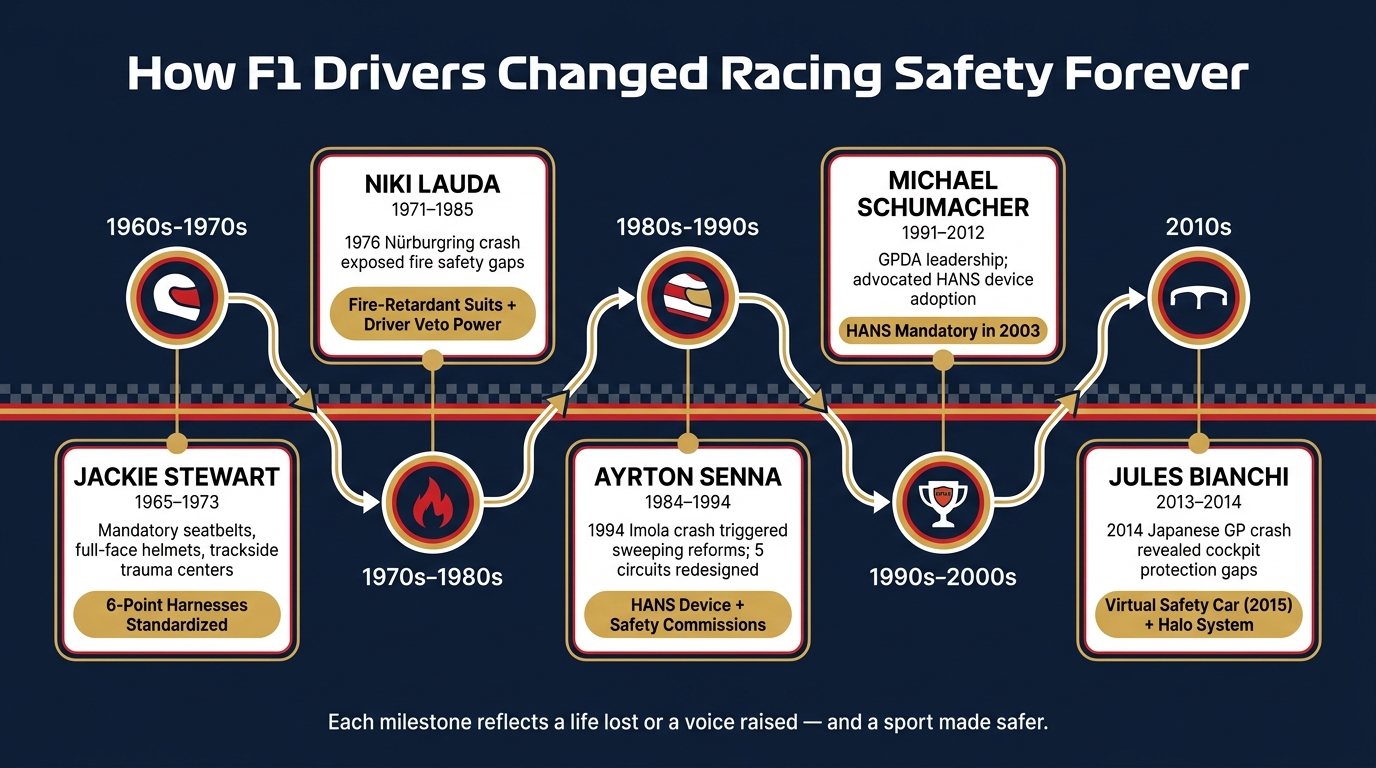
F1 Drivers Who Changed Safety: A Timeline of Impact
The F1 Driver Who Changed Safety Forever…
sbb-itb-7c68254
1. Jackie Stewart
In the early days of racing, safety was almost an afterthought. Drivers faced dangerous tracks, inadequate safety measures, and limited medical support. Jackie Stewart, however, wasn’t content to accept these risks as part of the sport.
Driven by the perilous conditions he witnessed and experienced, Stewart became a powerful advocate for change. As a key figure in the Grand Prix Drivers' Association (GPDA), he worked tirelessly to pressure circuit owners, race organizers, and the FIA to implement meaningful safety upgrades. His efforts helped empower drivers to push for critical track modifications, such as adding chicanes to reduce speeds in hazardous sections - a move that set a new standard for driver safety.
Stewart’s three World Championships (1969, 1971, 1973) gave him a platform that few could ignore, but it was his determination off the track that truly left a mark. By the time he retired in 1973, the sport had already begun to adopt better safety measures, thanks in large part to his work. The GPDA, which he helped invigorate, remains a crucial voice in addressing safety concerns today:
"extremely vocal" in warning the FIA about foreseeable safety risks.
Jackie Stewart’s unwavering dedication not only changed the sport during his time but also set a lasting precedent for drivers to demand safer conditions on and off the track.
2. Niki Lauda
Niki Lauda's horrific 1976 crash became a defining moment in Formula 1's push for safety. During the German Grand Prix at the Nürburgring, Lauda's Ferrari burst into flames after a crash, exposing critical flaws in the circuit's fire marshal coverage and emergency access. Ironically, Lauda had previously led a driver boycott, warning about the dangers of the Nürburgring's 14-mile layout, including its inadequate safety measures. Unfortunately, his concerns were ignored, and the crash brought those dangers into sharp focus.
This accident forced Formula 1 to reevaluate and improve track safety and emergency response protocols. Lauda's determination turned his personal tragedy into a driving force for change, linking earlier safety efforts to the advanced systems in place today. His actions not only reshaped emergency procedures but also paved the way for future champions to advocate for safer racing conditions.
3. Ayrton Senna
Ayrton Senna's tragic accident at the 1994 San Marino Grand Prix at Imola became a turning point in Formula 1's approach to safety. That devastating weekend saw the loss of two drivers - Roland Ratzenberger during qualifying on Saturday and Senna during the race on Sunday. These events forced the FIA and the Formula 1 community to confront the inadequacies in their safety measures.
The response was immediate and far-reaching. During the same season, five major circuits were reconfigured to improve safety. Tracks like Gilles Villeneuve, Silverstone, Spa-Francorchamps, Estoril, and Jerez underwent significant changes, with new chicanes added in high-speed sections to reduce cornering speeds. At the Circuit de Catalunya, drivers even pushed for a temporary chicane to be installed, emphasizing the growing recognition that track design was just as important as car safety.
Senna's influence extended beyond the immediate changes. His death underscored the need for a more proactive approach to safety, leading to the creation of the Expert Advisory Safety Committee. This committee introduced a data-driven, engineering-focused mindset to safety, replacing the reactive measures of the past. It also established a system of regular technical reviews and updates, forming the foundation of the FIA's modern safety regulations.
The reforms of 1994 continue to shape Formula 1 today. Discussions about modifying iconic corners, like Eau Rouge or Becketts, can be traced back to the sweeping changes sparked by the events at Imola. Senna's legacy is not just about the circuits that were redesigned but also about empowering drivers to demand safer racing conditions and setting a new standard for prioritizing safety in the sport.
4. Michael Schumacher
Michael Schumacher, widely regarded as one of Formula 1's most dominant drivers, played a key role in pushing for safety reforms after the tragic events at Imola in 1994. He strongly advocated for changes to circuits, such as introducing chicanes in high-speed sections, to slow down cornering speeds and enhance driver safety.
As an active supporter of the Grand Prix Drivers' Association (GPDA), Schumacher helped establish a culture where drivers took the lead in advocating for safety improvements. This collaboration with the FIA set the stage for many advancements in racing safety, both during and after his career.
His life took a tragic turn in December 2013 when he suffered a severe skiing injury, which highlighted the limitations of helmet technology at the time. This incident spurred further research into head injury prevention and protective gear.
Schumacher’s legacy is evident in modern safety innovations. Devices like the Halo cockpit protection system and upgrades to the HANS (Head and Neck Support) device were directly inspired by the safety-first mindset he championed. Additionally, the FIA's 2026 regulations will include a two-stage front impact structure, designed to protect drivers during secondary collisions, continuing the evolution of safety measures influenced by his contributions.
5. Jules Bianchi
Jules Bianchi's tragic crash at the 2014 Japanese Grand Prix highlighted serious safety issues in Formula One, leading to the introduction of the Virtual Safety Car (VSC) in 2015. This system enforces a consistent speed limit during caution periods, addressing the dangers posed by high closing speeds and large speed differences, especially on circuits like Suzuka. While Bianchi did not live to witness the changes sparked by his accident, the VSC has become a regular feature of race weekends, serving as a reminder of how loss can lead to progress. His legacy, like those of others before him, underscores how drivers' experiences continue to shape safety advancements in the sport.
Driver Safety Contributions at a Glance
Throughout Formula 1's history, drivers have played a critical role in shaping safety standards. From improving medical care at the track to introducing better cockpit protection, each era has left its mark. Here's a closer look at how key drivers contributed to advancing safety in the sport:
| Driver | Era | Main Safety Contribution | Lasting Outcome |
|---|---|---|---|
| Jackie Stewart | 1965–1973 | Championed mandatory seatbelts, full-face helmets, and professional medical facilities | Standardized trackside trauma centers and required 6-point harnesses |
| Niki Lauda | 1971–1985 | Pushed for fire protection standards and driver veto power on unsafe circuits | Improved fire-retardant race suits; drivers gained the right to refuse unsafe tracks |
| Ayrton Senna | 1984–1994 | His fatal crash led to a major safety overhaul in Formula 1 | GPDA reform, permanent track safety commissions, and the development of the HANS device |
| Michael Schumacher | 1991–2012 | Advocated for the HANS (Head and Neck Support) device as GPDA leader | HANS became mandatory in 2003; GPDA continues to influence modern safety standards |
| Jules Bianchi | 2013–2014 | His accident revealed weaknesses in cockpit protection and impact absorption | Virtual Safety Car (VSC) introduced in 2015; Halo cockpit protection became standard |
Each of these milestones reflects how lessons learned over time have collectively shaped today's safety measures in F1. Every contribution has helped create a safer environment for drivers, reinforcing the sport's commitment to continuous safety improvements.
Conclusion
These five drivers reshaped Formula 1 safety, proving that pushing for better conditions can go hand in hand with success on the track. Ayrton Senna's tragic accident forced the sport to face uncomfortable realities, while Michael Schumacher's involvement with the Grand Prix Drivers' Association kept safety advocacy at the forefront. Jules Bianchi's crash spurred the introduction of advanced cockpit protections like the Halo, which has since been credited with saving lives during high-impact incidents.
These changes didn’t happen overnight. Many required either devastating accidents or drivers risking their careers to demand action. Building on these pivotal moments, today’s drivers continue to champion safety improvements. For example, drivers like Carlos Sainz and Oliver Bearman recently raised concerns about dangerous speed differentials in the proposed 2026 regulations - taking action before a serious accident occurred.
"We've been warning that this kind of accident was always going to happen." - Carlos Sainz, GPDA Director
Reflecting the ongoing commitment to safety, the 2026 regulations introduced measures like reducing car weight by 30 kg (about 66 lbs, bringing the total to 724 kg) and targeting 90% wake management efficiency - the highest in F1 history. This allows cars to race closer together while minimizing collision risks. These advancements show that prioritizing safety doesn’t mean sacrificing competition.
The legacy of these drivers is visible every time a yellow flag signals caution, every time a driver walks away from a crash, and every time the sport chooses prevention over reaction. This shift toward proactive safety measures stands as their most lasting contribution, ensuring that their impact is felt in every decision made to protect drivers today and in the future.
FAQs
Which single safety change has saved the most lives in F1?
The evolution of safety in Formula One can't be pinpointed to a single change, but rather a series of advancements working together. Following the tragic 1994 deaths of Ayrton Senna and Roland Ratzenberger, significant track modifications were implemented to enhance driver safety. Other key improvements include the development of stronger monocoques and roll hoops, both designed to better protect drivers during crashes. Looking ahead, the 2026 energy deployment regulations are set to further enhance safety standards. These combined efforts, as detailed in F1 Briefing’s analysis, showcase the sport’s ongoing commitment to driver protection.
How does the GPDA pressure the FIA to change rules?
The Grand Prix Drivers’ Association (GPDA) plays a key role in shaping Formula 1 rules by engaging in open discussions with the FIA. Although the GPDA doesn’t have formal voting rights, it highlights safety concerns such as high-speed differentials or dangerous track conditions. By bringing these issues to the attention of the FIA and teams, drivers collectively influence technical priorities. However, the FIA ultimately holds the power to implement changes focused on safety.
Why weren’t the Halo and VSC introduced sooner?
The text doesn't delve into why the Halo or Virtual Safety Car (VSC) weren't introduced sooner. Instead, the spotlight now shifts to the 2026 regulations, particularly around energy management and closing speeds. For a closer look at Formula One's past, its safety advancements, and the role drivers have played, check out the expert breakdowns and insights available at F1 Briefing.