F1 battery management: guide to harvest and engine life
Battery strategy — not raw power — dictates lap time and power-unit lifespan in F1.
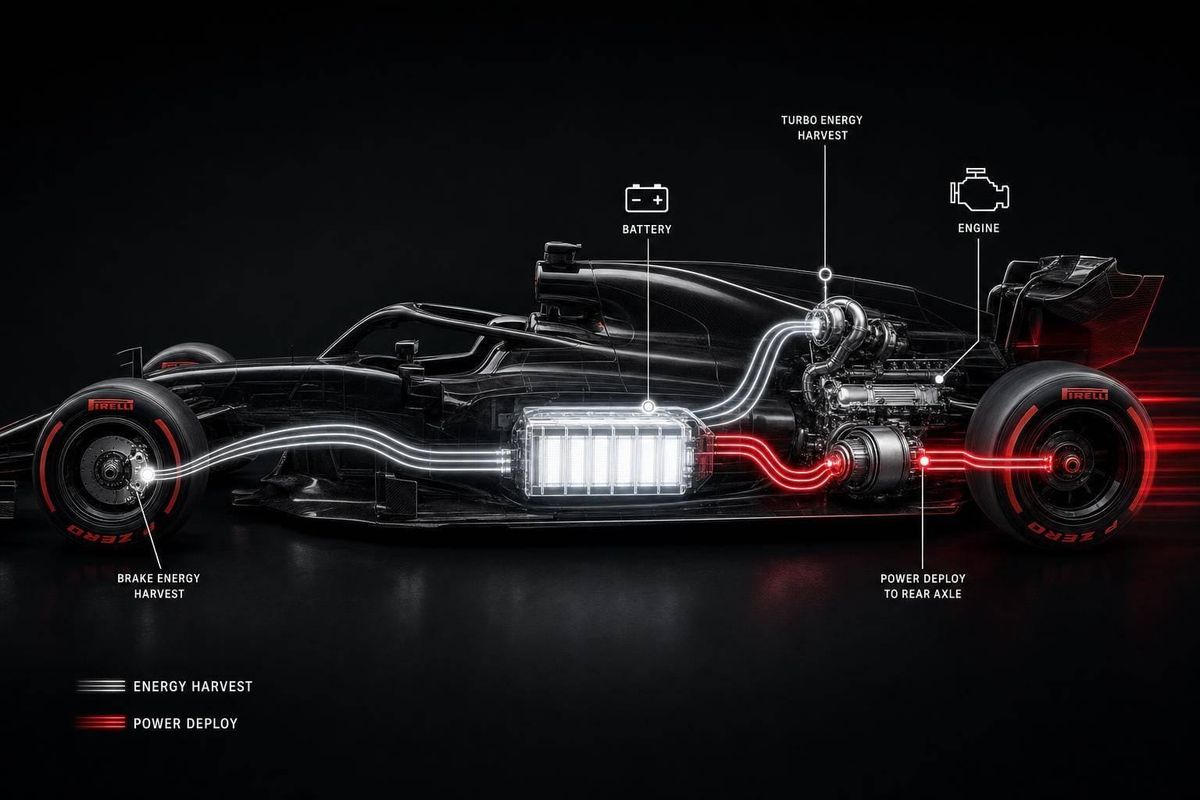
In F1, battery use can decide both lap time and how long the power unit lasts. My takeaway is simple: teams are not chasing a full battery. They are trying to keep charge in a tight window, harvest enough energy in the right parts of the lap, and avoid draining the system into superclipping.
Here’s the short version:
- Repeatable pace matters more than one fast burst
- Harvest and deployment are linked
- Track layout changes the whole energy plan
- Drivers help manage charge with braking, lift-and-coast, and throttle use
- Heat and mileage limit how hard teams can push
- FIA limits now shape qualifying too, including a drop from 7.5 MJ to 6.5 MJ of rechargeable energy at the British Grand Prix and a 50 kW-per-second ramp-down cap
Put another way: battery management is pace management. Teams use less electric boost in some corners so they can spend more on straights, while also keeping the MGU-K, energy store, and power unit in better condition over a race weekend and across the season.
What stands out to me most is how narrow the margin is. At places like Silverstone, where about 80% of the lap is full throttle, there are fewer normal braking zones to recover energy. That forces teams to trade speed in one section for speed in another, all while watching charge level, temperature, and component wear.
If I had to boil the article down to three points, it would be these:
- Keep SOC out of the extremes
- Spend energy where lap-time return is highest
- Back off before heat or low charge hurts pace and engine life
That is the whole framework in plain English: harvest smart, deploy at the right time, and protect the hardware while doing it.
How F1 harvests and stores energy
The hybrid system parts that shape battery behavior
Three parts run the energy flow in an F1 power unit: the MGU-K, the Energy Store, and the control electronics.
The MGU-K does the recovery work. It pulls energy back under braking and, in fast corners, by cutting electrical assist. The Energy Store keeps that energy in reserve. Then the control electronics decide when the car should harvest and when it should deploy.
That setup has always mattered, but for 2026 it matters more. The electrical side now has a much bigger effect on lap time, so harvest management isn’t just something happening in the background. It’s a direct performance lever.
Braking zones, regen limits, and SOC guardrails
Each time a driver hits the brakes hard, the MGU-K adds drag through the drivetrain and turns kinetic energy into electricity. Sounds simple on paper. On track, it’s a balancing act.
Engineers have to blend that regen with brake-by-wire so the rear of the car stays settled under braking. If the regen blend is off, the problem doesn’t stop at lap time. The car can feel awkward to drive, and rear tire load can shift in ways the driver doesn’t want.
The FIA also puts firm caps on recovery. For the 2026 British Grand Prix, the maximum rechargeable energy available in qualifying was reduced from 7.5 MJ to 6.5 MJ. The electrical power ramp-down rate is also limited to 50 kW per second, which helps avoid a sudden drop in power as the battery nears its lower limit.
Teams also have to protect both ends of the charge window:
- At the top end, they want to avoid wasting regen room
- At the bottom end, they need to stay above the superclipping floor
So the target keeps moving. The team has to recover enough energy to stay inside the SOC window, but not at the cost of the pace it will need later in the lap.
How track layout changes the harvest plan
Track layout changes everything. Some circuits make energy recovery fairly straightforward. Others make it a headache.
Take Silverstone. It’s a high-speed circuit where about 80% of the lap is full throttle. That leaves very little time for normal braking-based regen. In plain English: if the driver isn’t braking much, there aren’t many chances to harvest in the usual way.
That forces teams to get clever. On low-braking circuits, they can recover energy in corners by trimming assist, then use that saved energy on the next straight. So deployment also works like a harvest tool. Use less electrical help in one part of the lap, and you create more energy to spend in the next.
That’s why circuit design shapes the whole plan. The layout decides how much energy the car can realistically recover, and that then decides how much can be used later. Harvest control and deployment strategy are tied together, lap after lap.
That harvested energy becomes the fuel for the next phase: how teams deploy it for lap time without draining the battery.
sbb-itb-7c68254
How teams deploy energy for lap time without draining the battery
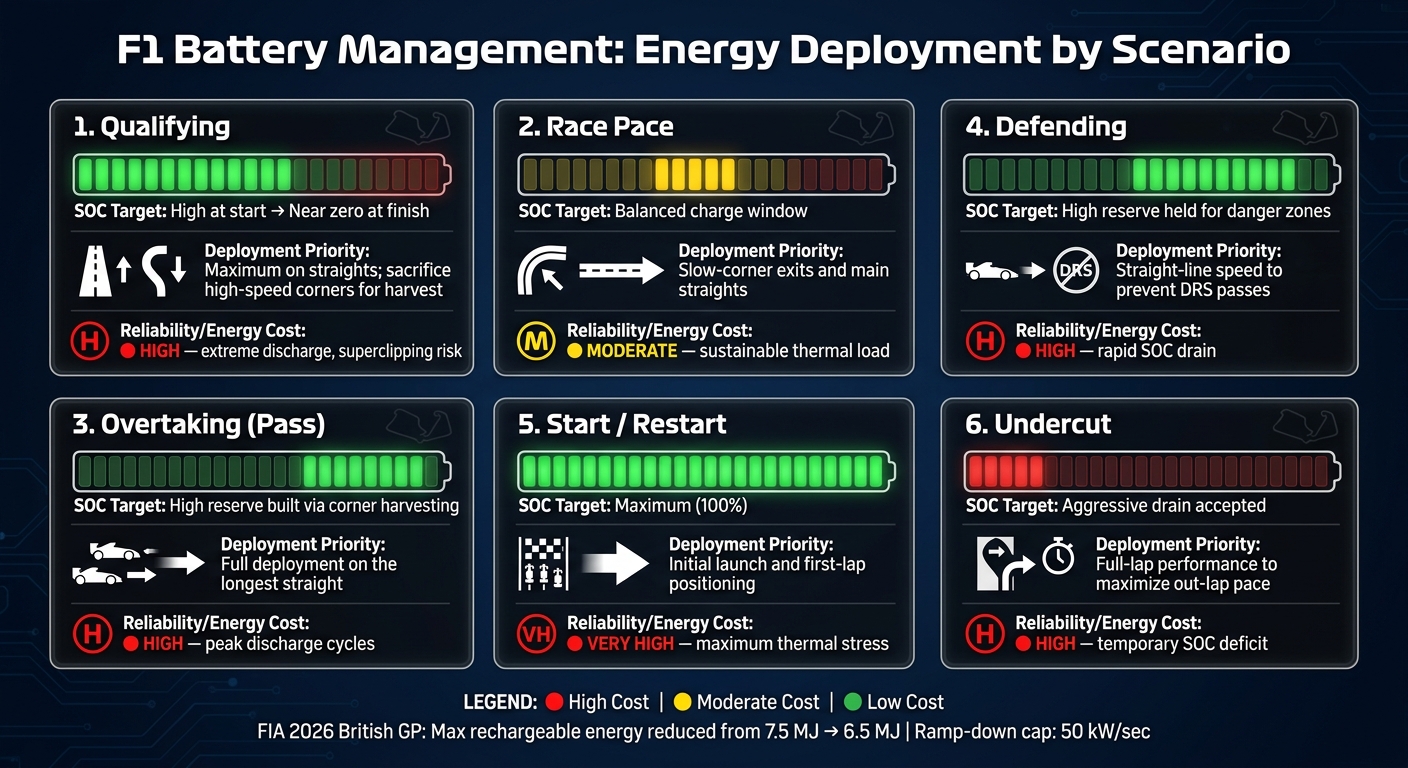
F1 Battery Management: Energy Deployment Modes Explained
Deployment maps for qualifying, race pace, and overtaking
After the car gathers energy, the next call is simple on paper and tricky in practice: where do you spend it?
Teams usually deploy energy at the start of long straights and on acceleration zones out of slow corners. That’s where electric boost helps lap time the most. Use it early in the acceleration phase, and the gain is much bigger. Use it at the end of a straight, when drag is already hitting the car hard, and the payoff drops off.
That’s why deployment changes by session. A qualifying lap, a race stint, a start, and a defensive lap all ask for different things, so teams run different maps for each one.
SOC control for starts, undercuts, and late-race pushes
Engineers don’t set one map and leave it there. They keep adjusting SOC targets and deployment priorities based on the situation.
Track position matters. Race phase matters too. A car trying to pass doesn’t use energy the same way as a car trying to hold position.
| Scenario | SOC Target | Deployment Priority | Reliability/Energy Cost |
|---|---|---|---|
| Qualifying | High at start; near zero at finish | Maximum on straights; sacrifice high-speed corners for harvest | High - extreme discharge, superclipping risk |
| Race pace | Balanced charge window | Slow-corner exits and main straights | Moderate - sustainable thermal load |
| Pass | High reserve built via corner harvesting | Full deployment on the longest straight | High - peak discharge cycles |
| Defend | High reserve held for danger zones | Straight-line speed to prevent DRS passes | High - rapid SOC drain |
| Start/restart | Maximum (100%) | Initial launch and first-lap positioning | Very high - maximum thermal stress |
| Undercut | Aggressive drain | Full-lap performance to maximize out-lap pace | High - temporary SOC deficit |
A race start needs a full battery. No half measures there.
An undercut is different. The driver has to push hard on the out-lap, so the team may accept a temporary SOC deficit to get the lap time they want. The trade-off is clear: spend more now, then recover enough charge over the laps that follow.
Lift-and-coast, throttle shaping, and the driver's role
The driver isn’t just following instructions on a screen. They’re helping shape how the battery behaves through the lap.
Drivers often trim electrical deployment in fast corners so the MGU-K can harvest energy while the car is still carrying speed. In that sense, the battery is also a pace tool. Less electric deployment can help control entry speed and recover energy at the same time.
On high-speed tracks, that trade becomes even more useful. A driver may give up some deployment through a fast section to save more charge for the next straight, where the lap-time return is better.
Cooling, reliability limits, and power unit life trade-offs
Battery and ERS cooling across different weather and track conditions
Once harvest and deployment are planned out, temperature becomes the hard limit. A team can only recover and use energy as long as the battery and ERS stay inside a safe thermal window. Push too hard for too long, and the system gets too hot.
That’s why cooling puts a cap on how aggressive teams can be over a stint. Hot weather, slow corners, and dirty air all drive battery and ERS temperatures up. When that happens, teams trim deployment to protect the cells and avoid shortening battery life.
This gets tougher on low-harvest circuits. If a track offers fewer chances to recharge between heavy-use zones, teams have to be more careful with deployment and tighter with energy use. There’s less room for error.
For the 2026 British Grand Prix, the FIA added another layer to that balancing act. It cut the maximum rechargeable energy available in qualifying from 7.5 MJ to 6.5 MJ and limited the electrical power ramp-down rate to 50 kW per second to reduce the severity of superclipping.
That same approach gets even stricter as the power unit racks up mileage.
How energy strategy changes as power units age
A fresh power unit can usually handle more aggressive settings. An older one often gets softer deployment maps and tighter harvest targets to reduce MGU-K stress and help the power unit last across the season.
The trade-off is pretty simple: give up some pace now to avoid extra wear later. And later matters a lot more when grid penalties start hanging over every decision.
Honda's updated power unit allocation on August 2, 2026, is one example of that kind of reliability management.
Protecting the power unit as a season-long tool
That’s the bigger idea behind all of this. Engineers don’t treat the power unit like a one-weekend weapon. They treat it like something that has to keep delivering month after month.
The teams that manage this best usually do three things well:
- Keep enough charge in the battery
- Avoid superclipping
- Protect the power unit so it stays competitive deep into the calendar
Conclusion: a working framework for balancing harvest and engine life
Once teams have sorted out SOC windows, deployment maps, lift-and-coast, and cooling, the last job is to pull everything into one repeatable race plan.
That’s what F1 battery management comes down to. It’s about repeating lap time, not draining the battery. Over a race weekend, teams work to keep the battery, ERS, and power unit inside a usable range instead of chasing one all-out lap at the cost of everything that comes after.
At the center of that balance are three calls:
- where to harvest
- where to deploy
- when to back off before temperatures or SOC drift outside the target window
The three operating modes teams switch between
Most race plans fit into three operating modes:
| Mode | When It's Used | What It Prioritizes |
|---|---|---|
| Performance-First | Qualifying, overtaking | Maximum deployment; manages superclipping at the end of straights |
| Adaptive / Track-Specific | Race conditions, safety cars, variable weather | Shifts harvesting to high-speed corners; reacts to track position and circuit layout |
| Conservation-First | Aging power unit, reliability windows | Reduced ERS stress; prioritizes cooling margins and component longevity |
Teams can move between these modes in the same weekend. A car may run performance-first in qualifying, switch to an adaptive setup in traffic, and lean into conservation-first as mileage builds.
The teams that handle those switches best stay quick without giving up the power unit.
FAQs
What is superclipping in F1?
Superclipping happens when an F1 car’s battery reaches its energy limit, so the electric boost stops or drops off hard while the car is still charging down a straight.
That leads to a sudden hit in acceleration and top speed. In plain English: the car loses part of its punch before the straight is over.
That’s why drivers have to manage energy with care across the whole lap. Use too much too soon, and there may not be enough left for the parts of the track where that extra power matters most.
Why don’t teams keep the battery fully charged?
Teams don't keep the battery fully charged because electrical energy is limited, and they have to manage it over a full lap. If a driver spent all the available energy on every straight, the battery would be too low before the lap was over.
So teams have to balance harvesting and deployment. The goal is to keep energy ready for the moments that matter most, like overtaking or defending, instead of wasting it in places where it won't do as much.
How does battery management affect engine life?
Battery management affects engine life in two main ways: thermal control and power regulation.
Harvesting and deployment both generate waste heat. That means teams have to manage battery use with care, or heat can build up and put extra stress on power unit parts.
On top of that, engine settings matter. Conservative settings, paired with well-tuned energy recovery, can lower strain on both the engine and the hybrid system.
Push too hard, though, and things can go south fast. Aggressive deployment or heavy electrical loads without enough cooling can lead to overheating and permanent damage.