F1 Broadcasting: From Analog to Ultra-HD
How F1 broadcasts evolved from regional analog TV to a centralized, data-rich 4K world feed that reshaped race viewing.
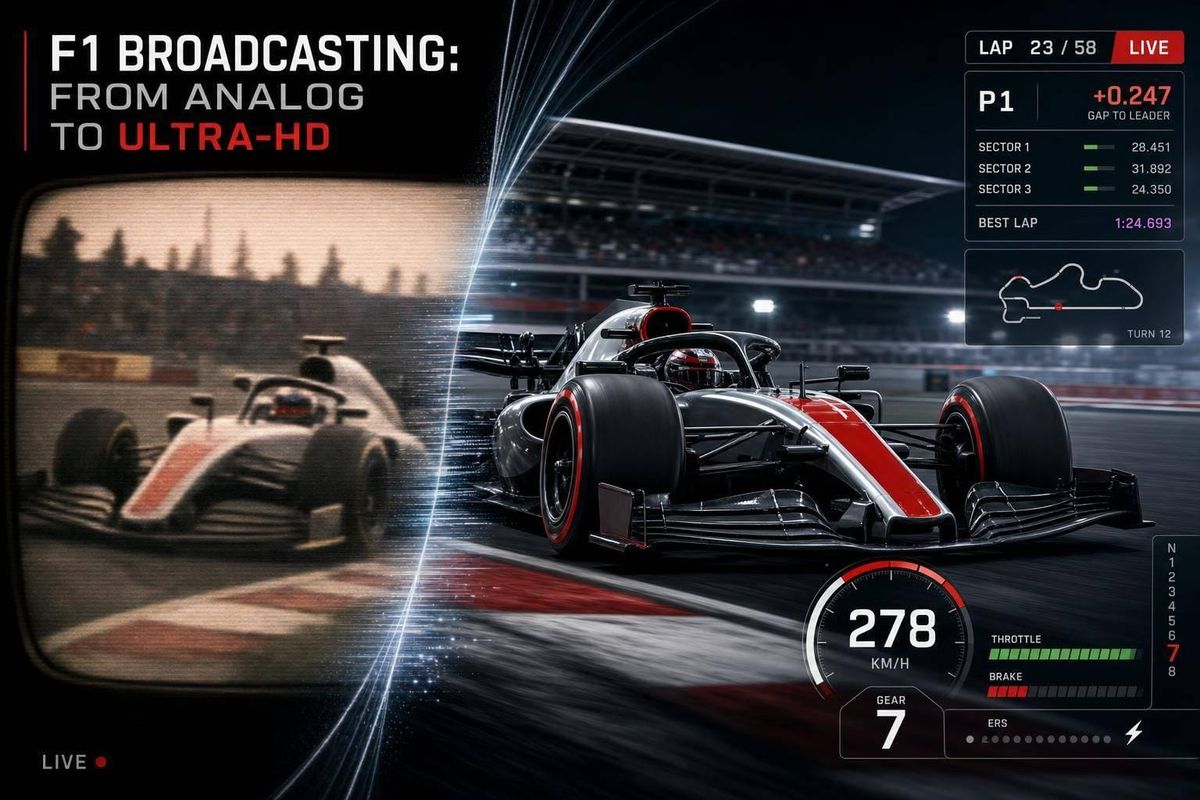
F1 TV went from patchy local coverage in the 1950s to one shared 4K race feed used around the world.
If you want the short version, here it is: early broadcasts were inconsistent because each country used its own TV system, crews, and camera plans. Then F1 moved toward one central feed, added digital features in 1996 with F1 Digital+, and later shifted from 4:3 standard definition to HD and then Ultra-HD (3,840 × 2,160). By 2008, Formula One Management had near-total control of the race feed, which changed both how races looked and how fans followed them.
Here’s what matters most:
- Early F1 TV was fragmented: local broadcasters controlled coverage, and fans in different countries often saw different race stories.
- Analog standards shaped the picture: NTSC ran at about 30 fps, while PAL and SECAM ran at 25 fps.
- Digital changed the model: one F1-produced world feed gave broadcasters the same base race coverage.
- F1 Digital+ added more data: onboard cameras, timing, team radio, and extra angles gave viewers more ways to follow a race.
- HD and 4K changed detail: sharper images made it easier to spot lock-ups, tire wear, and small driver inputs.
- Modern broadcasts changed the viewer’s role: fans can now read pit windows, pace changes, and mistakes live instead of waiting for post-race analysis.
Quick Comparison
| Era | Main setup | What viewers got | Main limit |
|---|---|---|---|
| Early analog era | Local broadcasters, local rights deals | Irregular live coverage, delayed highlights | No single feed, few cameras, mixed quality |
| Digital transition | F1-led shared production | More consistent race coverage across markets | Extra features were still limited by platform |
| HD era | Widescreen digital production | Sharper pictures and clearer graphics | Less detail than 4K |
| Ultra-HD era | Central 4K world feed with onboard data and telemetry | More detail, better replays, clearer race reading | Depends on viewer access and provider support |
So when I look at F1 broadcasting history, the big shift is simple: TV coverage moved from local and uneven to centralized and data-rich, and that changed how you watch a race from lights out to the checkered flag.
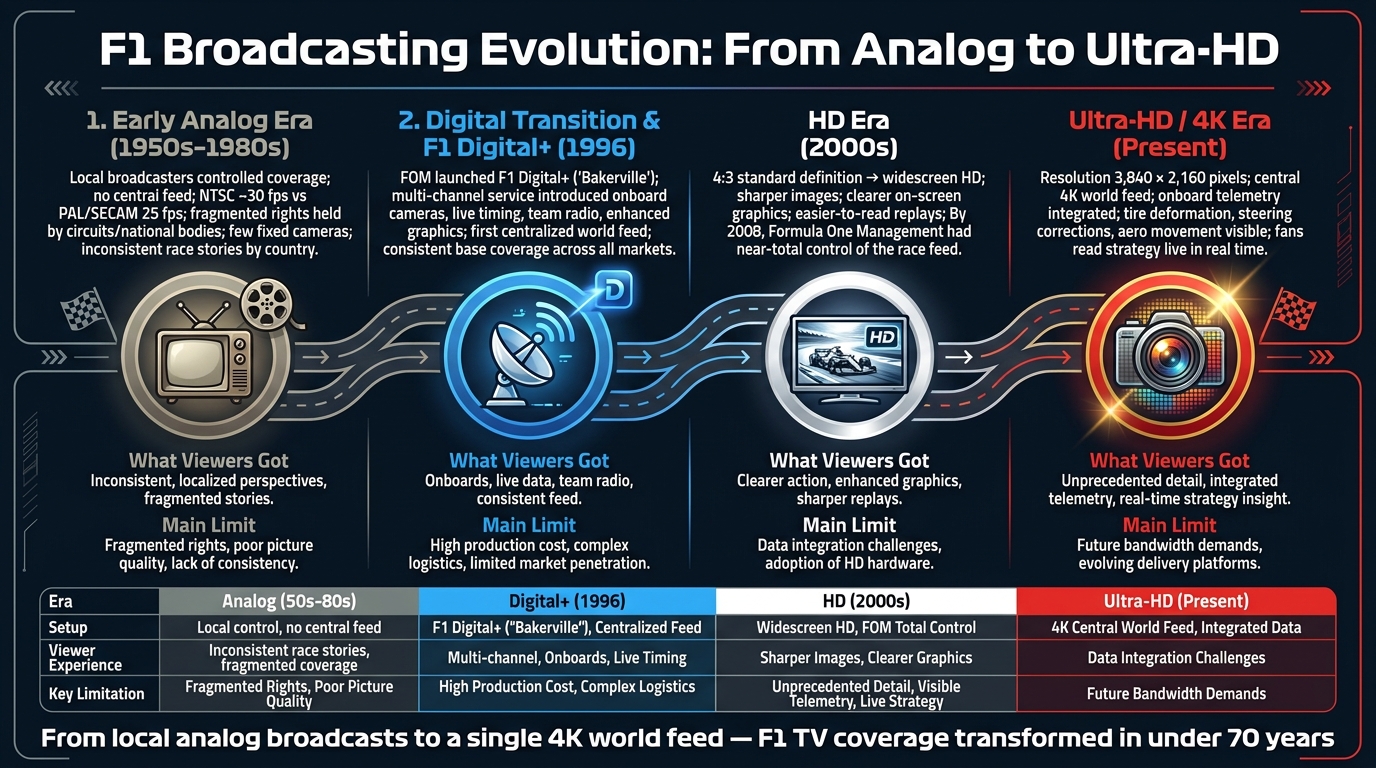
F1 Broadcasting Evolution: From Analog to Ultra-HD
The story of F1Digital+ - Always destined for failure?
sbb-itb-7c68254
Analog Foundations: Early Coverage and the First Rights Shift
Those regional standards shaped more than picture quality. They also shaped who controlled Formula 1 coverage.
In the sport’s early decades, live coverage was spotty, and highlights often aired later. Local broadcasters handled everything on their own, each making separate production choices. There was no central feed, no shared camera plan, and no consistent way to present the sport from one market to another.
The hardware side made things harder. Circuits had only a small number of fixed camera positions, and broadcasters worked with lean crews and basic gear. So the coverage didn’t just vary by technical format. It varied in what people at home actually saw. Camera angles changed, timing changed, and even the race story could feel different depending on the country.
Rights were split up too. Broadcasters negotiated straight with circuits or national motorsport bodies, which left F1 with little say over how the sport looked on screens around the world. That started to change as Formula 1’s commercial value grew and the case for one centralized rights setup became harder to ignore - the first step toward centralized F1 broadcast rights.
From that scattered starting point, F1 began moving toward a single world-feed model that changed both how the sport was sold and how it reached viewers.
Digital and HD: How the World Feed Became a Modern Broadcast Product
Digital production changed F1 from a loose mix of local broadcasts into one global TV product. Before that, what fans saw could vary a lot from one country to the next. Digital TV helped F1 standardize the viewing experience across markets, so the core race coverage looked and felt the same no matter where you watched.
F1 Digital+ and the First Multi-Angle Race Experience
In 1996, FOM launched F1 Digital+, a multi-channel digital service nicknamed "Bakerville." It gave fans more than the main race picture. Viewers could switch between onboard cameras, live timing, team radio, and enhanced graphics.
That setup laid the groundwork for the modern world feed. A lot of what now feels normal in F1 coverage started there: more angles, more data, and a closer look at what was happening inside the race.
Why the World Feed Mattered
The World Feed meant every broadcaster received the same FOM-produced race feed. That was a big shift.
Instead of each market relying on a very different base broadcast, everyone worked from the same shared live feed. Broadcasters could still shape their own coverage around it, but the race itself came from one central source. That gave F1 a more consistent on-screen product across the world.
From Standard Definition to HDTV
The move from 4:3 standard definition to widescreen HD made a clear difference on screen. Images looked sharper, graphics were easier to read, and replays became easier to study.
HD was the next step. But the bigger jump came later, when F1 moved to 4K production.
Ultra-HD F1: Technical Detail and Broadcast Production
What Ultra-HD Adds Beyond HD
Built on the HD world feed, Ultra-HD pushed F1 into 4K detail. Ultra-HD, or 4K, uses 3,840 × 2,160 pixels. That jump in resolution makes small things easier to spot on screen: steering corrections, tire deformation, and aero movement stand out more clearly.
But the sharper picture doesn’t come from resolution alone. It depends on how the feed is captured and put together at the track.
How a Modern F1 Broadcast Is Produced
Modern F1 broadcasts blend several moving parts into one race feed. Trackside cameras, onboard feeds, telemetry, and centralized mixing all work together at the same time. That mix is what turns 4K detail into a race picture that’s easier to follow.
In plain terms, the cameras gather the raw view, the onboard systems add the driver’s perspective, and telemetry adds context around what the car is doing. Then centralized mixing pulls it all into one clean broadcast. Without that production chain, 4K would just be a sharper image, not a better one.
How Better Broadcasting Changed F1 Analysis and Fan Understanding
How Modern Coverage Improves Strategy and Technical Reading
Once F1 switched to a centralized world feed, the broadcast stopped being just a record of the race. It became a way to read the race as it happened.
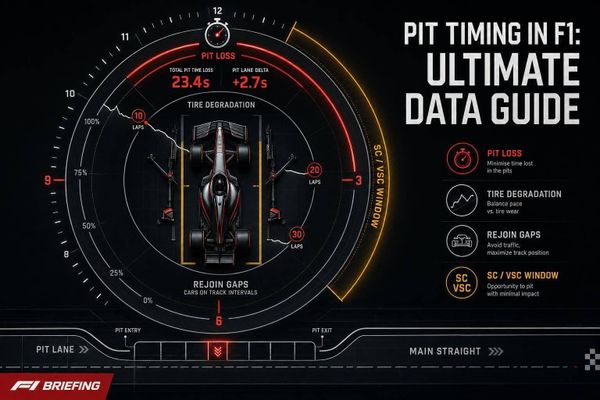
Modern F1 coverage turns each Grand Prix into a more readable tactical feed. Onboard shots, replays, and live data help viewers spot tire wear, pit window timing, and driver mistakes in real time. Instead of waiting until after the race to piece things together, fans can often see the story unfold corner by corner.
That changes the viewing experience in a big way. A lock-up, a slow out-lap, or a sudden tire drop-off is no longer easy to miss. The broadcast gives fans more of the same visual clues and data points that shape team decisions on the pit wall.
Why This Matters for F1 Briefing Readers
That is why better broadcast tech matters: it does not just improve picture quality, it changes how fans understand strategy as the race unfolds.
For F1 Briefing readers, that shift matters because race analysis now starts during the broadcast itself. Viewers are not just watching cars go around a track. They are reading gaps, tire choices, pit timing, and small errors as part of a live strategic picture.
In short, the viewer’s role changed from passive spectator to active analyst.
Conclusion: Key Milestones From Analog to Ultra-HD
From sporadic regional coverage to a centralized 4K world feed, F1 broadcasting grew into a global product built for clarity, consistency, and deeper race analysis.
FAQs
Why did F1 move to a single world feed?
F1 moved to a single world feed to deliver the same production quality and standardized coverage across global markets.
Before that, local host broadcasters led to big gaps in quality and reliability from one race to another. By bringing production in-house, Formula One Management (FOM) made the broadcast more uniform and made it easier to blend graphics, telemetry, and camera angles into one viewing experience.
What made F1 Digital+ such a big step?
F1 Digital+ marked a big shift in Formula 1 broadcasting. For the first time, the sport made a serious move to bring the world feed in-house instead of relying on uneven local host coverage. That meant a dedicated team at every race and a much more steady viewing experience from one Grand Prix to the next.
Launched in 1996, F1 Digital+ offered a commercial-free package with multiple channels. Viewers could watch onboard feeds, pit lane coverage, and real-time data, all as part of the same product. It also helped set a consistent production standard, and that standard played a major part in shaping what modern F1 broadcasting looks like today.
How does 4K change how fans read a race?
Ultra-HD 4K gives Formula 1 fans a sharper, brighter, more detailed picture. That means key moments are easier to follow, especially when everything happens in a split second.
It also makes small details stand out, from subtle changes in car performance to the look on a driver’s face. Add Dolby Vision and high-frame-rate streaming, and the race feels more immersive and lifelike than a standard broadcast.