F1 Corner Entitlement: Rules Of Engagement
Clear steward criteria for F1 corner fights: overlap, axle position, control and exit space - assess the whole corner, not a freeze-frame.
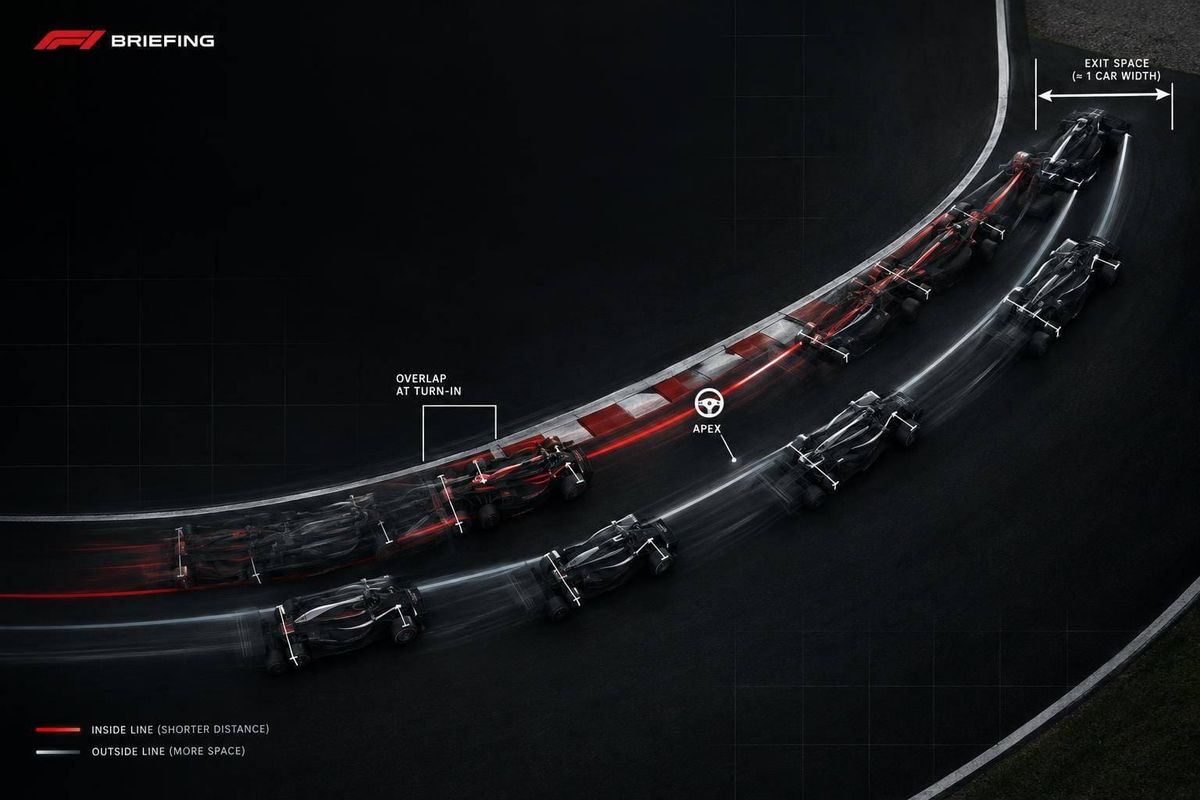
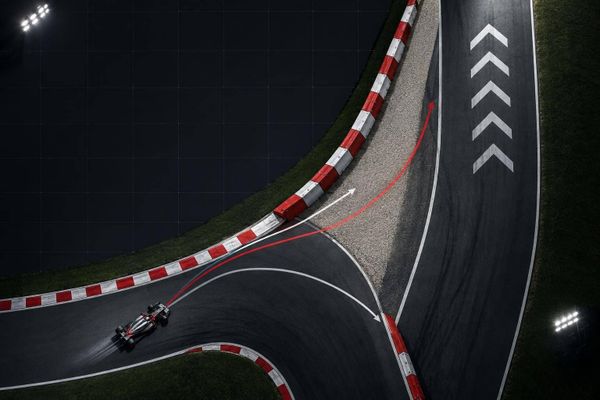
Being alongside doesn’t mean you own the corner. When I judge an F1 move, I check overlap, control, and room from braking through exit - not just who reached the apex first.
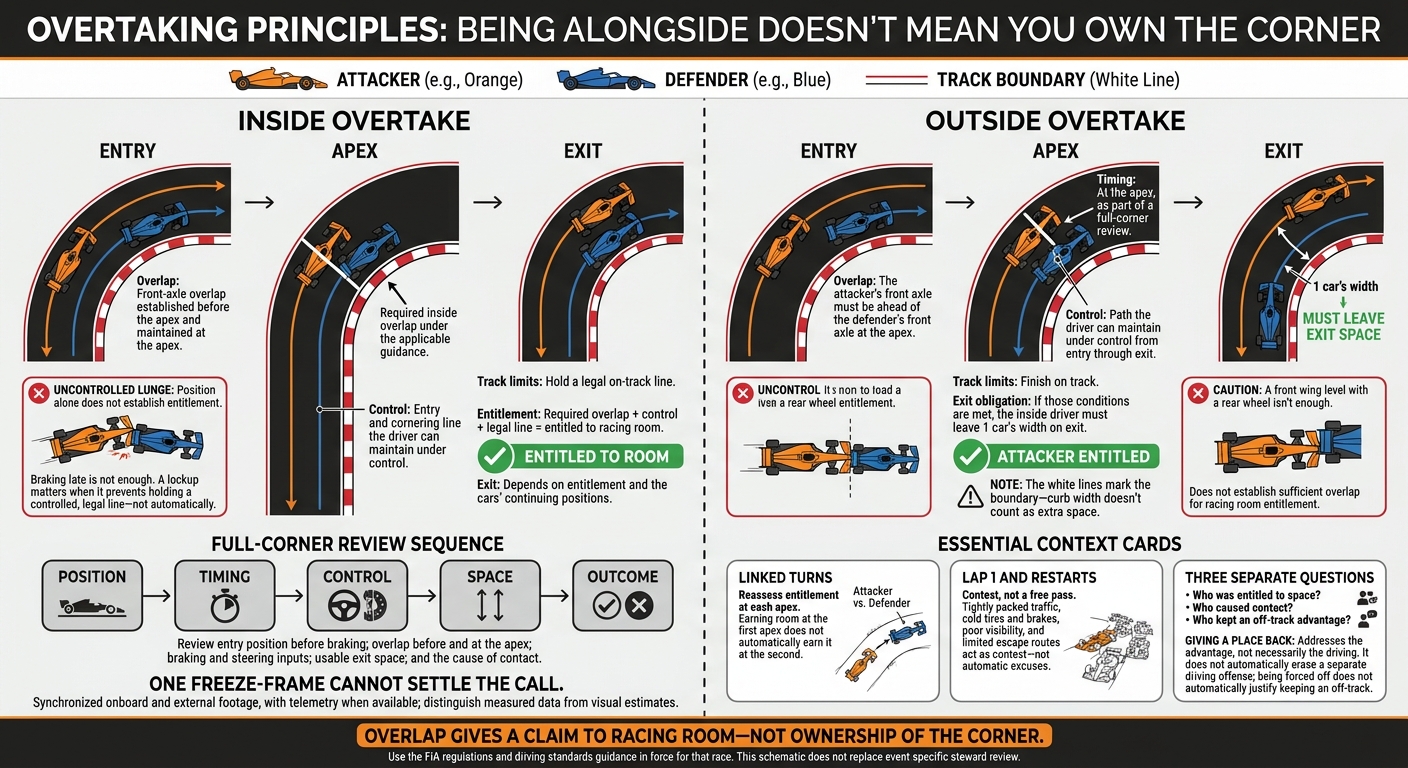
- Inside moves: The attacker needs the required overlap before and at the apex, plus a controlled line within track limits.
- Outside moves: The attacker’s front axle must be ahead at the apex. If the other conditions are met, the inside driver owes 1 car’s width on exit.
- Linked turns: I reassess the cars’ positions at each apex.
- Contact and off-track gains: I treat these as separate questions. Giving back a place doesn’t erase a driving offense.
Lap 1 and restarts add context, not a free pass. I use the rules and guidance in force for that race and review the whole corner, because <u>one freeze-frame cannot settle the call</u>.
F1 Corner Entitlement: Inside vs. Outside Overtakes
2024 New F1 Overtaking Rules Explained!
sbb-itb-7c68254
Turn-In Rights and Inside Overtakes
At turn-in, the defender cannot shut the door on a car with established inside overlap. But the attacker earns room only if it stays under control and can hold a legal line.
Inside Overlap Before and at the Apex
The inside threshold is front-axle overlap established before the apex and maintained at the apex. Getting alongside through entry speed the attacker cannot sustain does not earn the right to room.
Controlled Inside Moves vs. Late Lunges
Braking late proves nothing on its own. The attacker must stay under control and hold a line within track limits.
| Move | Position and control | Entitlement |
|---|---|---|
| Controlled inside move | Required overlap before and at the apex; speed under control and a legal on-track line | Entitled to racing room |
| Insufficient overlap | Front axle behind the required reference at the apex | No inside-overtake entitlement; attacker should yield |
| Uncontrolled lunge | Overlap gained only by overdriving the corner | Position alone does not establish entitlement |
Tracing the Car’s Path From Entry to Exit
A lockup weakens the attacker’s claim only if it stops the car from holding its line or staying within track limits. Once the apex is settled, attention shifts to whether the car on the outside is still owed space through the exit.
Outside Overtakes and Exit Space
The Outside Front-Axle Test
An outside overtake has stricter requirements than an inside move: the attacker needs both the right apex position and control. The attacker’s front axle must be ahead of the defender’s front axle at the apex. The attacker must also stay in control and complete the move on track. A front wing level with a rear wheel isn’t enough.
Leaving Space Through Corner Exit and Linked Turns
If the attacker meets those conditions, the inside driver must leave one car’s width on exit. Driving to the edge without leaving legal room can force the outside car off track. The white lines mark the boundary - curb width doesn’t count as extra space.
Linked turns and multi-apex corners make this harder to judge because the cars can swap inside and outside roles mid-sequence. Reassess entitlement at each apex. Earning room at the first apex doesn’t automatically earn it at the second.
Inside vs. Outside Overtake Requirements
| Factor | Inside overtake | Outside overtake |
|---|---|---|
| Overlap reference | Required inside overlap against the defender | Front axle ahead of the defender’s front axle |
| Assessment timing | Before and at the apex | At the apex, as part of a full-corner review |
| Control | Entry and cornering line the driver can maintain under control | Path the driver can maintain under control from entry through exit |
| Track limits | Hold a legal on-track line | Finish on track |
| Exit-space obligation | Depends on entitlement and the cars’ continuing positions | Inside driver must leave usable room for an entitled outside car |
Apex position doesn’t give a driver ownership of the corner; axle position establishes who has the stronger claim. Stewards must also review the exit: did the outside car run out of room, or did its driver lose control? Looking at the full corner helps them distinguish a clean defense from an avoidable squeeze.
How Stewards Judge First-Lap and Standard-Lap Incidents
Stewards use the event’s FIA regulations and driving standards guidance to assess three separate questions: who was entitled to space, who caused contact, and who kept an off-track advantage. Having a right to room does not excuse losing control. And avoiding blame for contact does not give a driver permission to keep an off-track gain. These distinctions matter most on lap 1 and at restarts.
First-Lap Conditions and Driver Responsibility
Stewards may allow more tolerance on opening laps and restarts when nearby cars limit a driver’s options. Cold tires, cold brakes, poor visibility, and no escape route all matter. But none is a blanket excuse. Stewards still ask whether the driver could reasonably have avoided the incident.
| Factor | First lap or restart | Standard lap |
|---|---|---|
| Field compression | A tightly packed field makes overlap harder to judge | Positions are usually easier to assess |
| Grip and control | Cold tires and brakes affect stopping and turning | Control is judged against the actual conditions |
| Available space | A trapped driver may have no realistic escape route | More escape room may exist, but stewards must check |
| Track limits | Being forced wide affects the ruling | Any off-track advantage is assessed separately |
The circumstances shape the judgment, but the footage still decides it.
Reviewing Evidence From Braking to Exit
Stewards work through the corner in sequence: entry position before braking, overlap before and at the apex, braking and steering inputs, usable exit space, and the cause of contact. They draw on driving expertise to assess whether a car could realistically change its line or avoid contact - not simply whether the cars touched.
Synchronized onboard footage and external camera angles help reconstruct what happened. Telemetry, when available, can confirm braking and steering inputs. Measured data and visual estimates are not the same thing: a single camera angle can hide overlap or make a gap look smaller. A lock-up deserves examination, but it does not automatically prove fault.
Hypothetical Incidents and Possible Findings
These cases show how overlap, control, and exit space work together.
Hypothetical case Decisive facts to establish Possible finding Inside entitlement The attacker established the required front-axle overlap against the defender’s cockpit or rear axle before and at the apex, remained controlled, and the defender closed usable space Defender may be responsible for contact or for failing to leave room Late lunge The attacker could not maintain a controlled path and caused contact Attacker may be wholly or predominantly responsible Outside squeeze The attacker’s front axle was ahead of the defender’s front axle at the apex, the attacker remained controlled, and was denied usable exit space Inside driver may have forced the attacker off track Off-track gain Leaving the track produced a position gain or lasting advantage The driver may be ordered to cede the place or face a penalty
Giving a position back addresses the advantage, not necessarily the driving. It does not automatically settle a separate infringement for causing a collision or forcing another driver off track. Likewise, being forced off does not automatically let a driver keep a position gained outside the track.
Conclusion: Position, Control, and Racing Room
Through braking, apex, and exit, overlap gives a driver a claim to racing room - not ownership of the corner. That overlap must exist by the apex, and the driver must stay in control and within track limits. Position alone isn’t enough.
For a steward-style review, check position, timing, control, space, and outcome. Assess the whole corner, not just the contact. First-lap congestion changes the context, not the standard.
FAQs
Which reference point defines inside overlap in F1?
In F1, no single, universally codified reference point defines inside overlap. As the cars reach a corner, stewards judge whether enough of the attacking car is alongside the defending car. They typically look at whether the attacker’s nose is level with the defender’s sidepod or front wheel. That assessment helps determine whether the attacking driver has earned racing room before turn-in.
How is the apex determined in a multi-apex corner?
In a multi-apex corner, such as a double-apex turn, each apex marks a separate point where the car reaches the innermost part of the track’s curve. Drivers use a split-apex strategy, adjusting the car’s balance and throttle between these points to maximize exit speed. A smooth driving line and precise traction control help manage lateral forces, which can reach 5G during the transition.
When must a driver return a position after being forced off?
In Formula 1, a driver who gains a lasting advantage or forces another driver off the track is generally expected to give the position back immediately. The provided documentation doesn’t set out one standard rule. Instead, stewards assess whether a driver was forced off the track or gained an illegal advantage during an overtake.
Drivers often return the position voluntarily to avoid an investigation or harsher penalties.