MGU-K, MGU-H, battery: how F1 links all 3
How F1’s MGU-K, MGU-H and battery share and manage energy during braking, acceleration and straights — and what changes in 2026.
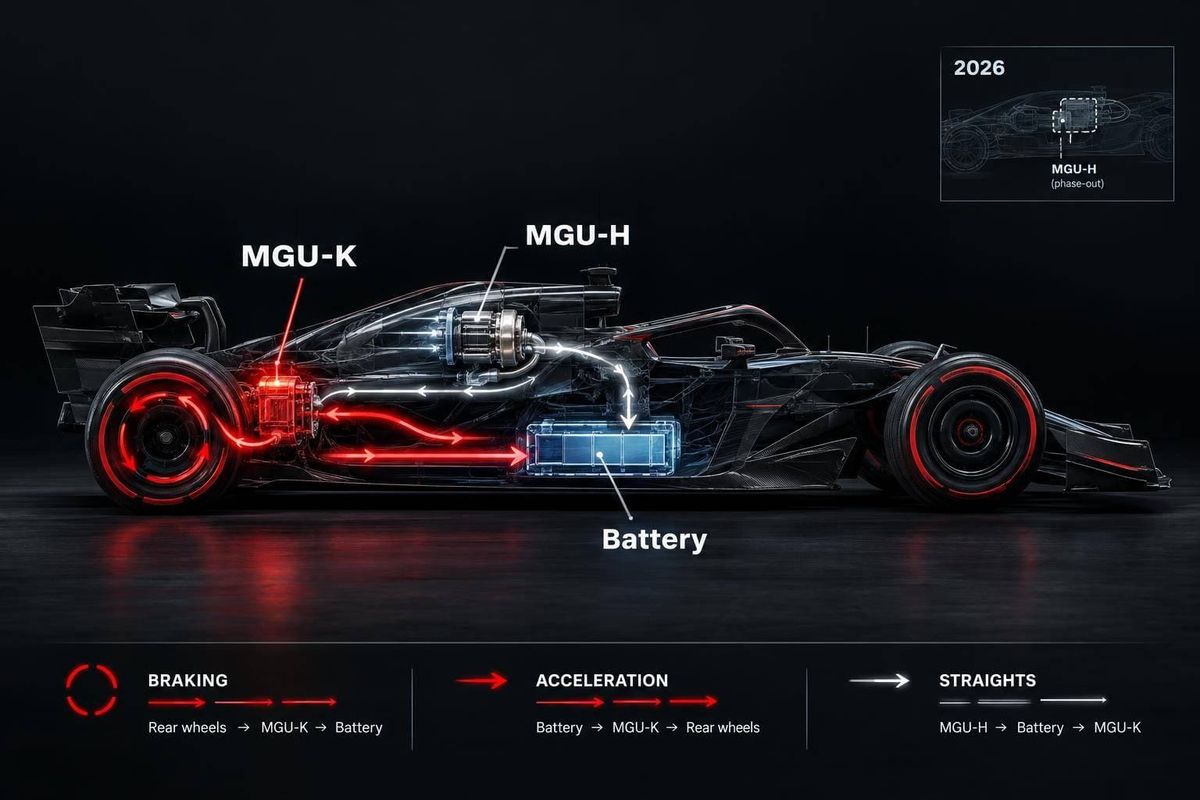
F1’s battery wasn’t the only link between the MGU-K and MGU-H. In the 2014–2025 system, electricity from the turbo-driven MGU-H could power the MGU-K directly, without first entering the battery.
Here’s how I break it down:
- MGU-K: Recovers energy under braking and adds torque during acceleration.
- MGU-H: Generates electricity from the turbo shaft or uses electricity to help spin it - not by turning heat directly into electricity.
- Battery: Stores recovered electricity for later use.
The goal isn’t maximum recovery at every turn. It’s <u>using energy where it saves the most lap time</u>, while managing tire grip, charge, heat, and fuel use.
For 2026, the setup changes: the MGU-H is gone, and maximum MGU-K power increases from 120 kW to 350 kW - about 161 to 469 hp. That puts more of the energy work on the MGU-K and battery, but peak power still depends on available charge and grip.
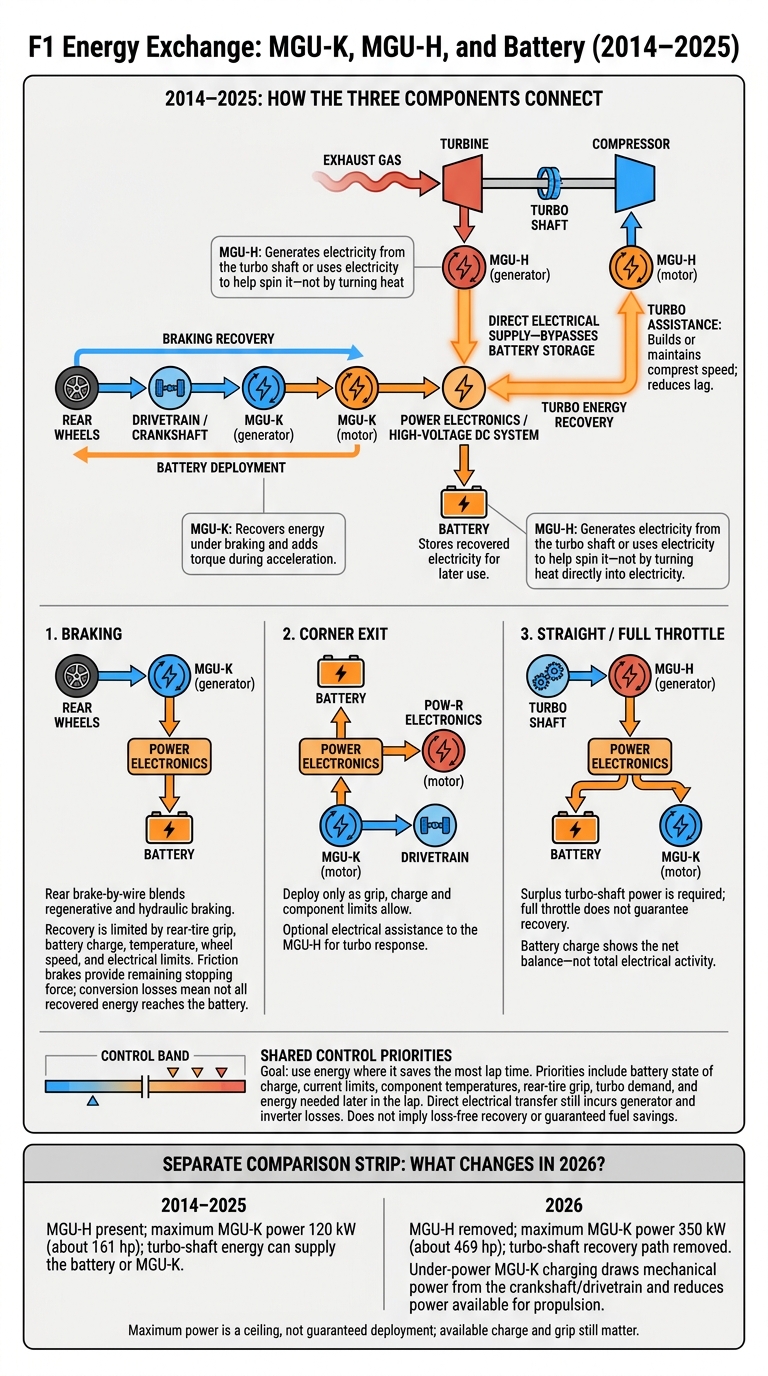
F1 Energy Flow: MGU-K, MGU-H and Battery
Braking: recovering energy with the MGU-K
The energy path from rear wheels to battery
Under braking, the rear wheels send torque back through the driveline to the crankshaft-mounted MGU-K. It generates electricity, which passes through power electronics and the high-voltage DC system to the battery. Friction brakes supply the rest of the stopping force, while the front axle takes more load as weight shifts forward.
Not all that recovered energy reaches the battery. Some is lost in the drivetrain, electrical system, and charging process.
Recovery must stay within the rear tires’ grip limits. The MGU-K’s braking torque affects how stable the car feels as it turns into a corner.
Balancing recovery and rear-wheel stability
Rear brake-by-wire blends regenerative and hydraulic braking. As regenerative torque increases, the controller reduces rear hydraulic pressure. As it drops, the controller restores pressure to maintain the target rear-brake balance. F1 introduced brake-by-wire with the 2014 ERS rules to manage regenerative rear-axle braking.
But blending can’t create extra tire grip. During turn-in, the rear tires handle braking and cornering at the same time. Too much braking torque can cause lockup or instability. Recovering more energy only helps if it doesn’t cost corner-entry speed.
Usable recovery depends on pedal input, grip, battery state of charge, component temperature, and wheel speed - all within the MGU-K’s power and torque limits. A full battery, excessive heat, or low wheel speed can limit harvesting, even under heavy braking. The controller must put stability and lap time ahead of maximum recovery.
On corner exit, the energy flow reverses: the battery and MGU-H feed the MGU-K to help accelerate the car.
sbb-itb-7c68254
Acceleration: adding torque with the MGU-K
Supplying the MGU-K from the battery and MGU-H
During acceleration, stored electrical energy and exhaust-driven energy help the engine through the MGU-K. A fixed gear connection lets the MGU-K add torque at the crankshaft. That combined torque then passes through the driveline to the rear wheels.
| Power source | Energy path | Control factors | Main role |
|---|---|---|---|
| Battery assistance | Battery → inverter → MGU-K → crankshaft | Fast, controllable torque; needs enough charge and electrical headroom | Best for immediate corner-exit torque |
| Direct MGU-H assistance, 2014–2025 | Exhaust-driven MGU-H → power electronics → MGU-K → crankshaft | Depends on available exhaust flow; bypasses battery storage | Extends deployment without draining the battery first |
| Combustion engine | Fuel → combustion → crankshaft | Torque depends on airflow, boost, and engine speed | Supplies continuous baseline power |
Through 2025, the MGU-H could feed the MGU-K directly. From 2026, the MGU-H is removed, and the MGU-K power limit increases to 350 kW, or about 469 hp. That ceiling caps corner-exit assistance - it doesn't guarantee full deployment.
At full throttle, the MGU-H can also affect how the car builds and sustains speed.
Why full deployment is not always fastest
The throttle requests torque, not a fixed amount of electric power. Torque delivery must match available grip, battery charge, current limits, component temperatures, and the applicable regulations. Too much combined torque can overwhelm the rear tires instead of accelerating the car.
Where teams spend energy matters as much as peak power. Using charge in a short acceleration zone can leave less for a longer run where it could save more time. Engineers allocate battery energy where it cuts lap time most, rather than simply wherever the driver requests torque.
Qualifying, overtaking, and defending all change where teams use energy. Defending a position may justify earlier deployment, but that can leave the car vulnerable later. The control system - not the driver - meters permitted torque and electrical flow.
Once the car is flat out, the 2014–2025 MGU-H can still influence that energy flow.
ERS: What It Is and How It Works
Full throttle: recovering energy with the MGU-H
On long straights, the MGU-H could recover energy when exhaust power exceeded turbo demand - even as the car accelerated. In 2014–2025 cars, exhaust gas drove a turbine that shared a shaft with the compressor and MGU-H. When the turbine produced more power than the compressor needed, the MGU-H could convert that surplus shaft power into electricity.
MGU-H generator and motor modes
The MGU-H also controlled turbo speed, switching between generator and motor modes as needed.
| MGU-H mode | Power direction | Energy source or destination | Purpose |
|---|---|---|---|
| Generator | Turbo shaft → MGU-H → electrical system | Output supplies the battery or MGU-K | Recover surplus shaft power |
| Motor | Electrical system → MGU-H → turbo shaft | Electricity powers the turbo | Build or maintain compressor speed and reduce lag |
Full throttle didn’t guarantee surplus power. The compressor could use nearly all the turbine’s output, leaving little energy to recover. The controller had to balance boost demand, turbo-speed limits, exhaust back-pressure, and thermal load. Each conversion also cost energy: even electricity sent directly from the MGU-H to the MGU-K incurred generator and inverter losses.
MGU-H recovery vs. MGU-K full-throttle harvesting
When surplus power was available, the controller could divide MGU-H output between charging the battery and assisting the MGU-K immediately. That split depended on battery state of charge, electrical limits, turbo requirements, and the next chance to deploy energy - not engine speed alone. Full-throttle data alone cannot tell you whether the battery was charging.
| Era and recovery method | Mechanical source | Electrical destination | Performance trade-off |
|---|---|---|---|
| 2014–2025: MGU-H generation | Exhaust-driven turbo shaft | Battery, MGU-K, or both | Recovers turbo energy without directly taking torque from the driven wheels, but adds conversion losses |
| 2014–2025: MGU-K braking recovery | Rear wheels through the drivetrain | Battery | Regenerative braking must stay within rear-wheel stability limits |
| 2026: under-power MGU-K charging | Crankshaft and drivetrain while under power | Battery | Generator load reduces power available for propulsion |
The turbo-shaft recovery path ends in 2026, shifting full-throttle charging to the MGU-K.
Managing energy for lap time and fuel use
How the controller budgets energy
Once the energy flows are clear, the next step is understanding when the controller spends or saves energy. It constantly balances battery state of charge, current, temperatures, rear tire grip, turbo demand, and energy needed later in the lap. A more charged battery isn't always better: it leaves less room to recover energy. Together, these limits set how much energy the controller can spend or recover each lap.
| Function | Typical energy path | Control priority |
|---|---|---|
| Recovery | Rear wheels → MGU-K → battery | Recover energy within grip, current, temperature, and charge limits |
| Deployment | Battery → MGU-K → drivetrain | Add torque where traction and later energy needs allow |
| Energy balancing | MGU-H ↔ turbo; MGU-H → battery or MGU-K | Maintain turbo response and distribute energy efficiently |
The controller can recover and deploy energy at the same time, but both draw on one shared energy budget. Pushing either too hard can hurt turbo response, leave less room for recovery, or limit assistance in the next acceleration zone.
A single lap shows how those choices play out.
An example lap: braking, exit, and the straight
Simplified lap sequence, 2014–2025: During braking, MGU-K recovery raises battery state of charge, then tapers as rear grip demands. Near the apex, deployment pauses or stays low. As steering unwinds, battery-powered MGU-K assistance increases, while the MGU-H can motor the turbo if needed. On the straight, the MGU-H can recharge the battery or feed the MGU-K directly; deployment may then taper to preserve energy for later.
Braking: Rear wheels → MGU-K generator → battery
Exit:    Battery → MGU-K motor → rear wheels
         Electrical power → MGU-H motor → turbo assistance
Straight: Turbo shaft → MGU-H generator → battery or MGU-K
Battery charge shows the net balance, not total electrical activity: direct MGU-H-to-MGU-K supply can support wheel torque without increasing stored charge.
These energy trade-offs affect both lap time and fuel use.
Conclusion: how coordinated energy use improves performance
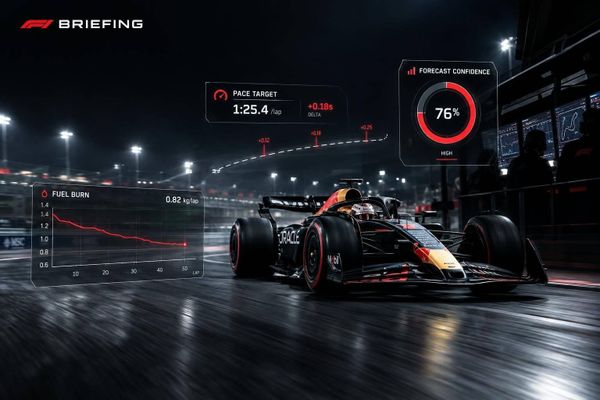
Coordinated energy use can cut fuel burned for a target lap time, though conversion losses and backpressure still matter. This three-part system defines the 2014–2025 era; the 2026 rules remove the MGU-H.
FAQs
Can an F1 car keep racing with a depleted battery?
Yes. An F1 car can keep racing with a depleted battery because its internal combustion engine remains its primary power source. But without the MGU-K’s electric boost, it loses acceleration out of corners and speed on the straights.
Teams manage when and how they use battery power to keep it from running out too early. Losing that hybrid assistance hurts lap times and makes the car less competitive.
How does track layout affect energy deployment?
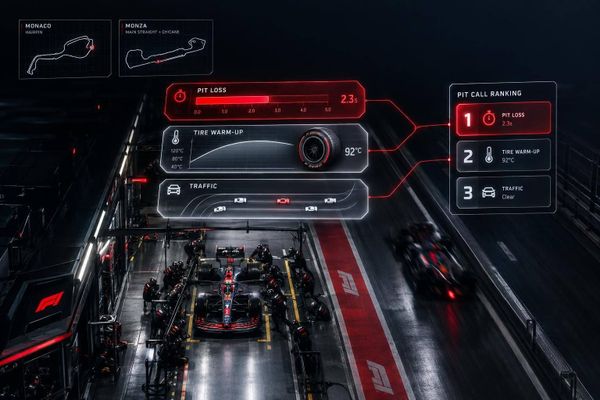
Track layout shapes the balance between kinetic energy recovery and heat harvesting. At tracks like Monza, long full-throttle sections favor sending electricity directly from the MGU-H to the MGU-K to maintain peak power.
Tighter tracks like Monaco call for a different approach. Frequent braking helps charge the battery, while the MGU-H keeps the turbocharger spinning through slow corners. The MGU-K then uses stored energy to boost acceleration on short straights without causing wheelspin.
Will removing the MGU-H increase turbo lag in 2026?
Yes. The MGU-H uses electrical energy to keep the turbocharger spinning when exhaust flow is too low, such as at low RPM or when exiting a corner. This eliminates turbo lag.
Removing it in 2026 means teams lose that instant boost. They’ll need new approaches using the MGU-K and energy management to limit lag.