F1 Barriers vs Escape Roads: Safety Trade-Offs
How F1 runoff and barrier choices balance space, speed, and impact direction to slow cars, absorb energy, and enable safe recovery.
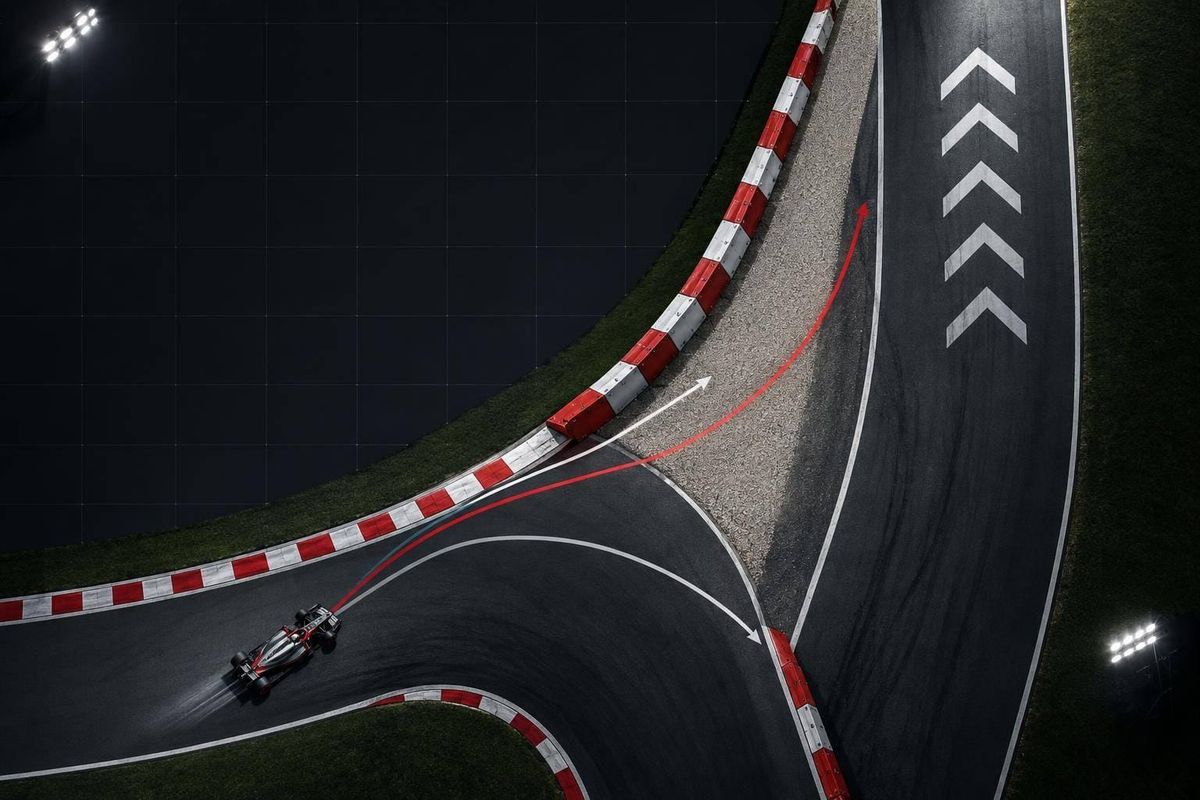
F1 safety needs both room to slow down and barriers for the impact that follows. My starting point: assess speed, likely impact direction, and available space - not just the corner’s shape. At 150 mph, a car carries 125% more kinetic energy than it does at 100 mph.
Here’s how I compare the options:
- Paved escape roads and runoff let drivers brake, steer, and sometimes rejoin - but grip, brake failure, or damage can limit stopping.
- Gravel adds drag but can strand a car or cause it to roll. Grass offers less predictable grip, especially when wet.
- TecPro and tire barriers absorb crash energy through deformation. SAFER uses steel and foam; Armco mainly contains and redirects cars. Each needs proper placement and room to deform.
Quick Comparison
| Factor | Escape roads and runoff | Barriers |
|---|---|---|
| Main job | Reduce speed before impact | Absorb remaining energy and contain cars |
| Main limits | Space, grip, and car condition | Impact speed, angle, and deformation space |
| Main risks | Continued sliding, stranding, or unsafe rejoining | Rebound, snagging, or a second impact |
The aim isn’t simply to keep a car racing. I judge the layout by whether it helps the car <u>stop safely</u>, allows a predictable rejoin, and gives recovery crews safe access. Runoff and barriers are partners, not substitutes.
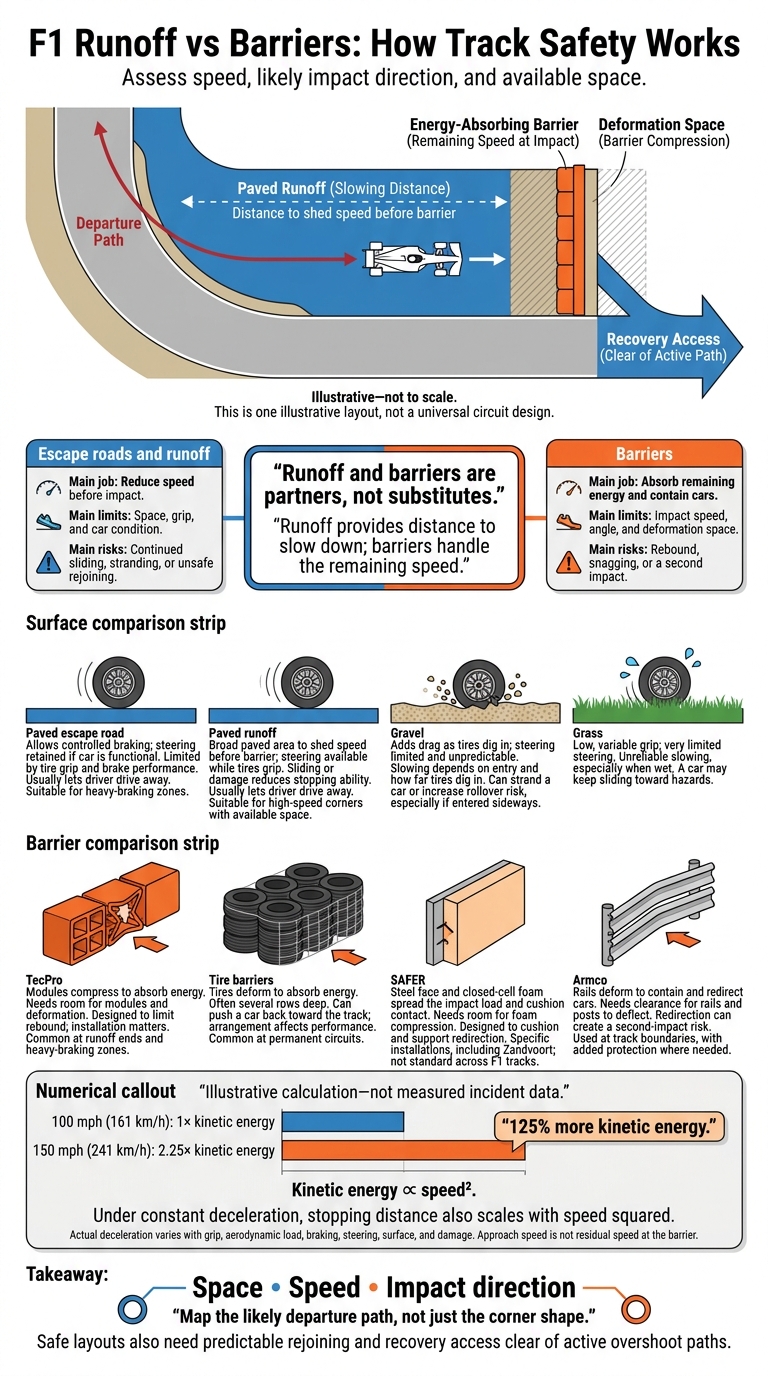
F1 Runoff vs Barriers: How Track Safety Works
Run off areas in F1 - Safety and shortcuts
sbb-itb-7c68254
Barriers: Absorbing Energy and Containing Cars
When runoff runs out, barriers must contain the car and absorb the energy the escape road couldn’t. As a barrier deforms, it converts crash energy into heat and structural damage. How it does that depends on the materials used.
How Barrier Systems Handle Impacts
TecPro modules use high-density polyethylene shells with internal foam or air pockets that compress on impact. Tire barriers absorb energy as the tires deform, but their arrangement affects how well they work.
SAFER - Steel and Foam Energy Reduction - pairs a steel face with closed-cell foam to spread the impact load and cushion contact. Its use depends on the circuit; it isn’t standard across F1 tracks. Armco redirects shallow-angle strikes as its rails deform. Faster or steeper impacts usually call for added TecPro or tire protection.
| System | Main function | Space needed | Rebound considerations | F1 application |
|---|---|---|---|---|
| TecPro | Absorbs energy as modules compress | Room for modules and deformation | Designed to limit rebound; installation matters | Common at runoff ends and heavy-braking zones |
| Tire barriers | Absorb energy as tires deform | Often several rows deep | Can push a car back toward the track | Common at permanent circuits |
| SAFER | Spreads impact load through steel and foam | Room for foam to compress behind the steel face | Designed to cushion contact and support redirection | Specific installations, including Zandvoort |
| Armco | Contains and redirects cars as rails deform | Clearance for rails and posts to deflect | Redirection can create a risk of a second impact | Track boundaries; added protection where needed |
Barrier Placement and FIA Circuit Assessment
Where a barrier sits matters as much as how it works. The FIA selects barriers based on design speed, impact angle, room for deformation, and the protection runoff provides. If a car would reach the barrier with more energy than it can absorb, the circuit needs a higher-performance system.
Deformation space matters as much as barrier type. Where buildings or terrain leave little room, barriers must work within that narrow footprint without creating a dangerous hard stop. They can compensate for limited runoff only when the remaining crash energy falls within what the system can absorb.
Escape Roads: Space to Slow and Rejoin Safely
Barriers absorb impacts that runoff cannot prevent. Escape roads aim to avoid impact altogether.
An escape road gives a car a controlled route out of a braking zone. Runoff gives it room to slow before reaching a barrier.
How Pavement, Gravel, and Grass Affect Stopping
Escape roads work best when the driver can still brake and steer. Pavement keeps those options open. Gravel adds drag, but it can strand a car or increase rollover risk, especially if the car enters sideways. Grass offers the least predictable grip, particularly when wet. Stopping also depends on distance, speed, and damage to the car.
| Surface or route | Slowing behavior | Steering control | Stopping limits | Recovery risks | Suitable locations |
|---|---|---|---|---|---|
| Paved escape road | Allows controlled braking | Retained if the car is functional | Tire grip and brake performance | Usually lets the driver drive away | Heavy-braking zones |
| Paved runoff | Gives a car a broad paved area to shed speed before the barrier | Available while tires grip | Sliding or damage reduces stopping ability | Usually lets the driver drive away | High-speed corners with available space |
| Gravel | Adds drag as tires dig in | Limited and unpredictable | Depends on entry and how far tires dig in | Can strand a car | Corners with frequent track-limit violations; final complex |
| Grass | Offers low, variable grip | Very limited | Unreliable, especially when wet | Car may keep sliding toward hazards | Trackside margins |
Surface choice means balancing recovery options against the ability to slow an uncontrolled car.
Safe Rejoining and Recovery Access
A designated rejoin route should make a car’s return predictable. Bollard-guided lanes direct drivers back onto the track in a controlled way.
Stopping areas must remain accessible to marshals and recovery crews. Crews must not have to cross an active overshoot path to reach a car. Keeping recovery access clear helps prevent a stranded car from turning one incident into two.
The space needed depends on speed and corner geometry.
How Speed and Corner Layout Guide Safety Design
Before choosing a barrier or an escape road, match both to the car’s likely departure path.
Map the likely departure path, not just the corner shape. Assess departure direction, available slowing distance, and likely speed at each impact point. Use these patterns as starting points, not fixed rules. Speed then determines how much energy the next safety system must absorb.
The same safety tool behaves differently when a car leaves at a shallow angle, travels straight ahead, or rotates.
| Corner or section | Departure pattern | Runoff priority | Barrier response |
|---|---|---|---|
| High-speed sweeper | Shallow-angle departure, possibly with yaw or redirection | Large exterior runoff along the projected path, within limits set by terrain and nearby corners | Energy-absorbing protection at the first likely impact point, with no snagging edges |
| Heavy-braking hairpin | Straight-line overshoot, lock-up, or partial rotation | Long braking escape road where buildings and track infrastructure allow | Terminal protection for remaining speed; sightlines and barrier angle affect the final hit |
| Chicane | Spin, curb-assisted launch, or changing departure angle | Coverage beyond the racing line and rejoin route, despite closely spaced turns | Local barriers at exits, inside obstacles, or crossover points |
| Street-circuit corner | Wall-side departure with little recovery room | As much deceleration distance as narrow corridors allow; remove or shield fixed hazards | Continuous, well-aligned protection with energy absorption near walls |
| Wall-lined segment | Oblique contact followed by redirection or rebound | Limited slowing distance beside permanent walls or bridges | Strong connections and barrier continuity to limit secondary-impact risk |
Approach Speed, Stopping Distance, and Impact Energy
The corner type helps predict the departure path. Speed determines how much room remains to slow down.
Illustrative calculation - not measured incident data: Because kinetic energy is proportional to (v^2), the same car at 150 mph (241 km/h) carries ((150/100)^2 = 2.25) times the kinetic energy of the same car at 100 mph (161 km/h). Under constant deceleration, stopping distance also scales with speed squared. Actual deceleration changes with grip, aerodynamic load, braking, steering, surface, and damage. Approach speed therefore cannot substitute for residual speed at the barrier.
Why Corner Angle Does Not Determine Impact Angle
A hairpin can produce a straight-line overshoot. A sweeper can send a car toward protection at a shallow angle. A spin can turn either departure into a more direct hit.
Radius, camber, banking, and grip affect the path. The car’s orientation determines which part strikes first. Barrier assessment must account for snagging, redirection, rebound, and secondary impacts, not just the corner’s angle on a map. FIA guidance specifically warns against tire barriers where the normal trajectory runs parallel or tangential to them.
Investigated example: In Romain Grosjean’s 2020 Bahrain crash, the FIA reported 150 mph (241 km/h) before departure and 119 mph (192 km/h) at the barrier. The reported impact angle was 29 degrees, with approximately 22 degrees of yaw. The survival cell pierced the barrier after its middle rail failed, showing why speed, trajectory, vehicle orientation, and barrier behavior must be assessed together.
Why Some Corners Need Both Runoff and Barriers
Runoff provides distance to slow down; barriers handle the remaining speed. Brake failure, rain, damage, or an unexpected departure angle can prevent a car from following the intended slowing path.
The design question is where the car loses enough speed before terminal protection takes over. That combination needs circuit-specific assessment under applicable FIA Appendix O guidance.
Conclusion: Where Barriers and Escape Roads Work Best
Runoff and barriers work together. Once a car leaves the track, its remaining speed determines whether runoff is enough or a barrier needs to finish the job.
The right mix depends on three things: space, speed, and impact direction.
| Design factor | Escape roads and runoff | Barriers |
|---|---|---|
| Best at | Reducing speed while leaving room for recovery | Absorbing remaining impact energy and containing cars |
| Main limit | Available distance, surface grip, and car condition | Energy capacity, room to deform, and large impact loads |
| Best locations | High-speed exits and heavy-braking zones with plenty of space | Tight corners, street circuits, and nearby hazards |
| Main failure mode | Too little slowing or a car stranded in gravel | Rebound into traffic, scattered damage and debris, or secondary impacts |
Each corner’s speed, available space, and likely departure path should guide the design. Where room is tight, barriers must handle more of the remaining impact energy. Where there’s room to slow down, runoff can do more before a car reaches a barrier.
FAQs
How does the FIA test runoff and barrier designs?
The FIA pairs physical testing with digital simulation. In past full-scale tests, barriers such as SAFER were tested using instrumented sleds and race cars. These tests measured peak deceleration and Head Injury Criterion (HIC) values to check them against safe limits.
Today, circuit designers rely heavily on AI and virtual simulations to assess thousands of crash scenarios. The results help them identify high-risk zones, determine runoff area sizes, and place energy-absorbing barriers to meet strict FIA safety standards.
Can more runoff ever make a corner less safe?
Yes. Runoff gives a car room to slow down. But poor design can leave it moving too fast or out of control when it reaches a barrier, causing it to hit at an unfavorable angle. Too much runoff can also encourage aggressive driving or late braking, increasing collision risks in tight, technical sections.
The barrier type and runoff length need to match the car’s likely path and speed through the corner.
How are barriers checked after a crash?
Modular systems like TecPro barriers let crews inspect and replace damaged sections quickly, keeping track downtime to a minimum. Maintenance helps ensure that energy-absorbing parts, including high-density polyethylene shells and foam cores, continue to meet FIA safety standards.
Engineers also use crash data and virtual simulations to check barrier performance and pinpoint high-risk areas.